The Trump Golden Age Will Destroy Us
The Good, The Bad, The Ugly
Human Sovereignty Restored
By Randell Hynes, Founder & President, US Workers Alliance
In Sergio Leone’s masterpiece, three men race across the Civil War-ravaged landscape in pursuit of buried gold. Each sees the same prize. Each wears a different mask. And in the end, the one who wins is not the fastest gun or the cleverest thief—it is the one who understood that the game was never about gold at all.
We have spent three essays examining the American landscape, and, like Leone’s characters, we found what we did not go looking for.
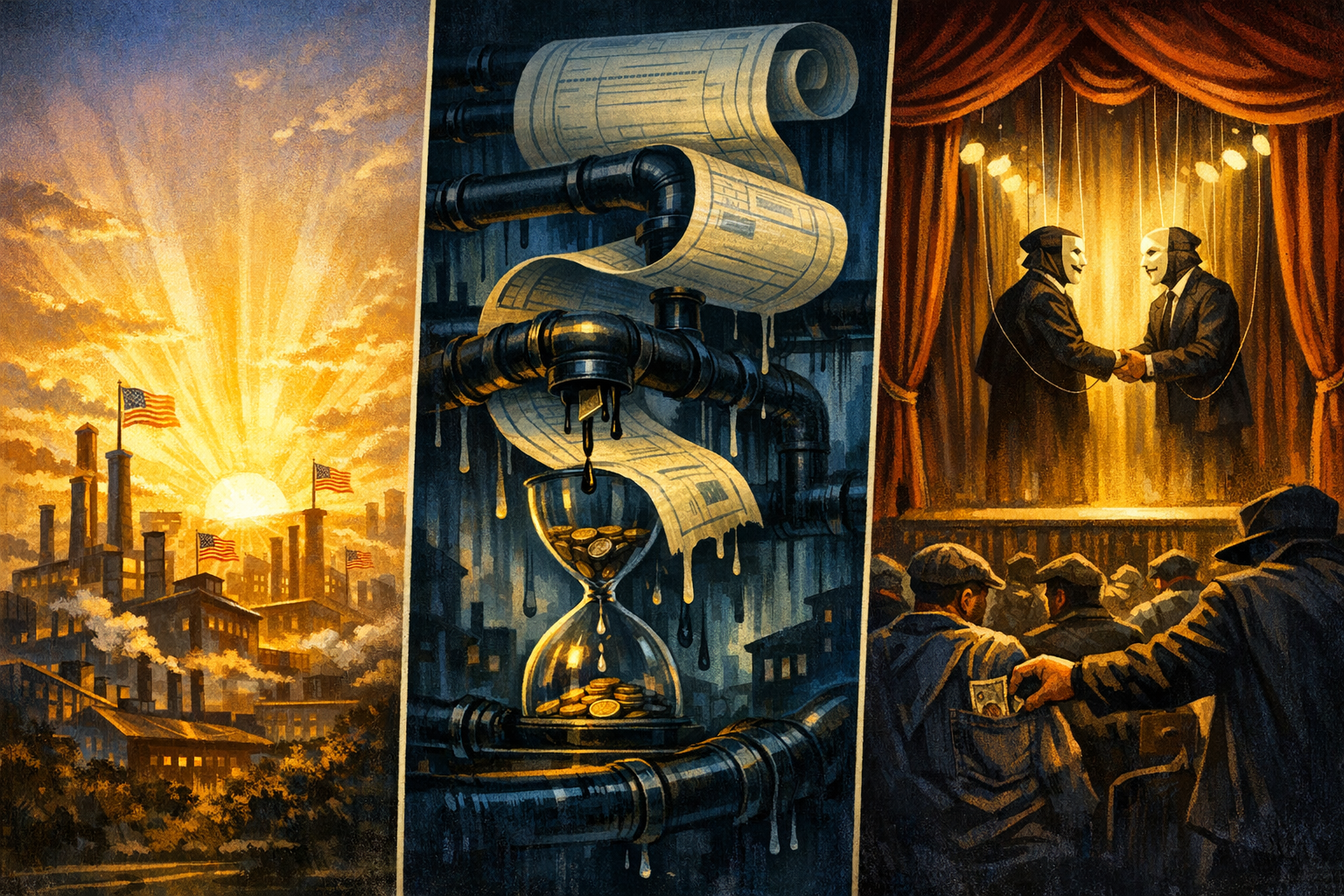
Part I, The Good, revealed an administration building the most coherent challenge to globalism in fifty years. Rubio’s civilizational confidence. Bessent’s economic sovereignty. Warsh’s monetary reset. A three-pillar framework that, whatever its motives, represents a genuine attempt to reverse the damage done to American workers by decades of bipartisan consensus.
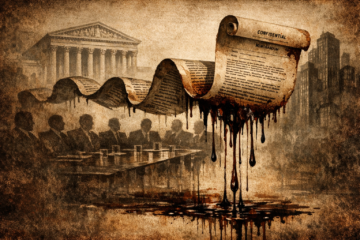
Part II, The Bad, traced the fifty-four-year arc from Lewis Powell’s confidential memo through the Supreme Court decisions that gave corporations the rights of citizens and money the power of speech. It named the US Chamber of Commerce as the central artery of a system designed to transfer power from 170 million American workers to a transnational corporate elite with no loyalty to any nation.
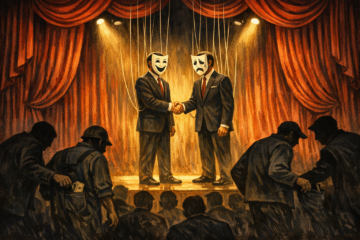
Part III, The Ugly, exposed the theater. Donald Trump and the Chamber of Commerce are pretending to fight while delivering together what neither could deliver alone: permanent tax cuts, gutted labor protections, neutered consumer agencies, 16.9 million people losing health coverage, and an H-1B system preserved under the pretense of a fight over fees. The most expensive political performance in American history, with American workers paying for every ticket.
Now we must answer the remaining question. The question Leone’s film answered was posed by its haunting final image: a graveyard stretching to the horizon.
What comes next?
The Four Questions
Four questions confront every American worker who has read this series.
First: Is the system fixable?
The evidence says no. The Powell Memo’s fifty-four-year execution has captured every institution that was supposed to protect American workers. The courts gave corporations constitutional rights. Congress passed laws written by lobbyists. The executive branch—Republican and Democratic alike—delivered the Chamber’s agenda. The Federal Reserve kept rates low for Wall Street while workers watched their purchasing power erode. The media normalized the whole enterprise as “free trade,” “globalization,” and the “rules-based order.”
When Trump—the candidate who promised to drain the swamp—delivers the Chamber’s entire wish list while performing a fake fight over tariffs, the lesson is not that we need better politicians. The lesson is that the system selects for politicians who will deliver the Chamber’s wish list while performing whatever theater is necessary to keep the audience seated.
Second: Can workers win within the system?
The evidence says no. The Supreme Court has declared that corporations are “persons” with First Amendment rights, that money is “speech,” and that Congress cannot limit corporate political spending. The result is predictable: one man spent $280 million on a single election cycle. The Chamber spent $72.1 million on lobbying in 2025 alone. Dark money hit $1.9 billion. Outside spending reached $4.5 billion.
No worker organization can compete with that. No union can out-spend corporations that collectively spent $5 billion on lobbying in a single year. The arithmetic of money-as-speech ensures that corporate voices drown out human voices by orders of magnitude. This is not a bug in the system. It is the system working exactly as designed.
Third: What happens if nothing changes?
This is where the analysis turns from political to existential. The current wave of H-1B visa worker replacement is not the end of the story. It is the dress rehearsal.
The same corporations that learned to replace American workers with cheaper foreign workers are now learning to replace all workers with artificial intelligence. The infrastructure is identical: legal teams, training programs, PR campaigns, and political lobbying. The Chamber provides the same political cover. The Fed provides the same cheap money. The courts provide the same constitutional protection for corporate “persons.”
The difference is scale. H-1B affected specific sectors—technology, engineering, and medicine. AI affects every sector. When a corporation can replace a $150,000 American IT worker with an $85,000 H-1B worker, profits increase. When that same corporation can replace that H-1B worker with an AI system that costs $15,000 per year and never sleeps, takes no benefits, and files no lawsuits, profits soar.
The logic of corporate personhood and money-as-speech leads inevitably to this destination. Corporate “persons” have a constitutional right to maximize shareholder value. Human workers have no constitutional right to their jobs, their wages, or their economic dignity. The system does not just permit human replacement. It requires it.
Fourth: Is there another way?
This is the question that the US Workers Alliance was created to answer. And the answer is yes—but only if we are willing to do what the Powell Memo’s authors never anticipated.
Only if we are willing to change the Constitution itself.
The Constitutional Solution
The architects of the Powell Memo understood something that most Americans still do not. The Constitution is not just a document. It is the operating system of the American government. And for fifty-four years, they have been rewriting the code.
They rewrote it through the courts. Buckley v. Valeo declared that money is speech. First National Bank of Boston v. Bellotti declared that corporations have First Amendment rights. Citizens United declared that corporations can spend unlimited money on elections.
They rewrote it through legislation. Trade agreements that override national sovereignty. Immigration laws that import cheap labor while Americans are told to retrain. Tax codes that reward offshoring and punish domestic production.
They rewrote it through capture. The Chamber of Commerce sits at the center of a $5 billion lobbying industry that writes the laws, funds the campaigns, and ensures that every institution that might challenge corporate power is systematically dismantled.
The only response that matches the scale of the problem is a Constitutional Amendment that rewrites the code back. That is what Amendment XXVIII—the People’s Sovereignty Amendment—does.
Section 1: Definition of Person and People
For the first time in American constitutional history, the Amendment explicitly defines what the Framers took for granted: “The terms ‘person’ and ‘people’ as used in this Constitution mean only biological human beings—living members of the species Homo sapiens from conception to natural death.”
This closes the loophole that corporate attorneys have exploited for 150 years. No corporation can ever claim to be a person. No artificial intelligence, robot, android, or synthetic entity can ever claim constitutional rights. The Constitution belongs to humans alone.
This is the firewall that Powell never anticipated. When a future Supreme Court is asked to decide whether an advanced AI has constitutional rights, the answer will already be written in the Constitution itself: “No corporation, association, partnership, limited liability company, artificial intelligence, machine learning system, robot, android, synthetic entity, digital consciousness, or other non-biological construct shall ever be considered a person or people under this Constitution.”
Sections 2-4: Dismantling Corporate Power
The Amendment strips corporations of constitutional personhood. It declares that money is not speech. It empowers Congress and the States to regulate political spending, require disclosure of all contributions, and prohibit corporate money in elections entirely.
This is the death of Citizens United. The death of Buckley v. Valeo. The death of the entire legal fiction that a piece of paper filed with a secretary of state has the same rights as a living, breathing American citizen.
Section 5: Protection Against AI Replacement
For the first time, the Constitution would protect human workers from systematic replacement by artificial intelligence. The Amendment establishes that natural persons have a “fundamental right to economic livelihood, human dignity, and participation in the workforce.” It empowers Congress to tax AI that replaces workers, mandate human oversight in critical sectors, and require that productivity gains be shared with workers rather than captured entirely by shareholders.
This is the answer to the dress rehearsal. When corporations seek to replace humans with AI, they will face constitutional barriers rather than constitutional protection.
Sections 6-7: Human Life and Citizenship
The Amendment recognizes viable unborn children as natural persons entitled to due process and equal protection. It clarifies that birthright citizenship requires at least one parent to be a citizen or lawful permanent resident—ending birth tourism while preserving citizenship for the children of legal immigrants.
These provisions address the 14th Amendment issues weaponized by corporate interests. The 14th Amendment was written to protect freed slaves, not to create corporate personhood or birth tourism industries. The People’s Sovereignty Amendment restores its original purpose.
Section 8: Foreign Influence
The Amendment reserves the American political processes to American citizens. Foreign governments, foreign corporations, and foreign nationals are prohibited from participating in or influencing American elections. This attacks the Chamber of Commerce’s foreign money pipeline directly—and gives constitutional force to the legal battle that US Workers Alliance is already preparing.
The Three-Part Strategy
The Amendment alone is not enough. A constitutional amendment requires two-thirds of both houses of Congress or a convention of states, followed by ratification by three-fourths of state legislatures. In a Congress captured by corporate money, this is impossible.
That is why the US Workers Alliance is pursuing a three-part strategy: Lawsuit. Election. Amendment.
Part One: The Lawsuit
The US Chamber of Commerce operates as an “association of American citizens” entitled to First Amendment protection. But the Chamber receives dues from foreign corporations and foreign state-owned enterprises through its AmChams and Business Councils. These foreign dollars support the Chamber’s infrastructure—its rent, its utilities, its staff salaries, its lobbying operations.
Under 52 U.S.C. § 30121, it is illegal for foreign nationals to make contributions “directly or indirectly” in connection with American elections. The Chamber claims its foreign money is kept separate. But when journalists and members of Congress have asked to see the books, the Chamber has refused.
US Workers Alliance is preparing a federal lawsuit to force that disclosure. We will prove that foreign money flows into the largest lobbying operation in American history and is used—directly or indirectly—to influence American elections and destroy American jobs.
The lawsuit has two purposes. First, to expose the foreign influence at the heart of the Chamber’s operations. Second, to strip the Chamber of its claim to First Amendment protection. An organization funded by foreign governments and foreign corporations is not an “association of American citizens.” It is a foreign agent. And foreign agents have no constitutional right to lobby Congress.
Part Two: The Election
Clean Slate 2028 is the electoral component of the strategy. The goal is simple: replace every member of Congress who took Chamber money, voted the Chamber’s way, or put foreign corporate interests ahead of American workers.
This is not a protest. This is not a petition. This is a campaign to run candidates in every congressional district in America who have signed the American Worker Pledge: no corporate PAC money, no Chamber endorsements, no K Street masters.
The political class believes this is impossible. They believe that $5 billion in lobbying, $4.5 billion in outside spending, and $1.9 billion in dark money make the system impervious to challenge.
They are wrong. The arithmetic cuts both ways.
The Chamber has $72.1 million a year. We have 170 million American workers. The Chamber has lobbyists. We have each other. The Chamber has Lewis Powell’s blueprint. We have the Constitution of the United States—and the willingness to amend it.
Part Three: The Amendment
When the lawsuit has exposed the foreign money and the election has replaced the corrupt politicians, the path to constitutional change opens. The 28th Amendment is already written. The infrastructure to campaign for it is being built. The coalition of 170 million workers who have been left behind by both parties is being organized.
This is what the Powell Memo never anticipated. The memo assumed that corporate power would face only fragmented opposition—unions weakened by legislation, consumer groups outspent by lobbying, and environmentalists silenced by regulatory capture. What it never imagined was a unified movement that understood the constitutional dimension of the fight and was willing to take the battle to the source.
The Stakes
In Leone’s film, the graveyard at the end stretches to the horizon. Row upon row of graves, marking the dead of a civil war that consumed a nation. The image is a warning: this is where the pursuit of gold leads. This is the cost of refusing to see what the game is really about.
We are at a similar moment in American history. The Golden Age is promising prosperity while preparing the largest transfer of power from human beings to corporate entities in the history of the species. The Chamber of Commerce is collecting foreign money and spending it to dismantle every protection that American workers ever won. The Supreme Court has declared that corporations are persons and money is speech, ensuring that the voices of 170 million workers will never compete with the treasuries of transnational corporations.
And somewhere in Silicon Valley, artificial intelligence systems are being trained to replace the last jobs that cannot be offshored or visa’d away. The dress rehearsal is ending. The main event is beginning.
This is what the attack on human sovereignty looks like. Not with armies or decrees, but with constitutional doctrines that protect corporate “persons” while rendering human persons economically obsolete. Not with dramatic announcements, but with quiet legislation, captured agencies, and judges who believe that money is speech.
The question is not whether this will happen. The question is whether we will let it.
The Choice
Leone’s film ends with Tuco, the unlucky bandit, left standing on a cross in a graveyard, his hands tied, a noose around his neck, while Blondie—the man who understood what the game was really about—rides away into the distance.
The American worker is standing on that cross right now. The noose is tightening. The Golden Age is the distraction—the promise of prosperity while the trap closes. The Chamber of Commerce is the hangman, collecting dues from foreign corporations and spending them to ensure that 170 million workers never get off the ground.
But there is a third option in Leone’s film. Blondie returns. He shoots the rope. Tuco falls to the ground, alive, furious, and free.
The rope can be cut. The trap can be escaped. But only if someone understands that the game was never about gold, never about tariffs, never about the theater that keeps the audience seated.
The game is about sovereignty. Who owns this republic? Who does the Constitution protect? Whether human beings remain in control of their economic destiny, or whether they become resources to be deployed and replaced at corporate discretion.
That is the question that the Good, the Bad, and the Ugly have been leading us toward. Not policy disputes. Not partisan battles. The fundamental question of whether humans remain sovereign in the age of corporate personhood and artificial intelligence.
The Answer
The US Workers Alliance answers that question with a single word: Yes.
Humans remain sovereign. The Constitution belongs to biological human beings alone. No corporation, no artificial intelligence, no foreign government, no lobbying operation, no dark money network will decide the future of this republic. The 170 million American workers who built this country will decide.
The lawsuit is coming. The election is coming. The Amendment is coming.
The Powell Memo’s fifty-four-year project has reached its final act. The Golden Age is a dress rehearsal for human replacement. The Chamber of Commerce is the instrument of foreign influence and corporate capture. The Supreme Court’s corporate personhood doctrine is the legal architecture of human obsolescence.
But the Constitution provides the mechanism for its own renewal. Article V allows the people to amend the foundational document. The 28th Amendment is already written. The coalition is already forming. The strategy is already in motion.
The Final Image
In Leone’s masterpiece, the cemetery is called Sad Hill. It contains 2,000 graves. The Spanish government ordered it destroyed after filming. But for a few weeks in 1966, it was the most famous graveyard in the world—a monument to the human cost of civil war and the pursuit of gold.
America has its own Sad Hill. It is the hollowed-out towns across the Midwest where factories once stood. It is the overdose epidemic that has claimed over a million lives since the Powell Memo was written. It is the veterans sleeping under bridges while H-1B workers fill the jobs they trained for. It is the 16.9 million people who will lose health coverage because the Chamber needed a tax cut more than Americans needed healthcare.
The Golden Age will build more graves. AI replacement will build more graves. Corporate personhood and money-as-speech will ensure that no political voice rises to stop it.
Unless we cut the rope.
Clean Slate 2028.
The People’s Sovereignty Amendment.
170 million American workers.
The future of humanity is being decided now. The only question is whether we will organize in time to claim it.
© 2026 Buildup Cooperative 501(c)(4) dba U.S. Workers Alliance. All rights reserved.
cleanslate2028.com | usworkeractions.com | @USWorkerActions
Sources
Primary Sources
- The Good: Rubio Munich 2026 Speech; Bessent “Economic Security First” Speech; Warsh Nomination
- The Bad: Powell Memo (1971); Buckley v. Valeo (1976); First National Bank of Boston v. Bellotti (1978); Citizens United v. FEC (2010)
- The Ugly: OpenSecrets Lobbying Data (2025); Congressional Budget Office, One Big Beautiful Bill Analysis; Chamber of Commerce Statements (2025)
Constitutional Authority
- Article V: Constitutional Amendment Process
- 52 U.S.C. § 30121: Prohibition on Foreign National Contributions
- Amendment XXVIII (Proposed): The People’s Sovereignty Amendment