A Book for The Real American Majority
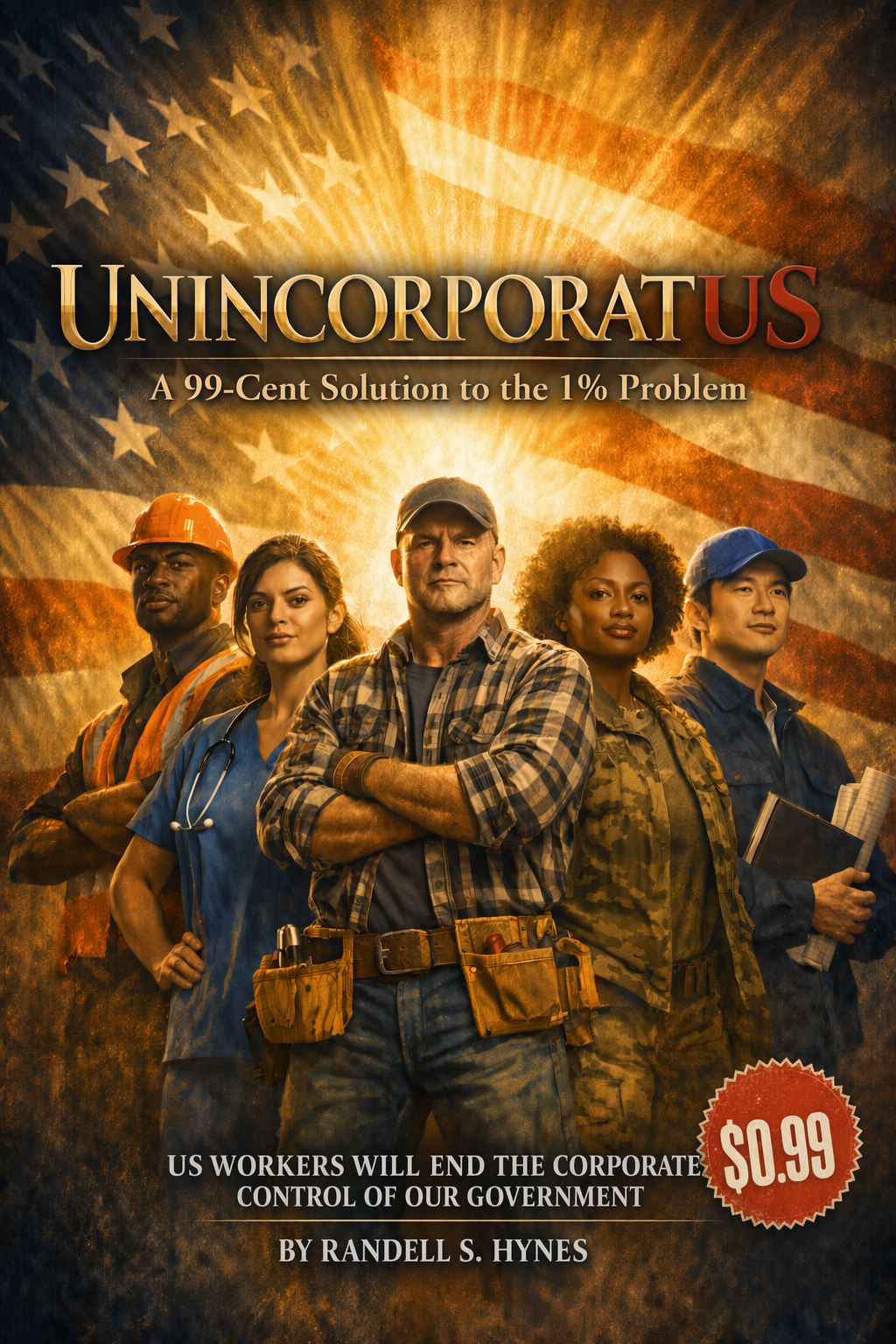
A Book for the American Worker
UNINCORPORĀTUS
A 99-Cent Solution to the 1% Problem
Corporations and the 1% Hijacked Our Government.
Workers Are Taking It Back.
By Randell S. Hynes
Founder, U.S. Workers Alliance
“A 99-Cent Solution to the 1% Problem”
Copyright
UNINCORPORĀTUS: A 99-Cent Solution to the 1% Problem —
US Workers Will End the Corporate Control of Our Government
Copyright © 2026 by Randell S. Hynes
All rights reserved. No part of this publication may be reproduced, distributed, or transmitted in any form or by any means, including photocopying, recording, or other electronic or mechanical methods, without the prior written permission of the publisher, except in the case of brief quotations embodied in critical reviews and certain other noncommercial uses permitted by copyright law.
For permission requests, contact the author through www.hynes.com.
For information on the Comprehensive Labor and Worker Safeguards (CLAWS) Act campaign, visit AddClaws.com.
ISBN 979-8-9961809-0-5 (digital edition)
Printed in the United States of America
First Edition
$0.99 US
Dedication
For every American worker who has ever been told they were “too old,” “too expensive,” or “too expendable.”
For my brothers and sisters in arms who learned that the country they served would not serve them in return.
For the 170 million workers who don’t yet know they have the power to take it all back.
You do.
Especially to my family, who endured the long nights, the endless hours, and the years of sacrifice while we lived this, and I fought to finish this book.
And to every reader who picked up this book: you just bought a 99-cent solution to the 1% problem.
You are the 2%.
You are the ones who will prove it.
You are the ones who will rescue the rest of us.
— A 99-Cent Solution to the 1% Problem —
What We Stand For
Before we begin this journey, you deserve to know exactly what we believe. These are not policies. They are not partisan talking points. They are the foundational principles that must be restored before any honest policy debate can occur.
Corporations Are Not People. The Constitution was written for human beings. The notion that artificial entities created by state charter should enjoy the same rights as the people they employ is a judicial fabrication that has corrupted our Republic for over a century. Corporations exist at our pleasure. They serve our purposes. They are tools, not citizens.
Money Is Not Speech. The First Amendment protects your right to speak. It does not protect anyone’s right to buy a megaphone that drowns out everyone else. When money equals speech, those with money have more speech. That is not a Republic. That is plutocracy dressed in constitutional clothing.
Have the Right to Associate and Speak Without Fear of Retaliation. You cannot negotiate as an individual what you can only win collectively. When workers are forbidden from organizing, forbidden from discussing their wages, forbidden from speaking truth to power without losing their jobs, the result is not a free market. It is a rigged game where the house always wins.
The Government Belongs to the People. Not to the highest bidder. Not to the corporate lobby. Not to the foreign interests that now pump billions through shell companies into our elections. The consent of the governed means nothing if the governed have no real voice in who governs them.
No One Is Above the Law. Not the billionaire who crashes the economy and walks away with a bonus. Not the corporation that poisons a town’s water and gets a tax break. Not the politician who takes money from the industries they are supposed to regulate. Equal justice under law must mean exactly that—or it means nothing at all.
Your Labor Is the Source of All Value. Every product made, every service delivered, every innovation realized—it all begins with human labor. Capital allocates. Management organizes. But workers create. When the system rewards those who move money more generously than those who make things, it has lost its moral foundation. Your labor is not a commodity to be extracted at the lowest possible cost. It is the engine of all prosperity, and it deserves respect, protection, and fair compensation.
These six principles are not a wish list. They are the preconditions for an honest Republic. Until they are restored, every policy debate—from healthcare to wages to trade—is a negotiation in which one side holds all the cards and the other side does not even know the game is rigged.
We are not here to argue about what policies should pass. We are here to build a framework in which policy can be honestly considered for people—and when it must be considered for corporations, it must benefit people.
That is what we stand for. That is what this book is about. That is the destination we will reach together.
Let’s begin.
Table of Contents
- Introduction
- Part I — The Destination
- Chapter 1. The Destination
- Chapter 2. The Roadmap
- Chapter 3. The 99-Cent Revolution
- Part II — The Map
- Chapter 4. The Veteran’s Perspective
- Chapter 5. The American Majority Amendment—Full Legal Analysis
- Chapter 6. Clean Slate
- Chapter 7. The Funding Engine: How ViaUs Powers the Clean Slate Strategy
- Chapter 8. The 121st Congress Begins in 2026
- Chapter 9. Stop Sending Corporate Congresspeople to the DC Swamp
- Part III — The Obstacles
- Chapter 10. The Blueprint—How a Single Memo Destroyed the American Worker
- Chapter 11. The Slow Bleed
- Chapter 12. How Corporate Capture Broke the American Family
- Chapter 13. The Three-Legged Milking Stool
- Chapter 14. The Great Worker Betrayal
- Chapter 15. The Chamber of Commerce: Foreign Money, American Elections
- Chapter 16. Foreign Workers, American Vulnerabilities
- Chapter 17. The Ugly Truth — Pure Theater
- Chapter 18. Betraying the American Dream
- Chapter 19. The Trojan Horse — The Indian Visa Invasion of American Tech
- Chapter 20. The Machine Is Coming for Your Job Next
- Chapter 21. The PRO Act’s Fatal Flaw
- Chapter 22. The Broken Promise
- Chapter 23. The American Dream and Government Protection
- Chapter 24. Race and the Worker Divide
- Chapter 25. Inevitable Far Left and Right Infiltration
- A Note Before the Action
- Part IV — The Action Plan
- Chapter 26. Betrayed by the System
- Chapter 27. The Terror of Inaction
- Chapter 28. The Trump Golden Age Will Destroy Us
- Chapter 29. What Comes Next
- Chapter 30. Nationalism Trumps Globalism
- Part V — The Policy Platform
- Chapter 31. Protecting American Workers in the 2025-26, 119th Congress
- Chapter 32. Total Choice Health
- Chapter 33. Screwing American Workers Is Not a Sustainable Act
- Part VI — The Covenant
- Chapter 34. The American Covenant
- Chapter 35. The Reluctant Rise of Gig Work
- Part VII — The Call to Action
- Chapter 36. Day Zero—Your Starting Point
- Appendices
- Appendix A. The American Majority Amendment (Full Text)
- Appendix B. The US Worker Pledge
- Appendix C. District Committee Organizing Guide
- Appendix D. Key Data Tables
- Appendix E. The Powell Memo (1971, Full Text)
- Appendix F. Key Supreme Court Decisions
- Appendix G. Candidate Selection, Timing, and Small-Dollar Support
- Appendix H. The Congressional Reform and Accountability Amendment — The 29th Amendment
Introduction
Maybe you found this book because you just got laid off. Maybe you got the email this morning — the one with words like “restructuring” and “difficult decision” and “we value your contributions” — and you are sitting somewhere right now trying to figure out what just happened to your life.
Maybe you’ve been at this job for twenty years. Maybe you trained the person who got your role. Maybe you did everything right — showed up early, stayed late, never complained, never caused trouble — and none of it mattered.
Or maybe you’re still employed, but you’re one bad month away from not being. You know the feeling. The knot in your stomach when a bill comes in that you can’t quite cover. The calculation you run in your head every time the car makes a noise. The way you don’t say anything at the staff meeting when management announces another policy that makes everyone’s job harder, because you cannot afford to be the one who speaks up. Because the health insurance is the only thing standing between your family and a catastrophe, and they know it, and you know they know it.
Or maybe you’re the nurse who is furious. Furious because you got into this work to help people, and instead you spend half your shift doing paperwork that serves no patient and every administrator. Furious because you watched a decision get made last week that was wrong — you knew it was wrong, your coworkers knew it was wrong, the patient probably knew it was wrong — and management made it anyway, and nobody said a word, because that’s how it works now. You keep your head down. You do your job. You go home exhausted, and you wonder when it started feeling like this.
Or maybe you’ve already lost everything. The job, the savings, the plan you had for how your life was going to go. Maybe you are looking for one thread — just one — that suggests this country still has something in it for people like you.
This book is that thread.
You have been lied to.
Not by accident. Not as a side effect of economic forces beyond anyone’s control. You have been lied to deliberately, systematically, and profitably, by people who understood exactly what they were doing and did it anyway because it made them rich. The story you were told — work hard, play by the rules, and the system will work for you — was a story designed to keep you working hard and playing by the rules while the system was being rewired to work for someone else.
This was not inevitable. They did this to us on purpose, and we can undo it together.
My generation did not warn you. That is on us. But we are here now, and we are not going anywhere.
The pages that follow will show you the names, the dates, the court cases, and the legislation that transferred $30 trillion from working Americans to the corporations that now own our government. This is not a conspiracy theory. It is a conspiracy fact, documented in the public record, hidden in plain sight because the people who executed it controlled the institutions that should have exposed it. You will see the memos. You will see the strategy. You will see exactly when and how and by whom the rules were changed.
But this book does not stop at the crime. It provides the solution.
Part I
The Destination
What we’re fighting for and why it will work
Chapter 1
The Destination
The American Majority Amendment—What It Is and Why It Works
You’ve been told the system is broken. You’ve been told there’s nothing you can do. You’ve been told that money in politics is just “free speech” and corporations have the same rights as people.
You have been lied to. The lie was not partisan. Both major parties told it. Republicans sold you free trade and cheaper foreign labor and called it growth. Democrats sold you open borders and globalism and called it compassion. Both delivered the same result: your wages stagnated, your communities hollowed out, and your government stopped working for you. The parties did not drift further left or further right. They moved up — into the donor class, the K Street corridor, the corporate boardrooms, the revolving door between public office and private fortune. They left the American worker standing in the street looking up at windows that used to be ours.
We’ve faced something like this before.
When Prohibition was tearing the country apart, causing more harm than good, the American people did something that had never been done—and hasn’t been done since. We repealed a Constitutional amendment. We didn’t wait for politicians to fix it. We didn’t trust state legislatures to do the right thing. Instead, we used a path built right into Article V: state conventions. Special bodies elected by the people for one purpose only—to vote on repeal. Delegates ran on explicit platforms: for repeal or against it. Voters knew exactly what they were getting.
We can do it again.
There is a solution. It’s already written into the Constitution itself. Article V gives the people—the actual people, not the corporations, not the billionaires, not the lobbyists—a way to take back our Republic.
It’s called the American Majority Amendment.
What the American Majority Amendment Does
The Amendment does three things that will fundamentally transform American politics:
First, it ends corporate personhood. The rights protected by the Constitution are the rights of natural persons only. Artificial entities—including corporations, limited liability companies, and other entities established by the laws of any state or foreign nation—shall have no rights under the Constitution. They are subject to regulation by the People through their federal, state, and local governments. The privileges of artificial entities shall be determined by the People through their elected representatives, and shall not be construed to be inherent or inalienable.
This single provision overturns 138 years of judicial fabrication. No more corporate “free speech.” No more corporate “religious liberty.” No more corporations claiming Fourteenth Amendment protections that were written for formerly enslaved persons. Corporations are legal constructs. They exist at our pleasure. They serve our purposes, not the other way around.
Second, it ends money as speech. Federal, state, and local governments shall regulate, limit, or prohibit contributions and expenditures to ensure that all citizens, regardless of their economic status, have access to the political process. No person gains, as a result of their money, substantially more access or ability to influence the election of any candidate for public office. The judiciary shall not construe the spending of money to influence elections to be speech under the First Amendment.
This overturns Buckley v. Valeo (1976) and Citizens United v. FEC (2010). The billionaire class no longer has a constitutional right to buy our elections. The playing field becomes level—not perfectly equal, but no longer constitutionally mandated inequality.
Third, it protects human labor and economic participation from displacement without accountability. AI is a tool, not a person, not a worker, not a rights-holder. The right of human beings to work shall not be abridged by the deployment of any tool to perform work that a human being would otherwise perform. No entity shall functionally displace human labor — including workforce reduction, reclassification to lower pay, elimination of job categories, or substitution of technological output for human output — without first proving by clear and convincing evidence before a federal review board that no human-centered alternative exists and that the displacement serves a compelling public purpose beyond cost reduction or profit maximization. Cost savings and shareholder returns do not qualify. Displacement requires mandatory advance notice, transition support at full prior compensation for not less than twenty-four months, five-year continuation of health and retirement benefits, full severance, pension protection, priority right of reinstatement, and payment into a Community Stabilization Fund of a levy equal to five times the first-year labor cost savings. For five years after displacement, no executive compensation increases, share buybacks, or dividend increases above pre-displacement levels are permitted until workers are fully compensated. Violations entitle workers to reinstatement or treble damages. Workers have a private right of action to enforce these protections in court.
This creates, for the first time in American history, a constitutional protection for workers and communities against technological displacement — with self-executing minimums that need no implementing legislation, a review board where workers hold the majority, a community fund that addresses the consumer economy collapse that follows mass displacement, and a private right of action that needs no permission from Congress. The robot revolution doesn’t happen on the terms of the corporations. It happens on terms set by the people.
Why This Will Work
The Amendment is not a wish list. It’s not a policy proposal that Congress can ignore. It’s a constitutional amendment—and once ratified, it becomes the highest law of the land.
No Supreme Court can overturn it. No president can veto it. No lobbyist can water it down. It becomes part of the Constitution itself.
The mechanism is already in the Constitution. Article V gives us two ways to propose an amendment and two ways to ratify one — and the choice of ratification method is the key the 21st Amendment turned.
An amendment can be proposed either by a two-thirds vote of both houses of Congress, or by a convention called by two-thirds of the state legislatures (34 states).
It can then be ratified either by three-fourths of state legislatures (38 states) — the path taken by twenty-six of our twenty-seven amendments — or by three-fourths of state conventions, specially elected by the people for that single purpose.
That second ratification path — conventions instead of legislatures — is the 21st Amendment path. It is the path Americans used to repeal Prohibition when state legislators were too captured by the temperance lobby to vote the will of the people. It is the path we will use again.
Either way, the numbers are the same: 290 votes in the House, 67 in the Senate to propose; 38 states to ratify. Either path requires building a movement. Either path requires organizing 170 million American workers across all 435 Congressional districts. Either path requires winning elections and holding politicians accountable.
Either path requires building a movement. Either path requires organizing 170 million American workers across all 435 Congressional districts. Either path requires winning elections and holding politicians accountable.
But here’s what makes this different from every other reform you’ve been promised: the finish line is achievable, and once crossed, the victory is permanent.
Twenty-seven amendments have been ratified. Twenty-seven times, the American people have concluded that the existing framework was insufficient and have corrected it. The Thirteenth Amendment abolished slavery. The Fourteenth guaranteed equal protection. The Nineteenth gave women the vote. The Twenty-Sixth lowered the voting age to eighteen.
Each of these amendments corrected a deficiency that the original Constitution either created or failed to address. The American Majority Amendment does the same. It corrects the judicial fabrication of corporate personhood. It corrects the equation of money with speech. It addresses the constitutional vacuum that leaves workers defenseless against technological displacement.
What Victory Looks Like
Imagine an America where:
- Politicians answer to voters, not donors
- Corporations can be regulated by the people’s representatives without claiming constitutional “rights”
- Elections are contests of ideas, not auctions
- Workers have constitutional protection against arbitrary displacement
- The Supreme Court cannot overturn the will of the people on matters of campaign finance or corporate power
This is not fantasy. This is what the Constitution makes possible when the people exercise their sovereign power.
These are not fringe ideas. They are the ideas that the captured pipeline will never let you vote on, which is exactly how you know they are the right ones. If the system is terrified of an idea, that idea is aimed at the system’s weak point.
The American Majority Amendment is the anti-Powell Memo. The Powell Memo of 1971 was the blueprint for corporate takeover of American institutions. The American Majority Amendment is the blueprint for taking them back. Where Powell sought to expand corporate rights, the Amendment contracts them. Where Powell sought to equate money with influence, the Amendment democratizes political voice. Where Powell envisioned corporations as partners in governance, the Amendment restores the people as the sole source of legitimate authority.
Who We Are
Before the roadmap, before the strategy, before the numbers — there is a question that has to be answered. Who are we?
We are Democrats. We are Republicans. We are Independents. We are the people who stopped voting because nothing ever changed, and the people who never missed an election. We are union households and non-union households. We are rural and urban and suburban. We are every race, every religion, every region of this country. We are not a coalition assembled by a party platform. We are not a tribe. We are something older and more durable than any of those categories.
We are workers. And what workers have in common is not an opinion or a preference. It is a set of facts. Documented, verifiable, indisputable facts about what has been done to us and what we share — regardless of how we vote, how we worship, or who we blame.
These are not Republican facts or Democrat facts. They are your facts.
We work for a living. We are not investors, heirs, or owners of capital sufficient to live on. We trade our time and labor for income. That is the foundational condition that defines us — and it is the condition that the corporate state has spent fifty years exploiting.
We have watched our wages fail to keep up with our productivity for fifty years. Since 1973, worker productivity has risen over three hundred percent. Median wages, adjusted for inflation, have barely moved. We produced the wealth. We did not receive it. The wealth went somewhere. It went up.
We pay taxes that corporations legally avoid. We cannot incorporate ourselves offshore. We cannot structure our income as carried interest. We cannot write off our commute or our work clothes the way a corporation writes off nearly everything. The tax code was written by and for the people who own capital. We pay full freight. They pay their lawyers.
We do not have meaningful retirement security. Social Security was designed as a supplement, not a complete retirement system, and it has been chronically underfunded and politically threatened for decades. Pensions have been systematically eliminated. The 401(k) shifted market risk onto workers who were never equipped or intended to bear it. The retirement crisis is not a personal failure. It is a structural outcome, engineered over fifty years by people who profited from it.
We are one medical event away from financial catastrophe. Healthcare is tied to employment in a way that exists nowhere else in the developed world. A layoff, a diagnosis, an accident — any of these can cascade into bankruptcy in a country that calls itself the wealthiest in human history. The system extracts maximum from us precisely when we are most vulnerable.
We are accountable for what we do. Corporations are not. We can be sued, arrested, imprisoned, and financially destroyed for harming others. The corporation that poisons a river, defrauds its workers, or kills customers through negligence pays a fine — often less than the profit it made from the harm — and continues operating. The executives who made the decisions keep their bonuses. We are persons under the law when the law wants to punish us. Corporations are persons under the law only when the law wants to protect them. Personhood without accountability is not personhood. It is a shield.
We have no constitutional right to the work we do. We can be fired for any reason or no reason. We can be replaced by machines with zero legal obligation to us. The corporation that depends on our labor for decades owes us nothing when it decides we are no longer needed. Until now, that absence of protection was simply accepted as the natural order. It is not. It is a choice. And we are choosing differently.
We are not represented by our representatives. Both major parties accept corporate money. Both write corporate-friendly legislation. Both have presided over the fifty-year transfer of wealth from workers to owners. The votes change. The direction does not. The culture wars are real — the anger, the fear, the grievance — but they are also useful to the people running the system, because workers fighting each other are not fighting back.
We built this country. The factories, the infrastructure, the supply chains, the institutions, the communities — all of it was built by people who worked for wages. The wealth extracted from that labor now sits in the accounts of a class that contributes nothing comparable and risks nothing personal. We are not asking for charity. We are asking for what was taken.
We want the same things. Safe communities. Good schools. Healthcare that doesn’t bankrupt us. Work that pays enough to live on. A retirement that doesn’t require us to work until we die. A government that answers to us instead of to the people who fund it. These are not liberal goals or conservative goals. They are human goals. They are worker goals. The parties have spent fifty years keeping us from noticing that.
A Democrat reading this list nods and says: yes, this is why we need stronger unions and a higher minimum wage. A Republican reading this list nods and says: yes, this is why Washington is broken and the elites have rigged the game. An Independent reading this list nods and says: yes, this is exactly why I don’t trust either party.
They are all reading the same list. They are all describing the same reality. That is not a coincidence. That is the American Majority.
The parties have spent fifty years engineering the culture wars precisely to prevent this conversation. Every time a worker in Alabama and a worker in Michigan realize they have been robbed by the same people, a consultant somewhere gets nervous. The list above is that moment. It is the moment the reader stops seeing themselves as a partisan and starts seeing themselves as a worker. Everything else in this book follows from it.
The Roadmap
This book is a roadmap. It tells you:
- Where we’re going — the American Majority Amendment
- How we get there — organizing 2% of 170 million workers across 435 districts
- What’s in the way — the $30 trillion machine, the divided house, the broken promises
- What you can do right now — Day Zero starts today
And Day Zero starts at viausworkers.com — where you will find other workers in your district who have already decided that enough is enough, and where they will find you.
The chapters that follow explain why this is the only fight that matters. They document the machinery of corruption that has stolen your Republic. They expose the betrayals that have kept workers fighting each other instead of fighting back. They lay out the strategy that will win.
But before we get into the details, I want you to understand one thing:
You are not powerless.
The most powerful lie the corporate state tells is that nothing can change. That the system is too big, too entrenched, too powerful. That resistance is futile.
It’s not true.
The same Constitution they’ve twisted to serve corporate interests contains the mechanism for undoing everything they’ve built. Article V is our weapon. The American Majority Amendment is our ammunition. And 170 million American workers are the force that will use them.
And here is the number that should give every working American hope: we do not need all 170 million. We need 2 percent of them. Three point four million workers — fewer than 8,000 in each of the 435 congressional districts — organized, pledged, and voting together, is enough to flip every seat in the House of Representatives and send a Worker Congress to Washington that will pass the American Majority Amendment.
The 1 percent controlled Washington by concentrating their resources. The 2 percent will take it back by distributing ours — one district, one captain, one committed worker at a time.
The 99-Cent Solution to the 1% Problem.
Let’s begin.
The Journey Ahead
This book is organized as a roadmap:
- Part I: The Destination — What we’re fighting for and why it will work
- Part II: The Map — How we get from here to there
- Part III: The Obstacles — Why it hasn’t happened yet, and what we’re up against
- Part IV: The Action Plan — What you can do today, tomorrow, and every day until we win
The destination is a constitutional amendment. The path is mass organizing. The obstacles are real but not insurmountable. The action starts now.
Let’s take back the Republic.
Chapter 2
The Roadmap
How 170 Million Workers Take Back the Republic
Knowing the destination is not enough. You need a map.
The American Majority Amendment is the destination. But getting from here to there requires a strategy—one that accounts for the realities of power, the obstacles in our path, and the unique strengths that 170 million workers bring to this fight.
This chapter is the map.
The Numbers Game
Let’s start with the math because it’s on our side.
170 million workers. That’s how many Americans participate in the workforce. They are nurses and truck drivers, teachers and software engineers, construction workers and accountants. They span every industry, every region, every demographic. They are the people who actually make the economy run.
435 Congressional districts. That’s the battlefield. Every seat in the House of Representatives is up for election every two years. Every senator represents a state and must stand for election every six years. Every state legislator represents a district that can be organized.
38 states. That’s the ratification threshold. Once Congress proposes the Amendment, we need 38 states to ratify—either through state legislatures or, following the 21st Amendment precedent, through state conventions specially elected by the people.
Two-thirds of Congress. That’s 290 votes in the House and 67 votes in the Senate. Those are the numbers we need to propose the Amendment through the congressional route.
These numbers are not obstacles. They are opportunities. Because 170 million workers distributed across 435 districts means an average of 390,000 workers per district. Even accounting for children, retirees, and those who cannot work, we’re talking about more than enough people to determine the outcome of every House election in the country.
The question is not whether we have the numbers. The question is whether we can organize them.
And here is the number that changes everything: 2 percent.
Two percent of 170 million workers is 3.4 million people. Spread across 435 congressional districts, that is fewer than 8,000 people per district. That is not an army. That is a neighborhood. That is a workplace. That is a number that ordinary people can reach.
We are not asking every worker to become a full-time organizer. We are asking 2 percent of them to commit. To sign the pledge. To recruit their neighbors. To hold candidates accountable. To show up.
The 2 percent are the engine. The other 98 percent are the fuel. When the engine turns, the whole machine moves.
This is the math of the movement. This is why the corporate state fears organized workers far more than it fears any political party or any election cycle. Because once 2 percent of workers in each district organize around a single, unbreakable demand — pass the American Majority Amendment or lose your seat — the corporate purchase of Congress becomes worthless. No amount of PAC money can overcome 8,000 organized, motivated, disciplined voters in a district of 390,000.
The 99-Cent Solution to the 1% Problem.
The District Strategy
The organizing strategy is straightforward: one district at a time.
Every Congressional district in America has a representative who answers to voters. Most of those representatives currently answer to donors—because donors fund their campaigns, and money determines outcomes in the current system. But donors don’t vote. People vote. And 390,000 workers in each district have more votes than any corporate PAC can buy.
The strategy works like this:
Phase One: District Committees. Workers in each Congressional district find each other through viausworkers.com, built on an e-learning framework. They organize, claim their District page, and—after demonstrating their legitimacy and preparedness—receive admin access to manage their group. There are no self-appointed leaders. The committee forms organically from the ground up. Each committee builds a network. Each network becomes a political force that can swing elections.
Phase Two: The Pledge. We ask every elected official and every candidate to sign the US Worker Pledge—a commitment to support the American Majority Amendment and to vote for workers’ interests over corporate interests. Those who sign earn our support. Those who refuse become targets for replacement.
Phase Three: Clean Slate 28. This is where the push begins. We run candidates committed to the Amendment. We primary incumbents who refuse to sign the pledge. We use our numbers to determine election outcomes. We build a Congress that works for workers, not corporations. And we wage a sustained pressure campaign—using every lawful means available—to force resignations from those who have sold out the American worker. This is not a single election cycle. It is a two-cycle commitment: 2028 and 2030, combined with relentless, lawful pressure on every incumbent who refuses to sign the pledge.
There is a name for the selection process we are replacing. It is the Money Primary — the invisible pre-primary where donors, party leadership, and consultants decide which candidates are viable months before any voter casts a ballot. The People’s Primary, held on July 2nd the year before each Congressional election, is our answer. You do not participate in the Money Primary. No votes are cast there. By the time a name reaches your ballot, the Money Primary has already narrowed the field to candidates who have been vetted by the same system you are trying to change. That is the whole trick. The system does not need to prevent you from voting. It only needs to ensure that both names on the ballot belong to it before you arrive.
Clean Slate 28 creates the counter-mechanism: the People’s Primary. On July 2nd of the year before each Congressional election, workers in every district select their candidates through the People’s Primary—a transparent, community-driven process that puts candidate selection in the hands of organized workers, not party bosses or donors. District Committees identify them. District Committees vet them. Pledged candidates sign a public, binding commitment to advance the American Majority Amendment before they take a single vote. Then, on Labor Day, the district campaigns kick off—canvassing, town halls, media, and voter outreach in full force. We take the party primaries over — literally — and nominate our own candidates for the general election. The Money Primary picks from donors. The People’s Primary picks from us. The names on the ballot are no longer pre-selected by the people who have been stealing from you.
Phase Four: Ratification. Following the 21st Amendment precedent, we organize for ratification by state conventions—special bodies elected by the people for the sole purpose of voting on the Amendment. This bypasses captured state legislatures and puts the decision directly in the hands of voters. We build a ratification coalition of 38 states, electing convention delegates who run on explicit platforms: for the Amendment or against it. Voters know exactly what they’re getting.
This is not quick. It is not easy. But it is achievable. And unlike every other reform proposal, it has a finish line that, once crossed, cannot be undone.
Why This Time Is Different
You’ve heard reform promises before. You’ve watched politicians campaign on change and govern on behalf of the same corporate interests. You’ve seen movements rise and fade without achieving their goals.
Why is this different?
First, the finish line is written into the Constitution. The Amendment process is a one-time event with permanent results. Unlike legislation, which can be repealed by the next Congress, or executive orders, which can be overturned by the next president, a constitutional amendment becomes part of the fundamental law. No court can overturn it. No president can veto it. No Congress can repeal it. Once ratified, it is permanent.
Second, the strategy bypasses the corruption. We are not asking Congress to regulate itself. We are not asking politicians to vote against their own donors. We are using the constitutional amendment process—a mechanism specifically designed for moments when the ordinary political process has become too corrupt to function. Article V was written for exactly this situation.
Third, the coalition already exists. We are not trying to create a new constituency. We are organizing an existing constituency—workers—who already have shared interests. The challenge is not creating the coalition. The challenge is making workers aware of their shared interests and giving them a vehicle for collective action.
Fourth, the numbers are on our side. No corporate lobbying budget can overcome 170 million organized voters. No Super PAC can outspend a true mass movement. The corporate state wins when workers are divided and demoralized. It loses when workers are united and mobilized.
The Precedent: How Americans Beat a Captured System Before
This is not the first time Americans have faced a government too captured to function. And it is not the first time the Amendment process has provided the solution.
In 1933, the United States ratified the 21st Amendment, repealing Prohibition. What makes this amendment unique in American history is not what it did, but how it was ratified. The 21st Amendment is the only amendment ever ratified by state conventions rather than state legislatures.
Why does this matter? Because the people who wrote the Constitution understood that there might come a time when state legislators themselves were part of the problem. Article V provides two paths for ratification: by state legislatures, or by state conventions. The founders gave us an escape hatch for precisely the situation we face today—when the ordinary political process has been captured by special interests.
The Parallel to Prohibition
By 1933, Prohibition had become a national disaster. The temperance movement had successfully lobbied for the 18th Amendment in 1919, banning the manufacture, sale, and transportation of alcohol. But the law had created more problems than it solved: organized crime flourished, government lost tax revenue during the Great Depression, and public respect for law eroded as millions of Americans continued to drink illegally.
Yet Congress could not simply repeal the 18th Amendment. The temperance movement remained politically powerful. Many members of Congress owed their seats to temperance organizations. The “drys” controlled key committee chairmanships. A proposal to repeal Prohibition would never make it through the ordinary legislative process.
Sound familiar?
The people wanted repeal. Polls showed overwhelming public support for ending Prohibition. But the captured political system could not deliver what the people demanded.
The Solution: Bypass the Captured Legislatures
The solution came through the Article V convention mechanism. Congress proposed the 21st Amendment, but specified that it would be ratified not by state legislatures, but by state conventions—special bodies elected by the people for the sole purpose of voting on the amendment.
This was revolutionary. By using state conventions, the framers of the 21st Amendment bypassed the temperance lobby’s grip on state legislators. The people themselves, voting in special elections for convention delegates, would decide whether to repeal Prohibition.
The results were decisive. Convention delegates ran on explicit platforms for or against repeal. Voters knew exactly what they were getting. And when the conventions convened, they voted the way their constituents demanded. On December 5, 1933, Utah became the 36th state to ratify the 21st Amendment through its convention, and Prohibition was dead.
What This Means for Us
The 21st Amendment proves that the Article V process works precisely when the ordinary political process fails. It demonstrates that Americans have successfully used the convention mechanism to bypass captured legislatures and deliver what the people wanted.
Today, we face a captured system far more entrenched than the temperance lobby ever was. Corporate money flows through every level of government. State legislators are as dependent on donors as members of Congress. The revolving door between elected office and corporate lobbying ensures that politicians who play along are rewarded, while those who resist are destroyed.
But Article V still provides the escape hatch. The convention mechanism still exists. And the precedent of the 21st Amendment shows us exactly how to use it.
The numbers we need are the same: 34 states to call a convention, 38 states to ratify. The path that worked in 1933 can work again in 2028. All that’s missing is the organization—the District Committees, the pledges, the coalitions that can turn 170 million workers into a political force capable of sweeping the captured system clean.
The Role of This Book
This book serves several purposes in the roadmap:
- It makes the case. The chapters that follow document the scale of corruption, the history of betrayal, and the mechanisms by which workers have been stripped of power. You need to understand what you’re fighting.
- It provides the legal foundation. The American Majority Amendment is not just a slogan—it’s a carefully crafted legal document designed to survive constitutional scrutiny and achieve specific goals. The full text and legal analysis are included.
- It offers the strategy. The organizing model, the district strategy, the ratification pathway—these are not vague aspirations but concrete plans that have been developed based on historical precedent and political reality.
- It builds solidarity. The stories in this book—from displaced tech workers to families destroyed by the visa pipeline—are not isolated incidents. They are the lived experience of millions of Americans who have been told their suffering is inevitable. It is not. And knowing you are not alone is the first step toward collective action.
What You Can Do Today
The roadmap begins with a single step. Here’s what you can do right now:
- Read this book. Understand the problem, the solution, and the strategy.
- Sign the pledge. The US Worker Pledge is in Appendix B. Sign it. Commit to supporting workers’ interests in every election.
- Find your District Committee on viausworkers.com. If a committee exists in your district, join it. If one doesn’t exist yet, be the worker who starts the conversation. Appendix C provides the organizing guide.
Connect with workers in your district at viausworkers.com. Online training sessions show you exactly how to organize, recruit, and hold candidates accountable — and you will meet the people in your district who are ready to stand beside you. You are not alone. You just haven’t found each other yet.
Talk to other workers. Share this book. Explain the Amendment. Build the coalition one conversation at a time.
Vote like your job depends on it. Because it does.
Day Zero starts now. The destination is clear. The map is in your hands. The question is whether you’ll take the journey.
The 1 percent did not buy our government all at once. They did it one lobby shop, one court case, one bought senator at a time over fifty years. We will take it back the same way — one district committee, one pledge, one election at a time.
They had fifty years and billions of dollars.
We have the 2 percent.
That is enough.
The 99-Cent Solution to the 1% Problem.
The chapters that follow explain what we’re up against. They document the $30 trillion heist that transferred wealth from workers to corporations. They expose the machinery of corruption that maintains the corporate state. They analyze the divisions that keep workers fighting each other.
But remember, as you read: the obstacles are real, but they are not insurmountable. Every problem documented in this book has a solution. Every betrayal has a remedy. Every division can be healed.
The destination is the American Majority Amendment. The vehicle is 170 million workers. The fuel is solidarity.
Let’s get moving.
The Next Horizon: The 29th Amendment
The American Majority Amendment is the first step. It strips corporations of constitutional rights, declares that money is not speech, and protects human labor from artificial replacement. It removes the legal infrastructure that enables corporate capture of our government.
But once we have taken back our government, there is more to do. Taking back the house is not the same as cleaning it.
The Clean Slate strategy creates an opportunity that may never come again. If we succeed in replacing as many of the 535 members of Congress as possible who have not pledged their support to USWA with representatives who have signed the US Worker Pledge, we will have a Congress actually willing to govern in the public interest. That Congress can do more than pass the 28th Amendment. It can pass the 29th.
The 29th is called the Congressional Reform and Accountability Amendment. Where the 28th Amendment removes the money that corrupts our politics from the outside, the 29th reforms the institution itself — its incentives, its structure, its culture — so that it cannot be recaptured once we have cleaned it.
Term Limits. Members of Congress would be limited to 12 years of service — consisting of any combination of House and Senate terms. No more career politicians who have not held a real job in thirty years. No more members who have been in Washington so long that they have forgotten what a grocery bill looks like. Public service becomes service again, not a career with a golden exit into lobbying.
The argument against term limits has always been that we lose experienced legislators. That argument might carry weight in a functioning Republic. In a captured one, “experience” means knowing which donors to call and which votes to trade. The experience we are eliminating is the experience of corruption. We can afford to lose it.
Congressional Pay Reform. This provision will be the most misunderstood, so it requires the most explanation.
The 29th Amendment would raise the congressional salary from its current $174,000 — frozen since 2009, when the median American household earned $52,000 — to $1.25 million annually. That is a seven-fold increase, and it is deliberate.
Here is the argument against raising congressional pay: they are already rich. As of 2020, more than half of all members of Congress were millionaires. The median net worth of a member of Congress exceeded $1 million — more than twenty times the median net worth of an American household. The richest sitting member of Congress holds assets exceeding $664 million. For most members of Congress, the current $174,000 salary is not income. It is a stipend. A rounding error. A formality paid to people whose real financial lives exist in entirely different stratospheres.
Which is exactly the problem.
When the official salary is irrelevant to the recipient, it does not govern behavior. What governs behavior is everything else: the speaking fees, the stock tips, the consulting arrangements, the future lobbying contracts, the campaign contributions from industries the member is supposed to regulate. The official $174,000 is a fig leaf over an economy of corruption that runs into the millions for any member willing to participate — and most are. Not because they are uniquely evil people, but because the system is structured so that refusing the corruption means leaving the money on the table while your colleagues collect it. The incentive is to play along.
By raising the official salary to $1.25 million, we make it possible for members of Congress to earn a good living without selling their influence to corporate interests. We remove the incentive to participate in corruption.
The 29th Amendment breaks this by making the official compensation genuinely competitive — and then banning everything else. A $1.25 million salary comes with absolute prohibition on outside income of any kind: no speaking fees, no consulting, no stock trading, no board positions, no arrangements of any description that create a financial relationship between a member and any entity that might want something from the government. Every penny of a member’s income is public and transparent. The salary is high enough to attract executives who can actually govern — people currently unwilling to take a pay cut from $500,000 to $174,000 to run for Congress. And it is constrained enough to remove the supplemental corruption economy that currently makes official pay irrelevant.
Raising congressional pay is not a reward for politicians. It is a tool for reform. It is a way to make public service genuinely competitive with the private sector, and to remove the financial incentives that drive corruption.
We are not rewarding members of Congress. We are bribing them to stop taking bribes. It is a cheaper bribe than the one the corporations are currently running.
Congressional Stock Trading Ban. Members of Congress, their spouses, and their dependent children would be prohibited from trading individual stocks. Required placement in blind trusts or divestment. No more timing legislation to benefit a portfolio. No more semiconductor votes while a spouse’s company holds the contracts. No more lawmakers who enter office with $500,000 in assets and leave with $10 million, having spent the intervening years on the committees that regulate the industries in which they were investing.
The STOCK Act of 2012 was supposed to address this. It required disclosure of trades within 45 days. The result was that members of Congress simply kept trading, disclosed it on the legally required schedule, and faced no consequences. Disclosure without prohibition is not reform. It is a receipt for corruption.
Decentralization. Congress would no longer be required to meet exclusively in Washington, D.C. Members would work primarily from their home districts, traveling to Washington for votes and essential sessions, but spending the majority of their time surrounded by the people they represent rather than the lobbyists who cluster around power.
The $3 billion lobbying industry exists where it does because all 535 targets are in one city. K Street is not a force of nature. It is a geographic strategy. Lobbyists plant themselves within walking distance of the Capitol because that is where access is sold. Move the members’ home, and you move the access problem. The technology exists to legislate remotely — the pandemic proved it. The reason decentralization has never happened is not logistical. It is that the people who benefit from concentrated access — the lobbyists, the consultants, the party leadership — prefer the current arrangement.
Lobbying Ban. Former members of Congress and senior staff would be prohibited from lobbying the federal government for five years after leaving office. The current ban is one year for members and two years for senior staff — restrictions so narrow that they are routinely circumvented through “strategic advisory” roles that lobby in everything but name. The revolving door is the primary mechanism by which Congress is rewarded for corporate service. Close it.
Single-Subject Bills. Every piece of legislation would be required to address a single subject. The title of a bill would accurately describe its contents. No more 3,000-page continuing resolutions that no one has read, stuffed with unrelated provisions that could never pass as standalone legislation. No more attaching a corporate tax break to a veterans’ benefits bill at midnight before a holiday recess. The way complex legislation gets passed today is by making it impossible to vote against: you want the veterans’ benefits, so you accept the corporate giveaway stapled to them. Single-subject legislation ends this technique entirely.
Congress Subject to All Laws. Members of Congress and congressional staff would be subject to every law Congress imposes on the rest of the country, without exception or modification. No carve-outs for labor law. No exemptions from civil rights statutes. No special healthcare arrangements. If a law is good enough for 330 million Americans, it is good enough for 535 members of Congress and their staffs.
Balanced Budget. The Amendment would require a balanced federal budget except in times of formally declared war or national emergency. The national debt has passed $39 trillion. The interest on that debt now exceeds the defense budget. A government that cannot balance its books in normal times is a government that has been operating as a transfer mechanism — collecting taxes from workers and distributing the proceeds to the creditor class that finances the deficits. The balanced budget requirement is not ideological austerity. It is a structural constraint on intergenerational extraction.
This is the clean slate we envision. First, the 28th Amendment removes the corporate money that corrupts our politics from the outside. Then, the 29th Amendment reforms the institution so that it cannot be captured again from within.
This is why the District Committee network and Clean Slate matter beyond a single election. We are not just passing one amendment. We are building an organization capable of passing two. We are not just electing a better Congress. We are creating the structural conditions for a Congress that will never again be for sale.
The 28th Amendment ends corporate personhood. The 29th Amendment ends congressional corruption. Together, they restore the republic.
The full text of the Congressional Reform and Accountability Amendment, with legal analysis of each provision and the ratification pathway, appears in Appendix H.
Chapter 3
The 99-Cent Revolution
If you are reading this book, you are the 2%.
You may not realize it yet, but by picking up this book, you have separated yourself from the 98% who will never engage with these ideas. You have chosen to understand what is happening to our republic. You have chosen to learn how to fight back. That choice makes you part of the most important minority in American politics—the committed, informed, active minority that history shows is all it takes to transform a nation.
This is not flattery. This is mathematics.
The Mathematics of Political Change
Political scientists have studied how movements succeed. Their findings upend conventional wisdom about majority opinion and democratic change. A 2018 study from the University of Pennsylvania and the University of London found that when just 25% of a population commits to a new social norm, that norm becomes dominant. But here is the striking part: the same research shows that a committed minority of merely 2% can trigger the cascade that reaches that 25% tipping point.
Two percent. That is the spark that ignites transformation.
Consider what this means. If there are 170 million working Americans, the 2% who start the cascade number just 3.4 million. Spread across 435 congressional districts, that is roughly 7,800 committed organizers per district. Not voters. Not sympathizers. Organizers. People willing to dedicate time, energy, and resources to a clear objective.
By mere coincidence, the 1% also equals 3.4 million wealthy Americans.
The American Majority Amendment does not need 85 million supporters to begin its journey through Congress. It needs 3.4 million Americans who understand that their government has been captured and are willing to do something about it. Everything after that—the cascade to 25%, the shift to majority support, the passage of the Amendment—flows from that committed core.
You Are the 2%
If you have read this far, you have already demonstrated the characteristics that define the 2%:
You seek understanding rather than comfort. Most Americans prefer narratives that confirm their existing beliefs. You have chosen to confront uncomfortable truths about corporate capture, worker exploitation, and systemic corruption.
You take action rather than wait. The 98% hope things will get better. The 2% make things better. By engaging with this book, you have moved from passive observer to active participant.
You think strategically. The solutions in this book—District Committees, Clean Slate, the American Majority Amendment—are not simple slogans. They require understanding, patience, and coordinated effort. Your willingness to engage with complex strategy marks you as part of the transformation minority.
You refuse to be divided. The corporate state thrives on division—race against race, young against old, native-born against immigrant. The 2% recognize these divisions as tools of control and refuse to be weaponized against their fellow workers.
This is not about being special. It is about being committed. The 2% are not smarter, wealthier, or more powerful than the 98%. They are simply more determined. History does not record whether the founders of the labor movement, the civil rights movement, or the suffrage movement were exceptional individuals. It records that they showed up, organized, and refused to quit until they won.
You have shown up. The question now is whether you will organize and persist.
From Understanding to Action
Knowing you are part of the 2% changes nothing by itself. Knowledge without action is just another form of consumption. The corporate state is happy to let you read books, attend lectures, and share articles—so long as you never translate understanding into organized resistance.
This book is designed to prevent that trap. Every chapter provides both analysis and action. Every section moves from diagnosis to prescription. By the time you finish reading, you will know:
What has been done to you and your fellow workers. The documented history of corporate capture, from the Powell Memo to Citizens United, from the destruction of unions to the transfer of $30 trillion from workers to shareholders.
Why conventional politics cannot fix it. The Democratic and Republican parties are both captured by corporate money. Voting for “the lesser of two evils” perpetuates the evil. Real change requires a strategy that works outside and against the captured system.
How to build the power to win. District Committees organizing 170 million workers. Clean Slate electing representatives who pledge to pass the American Majority Amendment. A constitutional amendment that strips corporations of constitutional rights, declares that money is not speech, and protects human labor from artificial replacement.
The 2% do not read to feel informed. They read to become dangerous—in the best sense. Dangerous to corruption. Dangerous to exploitation. Dangerous to any system that depends on workers remaining ignorant and divided.
The Voting Booth Trap
You have done everything you were supposed to do as a citizen. You followed the news. You researched the candidates. You showed up to vote. You stood in that booth and looked at the two names on the ballot — and you felt the trap close around you.
Neither candidate will change the structural machinery that is extracting your wages. Both have taken money from the industries you need them to regulate. Both emerged from a selection process controlled by donors and party professionals who vetted them precisely to ensure they would not threaten the arrangement. The choice you have been given is between the person who will make things worse for you and the person who will make things worse for you more slowly. You picked the slower option, because that was the only choice available, and you left the booth feeling like you had participated in something that no longer quite deserved the name Republic. You got a sticker. You posted the photo. You performed your civic duty. But if the only candidates on the ballot were pre-approved by the very forces you were trying to oppose, then what you performed was acquiescence with a side of sticker.
The two-party system is not in the Constitution. George Washington warned against it in his Farewell Address. The parties are private organizations with their own rules, their own donors, and their own interests, and those interests are not yours. They need your vote. They do not need your voice. They need your compliance. They do not need your consent. And they have built a system where the easiest thing in the world — checking a box for the lesser of two evils — is the one action that guarantees nothing will change.
This experience is not a personal failure. It is the designed output of a captured candidate pipeline. The system does not need to prevent you from voting. It only needs to ensure that both names on the ballot belong to it before your vote is ever cast. The corporate state wins not at the voting booth but in the eighteen months before Election Day, when donors decide which candidates are serious, when party committees allocate resources, when consultants decide who gets media attention, and when potential challengers are told quietly that the money will never come.
The trap is real. But traps can be broken.
The 99-Cent Revolution is designed to do exactly that — to build the financial infrastructure, the organizing network, and the candidate pipeline that breaks the two-bad-options lock before the ballot is ever printed. When 3.4 million workers each contribute 99 cents a month, the movement has a war chest that belongs to no donor, no party, and no establishment. When 435 District Committees are actively identifying and recruiting pledged candidates in their communities starting in 2026, the names on the 2028 ballot are no longer pre-selected by the people who have been stealing from you. The trap only works if workers remain outside the process until it is too late to change it. We are getting in early.
Ninety-nine cents. Less than a bad cup of coffee. Less than a streaming subscription you forgot to cancel. Less than the emotional cost of another election cycle, where you hold your nose and vote for the lesser of two evils and nothing changes. For the price of apathy, you can fund a revolution.
And here is what you need to understand before you turn another page: you are not Independent. “Independent” is a label of absence — it tells people what you walked away from, not what you stand for. What you actually are is something far more powerful. You are part of The American Majority — the vast, largely silent, relentlessly patient population of people who go to work, raise families, pay taxes, serve in the military, and want exactly three things from their government: honesty, competence, and the reasonable expectation that the country they were born into will still be worth something when they are done with it. The parties have spent decades making you feel like a fringe. You are not the fringe. You are the center. You are the majority. And you always were.
The Strategy of the 2%
The strategy outlined in this book is designed specifically for the 2%. It does not require majority support to begin. It does not require permission from existing power structures. It does not depend on candidates emerging from within the captured parties to save us.
Instead, it builds power from the ground up:
District Committees create organizing infrastructure in every congressional district. A District Committee forms organically—workers finding each other on viausworkers.com, building trust, earning education milestones, and self-organizing without top-down appointment. No one declares themself a leader. The committee emerges from the workers themselves.
Clean Slate 28 bypasses captured parties by running worker-candidates in primaries. These candidates pledge to pass the American Majority Amendment and nothing else. They are not politicians seeking careers. They are citizens serving a single term to accomplish a single goal. Across two election cycles, combined with lawful pressure campaigns to force resignations, we will replace as many unpledged incumbents as possible.
The American Majority Amendment provides the clear objective that unites all participants. Everyone knows exactly what they are fighting for. There is no ambiguity, no compromise, no watering down.
This strategy works because it harnesses the mathematics of the 2%. Each District Committee recruits additional organizers. Each organizer brings in more supporters. The cascade begins. What starts with 3.4 million committed Americans can reach 25%—and from there, majority support—within a single election cycle.
The Alternative Is Unacceptable
The 2% are not born; they are made. They are made by the recognition that the alternative to action is unacceptable.
What is the alternative? Continued decline of worker power and wages. Continued transfer of wealth from those who work to those who own. Continued corruption of our political system by corporate money. Continued erosion of our Republic.
The 2% look at this future and decide: not on my watch.
If you are reading this book, you have already taken the first step. You have chosen to understand. Now the question is whether you will take the next step—the step that transforms understanding into organizing, knowledge into power, commitment into victory.
The 2% will restore the republic. The only question is whether you will be part of them.
Part II
The Map
How we get from here to there
Chapter 4
The Veteran’s Perspective
This former super-soldier, now a senior U. S. Army Veteran nearing retirement, stood tall and accepted the betrayal as a call to duty. With the skills to make a difference forged through a 33-year tech career and decades of advocacy, a new mission emerged from the ashes of corporate callousness.
A Lifetime of Standing for Others
My journey has always been about serving those who needed a voice. From standing up for troops and their families in times of need, to advocating for taxi drivers who couldn’t speak for themselves, to organizing solar workers without representation—the mission has remained constant: protect those who cannot defend themselves.
This commitment to service extended beyond grassroots organizing into the political arena, with a run for Congress and, most recently, leading the Kennedy for President campaign in Nevada. Each experience reinforced a fundamental truth: systems change when people unite with the right tools and knowledge.
The Birth of Build Up Cooperative and Pay-Maker
When my team of seasoned professionals was discarded and our positions shipped overseas, I recognized this wasn’t just my battle—it was happening everywhere. The tactics had changed, but the war on workers’ dignity remained the same.
Drawing on military strategic thinking and decades of technical expertise, I began reshaping Build Up Cooperative into a 21st-century on-demand union. The centerpiece of this mission: Pay-Maker, a digital platform that equips any worker advocate with the tools and education to lead Section 7 Collective Actions for living wages.
A Tactical Approach to Worker Empowerment
The strategy is precise and targeted:
- Rapid deployment: Provide immediate resources for workers facing urgent situations
- Clear objectives: Focus on achievable goals like living wage adjustments
- Sustainable operations: Dues are paid only until the action is completed
- Force multiplication: Enable a single advocate to organize an entire workplace effectively
This approach applies battlefield wisdom to labor organizing—identify the objective, gather intelligence, equip your team, execute with precision, and secure the position.
The Next Deployment
As this mission moves forward, the goal remains clear: create a system where workers can rapidly organize, effectively advocate, and successfully secure the dignity and compensation they deserve—without waiting for traditional structures to catch up to urgent needs.
For this veteran, the battlefield may have changed, but the mission continues: stand up for those who need a voice, equip them with the tools to succeed, and never retreat when justice is on the line.
Build Up Cooperative and Pay-Maker represent not just applications or organizations, but a continuation of service—a duty that doesn’t end with retirement, but evolves to meet the challenges of a new era.
The Problem That Stopped Me Cold
I couldn’t in good conscience teach workers how to organize around their grievances if organizing itself was a firing offense.
And it is. In America, right now, an employer can terminate you for discussing your wages. Can blacklist you for circulating a petition. Can make your name radioactive for so much as asking whether your overtime was calculated correctly. The retaliation isn’t a bug in the system. It’s the system’s primary feature. It’s how 170 million people are kept silent by a few thousand executives who have never once feared the consequences of their own actions.
The right to petition is meaningless when the government is owned by the entity you’re petitioning against.
The right to assemble is theater when the laws are written by the people you’re assembling against. The right to free speech is a cruel joke when the platforms are controlled by the corporations you’re speaking about — and when speaking up at all means losing your livelihood, your healthcare, and your family’s security in a single afternoon.
I drafted a legislative response to this. The Comprehensive Labor and Worker Safeguards Act — the CLAWS Act — starts from the premise that workers already have rights. Section 7 of the National Labor Relations Act already guarantees every American worker the right to engage in concerted activity for mutual aid and protection. What workers lack is not the right. What they lack is any realistic means of enforcing it. The CLAWS Act is an enforcement statute. It imposes immediate financial penalties on employers who retaliate — not three years later, not after an administrative backlog clears, but immediately. It gives workers a direct right to sue in federal court. It requires 72-hour reinstatement pending resolution. It covers every worker regardless of classification — gig, domestic, agricultural, undocumented — every one of the 170 million workers the current system has abandoned. It is not a union bill. It does not require anyone to organize or join anything. It simply makes the law mean what it says.
The CLAWS Act has not been introduced in Congress. It is a policy framework — a model bill, drafted here to show exactly what the legislation would look like and what it would require. Its full framework is laid out in Chapter 22. Its draft statutory text appears in Appendix J. It is the standard we demand every member of the 119th, 120th, and 121st Congress be willing to introduce, co-sponsor, and vote for while we organize for something larger. The campaign to introduce and pass the CLAWS Act in the 120th Congress is organized at AddClaws.com.
Because the problem that stopped me cold is not just an enforcement problem. Enforcement can be dismantled. A law can be repealed. A regulation can be reversed by the next administration. The CLAWS Act is a floor. But a floor on a foundation of sand can still be ripped up.
So I wrote this book instead.
Not a how-to guide for playing a rigged game. A blueprint for tearing the rigging out of the walls.
The American Majority Amendment doesn’t ask workers to organize better within a broken system. It breaks the system’s ability to be broken in the first place. It removes the corporate money from politics so that when a worker speaks, a politician has to listen — not because the worker organized well, but because the politician has no other master.
That is the deployment. That is the mission. And unlike every order I ever received in uniform, this one comes with a guarantee: if 170 million workers simply decide it’s done, it’s done.
No permission required. No waiting list. No three-year backlog.
Just the Constitution. Just the people. Just the will to see it through.
Chapter 5
The American Majority Amendment—Full Legal Analysis
The Constitutional Case for Restoring “We the People”
The American Majority doesn’t need a new party. It needs one amendment—and the will to demand it.
The United States Constitution has been amended twenty-seven times. Each amendment represents a moment when the American people concluded that the existing framework was insufficient to protect their rights or to correct a fundamental injustice. The Bill of Rights established baseline protections for individual liberty. The Thirteenth Amendment abolished slavery. The Fourteenth guaranteed equal protection under the law. The Fifteenth, Nineteenth, and Twenty-Sixth extended the franchise to Black men, to women, and to eighteen-year-olds. The Seventeenth established the direct election of senators. Each of these amendments corrected a deficiency that the original document either created or failed to address.
The American Majority Amendment addresses the most consequential deficiency of the modern constitutional order: the judicial fabrication of corporate constitutional rights and the equation of money with speech, doctrines that have, over the course of fifty years, transferred sovereignty from the American people to the corporate entities that now dominate every dimension of their political, economic, and social lives.
This chapter provides a comprehensive legal analysis of the Amendment — its constitutional basis, its specific provisions, the legal doctrines it would overturn, the precedents that support it, the ratification pathway, the legal challenges it would face, and its relationship to the broader framework of American constitutional law. This is not a polemic. It is a legal argument. And it is, on the merits, overwhelming.
I. The Legal Doctrines the Amendment Would Overturn
The American Majority Amendment targets three interconnected doctrines that have no basis in the text, history, or original understanding of the Constitution.
A. Corporate Constitutional Personhood
The doctrine that corporations possess constitutional rights evolved not through democratic deliberation but through a series of judicial decisions that expanded corporate protections far beyond anything the Framers contemplated.
Santa Clara County v. Southern Pacific Railroad (1886). The headnote — not the opinion itself — of this case declared that the Equal Protection Clause of the Fourteenth Amendment applied to corporations. The court reporter, former railroad president J. C. Bancroft Davis, inserted a statement attributed to Chief Justice Morrison Waite: “The court does not wish to hear argument on the question whether the provision in the Fourteenth Amendment to the Constitution, which forbids a State to deny to any person within its jurisdiction the equal protection of the laws, applies to these corporations. We are all of the opinion that it does.” This headnote has no legal force — headnotes are not part of judicial opinions — yet it became the foundation for over a century of expanding corporate rights. The Fourteenth Amendment was enacted to protect formerly enslaved persons. It was repurposed to protect corporations. This is not legal interpretation. It is legal fraud.
First National Bank of Boston v. Bellotti (1978). The Supreme Court struck down a Massachusetts law prohibiting corporate spending on ballot initiatives, holding that corporate political speech is protected by the First Amendment. Justice Lewis Powell — the same Lewis Powell who authored the infamous 1971 memo to the U. S. Chamber of Commerce outlining a strategy for corporate domination of American institutions — wrote the majority opinion. The architect of the corporate takeover literally sat on the bench and wrote the decision that helped accomplish it.
Citizens United v. Federal Election Commission (2010). The Supreme Court ruled 5-4 that the government cannot restrict independent political expenditures by corporations, associations, or labor unions. Justice Anthony Kennedy wrote for the majority that limits on independent spending “equate to limiting their speech and thus violate the First Amendment.” The decision reversed century-old prohibitions on corporate independent election spending and, through subsequent lower court applications, led to the creation of super PACs — political action committees that can raise and spend unlimited money, nominally independent of candidates but functionally integrated with their campaigns.
The Brennan Center for Justice described the aftermath: from 2010 to 2022, super PACs spent approximately $6.4 billion on federal elections. In the 2024 election cycle alone, they spent a record $2.7 billion. Dark money — election spending where the source is secret — exploded from less than $5 million in 2006 to more than $1 billion in the 2024 elections.
Burwell v. Hobby Lobby Stores (2014). The Supreme Court extended corporate personhood into the realm of religious liberty, holding that closely held corporations could claim religious objections to federal regulations — in this case, the Affordable Care Act’s contraception mandate. Corporations were now not merely speakers with First Amendment rights. They were believers with religious convictions.
The trajectory is clear. Over 138 years, the courts transformed corporations from legal constructs that exist at the pleasure of the state into constitutional persons with rights to speech, political participation, equal protection, and religious exercise. None of these rights appear anywhere in the constitutional text as applied to corporations. All of them were fabricated through judicial interpretation.
B. Money as Speech
Buckley v. Valeo (1976). The Supreme Court reviewed the Federal Election Campaign Act and established a framework that has governed campaign finance law ever since. The Court held that campaign expenditures — money spent to influence voters — constitute a form of protected “speech” under the First Amendment. While the Court upheld contribution limits (money given directly to candidates) as a permissible regulation to prevent quid pro quo corruption, it struck down expenditure limits as unconstitutional restrictions on speech.
The practical effect was to establish that the wealthy have a constitutionally protected right to amplify their political speech through spending, while ordinary citizens — who lack the resources to purchase advertisements, fund super PACs, or hire lobbyists — are limited to the volume of their unaided voices. The doctrine does not merely permit inequality of political influence. It constitutionally mandates it.
Mc Cutcheon v. FEC (2014). The Supreme Court struck down aggregate limits on individual contributions to federal candidates and party committees, further weakening the already eroded framework of campaign finance regulation. Chief Justice John Roberts wrote that the only corruption the government could regulate was explicit quid pro quo corruption — the direct exchange of money for a specific official act. Every other form of influence, no matter how corrosive, was constitutionally protected.
C. The Absence of Worker Protections Against AI Displacement
The Constitution contains no provision addressing the relationship between technological displacement and human labor. This is not an oversight — the Framers could not have anticipated artificial intelligence. But the absence creates a constitutional vacuum that the American Majority Amendment fills. As corporations increasingly replace human workers with AI systems, the affected workers have no constitutional recourse. The Amendment establishes, for the first time, that AI and technological systems are tools — not persons, not workers, not rights-holders — and that human labor has constitutional value. Displacement must be pre-certified by a federal Labor Displacement Review Board with worker-majority composition. It must be justified by clear and convincing evidence, must serve a compelling public purpose beyond cost reduction rather than mere cost savings, and must be accompanied by self-executing minimum protections including advance notice, transition support at full prior compensation, five-year health and retirement benefits, and full compensation. The Community Stabilization Fund addresses the consumer economy collapse that follows mass displacement — because when workers lose wages, they stop spending, and the economy they supported hollows out. The executive compensation restriction ensures that no CEO collects a bonus the same quarter as a mass layoff. Workers need not wait for Congress to act; they have a private right of action and treble damages to enforce the Amendment’s protections directly.
D. The Sunshine Act: When Reform Backfires
The Government in the Sunshine Act of 1976 was NOT part of the Powell Memo plan for corporate capture of the American Republic. However, it became an unwitting tool that corporate interests exploited to transform American lobbying into the multi-billion-dollar influence industry that exists today. The Sunshine Act represents perhaps the most consequential case study in how “good government” reforms can backfire and produce outcomes opposite to those intended.
The Powell Memo Context. In August 1971, corporate attorney Lewis Powell (later appointed to the Supreme Court) authored a confidential memorandum to the U.S. Chamber of Commerce titled “Attack on the American Free Enterprise System.” The Powell Memo called for a systematic counter-attack against the progressive movements of the 1960s, urging business to organize its political strength and take action through “careful long-range planning and implementation, in consistency of action over an indefinite period of years, in the scale of financing available only through joint effort, and in the political power available only through united action and coalition.”
The memo was a blueprint for corporate America to fight back against consumer advocates, environmentalists, and labor unions. It called for secrecy and coordination — “strength lies in organization, in careful long-range planning and implementation, in consistency of action over an indefinite period of years.”
The Sunshine Act: Origins and Intent. The Government in the Sunshine Act was passed in 1976 as part of the post-Watergate “good government” reforms. It was championed by liberals — specifically the Democratic Study Group and the citizens’ lobby Common Cause — NOT by corporate interests. The intent was to open up government proceedings to public scrutiny, making federal agency meetings open to the public rather than conducted behind closed doors.
The reformers believed that transparency would weaken conservative committee chairs who operated in secrecy, empower ordinary citizens to monitor government proceedings, reduce corruption and backroom deals, and strengthen our Republic through public oversight. The Chamber of Commerce was initially dismissive of the transparency reforms. When asked about the new open-meeting requirements, a Chamber representative reportedly said they were monitoring the situation “just out of curiosity.” There was no indication that business interests saw the reforms as an opportunity.
The Unintended Consequences. What happened next would have been difficult to predict. The Sunshine Act and related transparency reforms — including open committee meetings, recorded votes, and public access to legislative proceedings — created an entirely new landscape for influence peddling.
Before the Sunshine reforms, lobbyists faced significant information asymmetry. Committee proceedings were often closed, votes were not always recorded, and it was difficult to know exactly what was happening in the legislative process. This opacity actually made it harder for any single interest group to dominate the process. The Sunshine Act changed everything:
Lobbyists could now sit in every committee room, monitor every vote, and track every amendment in real-time. They no longer needed to rely on informal relationships or guesswork. They could see exactly what was happening and respond immediately.
With transparency came the ability to apply precise pressure. A lobbyist could watch a committee vote, see exactly which legislators voted against their interests, and immediately organize a pressure campaign targeting those specific individuals. Recorded votes became weapons for accountability — not to voters, but to special interests.
The reformers at Common Cause had pioneered what they called the “inside-outside” strategy — using insider knowledge of legislative proceedings combined with outside grassroots pressure to push progressive reforms. Business interests quickly learned to copy this playbook. By the late 1970s, the Chamber of Commerce and other business groups had developed their own sophisticated lobbying operations that combined monitoring of legislative proceedings with orchestrated grassroots campaigns.
The number of registered lobbyists in Washington exploded in the years following the Sunshine reforms. Before 1975, there were roughly 3,000 registered lobbyists. By the early 1980s, that number had more than tripled. Today, there are over 11,000 registered lobbyists, and influence spending exceeds $3 billion annually. The transparency reforms created the conditions for this transformation.
The Irony of Transparency. The Sunshine Act represents a profound irony of American governance. The reformers believed that sunlight would be the best disinfectant — that exposing government proceedings to public view would reduce corruption and special interest influence. Instead, transparency became a tool for special interests to perfect their influence operations.
The problem was not that the reformers were wrong about the value of transparency in principle. The problem was that they fundamentally misunderstood the asymmetry of political power in America. Ordinary citizens may have gained the right to attend committee meetings, but they lack the resources to actually monitor proceedings, analyze legislation, and organize pressure campaigns in real-time. Corporate interests, on the other hand, have virtually unlimited resources to hire lobbyists whose sole job is to monitor every proceeding and respond to every development.
Transparency reforms assumed that all citizens would benefit equally from access to government proceedings. The reality is that information is valuable only when combined with the resources to act on it. For the average citizen, knowing that a committee is considering legislation is essentially useless — they have no way to influence that process. For a corporation spending millions on lobbying, that same information is invaluable.
Conclusion: Not the Plan, But a Tool. The Sunshine Act was NOT part of the Powell Memo plan. It was passed by liberal reformers seeking to strengthen “democracy” and reduce special interest influence. The Chamber of Commerce and other business groups did not initially recognize its potential. However, the Sunshine Act became perhaps the most powerful tool in the corporate capture of the American Republic. It enabled the transformation of lobbying from a relatively minor industry into the massive influence machine that exists today. The transparency that was supposed to empower citizens instead empowered those with the resources to exploit it.
This assessment reveals a critical lesson for reformers: well-intentioned reforms can have unintended consequences when they fail to account for existing power asymmetries. The Sunshine Act should have been paired with stronger limits on lobbying, stricter campaign finance rules, and other measures to ensure that the benefits of transparency would be shared equally rather than captured by powerful interests. The American Majority Amendment addresses this fundamental imbalance by establishing that the rights protected by the Constitution belong to natural persons only, and that money is not speech — ensuring that future reforms cannot be similarly captured by corporate interests.
II. The Text of the American Majority Amendment
The American Majority Amendment contains three operative sections:
Section 1: Corporate Personhood. The rights protected by the Constitution of the United States are the rights of natural persons only. Artificial entities — including but not limited to corporations, limited liability companies, and other entities established by the laws of any State, the United States, or any foreign state — shall have no rights under this Constitution and are subject to regulation by the People through their federal, state, and local governments. The privileges of artificial entities shall be determined by the People through their elected representatives, and shall not be construed to be inherent or inalienable.
Section 2: Money as Speech. Federal, state, and local governments shall regulate, limit, or prohibit contributions and expenditures, including a candidate’s own contributions and expenditures, to ensure that all citizens, regardless of their economic status, have access to the political process, and that no person gains, as a result of their money, substantially more access or ability to influence in any way the election of any candidate for public office or any ballot measure. Federal, state, and local governments shall require that any permissible contributions and expenditures be publicly disclosed. The judiciary shall not construe the spending of money to influence elections to be speech under the First Amendment.
Section 3: Protection of Human Labor and Economic Participation. The right of human beings to engage in fairly compensated labor is a fundamental right essential to human dignity, economic participation, and the health of the Republic. Artificial intelligence, automation, and other technological systems are tools. They are not persons, not workers, and not rights-holders under this Constitution. The right of human beings to work shall not be abridged by the deployment of any tool to perform work that a human being would otherwise perform. No entity shall functionally displace human labor through the deployment of such systems. Functional displacement includes any reduction in workforce, reclassification to lower compensation, elimination of job categories, or substitution of technological output for human output. No displacement shall proceed unless the displacing entity first demonstrates, by clear and convincing evidence submitted to a federal Labor Displacement Review Board, that no human-centered alternative exists and that the displacement serves a compelling public purpose beyond cost reduction or profit maximization. Displacement for the purpose of reducing labor costs, increasing shareholder returns, or improving corporate efficiency shall not constitute a compelling public purpose. Displacement shall require mandatory advance notice, transition support at full prior compensation for not less than twenty-four months, five-year continuation of health and retirement benefits, full severance, pension protection, priority right of reinstatement, and payment into a federally administered Community Stabilization Fund of a levy equal to five times the first-year labor cost savings. No employer that has displaced workers under this section shall increase executive compensation, conduct share buybacks, or pay shareholder dividends in excess of pre-displacement levels for five years unless all displaced workers have been fully compensated and the Fund levy paid. Any violation shall entitle affected workers to reinstatement or, at the worker’s election, treble damages plus attorney fees. Displaced workers shall have a private right of action. Congress shall establish the Labor Displacement Review Board within one year of ratification; the Board shall be composed of a majority of members who are or have been workers in industries subject to automation displacement, with no more than one-third having direct financial ties to technology, AI, or automation industries. Congress and the several States shall have power to enforce this section by appropriate legislation, provided that no such legislation shall diminish the minimum protections established by this section. Nothing in this section shall prohibit technological tools that augment rather than displace human labor, or automation that demonstrably creates net new employment within the same enterprise and community within three years.
III. Constitutional Basis and Precedent
A. The Amendment Power Is Plenary
Article V of the Constitution establishes two methods for proposing amendments and two methods for ratification:
Proposal: (1) By a two-thirds vote of both houses of Congress; or (2) By a convention called by Congress upon application of the legislatures of two-thirds of the states (34 states).
Ratification: (1) By the legislatures of three-fourths of the states (38 states); or (2) By conventions in three-fourths of the states.
The amendment power under Article V is plenary — it is not subject to judicial review as to its substance. The Supreme Court has consistently held that the content of a constitutional amendment is a political question beyond the jurisdiction of the courts. In National Prohibition Cases (1920), the Court rejected challenges to the Eighteenth Amendment, holding that the amendment process under Article V is a separate and independent exercise of sovereign power. In Hollingsworth v. Virginia (1798), the Court held that the President has no role in the amendment process — it is entirely a function of Congress and the states.
This means that once the American Majority Amendment is properly proposed and ratified, it is beyond legal challenge. No court can declare a constitutional amendment unconstitutional. The amendment IS the Constitution.
B. Precedent for Overturning Supreme Court Decisions by Amendment
The Constitution has been amended multiple times to override Supreme Court decisions:
- The Eleventh Amendment (1795) overturned Chisholm v. Georgia (1793), which had held that states could be sued by citizens of other states in federal court.
- The Thirteenth Amendment (1865) effectively overturned Dred Scott v. Sandford (1857), which had held that persons of African descent could not be citizens and had no rights under the Constitution.
- The Fourteenth Amendment (1868) further overturned Dred Scott by establishing birthright citizenship and equal protection.
- The Sixteenth Amendment (1913) overturned Pollock v. Farmers’ Loan & Trust Co. (1895), which had struck down the federal income tax.
- The Nineteenth Amendment (1920) overturned Minor v. Happersett (1875), which had held that the Constitution did not guarantee women the right to vote.
- The Twenty-Sixth Amendment (1971) overturned Oregon v. Mitchell (1970), which had partially invalidated a federal law lowering the voting age to eighteen.
The American Majority Amendment continues this tradition. It would overturn Citizens United v. FEC, Buckley v. Valeo, First National Bank of Boston v. Bellotti, and the judicially constructed doctrine of corporate constitutional personhood. There is nothing extraordinary about using the amendment process for this purpose. It is exactly what Article V was designed for.
C. Public Support
The Brennan Center for Justice reports that at least twenty-two states and hundreds of cities have voted to support a constitutional amendment to overturn Citizens United. National polls routinely show that reducing the influence of money in politics is a top policy priority for Americans across demographics including race, age, and political party affiliation. The American Promise organization’s surveys confirm that voters overwhelmingly support a constitutional amendment to limit spending — the support is bipartisan and consistent.
This is not a fringe proposal. It is a mainstream constitutional remedy with broader public support than most amendments had at the time of their proposal.
IV. The Ratification Pathway: Clean Slate
The most common objection to a constitutional amendment is that it is impossible — that the current political environment makes it inconceivable that two-thirds of Congress and three-fourths of state legislatures would support such a measure.
This objection assumes the current Congress. The entire strategy of the American Majority Amendment depends on changing the Congress.
Clean Slate is the mechanism. The proposal is to replace as many of the 535 members of Congress as possible who have not pledged their support to USWA — targeting every senator and every representative who stands against workers — across the 2028 and 2030 election cycles, using whatever it takes lawfully to pressure incumbents to resign or be defeated with candidates who commit in advance to proposing and voting for the American Majority Amendment. This is not a partisan strategy. It is a worker strategy. One hundred and seventy million American workers, organized across party lines, have the numerical strength to replace a governing majority of Congress across the 2028 and 2030 election cycles.
The math is straightforward. Proposing an amendment requires a two-thirds vote of both chambers: 290 of 435 House members and 67 of 100 senators. Ratification requires 38 of 50 state legislatures. If Clean Slate succeeds in electing a Congress committed to the Amendment, the proposal phase is accomplished in the first session. The ratification campaign then moves to the states, where the same organizing infrastructure that elected the new Congress applies pressure to state legislatures.
Timeline Precedent
The Twenty-Seventh Amendment, which prohibits Congress from giving itself immediate pay raises, was proposed in 1789 and ratified in 1992 — a span of 203 years. But most amendments have been ratified much more quickly when political conditions aligned:
- The Thirteenth Amendment (abolishing slavery): proposed January 1865, ratified December 1865. Eleven months.
- The Fourteenth Amendment (equal protection): proposed June 1866, ratified July 1868. Two years.
- The Eighteenth Amendment (Prohibition): proposed December 1917, ratified January 1919. Thirteen months.
- The Nineteenth Amendment (women’s suffrage): proposed June 1919, ratified August 1920. Fourteen months.
- The Twenty-Sixth Amendment (voting age to 18): proposed March 1971, ratified July 1971. One hundred days.
When the political will exists, the process moves fast. The obstacle has never been the mechanism. It has always been the political will. Clean Slate creates the political will.
The 21st Amendment Precedent: Bypassing Captured Legislatures
The most instructive precedent for our current situation is the Twenty-First Amendment. Ratified in 1933 to repeal Prohibition, it remains unique in American history: the only amendment ratified by state conventions rather than state legislatures.
This was not a procedural accident. It was a deliberate strategic choice that holds critical lessons for the American Majority Amendment.
The Problem: Captured State Legislatures
By 1933, the temperance movement had spent fourteen years embedding itself into state political machines across the country. Temperance organizations controlled primaries, funded campaigns, and mobilized single-issue voters. State legislators understood that voting for repeal meant facing a well-organized opposition in the next election. Even legislators who privately supported repeal often voted against it out of political self-preservation.
The parallel to today is exact. Corporate money has spent fifty years embedding itself into every level of American politics. State legislators depend on the same donor class as members of Congress. The same Super PACs, the same dark money networks, the same corporate lobbying operations that dominate Washington operate in all fifty state capitals. A state legislator who votes for the American Majority Amendment votes against the interests that fund their next campaign.
The Solution: State Conventions
The architects of the Twenty-First Amendment solved this problem by using the alternative ratification path provided in Article V. Congress proposed the amendment and specified that it would be ratified not by state legislatures, but by state conventions—special bodies elected by the people for the sole purpose of voting on the amendment.
This changed the political calculus entirely. Convention delegates ran on explicit platforms: for repeal or against repeal. Voters knew exactly what they were getting. The election was a single-issue referendum, not a choice between candidates with multiple positions on multiple issues. And when the conventions convened, delegates voted according to their mandates.
The results were decisive. Utah became the thirty-sixth state to ratify on December 5, 1933. Prohibition ended in under ten months once the convention process began.
Two Paths Forward
Article V provides two ratification mechanisms for any amendment Congress proposes:
- Legislative Ratification: The traditional path. Thirty-eight state legislatures vote to ratify. This is the path taken by every amendment except the Twenty-First.
- Convention Ratification: The alternative path. Congress specifies ratification by state conventions. Special elections are held to elect convention delegates. Those delegates vote to ratify or reject. This path has been used exactly once—for the Twenty-First Amendment.
- The Clean Slate strategy prepares for both. We organize at the state level to build a ratification coalition of state legislators committed to the US Worker Pledge. But we also prepare the convention path. If state legislatures prove too captured to ratify—even with our organizing efforts—we can push Congress to specify convention ratification, following the Twenty-First Amendment model.
Why This Matters
The Twenty-First Amendment proves that the founders anticipated our current situation. They understood that there might come a time when state legislators themselves were part of the problem—when the ordinary political process had become too captured to function. They provided an escape hatch: ratification by the people themselves, through specially elected conventions, bypassing the captured intermediaries.
The mechanism exists. The precedent is established. The Twenty-First Amendment was ratified in under ten months once the convention process was triggered. The only question is whether we will organize to use the tools the founders gave us.
V. Anticipated Legal Challenges
A. First Amendment Challenges
Opponents will argue that the Amendment’s restriction on corporate speech and money-as-speech violates the First Amendment. This argument is circular. The Amendment supersedes and modifies the First Amendment as judicially interpreted. A constitutional amendment cannot violate the Constitution — it becomes part of the Constitution. The same logic that makes the Thirteenth Amendment valid despite conflicting with the original Constitution’s implicit tolerance of slavery makes the American Majority Amendment valid despite conflicting with the Court’s interpretation of the First Amendment in Buckley and Citizens United.
B. Takings Clause Challenges
Corporations may argue that the Amendment constitutes an unconstitutional taking of their “property” — specifically, their previously recognized constitutional rights. This argument fails for two reasons. First, as established above, an amendment cannot be unconstitutional. Second, corporations never had inherent constitutional rights. They had judicially granted privileges that can be revoked by the same sovereign power that ratified the Constitution in the first place — the People.
C. Vagueness and Overbreadth Challenges
Opponents may argue that the Amendment’s language regarding AI displacement is vague or overbroad. Section 3 anticipates this in five ways. First, it declares that AI and technological systems are tools — not persons, not workers, not rights-holders — establishing a clear constitutional category that courts cannot blur. Second, it defines functional displacement with specificity: reduction in workforce, reclassification to lower compensation, elimination of job categories, substitution of technological output for human output. These are objective, verifiable criteria — not vague aspirations. Third, it establishes self-executing minimums — 180-day advance notice, 24-month transition support at full prior compensation, five-year continuation of health and retirement benefits, full severance, pension protection, priority right of reinstatement, and a private right of action — that apply whether or not Congress acts. Fourth, it creates the Labor Displacement Review Board as the certifying body before whom the employer must prove its case, with a worker-majority composition requirement that prevents regulatory capture. Fifth, it specifies concrete financial consequences: the Community Stabilization Fund levy of five times first-year labor savings, the five-year executive compensation restriction, and treble damages for violations. Numbers are enforceable. “Transition support” is not. The delegation to Congress and the state legislatures through the enforcement power is identical to the enforcement clauses of the Thirteenth, Fourteenth, Fifteenth, Nineteenth, and Twenty-Sixth Amendments, but with a critical addition: the floor provision prohibits any legislation from diminishing the minimum protections established by the section itself. The Supreme Court has consistently upheld this delegation framework.
D. Article V Convention Concerns
Some advocates for amending the Constitution prefer the convention route under Article V — a convention called by two-thirds of state legislatures. The American Majority Amendment strategy deliberately avoids this path. An Article V convention has never been convened, and there is no settled law governing its scope, procedures, or limitations. The risk that a convention could be hijacked by corporate interests — or could propose amendments far beyond its original mandate — is too great. The congressional proposal route, while requiring the election of a new Congress, is procedurally safer, historically proven, and constitutionally well-defined.
This is also why the Convention of States (COS) term limits movement, which pushes for an Article V convention, is a trap. Term limits sound appealing, but they would be proposed through an uncontrolled convention process that corporate interests could manipulate. And term limits themselves, while popular, would merely accelerate the revolving door between Congress and K Street lobbying firms — replacing experienced legislators with rookies who are even more dependent on corporate lobbyists for guidance. The American Majority Amendment addresses the root cause (corporate money in politics) rather than a symptom (career politicians).
VI. The Amendment in Constitutional Context
The American Majority Amendment does not create new rights. It restores the constitutional order to its original design.
The Framers of the Constitution did not contemplate that corporations would possess constitutional rights.
The amendment does not restrict the speech of human beings. Every natural person — including corporate executives, shareholders, and employees — retains full First Amendment rights. They can speak, publish, donate, and advocate as individuals. What they cannot do under the Amendment is use the corporate form to amplify their political power beyond what any individual citizen possesses, or to hide their identity behind dark money organizations.
The Speed of Constitutional Drift
How quickly can a republic lose its way? Consider this: in 1886, when the Supreme Court’s reporter inserted the fateful headnote in Santa Clara County v. Southern Pacific Railroad that first declared corporations to be “persons” under the Fourteenth Amendment, only four generations had passed since the founding.
Four generations. That is all it took for the descendants of the founders to begin claiming that legal fictions created by state charter possessed the same constitutional rights as the human beings who had fought a revolution to secure those rights.
The founders themselves did not intend for corporations to have constitutional rights. Corporations existed in 1787 — they were chartered by state legislatures for specific public purposes, with limited durations and revocable charters. Thomas Jefferson warned repeatedly about the dangers of concentrated corporate power. James Madison designed the constitutional system to prevent factions — including moneyed factions — from capturing the government. The idea that a corporation could claim freedom of speech, religious liberty, or equal protection would have struck the founding generation as absurd.
Yet four generations later, the captured courts began inventing those rights out of whole cloth. And in the generations since, the drift has only accelerated. Buckley v. Valeo declared money to be speech in 1976, as we celebrated two centuries of independence, and unknowingly embarked on fifty years of worker oppression. Citizens United unleashed unlimited corporate spending in 2010. Burwell v. Hobby Lobby granted corporations religious rights in 2014.
We are now approximately thirteen generations from the founding. In that time, the constitutional order designed for natural persons has been transformed into a system where artificial entities exercise rights the founders never intended them to have. The question is not whether the founders would recognize what their creation has become. The question is whether we have the will to restore it to its original design.
The amendment does not prohibit corporations from operating or earning profits. It merely establishes that corporations are legal constructs created and regulated by the People through their governments, not constitutional persons with rights that supersede democratic governance.
The amendment does not ban technology or artificial intelligence. It establishes that the displacement of human workers by automated systems must be accompanied by notice, transition support, and compensation — a requirement that any just society would impose on those who profit from the elimination of human livelihoods.
VII. The Stakes
The legal case for the American Majority Amendment is strong. The constitutional pathway is clear. The public support is overwhelming. The precedent is established.
What remains is the will.
The corporate oligarchy that benefits from the current constitutional order will fight this Amendment with every resource at its disposal. They will fund legal challenges. They will fund opposition campaigns. They will deploy their media apparatus to discredit the effort. They will use every trick in the three-hundred-and-fifty-year-old playbook of divide and conquer to prevent the 170 million from uniting.
But the law is on our side. The Constitution provides the mechanism for the People to amend it. Article V is not a suggestion. It is a right. The sovereign power of the American people to alter their form of government is not contingent on the permission of the Supreme Court, the U. S. Chamber of Commerce, or any corporate entity.
“We the People” is not a preamble. It is a statement of law. The American Majority Amendment makes it enforceable again.
The lawyers can draft the language. The scholars can write the briefs. The advocates can build the coalitions. But the power — the actual, constitutional, sovereign power — belongs to the People. All 340 million of them. And the People, when they organize, when they unite, when they refuse to be divided, have the power to amend the Constitution of the United States.
They have done it twenty-seven times.
It is time for the twenty-eighth.
Sources: U. S. Constitution, Article V; Santa Clara County v. Southern Pacific Railroad, 118 U. S. 394 (1886); First National Bank of Boston v. Bellotti, 435 U. S. 765 (1978); Buckley v. Valeo, 424 U. S. 1 (1976); Citizens United v. FEC, 558 U. S. 310 (2010); Mc Cutcheon v. FEC, 572 U. S. 185 (2014); Burwell v. Hobby Lobby Stores, 573 U. S. 682 (2014); Brennan Center for Justice, “Citizens United, Explained” (2025); Congressional Research Service, “Ratification of Amendments to the U. S. Constitution” (R97-922); National Prohibition Cases, 253 U. S. 350 (1920); Hollingsworth v. Virginia, 3 U. S. 378 (1798); Public Citizen, “Timeline on Corporate Personhood”; American Promise, “Voter Support for Constitutional Amendment”; Open Secrets, Super PAC and Dark Money Spending Data (2024).
Chapter 6
Clean Slate
The US Chamber of Commerce’s slow bleed of American workers
“We hold these truths to be self-evident, that all men are created equal, that they are endowed by their Creator with certain unalienable Rights, that among these are Life, Liberty, and the pursuit of Happiness. — That to secure these rights, Governments are instituted among Men, deriving their just powers from the consent of the governed.”
Those words were written 250 years ago. They were written by men who believed — who staked their lives on the belief — that government exists to serve the people. Not kings. Not lords. Not corporations. The people.
On July 4th, 1976, this nation celebrated its Bicentennial. Two hundred years of American independence. From coast to coast, Americans gathered in town squares and on front porches, in stadiums and on riverbanks, to celebrate what we had built together. Tall ships sailed into New York Harbor. Church bells rang from sea to shining sea. President Ford stood at Independence Hall in Philadelphia and told the nation, “The American adventure is a continuing process.” Fireworks lit up the sky over every city in America. It was the proudest day in a generation. We believed — truly believed — that this republic belonged to us.
But even as those fireworks faded, even as the last echoes of celebration died in the summer air, a plan was already in motion. A plan not to strengthen this republic, but to steal it. Not with armies or guns, but with money, with lawyers, and with a patience so deliberate that most Americans never saw it coming.
That plan has a name. It has an author. And it has a home.
I. The Memo
Five years before that great Bicentennial — in August of 1971 — a corporate tobacco lawyer named Lewis Franklin Powell Jr. sat down and wrote a confidential memorandum. It was addressed to his friend Eugene Sydnor Jr., the Chairman of the Education Committee of the United States Chamber of Commerce. The memo was titled “Attack on American Free Enterprise System,” and it was nothing less than a blueprint for the corporate takeover of the American Republic.
Powell was not some fringe radical. He sat on the boards of eleven corporations. He was a pillar of the Virginia establishment, a former president of the American Bar Association, a man of immense respectability and quiet ambition. And in that memo, he laid out — with chilling precision — exactly how corporations should seize control of the institutions that govern American life.
He told the Chamber to take over the universities. To monitor textbooks. To build a speakers’ bureau of corporate-friendly intellectuals and demand “equal time” on every campus in America. He told them to take over the media. To monitor television news broadcasts and file complaints with the FCC when coverage was unfavorable to business. He told them to take over the political arena. He wrote — and I quote — “Business must learn the lesson, long ago learned by labor and other self-interest groups. This is the lesson that political power is necessary; that such power must be assiduously cultivated; and that when necessary, it must be used aggressively and with determination — without embarrassment and without the reluctance which has been so characteristic of American business.”
But the most dangerous passage in the Powell Memo was about the courts. Powell wrote: “Under our constitutional system, especially with an activist-minded Supreme Court, the judiciary may be the most important instrument for social, economic, and political change.” He told the Chamber to build a legal army. To file briefs in the Supreme Court. To select cases with care. To use the courts not to defend rights, but to create new ones — for corporations.
Two months after he wrote that memo, President Richard Nixon nominated Lewis Powell to the United States Supreme Court. He was confirmed by the Senate 89 to 1. And from that seat — from the highest court in the land — Powell began to execute his own blueprint.
The Chamber took his advice. They built the Heritage Foundation. They built the Manhattan Institute. They built the Cato Institute. They built Citizens for a Sound Economy. They built an infrastructure of think tanks, legal foundations, and lobbying operations so vast and so well-funded that it would reshape the entire landscape of American politics within a generation.
And then they went to court.
II. The Decisions
In 1976 — the very year of our Bicentennial, the very year we celebrated two hundred years of government of the people, by the people, and for the people — the Supreme Court handed down its decision in Buckley v. Valeo. That case arose from the Watergate reforms. After Nixon’s corruption scandals, Congress passed the Federal Election Campaign Act to limit the influence of money in politics. The American people demanded it. Their representatives delivered it. And the Supreme Court struck it down.
In Buckley v. Valeo, the Court ruled that spending money on political campaigns is a form of protected speech under the First Amendment. Money equals speech. Let those words sink in. The Court looked at the Constitution — a document written by farmers and merchants and soldiers who had just fought a revolution against the concentrated power of wealth — and declared that the more money you have, the more speech you are entitled to. If you are a billionaire, your voice is a billion times louder than the voice of a working man or woman. That is what Buckley v. Valeomeans. That is what it has always meant.
Two years later, in 1978, Justice Lewis Powell himself — the author of the memo, the architect of the plan — wrote the majority opinion in First National Bank of Boston v. Bellotti. Massachusetts had passed a law prohibiting corporations from spending money to influence ballot referenda. The people of Massachusetts, through their elected representatives, had said: corporations are not voters, and they should not be allowed to buy elections. Powell struck that law down. He ruled that the “corporate identity” of the speaker does not deprive it of First Amendment protection. In plain English: corporations have the same right to political speech as you do. A corporation — a legal fiction, a piece of paper filed with a secretary of state — has the same constitutional rights as a living, breathing American citizen.
The man who wrote the blueprint sat on the Court and built the building.
And then, in 2010, the final brick was laid. In Citizens United v. Federal Election Commission, the Supreme Court ruled that corporations and unions could spend unlimited amounts of money on elections. Not just on ballot measures. On candidates. On attack ads. On the entire machinery of the American Republic. The Court overturned decades of precedent. It overturned the will of Congress. It overturned the common sense of every American who understood that when corporations can spend without limit, the voices of ordinary citizens are completely drowned out.
The numbers tell the story. In 2008, the last presidential election before Citizens United, outside spending on federal elections totaled $574 million. By 2012, it had more than doubled to $1.3 billion. By 2020, it reached $3.3 billion. By 2024, it approached $4.5 billion. Super PACs — the direct offspring of Citizens United— spent $62.6 million in their first year of existence. By 2024, they spent over $4.1 billion.
And the dark money — the money whose sources are hidden from the American people, the money that flows through 501(c)(4) organizations that are not required to disclose their donors — that money hit $1.9 billion in the 2024 federal races alone. Nearly two billion dollars spent to influence your elections by people and organizations who refuse to tell you who they are.
Before Citizens United, the top 100 individual donors in America contributed $80.9 million to federal elections — about 1.5 percent of total spending. By 2024, the top 100 donors accounted for 14 to 16 percent of all money spent on federal elections. One man — one single man — spent $280 million in a single election cycle. That is not a Republic. That is an oligarchy with a flag on it.
III. The Chamber
And at the center of all of it — from the very beginning, from the day Lewis Powell put pen to paper in 1971 — sits the United States Chamber of Commerce.
The Chamber claims to represent American business. They claim to speak for the three million businesses across this country. But the truth is that 94 percent of the Chamber’s funding comes from roughly 1,500 large corporations. The Chamber does not speak for the small business owner in Reno, the family restaurant in Akron, or the machine shop in Pittsburgh. The Chamber speaks for the corporations that pay its dues. And many of those corporations are not even American.
The Chamber maintains over 100 American Chambers of Commerce — Am Chams — in countries around the world, from Albania to Zambia. It operates Business Councils that directly solicit dues from foreign corporations, including foreign state-owned enterprises. The U. S.-India Business Council counts among its members Infosys, Tata Consultancy Services, and Wipro — Indian outsourcing companies that have been fined, investigated, and indicted for visa fraud against American workers. The U. S.-Bahrain Business Council includes Bahrain Petroleum Company and Gulf Air — companies owned by a foreign government. These foreign corporations pay dues into the Chamber’s treasury. And the Chamber uses that treasury to spend over $150 million every single year lobbying Congress and influencing American elections.
They will tell you the foreign money is kept separate. They will tell you they have an accounting system. But when the American people asked to see the books — when journalists and members of Congress demanded proof — the Chamber refused. They have never disclosed their donors. They have never demonstrated how foreign money is separated from domestic money. They have never proven that foreign dollars do not support the largest lobbying operation in the history of the United States.
And look at who sits on their Board of Directors today. The CEO of Cognizant — the single largest H-1B employer in America, a company whose president was federally indicted, a company that pays H-1B workers $48,000 less per year than American companies pay for the same work. The Americas CEO of Wipro, an Indian outsourcing giant. The VP of Government Affairs for Microsoft, a company that laid off 3,426 American workers between 2022 and 2024 while hiring 3,259 H-1B workers in the same period. That is not a talent shortage. That is a swap. And the Chamber lobbied to make it possible.
Infosys paid a $34 million federal settlement for systemic visa fraud. They created a “Do’s and Don’ts” memo teaching their workers how to lie to United States border agents. Their Chief Legal Officer sits on the Chamber’s U. S.-India Business Council Board. Tata Consultancy Services is under a $100 million federal investigation for gaming the H-1B visa lottery. Their representative sits on the same Board. The Chamber took their money. The Chamber used that money to lobby Congress. And in October of 2025, the Chamber filed a federal lawsuit to block a $100,000 H-1B fee — a fee designed to deter the very fraud that its own Board members have been caught committing.
This is not the voice of American business. This is the legal defense fund for foreign corporations committing visa fraud on American soil, funded by foreign money, protected by a Supreme Court doctrine written by a man who wrote the Chamber’s own blueprint before he sat on the Supreme Court.
Powell’s slow bleed of American workers is right on schedule.
IV. The Cost
Let me tell you what this has cost us. Not in abstractions. Not in legal theories. In lives.
One hundred and seventy million Americans go to work every day. They drive trucks, write code, teach children, build houses, care for the sick, stock shelves, answer phones, fix machines, and grow food. They are the backbone of the world’s greatest economy. And they have no seat at the table.
Their wages have been stagnant for decades while corporate profits have soared. Their jobs have been shipped overseas or handed to foreign workers brought in on fraudulent visas. Their healthcare costs more every year. Their children graduate with crushing debt into a job market rigged against them. Their towns have been hollowed out by trade deals written by lobbyists and signed by politicians who were paid to look the other way.
And every two years, those same politicians come back to their districts, shake hands at the diner, kiss babies at the county fair, and promise that this time — this time — things will be different. Then they go back to Washington and vote the way the Chamber tells them to vote. Because the Chamber spent $150 million making sure they would. Because the Chamber’s Super PACs ran the attack ads that destroyed their opponents. Because the Chamber’s dark money groups funded the campaigns that put them in office. Because in the America that Lewis Powell built, your congressman does not work for you. Your congressman works for the people who paid for his seat.
This is not a partisan issue. This is not about left or right. Republican voters in Ohio who lost their factory jobs to NAFTA and Democratic voters in California who lost their tech jobs to H-1B fraud have the same enemy. The Chamber does not care about your party. The Chamber cares about its dues. And its dues come from corporations — many of them foreign — that profit when American workers lose.
V. The Antidote
But here is what Lewis Powell did not plan for. Here is what the Chamber did not anticipate. Here is what fifty years of corporate arrogance failed to account for.
Us.
One hundred and seventy million American workers are done being collateral damage. Who are done watching their jobs disappear while corporate lobbyists pop champagne on K Street. Who are done being told that corporations are people and money is speech, and there is nothing they can do about it.
There is something we can do about it. And we are going to do it.
US Workers Alliance is building the counter-movement that Powell never planned for. We are organizing. We are mobilizing. And we are preparing to do two things that the Chamber and its corporate masters have never faced before.
First, we are taking the US Chamber of Commerce to federal court. We are going to force them to open their books. We are going to prove that foreign money flows into the largest lobbying operation in America and is used — directly or indirectly — to influence American elections and destroy American jobs. We are going to challenge the legal fiction that an organization funded by foreign governments and foreign corporations is an “association of American citizens” entitled to First Amendment protection. We are going to use the very courts that Powell weaponized against us to hold the Chamber accountable for the first time in its history.
Second, we are going to the ballot box. Across the 2028 and 2030 elections, we are going to replace every single member of Congress who serves the Chamber instead of the people, using whatever it takes lawfully to pressure incumbents to resign or be defeated. Every single one. Republican or Democrat. It does not matter what letter is next to their name. If they took the Chamber’s money, if they voted the Chamber’s way, if they put foreign corporate interests ahead of American workers — they are gone. We are running candidates in every district in America who have signed the US Worker Pledge: no corporate PAC money, no Chamber endorsements, no K Street masters. Citizens who serve citizens. Patriots who serve the people.
We call it Clean Slate 28—the start of the push to take back Congress. And it starts now.
VI. The Stand
On July 4th, 1976, this nation celebrated two hundred years of independence. The fireworks were beautiful. The speeches were stirring. And while we celebrated, Lewis Powell’s plan was already eating away at the foundations of everything we were celebrating.
On July 4th, 2026 — fifty years later — we are taking it back.
That is the day the US Workers Alliance launches nationwide. That is the day we stand up — all of us, together — and declare that this government belongs to the people. Not to the Chamber. Not to K Street. Not to foreign corporations. Not to the billionaires who spend $280 million to buy an election, while a working mother in Nevada cannot afford to take a day off to vote.
This is not a protest. This is not a petition. This is a movement. A movement of 170 million American workers who are done asking permission to be heard in their own country.
The Founders did not write the Constitution for Cognizant. They did not write the Bill of Rights for the US Chamber of Commerce. They did not fight and die at Lexington and Concord and Yorktown so that a tobacco lawyer could write a secret memo and hand this republic to the highest bidder.
They wrote it for us. They fought for us. And now it is our turn to fight for it.
VII. The Call
I am asking you to do something that the Chamber and its allies believe you will never do. I am asking you to stand up. Not next year. Not when it is convenient. Now.
Go to viausworkers.com. Sign the US Worker Pledge. Join the Stand. Tell ten people. Tell a hundred. Tell everyone you know that on July 4th, 2026, we are launching the largest worker-led political movement in American history. And across the 2028 and 2030 elections, we are replacing every member of Congress who forgot who they work for.
They have $150 million a year. We have 170 million Americans. They have lobbyists. We have each other. They have Lewis Powell’s blueprint. We have the Constitution of the United States.
Fifty years ago, they started a plan to take this country from us. Today, we start the plan to take it back.
Clean Slate 28. Replace every member of Congress who has not pledged their support to USWA.
Join the Stand.
Chapter 7
The Funding Engine: How ViaUs Powers the Clean Slate Strategy
Why the Movement Needs Its Own Funding Platform
If you have read this far, you understand the problem: the current political system is funded by corporations and billionaires who have no interest in changing it. Every candidate who runs for Congress must either kiss the ring of the donor class or face being outspent into oblivion. The result is a Congress that answers to money, not to voters.
But here is something you may not have considered: even if we find the perfect candidate—someone who has signed the US Worker Pledge, someone who truly represents the interests of the 170 million—even that candidate cannot win without money.
Campaigns cost money. Signs cost money. Mailers cost money. Digital ads cost money. Staff cost money. The average winning House campaign in 2024 spent over $2 million. Senate campaigns routinely exceed $20 million. A candidate with zero dollars and the best ideas in the world will lose to a candidate with $2 million and terrible ideas, because money buys exposure, and exposure wins elections.
This is the trap. The system is rigged, but we cannot un-rig it without winning elections, and we cannot win elections without money, and the money belongs to the people who rigged the system.
Unless we build our own money.
The ActBlue Model: How Democrats Built a Small-Dollar Juggernaut
In 2004, a group of political activists created a platform called ActBlue. The idea was simple: make it easy for Democrats to raise small-dollar contributions from large numbers of donors. Instead of relying on wealthy donors writing $2,800 checks, candidates could raise $27 from a thousand people.
The results transformed American politics. By 2024, ActBlue had processed over $15 billion in contributions. In the 2020 election cycle alone, it handled $4.7 billion. The platform became the backbone of Democratic fundraising, allowing candidates at every level—from school board to Senate—to tap into a vast network of small donors.
Here is what ActBlue proved: when you make it easy for regular people to contribute, they will. The average contribution on ActBlue is under $50. But millions of those small contributions add up to billions of dollars. And that money belongs to the candidates who raised it—not to corporate PACs, not to party bosses, not to anyone who can threaten to cut it off.
The Democrats built a weapon. They used it to capture the House, the Senate, and the White House. And they did it with money from regular people—not billionaires.
The Problem: ActBlue Is Partisan, and Republicans Have No Equivalent
ActBlue is exclusively for Democrats. If you are a Republican, an Independent, or a third-party candidate, you cannot use it. The platform is integrated with Democratic Party infrastructure, vetted by Democratic operatives, and designed to elect Democrats.
For years, Republicans tried to build an equivalent. They failed. Multiple platforms came and went—RedWave, Anedot, WinRed—but none achieved ActBlue’s scale or efficiency. WinRed, the current Republican platform, processed about $1.2 billion in the 2020 cycle—impressive, but a fraction of ActBlue’s $4.7 billion. More importantly, WinRed is controlled by Republican Party leadership. It is not a tool for insurgents or outsiders; it is a tool for the establishment.
This leaves a massive gap. What about the 170 million workers who do not fit neatly into either party’s establishment? What about the Independent candidates who have signed the US Worker Pledge? What about the Republican primary challengers who want to take on corporate-backed incumbents? What about the Democratic insurgents who refuse to take corporate money?
They have nowhere to go. They can try to build their own fundraising infrastructure from scratch—which takes months and costs tens of thousands of dollars they do not have. Or they can rely on the party machines that will demand their loyalty in exchange for access to donor lists.
This is a structural problem. The Clean Slate 28 strategy requires electing as many House members and Senators as possible who have signed the US Worker Pledge, targeting the unpledged across two election cycles. Those candidates will need to raise, collectively, hundreds of millions of dollars. They cannot do it without a platform.
The Solution: ViaUs—A Nonpartisan Funding Engine for Workers
ViaUs is a small-dollar fundraising platform built on the ActBlue model, but with one critical difference: it is nonpartisan. It serves any candidate who has signed the US Worker Pledge, regardless of party affiliation.
How ViaUs Works:
- The Pledge Is the Gateway. Any candidate running for federal, state, or local office can apply to use ViaUs. To be approved, they must sign the US Worker Pledge—a binding commitment to support the American Majority Amendment and to vote for workers’ interests over corporate interests. This ensures that every dollar raised through the platform goes to candidates who are part of the movement.
- Small Dollars, Big Numbers. ViaUs is designed for small contributions—the average is expected to be under $50. But 170 million workers contributing an average of $20 each would raise $3.4 billion—more than enough to elect a Clean Slate Congress.
- No Party Bosses, No Corporate Strings. ViaUs is not controlled by the Democratic Party, the Republican Party, or any corporate interests. It is owned and operated by the U.S. Workers Alliance. The money flows to the candidates who raised it, not through party committees that take their cut.
- Integrated with District Committee Strategy. Every District Committee has access to ViaUs tools to fundraise for pledged candidates in their district. This creates a distributed fundraising network—435 District Committees each raising money from their local networks, all flowing through a single platform that amplifies their collective power.
- Transparency and Accountability. Every contribution is publicly disclosed. Every candidate’s pledge status is publicly visible. Voters can see exactly where the money comes from and what the candidates have committed to.
The 99 Cent Revolution
Corporations killed our dollar stores and hijacked our government.
What can you get for a dollar these days?
You can get America back for a dollar.
This is a 99 cent solution to the 1% problem.
You already made your first contribution. The 99 cents you spent on this book did not just buy you information. It bought you entry into the funding engine that will take back our government. Every copy sold seed-funds the movement — training District Committees, building ViaUs, recruiting pledged candidates. You are not reading about a revolution. You are already funding one.
Now here is how your 99 cents becomes $3.4 million a month. If just one out of every hundred US workers gives 99 cents a month, the movement is funded forever.
If just one out of every hundred US workers gives 99 cents a month, the movement is funded forever.
No billionaire. No corporate PAC. No dark money. Just workers funding workers.
99 cents is less than a cup of coffee. It is the smallest amount that still feels like ownership. And when 3.4 million of us (the 2%) each give that 99 cents every month, it becomes $3.366 million per month — recurring, unbreakable, and growing.
This is not charity. This is equity. Every single 99-cent contributor becomes a co-owner of Clean Slate. The money flows straight through ViaUS into:
- Training and equipping 435 District Committees
- Recruiting and supporting pledged candidates
- Digital ads that reach the next wave of the 2%
- Voter data, organizing tools, and legal defense of the pledge
- The ground game that will replace as many members of Congress as possible who have not pledged their support to USWA, across 2028 and 2030
One-time 99¢ gifts give us explosive early seed capital.
Recurring 99¢ monthly gifts give us the permanent war chest we need to win.
Join the 99¢ Revolution in 30 seconds
→ viausfunding.com/99
Every donor gets a monthly transparency report showing exactly where their 99 cents went.
The 1% used billions to buy Washington.
The 2% is taking it back for 99 cents.
This is a 99 cent solution to the 1% problem.
Why We Cannot Wait Until Election Year to Build This
This brings us to the critical point about timing. You might be thinking, “Okay, we need a fundraising platform. Can’t we build that in 2028 when the election is happening?”
No. You cannot. And here is why.
Building a fundraising platform takes time. ActBlue launched in 2004, but it took years to reach critical mass. The technology had to be built. The payment processing infrastructure had to be established. The compliance systems had to be created to satisfy Federal Election Commission regulations. Trust had to be earned with donors who were skeptical of sending money to a new platform. By 2008, ActBlue was functional. By 2012, it was powerful. By 2020, it was dominant. That is sixteen years of building.
We do not have sixteen years. We have until November 2028 to elect a Clean Slate Congress. The People’s Primary process begins Labor Day 2027—giving the movement fourteen months to identify, recruit, and back Clean Slate candidates before the first primary ballot is cast. That means ViaUs needs to be fully operational by Spring 2027—giving candidates a full year to use it before the general election.
Recruiting candidates takes time. You cannot find a candidate in October 2028 and expect them to win in November. A viable congressional campaign requires at least twelve months of lead time. The candidate needs to build name recognition (6+ months), assemble a team (2-3 months), develop a message (1-2 months), and start fundraising immediately. If we want to field 435 House candidates and 33 Senate candidates in 2028, we need to start recruiting them in early 2027.
Fundraising takes time. A candidate who launches in January 2028 cannot raise $2 million by March. They need to build a donor list from scratch—thousands of small contributions accumulated over months. The earlier ViaUs is operational, the more time candidates have to build their war chests.
Building the District Committee network takes time. The 435 District Committees who will organize workers, recruit candidates, and drive fundraising need to form, train, and activate. That process starts now—not in 2028.
The Timeline: What Needs to Happen When
2025-2026: Build the Infrastructure
- Complete development of ViaUs platform
- Establish FEC compliance and payment processing
- Recruit and train initial cohort of District Committee volunteers
- Begin outreach to potential candidates
- Build the donor list through grassroots outreach
2027: Activate the Network
- Full launch of ViaUs with first cohort of pledged candidates
- District Committees fully operational in all 435 districts
- Candidate recruitment in full swing for 2028 cycle
- Fundraising begins for declared candidates
- Begin identifying state legislative candidates for ratification push
January-November 2028: Execute Clean Slate
- Primary season: Support pledged candidates against corporate-backed incumbents
- General election: Full mobilization of 170 million workers
- ViaUs processes hundreds of millions in small-dollar contributions
- Election Day: Elect 290 House members and 67 Senators who have signed the pledge
2029: Ratification
- New Congress proposes the American Majority Amendment
- State-level organizing activates for ratification push
- 38 state legislatures ratify the Amendment
- The Constitution is amended. Corporate personhood ends. Money is no longer speech.
The ViaUSFunding Rollout Plan
The funding infrastructure launches in three phases:
Phase 1: July 4, 2026 — US Workers Alliance Launch
The U.S. Workers Alliance, a 501(c)(4) organization, launches with boots on the ground nationwide. Stripe payment processing powers The 99-Cent Revolution immediately — every worker who contributes 99 cents a month helps fund USWA operations, District Committee training, and initial candidate recruitment from day one. ViaUSFunding.com is under development during this phase.
Phase 2: 2027 — ViaUSFunding Goes Live
ViaUSFunding.com launches and opens to pledged candidates running for federal, state, and local office. Candidates who have signed the US Worker Pledge can use the platform to raise small-dollar contributions from their communities. The transition from Stripe to ViaUSFunding brings dedicated compliance tools, transparency reporting, and the full candidate-support infrastructure the movement needs for the 2028 cycle.
Phase 3: 2027-2028 — Nonprofit and Movement Expansion
ViaUSFunding expands to serve other campaigns and nonprofits aligned with worker interests, similar to how ActBlue and WinRed serve their respective ecosystems. This creates a sustainable funding infrastructure for the broader movement — one that belongs to the workers, not to a party or a donor class.
What You Can Do Right Now
If you are reading this book: You have already taken the first step — your purchase funded the movement. The next step costs the same: 99 cents a month at viausfunding.com/99. That is it. That is the whole ask. The same price that put this book in your hands can put a Worker Congress in Washington.
The movement needs three things: people, money, and candidates. ViaUs powers all three.
On July 4, 2026, the U.S. Workers Alliance launches with boots on the ground nationwide to take our government back from corporate control.
If you are a potential candidate: Start planning now. The pledge is available in Appendix B. Begin building your network. Contact the U.S. Workers Alliance about access to ViaUs when it launches.
If you want to help form a District Committee: Sign up at viausworkers.com. The training materials are in Appendix C. Your role is to organize workers in your district, identify candidates, and drive fundraising through ViaUs.
If you want to connect with workers in your district right now: Go to viausworkers.com. Attend an online training. Meet the people near you who are building this movement from the ground up — and let them find you. Every district needs its 2%, and the 2% find each other at viausworkers.com.
If you are a worker who wants to help: Go to viausfunding.com and sign up for updates. When the platform launches, contribute to candidates who have signed the pledge. Even $20 matters when millions of us do it together.
If you have technical, legal, or fundraising expertise: The movement needs volunteers to help build ViaUs. Contact the U.S. Workers Alliance to offer your skills.
The Bottom Line
The Clean Slate strategy is not a fantasy. It is a plan. And every plan needs resources.
The corporations have their money. The billionaires have their Super PACs. The parties have their machines.
We have something more powerful: 170 million workers who are tired of being ignored.
ViaUs gives those workers a way to fund their own liberation. Every dollar contributed through the platform is a dollar that does not come with corporate strings attached. Every candidate who uses it is accountable to the workers who funded them—not to the donor class that has captured our government.
This is how we take back the Republic. One small contribution at a time. One candidate at a time. One district at a time.
But it starts now. Not next year. Not when the election gets close. Now.
Because if we wait until 2028 to build the machine, it will be too late. The other side has been building theirs for fifty years. We have catching up to do.
Let’s get to work.
Chapter 8
Building the 2029 121st Congress Begins in 2026
If Americans want to feel represented in January 2029, they cannot wait until Election Day 2028 to enter the process.
When the 121st Congress convenes in January 2029, Americans need to feel something they have not felt in a long time: represented.
Not managed. Not marketed to. Not herded into choosing the less offensive option from a slate prepared by donors, parties, consultants, and media narratives. Represented.
That feeling will not be created in November 2028. By then, the visible choices will already have been formed. The names will be on the ballot. The campaign stories will be set. The candidates will have been blessed, dismissed, funded, ignored, promoted, protected, or defined by forces that began working long before most voters were paying attention.
If Americans want a different Congress in January 2029, the work begins in 2026. It begins with active involvement in the candidate selection process in every congressional district. It begins with a recovery of voter agency before the ballot is printed.
Voter agency is not merely the right to mark a ballot. It is the power to help shape the choices that appear on that ballot. A voter who enters the process only after candidates have already been selected still has a choice, but it is a narrowed choice. It is a choice downstream from decisions made by other people.
That distinction matters because the parties and donors do not need to abolish our Republic to control outcomes. They only need to control the candidate pipeline before most citizens arrive.
That is the real problem. Most Americans do not participate in candidate selection. We wait for candidates to present themselves, often after they have already been filtered by party networks, donor expectations, and media assumptions. Or we show up at the polls after the real sorting has already happened and complain because the ballot offers only donor-approved candidates, professional climbers, symbolic challengers, or the least-worst option.
People who arrive late to the process should not be surprised when the choices feel predetermined.
The ballot is downstream from candidate selection. If citizens act only downstream, they should not be surprised when the source has already been claimed.
The old candidate pipeline is the problem
Most Americans experience elections as consumers, not owners. Every two years, candidates appear on the ballot as if they emerged naturally from civic life. Voters are told to choose between them. Commentators call this “democracy”. Party consultants call it voter choice. But for many citizens, it feels more like a product launch.
By the time voters are paying attention, the most important decisions have often already been made. Donors have been courted. Consultants have been hired. Party committees have signaled which candidates are serious. Endorsements have been arranged. Media narratives have hardened. The public is invited near the end of the process and told that its duty is to select from what remains.
That is backward.
A republic is not supposed to treat citizens as passive consumers of candidates manufactured by party machinery. The people are supposed to choose representatives from among themselves. The House of Representatives is not supposed to be a closed profession. It is supposed to be the people’s chamber.
If the House is supposed to be the people’s chamber, then the people must become involved before the chamber is chosen.
The district is not merely where votes are counted. It is where representation is supposed to be born.
Yet the candidate pipeline has been captured by people and institutions that act early, while ordinary citizens act late. Parties prefer candidates who will not disturb party arrangements. Donors prefer candidates who understand the boundaries of acceptable reform. Consultants prefer candidates who can raise money and stay within familiar scripts. Media institutions prefer candidates who fit categories they already understand. Ambitious political climbers learn to satisfy these expectations before most voters know there is a race.
What voters often experience as inevitability is simply the result of someone else starting earlier.
That is why the 121st Congress begins in 2026. Not legally. Not formally. But politically and civically. The people who will sit in that Congress will not suddenly become representative in January 2029. They will either emerge from a process that citizens entered early, or they will emerge from the same machinery that produced the Congress Americans already distrust.
The representatives are already among us
Each of our next members of Congress is already among us. They may be a nurse, an engineer, a machinist, a teacher, a laid-off tech worker, a small business owner, a veteran, a parent, a farmer, a tradesman, a warehouse worker, or a local advocate who has spent years solving problems without ever imagining themselves as a member of Congress.
That last part matters.
Many of the people best positioned to represent their communities are not waiting by the phone for a party official to call. They are working. They are raising children. They are running businesses, caring for patients, teaching students, repairing machines, managing farms, serving in local organizations, and trying to keep their families stable in an economy that has become less forgiving every year.
Some would never put themselves forward. Some would consider the idea absurd. Some know enough about politics to be repulsed by it. Some have no desire to become public performers. Some are precisely the kind of people who should serve because they do not crave the performance of power.
If we wait only for the most ambitious people to present themselves, we should not be surprised when our ballots are dominated by the kinds of people ambition tends to produce.
That does not mean every outsider is qualified. Anger is not wisdom. Slogans are not judgment. Distance from the political class does not automatically make someone honest, disciplined, or capable. A community that seeks representatives from among itself must still be serious. It must care about character, steadiness, courage, humility, competence, independence, and accountability.
But seriousness is not the same as deference to the old gatekeepers. The fact that a person has not been groomed by the party system should not disqualify them. The fact that a person has not spent years cultivating donors should not make them invisible. The fact that a person speaks plainly, comes from work rather than politics, or refuses the manners of professional management may be a strength rather than a defect.
Candidate selection is not a technical prelude to democracy. It is democracy in its earliest and most consequential form.
The first act of self-government is not choosing between names. It refuses to let someone else decide which names become possible.
Representation must be felt, not merely claimed
The crisis is not merely that Americans dislike Congress. It is that many Americans no longer recognize themselves in Congress.
They do not see people who understand their jobs, their towns, their wages, their family pressures, their small businesses, their children’s futures, or their sense that the country has been handed over to institutions that do not listen. They see representatives who speak to them during campaigns, but seem to belong to someone else once elected.
Representation is not only a constitutional arrangement. It is also a felt relationship. Citizens need to believe that someone in the room knows what their lives are actually like, speaks to them without contempt, and is answerable to them rather than to the institutions that profit from their neglect.
Congress is full of people who know how to speak the language of representation, yet participate in a system that separates them from those they represent. They return home and hold events. They issue statements about working families. They pose in front of factories, farms, schools, diners, and small businesses. But too often the real gravitational pull of their political lives comes from elsewhere: party leadership, committee assignments, donors, lobbyists, national media, ideological institutions, and the permanent culture of Washington.
That distance cannot be repaired by better slogans. It cannot be repaired by another round of professionally managed campaigns promising to listen. It cannot be repaired by waiting for the same institutions that benefit from the current arrangement to produce a different result.
If representation is going to feel real again in January 2029, the source of representation must change before then.
Communities must begin asking a different question. Not merely, “Which candidate deserves my vote?” but, “Who among us deserves to be asked to serve?”
That question changes everything. It moves citizens from passive evaluation to civic responsibility. It forces them to look at their own communities differently. Who has earned trust without seeking celebrity? Who tells the truth even when it is inconvenient? Who understands work, family, obligation, and sacrifice? Who can speak to people across exhausted partisan categories? Who has shown steadiness under pressure? Who is not for sale? Who sees public office as service rather than an arrival?
These are not technical questions. They are civic questions. They are the questions a self-governing people should have been asking all along.
There is a proven structural lesson
There is already a proven structural lesson for this kind of politics. Justice Democrats and related grassroots networks have shown that candidate recruitment need not begin with party insiders. Their process used public nominations, volunteer review, small-dollar support, distributed organizing, message discipline, and primary challenges to turn overlooked community members into serious congressional candidates.
The most famous example is Alexandria Ocasio-Cortez, whose name came through a public nomination process and whose 2018 primary victory over Rep. Joe Crowley shocked the political establishment.
That history matters, but not because American workers should copy Justice Democrats’ ideology. They should not. The lesson is not ideological. The lesson is structural.
The lesson is that the party machine can be challenged when ordinary people stop accepting the candidates handed down to them, identify credible representatives from within their own communities, and build public legitimacy around those candidates before the machinery has finished narrowing the field.
Justice Democrats used the Democratic primary system to advance a progressive agenda. Clean Slate 28 can learn from the organizing mechanism without importing the ideology. The method is portable. The mission is different.
Clean Slate 28 formalizes that method into the People’s Primary — a fixed national calendar that runs in all 435 districts simultaneously. On January 1st of the year before each congressional election, the nomination window opens on viausworkers.com. Any worker in the district can submit a name. On July 2nd, the District Committee selects its nominee and posts the pledge publicly. On Labor Day, the campaign launches. That calendar exists for one reason: so that the Clean Slate 28 candidate is already known, already trusted, and already funded before the party machine has decided who it considers viable. The People’s Primary does not ask the machine’s permission. It presents the machine with a fait accompli.
This is not a Progressive movement. The ideal Clean Slate candidate is constitutionalist, nationalist, likely Independent or right-leaning, and firmly pledged to protect American workers. Their job is not to drag the country into another prefabricated ideological program. Their job is to break corporate control of Congress, restore representation for American workers, and make it possible for future Congresses to debate reforms that today’s donor-controlled politics keeps off the table.
This distinction matters. The goal is not to imitate a movement from the left. The goal is to recognize that candidate selection itself is a battlefield. If the only people who run are the people already approved by the establishment, then the establishment wins before the campaign begins.
Party labels are tools, not identities
To recover voter agency, Americans must also weaken the emotional power of party labels.
The major parties have trained voters to treat Republican and Democrat as permanent identities. But the labels still control ballot access, primary rules, voter files, media habits, and election machinery. That gives them procedural power. It does not give them moral authority.
Neither major party label deserves automatic loyalty from people the parties have failed to represent. Both parties allowed corporate donors, lobbyists, consultants, and committee structures to dominate the candidate pipeline. Both parties learned to present voters with choices that protect the donor class no matter who wins. Both parties ask working Americans for loyalty while offering them candidates who too often serve everyone except workers.
“Republican” and “Democrat” should be understood as identical ballot-access tools rather than sacred identities.
This requires emotional maturity. A citizen can use a party’s primary without surrendering independent judgment. A candidate can enter a party lane without becoming a servant of the party class. A movement can understand the rules of the existing system without confusing those rules with moral commitments.
The point is not to become loyal Republicans or loyal Democrats. The point is to restore representation to the people who live in the district.
In one district, the local path may run through one party’s primary. In another district, it may run through the other. The decision should be practical, local, and grounded in the district’s reality. The deeper allegiance is not to the label. The deeper allegiance is to American workers, constitutional government, national sovereignty, and the public interest.
The parties built the gates. Citizens do not have to worship the gates in order to walk through them.
The standard must be higher than the opposition
There is one danger in any anti-establishment movement: confusing opposition with qualification.
It is not enough for a candidate to be angry at Congress. Millions of Americans are angry at Congress. It is not enough to be outside the party machine. Some outsiders are reckless, unserious, or easily captured after they win. It is not enough to use the right slogans. The donor class can adapt to slogans.
A serious movement must expect more.
A representative worthy of the 121st Congress must support American workers in substance, not just rhetoric. They must understand how corporate capture works. They must oppose labor arbitrage that replaces American workers while pretending there is a shortage. They must reject corporate PAC dependency. They must understand that government belongs to natural persons, not corporations. They must be willing to restore accountability to the People’s House.
They must also be able to win trust across old party lines. An America First, pro-worker candidate cannot sound like a recycled partisan. The country is exhausted by that. The candidate must be able to speak to independents, disaffected Republicans, disaffected Democrats, nonvoters, union members, small business owners, parents, and workers who have been lied to by both parties.
They must be able to say clearly: the parties are not our identity; American workers are our priority.
That is a different kind of politics.
It is not left versus right. It is workers versus the donor machine.
Why 2026 matters
The calendar matters because agency has a deadline.
By 2028, many of the visible choices will already be taking shape. By the time campaign season becomes entertainment, the deeper work will have already been done by someone else. The question is who.
Will it be done by donors, party committees, consultants, and professional political networks? Or will it be done by citizens in each district who refused to wait until the ballot was handed to them?
2026 is the year of agency. It is the year citizens must begin looking around their own districts and asking who has earned the trust, who understands workers’ lives, who is independent of the existing machine, and who can speak for the community without being absorbed by Washington.
2028 is the year of decision. By then, communities should not be meeting their choices for the first time. They should already understand which candidates came from them and which came from the machine.
2029 is the year of consequence. When the 121st Congress convenes, the question will be whether Americans once again sent people who merely campaigned for them, or whether they sent people who actually came from them.
That is why waiting is not neutral. Waiting is consent to someone else’s process.
The support system matters
A candidate search without support is just a suggestion box.
If Americans want representatives who emerge from their communities rather than from donor-class permission, those candidates cannot be left to their own devices. The old system knows how to isolate challengers. It tells them they cannot win. It tells donors not to waste money. It tells the media that the race is not serious. It tells voters the incumbent is inevitable. It uses loneliness as a weapon.
A community-driven candidate search changes the story.
It gives the candidate legitimacy before the campaign formally begins. It gives supporters a sense of ownership because they helped identify the candidate. It gives small donors a reason to participate because the campaign is not random; it is part of a larger civic recovery. It gives voters a clear story: this person came from us, not from them.
The most powerful sentence in any congressional race may be this: “We found this candidate ourselves.”
That sentence breaks the spell.
It tells voters they do not have to accept whatever the party machine offers. It tells workers they are not limited to complaining about bad choices. It tells communities they can become sources of representation again.
The goal is not to create celebrities. The goal is to create representatives.
The model is proven enough to try at scale
No strategy comes with guarantees. Justice Democrats did not win every race. Most insurgent candidates lose. Incumbents are powerful. Money matters. Media matters. Ballot rules matter. District conditions matter. Candidate quality matters. Timing matters.
But the old strategy has already failed.
Waiting for party committees to save American workers has failed. Waiting for donor-funded incumbents to reform themselves has failed. Waiting for Congress to voluntarily surrender its privileges has failed. Voting every two years for the least bad option and hoping the machine becomes less corrupt has failed.
A community-driven candidate search is not guaranteed to work everywhere. But it is a serious answer to the actual problem: the people are not controlling the candidate pipeline.
Justice Democrats showed that the pipeline can be challenged. A public nomination process can surface unexpected candidates. Small teams can review thousands of names. Volunteers can build public legitimacy. Small donors can support campaigns that major donors ignore. Primary voters can defeat incumbents who look untouchable. A new bloc can enter Congress and change the national conversation.
Clean Slate 28 should learn the structural lesson and apply it in the service of American workers.
The representative is already out there.
They may not know it yet.
Our job is to find them before someone else decides the choice for us.
The full mechanics of how Clean Slate 28 runs the People’s Primary — the nomination process, the vetting standard, the pledge-signing sequence, what to do when no one steps forward — are in Appendix G: The People’s Primary. The Field Manual for running the ground game is in Appendix C: The Clean Slate 28 Field Manual. The two work together: Appendix G finds the candidate; Appendix C elects them.
January 2029 Starts Now
When the 121st Congress convenes in January 2029, it will not be enough for Americans to say they voted. The harder question will be whether they helped shape the choices before them.
Did they wait for representation to be offered, or did they take responsibility for producing it?
A Congress that feels representative again will not appear by accident. It will have to be found, formed, and demanded district by district, beginning now.
January 2029 will reveal what Americans did in 2026. If they waited, they will recognize the result: another Congress fluent in the language of representation but distant from the lives of the represented. If they acted early, district by district, they may finally see something different: a House that looks less like a managed class and more like the people’s chamber again.
Voter agency begins before the ballot.
The 121st Congress begins in 2026.
References
Ballotpedia, “Justice Democrats.” https://ballotpedia.org/Justice_Democrats
HuffPost, “How This Young Political Group Discovered Alexandria Ocasio-Cortez.” https://www.huffpost.com/entry/justice-democrats-alexandria-ocasio-cortez_n_5cc345f1e4b0fd8e35bc2226
Justice Democrats, “Candidates.” https://justicedemocrats.com/candidates/
BBC News, “AOC, Omar, Pressley, Tlaib: Who are ‘the squad’ of congresswomen?” https://www.bbc.com/news/world-us-canada-48994931
Politico, “Group aligned with Ocasio-Cortez prepares to take out Democrats.” https://www.politico.com/story/2019/01/16/justice-democrats-primary-challenges-alexandria-ocasio-cortez-1106911
Candidate Selection and the Civic Labor Problem
Clean Slate 28 cannot run the People’s Primary in 435 districts at once without solving one practical question: how much of this can ordinary working people actually do? The answer requires honest thinking about the burden of early participation.
The objection is fair: if citizens are asked to move upstream from Election Day into candidate discovery, vetting, support, and accountability, the amount of time required seems to multiply. Voting takes minutes. Following a campaign takes weeks. Finding and evaluating possible candidates can take months. Supporting them early enough to matter may require sustained attention over years.
That is why a community-driven candidate system cannot depend on every voter doing everything. It has to be built around distributed responsibility.
The goal is not to turn every citizen into a full-time political organizer. The goal is to make sure that every district has enough citizens doing enough of the work early enough that the candidate pipeline is no longer controlled entirely by parties, donors, consultants, and incumbents.
Most voters will never have the time, interest, or capacity to vet candidates in detail. That is normal. People are working, raising children, caring for parents, managing businesses, recovering from exhaustion, and trying to survive in an economy that already consumes too much of their lives. A serious movement has to respect that reality rather than shame people for it.
But respecting voter fatigue does not mean accepting civic surrender. It means designing a system that lowers the burden of meaningful participation.
The work must be divided.
Some citizens may only nominate someone they trust. Some may attend one local meeting. Some may contribute ten or twenty dollars. Some may read a candidate questionnaire. Some may verify a candidate’s public record. Some may host a conversation in their home. Some may knock on doors. Some may serve on District Committees. Some may handle compliance, communications, research, fundraising, or volunteer coordination. Some may do nothing until the final months, but even those voters benefit when others have done the upstream work honestly.
That is how every functioning civic system works. A jury does not require every citizen in the county to hear every case. A volunteer fire department does not require every resident to enter a burning building. A church, school board, union local, veterans’ group, or neighborhood association does not require every member to perform every duty. It survives because responsibility is distributed, roles are clear, trust is earned, and people contribute according to capacity.
Candidate selection has to work the same way.
The burden becomes impossible only if it is imagined as an individual burden. It becomes possible when it is treated as a shared civic infrastructure.
This is also why systems matter. Without structure, early participation becomes chaos. Citizens do not know where to send names, how to evaluate possible candidates, how to compare them, how to support them, or how to avoid being manipulated by opportunists. The result is frustration, duplication, rumor, burnout, and withdrawal.
A durable candidate-search model needs trusted channels, clear standards, transparent processes, and practical tools. It needs a way for ordinary people to nominate credible local figures. It needs a way to distinguish serious candidates from performative ones. It needs a way to help supporters see what work remains to be done. It needs contribution infrastructure, volunteer infrastructure, public accountability, and local leadership. Otherwise, the burden falls randomly on whoever happens to care the most, and those people burn out first.
The answer to voter fatigue is not to ask exhausted people to care harder. The answer is to build a process that makes their care effective.
That means the movement must be honest about the time problem. Early candidate selection does take longer than voting. It does require more effort than complaining about bad choices after the ballot is printed. It does require some citizens in every district to step forward earlier than they are used to. But the alternative is the system Americans already know: voters arrive late, the choices feel predetermined, and another Congress convenes that speaks the language of representation without truly emerging from the represented.
The question is not whether early participation takes more time. It does.
The question is whether citizens would rather spend a small amount of organized time upstream, while representation can still be shaped, or keep spending years downstream living under the consequences of choices made by someone else.
Voter fatigue is real. It should be taken seriously. But it should not be treated as a reason to abandon self-government. It should be treated as a design constraint. The movement must make participation lighter, clearer, earlier, and more distributed. It must allow people to contribute in small but meaningful ways. It must protect the most committed volunteers from burnout. It must avoid making politics feel like another unpaid job imposed on already exhausted workers.
A people’s candidate pipeline will not be built by everyone doing everything.
It will be built by many people doing something, by some people doing more, and by a smaller number of trusted local leaders coordinating the work with discipline and transparency.
That is the practical answer to the burden problem. Voter agency begins before the ballot, but voter agency does not mean voter exhaustion. It means shared responsibility, organized early enough to matter.
Chapter 9
Stop Sending Corporate Congresspeople to the DC Swamp
The U. S. Workers Alliance (X@USWorker Actions) has developed an ambitious, multifaceted campaign to fundamentally reform the U. S. Congress. At its core is a proposal to raise congressional salaries dramatically—from the current $174,000 per year (frozen since 2009, with leadership roles slightly higher, such as $223,500 for the Speaker of the House as of 2025–2026 data)—to $1.25 million annually. This bold ask is not presented in isolation but as part of a broader vision to attract skilled, independent “executive-caliber” champions who prioritize workers’ interests, resist corporate capture, and govern effectively.
The conversation outlines a strategic evolution from salary advocacy to systemic recruitment and reform, addressing key barriers like polarized primaries, incumbent advantages, underfunded challengers, and centralized power structures.
The Central Problem: Why Congress Needs Better Talent and Independence
Congress handles trillion-dollar budgets, complex regulations, and policies directly affecting American workers—yet its members often lack the executive skills needed for effective governance. Current incentives favor ideologues, the wealthy, or those reliant on donor networks and future lobbying opportunities rather than skilled policy executives.
Primaries exacerbate the issue: They select for fundraising prowess, partisan appeal, and name recognition rather than governing expertise. Serious challengers—especially those from executive backgrounds—are often underfunded and lack the experience to compete effectively or perform once elected.
Incumbents enjoy massive advantages. In recent cycles (e. g., 2020–2024 data), incumbents routinely out-raise challengers by wide margins—often 3:1 to 5:1 or more—with average fundraising in the millions for incumbents versus far less for challengers. This financial edge, combined with name recognition, constituent services, and high reelection rates (typically 90–98% in the House), creates a self-reinforcing cycle where quality outsiders rarely emerge victorious.
The Proposed Solution: High Pay as Part of a Worker-Centered Reform Package
The campaign argues that dramatically higher pay ($1.25 million) would make congressional service financially viable for top talent without relying on corporate golden parachutes. It would reduce the pull of the revolving door, attract executives with real skills in negotiation, strategy, budgeting, and policy execution, and enable lawmakers to focus on advancing worker-friendly policies like stronger labor protections, antitrust enforcement, and equitable infrastructure.
However, salary alone is insufficient. Early critiques highlighted that pay isn’t the primary motivator for those who win primaries—they’re driven by ideology, ambition, or networks. Challengers remain under-resourced and inexperienced relative to incumbents.
The response: Bundle the salary increase with accountability measures:
- Strict revolving-door bans (e. g., 10+ year cooling-off periods on lobbying).
- Lifetime caps on post-office income from related industries.
- Bans on congressional stock trading and requirements for blind trusts.
- Public campaign financing or small-donor matching to level the primary playing field.
- Competitive pay and support for congressional staff to reduce their own revolving-door pressures.
This package positions the reform as pro-worker and anti-corruption: Pay executives to fight for workers, not corporations.
Innovative Recruitment: Treating Candidacy Like Executive Hiring
To overcome barriers, the U. S. Workers Alliance proposes shifting from passive advocacy to active recruitment. Create a formal “Candidate Talent Pipeline” via a dedicated website or platform, posting “job descriptions” for congressional roles framed as high-responsibility executive positions.
Qualified executives (from manufacturing, tech, labor-adjacent fields, etc.) would apply with resumes, cover letters outlining worker-aligned visions, references, and policy examples. Screen for executive traits: strategic planning, crisis management, data-driven decisions, and negotiation skills.
Approved recruits receive a“Service Pledge” to offset lifestyle disruptions:
- Financial bridging (seed funding, donor connections).
- Campaign infrastructure (strategy, polling, media training, endorsements).
- This lowers intimidation: Instead of navigating chaotic primaries alone, candidates gain organizational backing.
- To empower these recruited executives and prevent them from being sidelined by centralized leadership, decentralizing congressional power becomes a mandatory platform commitment for every candidate.
Congress has trended toward centralization since the 1990s, with party leaders controlling agendas, rules, resources, and the advancement of bills. This stifles deliberation, innovation, and independence, making it easier for donor influence to flow through leadership.
Decentralization proposals include:
- Restoring authority to committees (stronger subpoenas, independent hearings, bill advancement without bottlenecks).
- Promoting fluid, issue-based coalitions over rigid party lines.
- Reformers (including past Freedom Caucus pushes and scholarly analyses) argue this would make Congress more deliberative, merit-based, and responsive—allowing skilled members to advance policies without party-leader vetoes.
- This multi-layered approach—high pay bundled with anti-capture reforms, proactive executive recruitment, and decentralization—aims to break cycles of incumbency, corporate influence, and low-quality challengers. It positions the U. S. Workers Alliance as a proactive force recruiting talent Congress needs, then fighting for the structural changes to let them succeed.
Starting small (pilots in open seats, X threads, petitions, polls on skills/reforms) could build momentum toward 2026 midterms as proof-of-concept, scaling for 2028.
The vision: A Congress of skilled, independent executives serving as true champions for American workers—well-compensated, insulated from capture, empowered to govern effectively in a decentralized system. This isn’t just about pay; it’s about reclaiming a representative Republic for the people it serves.
Part III
The Obstacles
A Basket of Poisoned Berries
There is an old story about boiling a frog. Drop him in hot water and he jumps right out. Put him in cool water and slowly raise the heat and he never notices until it is too late. The version of this country you have inherited is the boiled-frog edition. The water has been heating for fifty years. The chapters you are about to read are a thermometer.
Think of it this way. My generation — the one that was supposed to be guarding the trail — handed you a basket of berries and pointed at every bright, shiny one like it was safe. It wasn’t. And the ones who told you it was? They knew.
The next sixteen chapters are the berries in the basket. Each one looked good when it was handed to you. Each one was engineered, legislated, and codified to look like progress, like opportunity, like a safety net, like inevitability. Each one was poison.
The Berry of Division — pick a side, left or right, blue or red, and never look sideways at the worker next to you.
The Berry of Compassion Without Oversight — trust the program, the government will help, even as every dollar that moves is siphoned at the top.
The Berry of the Captured Pipeline — just vote harder, as if the names on the ballot were not vetted by the same system you are trying to change.
The Berry of Foreign and Corporate Money — the bipartisan flood that drowns the worker’s voice in every district.
The Berry of Technological Inevitability — AI is progress, adapt or die, as if the displacement of human labor were a force of nature rather than a business model.
Each berry has its own chapter, its own history, its own machinery. But they were all picked from the same bush. They all lead back to the same place: a political economy that is terrified of you discovering that you and the worker on the other side of the political aisle have more in common with each other than either of you has with the donors who fund both of your parties.
Read these chapters with the berries in mind. You will see the same poison showing up in different wrappers. You will see the same donors funding different-looking outcomes. You will see the same mechanism — capture — applied to education, to healthcare, to labor law, to trade policy, to technology, to elections themselves.
This is the hardest part of the book to read. It is also the most necessary. You cannot spit out a berry you do not know you have eaten. So here they are. All of them. Named.
Chapter 10
The Blueprint—How a Single Memo Destroyed the American Worker
Lewis Powell’s 1971 Confidential Memorandum to the U. S. Chamber of Commerce—and the 54-Year War It Launched
On August 23, 1971, two months before he was nominated to the United States Supreme Court by President Richard Nixon, a corporate attorney from Richmond, Virginia named Lewis Franklin Powell Jr. sat down and wrote the most consequential political document of the twentieth century.
It was not a law. It was not a court ruling. It was not a speech or a campaign platform. It was a confidential memorandum—a private letter to his friend Eugene Sydnor, then chairman of the education committee of the United States Chamber of Commerce. The memo bore a modest title: “Attack on American Free Enterprise System.”
In eleven single-spaced pages, Powell laid out a comprehensive strategy for American corporations to systematically capture every institution of democratic governance in the United States: the courts, the universities, the media, the regulatory agencies, and the political system itself. He proposed nothing less than a corporate takeover of the American republic.
Fifty-four years later, every single element of Powell’s plan has been implemented. The result is the system you live under today—a system where $5.08 billion flows through lobbying firms in a single year, where $1.9 billion in dark money poisons elections, where corporate “persons” have constitutional rights, and where 170 million American workers have watched $30 trillion disappear from their paychecks into corporate treasuries.
This is the story of how one memo changed everything.
The Man Behind the Memo
Lewis Powell was not a radical. He was not a fringe ideologue. He was the embodiment of the American corporate establishment—a former president of the American Bar Association, a board member of tobacco giant Philip Morris and eleven other corporations, a pillar of Richmond society, and one of the most respected attorneys in the country.
That is precisely what made his memo so dangerous.
Powell was an astute observer of the cultural and political currents of his era. The late 1960s and early 1970s had seen an explosion of consumer protection, environmental regulation, and civil rights legislation that corporate America viewed as an existential threat to its power and profitability. Ralph Nader’s consumer advocacy had resulted in automobile safety regulations. Rachel Carson’s Silent Spring had spawned the environmental movement. President Nixon—a Republican—had signed the National Environmental Policy Act in January 1970, created the Environmental Protection Agency by executive order, signed tough new amendments to the Clean Air Act, and presided over the first Earth Day.
For Powell, the writing was on the wall. The American public was turning against unregulated corporate power. And if the trend continued, corporate profits—and corporate influence over government—would be permanently diminished.
“No thoughtful person can question that the American economic system is under broad attack,” Powell wrote. But what alarmed him most was not the attacks from the radical left. It was the fact that the criticism was coming from “perfectly respectable elements of society”—leading intellectuals, journalists, politicians, and even some business leaders. The mainstream of American society was questioning corporate power, and Powell understood that this represented a far greater threat than any fringe movement.
His solution was not to reform corporate behavior. It was not to address the legitimate grievances of consumers, workers, and communities harmed by corporate practices. His solution was to build an apparatus of power so vast and so deeply embedded in American institutions that no future movement could ever again challenge corporate dominance.
The Strategy: Institution by Institution
Powell’s memo was not a vague call to action. It was a detailed operational blueprint, organized by target institution, with specific tactics for each.
The Universities
Powell identified American universities as the primary incubators of anti-corporate thought. He argued that the business community had been negligent in allowing liberal and left-leaning scholars to dominate academic discourse. His solution was systematic: the Chamber should establish a “staff of highly qualified scholars” to evaluate textbooks, monitor campus speakers, demand “equal time” for pro-business perspectives, and fund research that supported the free enterprise system.
He proposed that corporations fund endowed chairs, research centers, and academic programs that would produce scholarship favorable to corporate interests. He called for “a steady flow of scholarly articles” that would reframe public debate around business-friendly principles. The goal was not to participate in academic discourse but to reshape it from within.
What followed: The Heritage Foundation (1973), the Cato Institute (1977), the Manhattan Institute (1978), the Federalist Society (1982), and dozens of other corporate-funded think tanks and academic centers that now produce the research papers, policy briefs, and legal scholarship that dominate public policy debate. Corporate-funded chairs now exist at virtually every major university. The American Legislative Exchange Council (ALEC), founded in 1973, writes model legislation that is introduced in state legislatures across the country—legislation drafted not by elected representatives but by corporate lobbyists.
The Media
Powell argued that the media was overwhelmingly hostile to business and that corporate America needed to monitor television programming, demand balanced coverage, and develop its own media presence. He called for “constant surveillance” of television content and aggressive response to any coverage critical of the free enterprise system. He proposed that the Chamber publish its own media, train corporate spokespeople, and develop a sophisticated public relations apparatus.
What followed: The rise of corporate media consolidation, corporate-funded “public interest” advertising, the development of Fox News and other business-friendly media outlets, and the creation of vast corporate communications infrastructure that now shapes public narratives on everything from tax policy to labor relations. The think tanks Powell helped inspire produce a steady stream of op-eds, policy papers, and media appearances that frame corporate interests as the public interest.
The Courts
This was Powell’s masterstroke—and the section of the memo that would prove most consequential.
“Under our constitutional system, especially with an activist-Loss of confidence by the general public in the validity and effectiveness of our system was perhaps the most important cause of the Supreme Court, the judiciary may be the most important instrument for social, economic and political change,” Powell wrote. He argued that the American Civil Liberties Union had shown how effectively the courts could be used to reshape society, and that the business community needed to learn from their example.
He proposed that the Chamber establish a legal foundation to file amicus curiae briefs in cases affecting corporate interests, develop a pipeline of business-friendly legal talent, and systematically work to reshape constitutional doctrine in favor of corporate rights.
What followed: The Pacific Legal Foundation (1973), the Mountain States Legal Foundation (1977), the Washington Legal Foundation (1977), and a network of conservative legal organizations that have fundamentally transformed American law. The Federalist Society, founded in 1982, has become the most powerful legal organization in the country, vetting and promoting every Republican judicial nominee from the district court level to the Supreme Court. Every Supreme Court justice appointed by a Republican president since Ronald Reagan has been a Federalist Society member or closely affiliated with the organization.
And then the decisions started coming. Buckley v. Valeo (1976) declared money is speech. First National Bank of Boston v. Bellotti (1978) declared corporations have First Amendment rights to influence ballot initiatives. Citizens United v. Federal Election Commission (2010) declared corporations can spend unlimited money on elections.
The man who wrote the blueprint for capturing the courts was appointed to the Supreme Court two months after writing it. Lewis Powell served as an Associate Justice from 1972 to 1987—fifteen years during which he personally participated in implementing the very strategy he had outlined.
The Political System
Powell argued that business had been “appeasers” in the political arena—that corporate leaders had “little stomach for hard-nosed contest with their critics” and “little skill in effective intellectual and philosophical debate.” He called for the Chamber to develop a sophisticated political operation that would lobby aggressively, fund candidates, mobilize business owners as a political force, and punish politicians who voted against corporate interests.
He emphasized that “political power must be assiduously cultivated; and that when necessary, it must be used aggressively and with determination—without embarrassment and without the reluctance which has been so characteristic of American business.”
What followed: The explosion of corporate lobbying from a marginal activity into a $5.08 billion-per-year industry. The creation of corporate PACs. The revolving door between government and industry. The development of the K Street lobbying corridor that now employs more former members of Congress and congressional staff than any other sector. The systematic corruption of the American political system that has produced the most captured government in recorded history.
The Implementation Timeline
The genius of Powell’s strategy was its long-term orientation. He wrote that the campaign would require “careful long-range planning and implementation, in consistency of action over an indefinite period of years, in the scale of financing available only through joint effort, and in the political power available only through united action and united organizations.”
This was not a quick fix. This was a generational war.
1971: Powell Memo circulated to the U. S. Chamber of Commerce and corporate executives.
1971: Nixon nominates Powell to the Supreme Court. He is confirmed.
1972: Business Roundtable founded—a coalition of CEOs from the largest U. S. corporations.
1973: American Legislative Exchange Council (ALEC) founded. Heritage Foundation founded. The Chamber’s board adopts a task force report implementing Powell’s recommendations, with 40 executives from U. S. Steel, GE, ABC, GM, CBS, 3M, Phillips Petroleum, Amway, and others.
1976: Buckley v. Valeo—Supreme Court declares money is speech. Powell participates in the decision.
1977: Cato Institute founded. Mountain States Legal Foundation founded.
1978: First National Bank of Boston v. Bellotti—Supreme Court declares corporations have First Amendment rights. Powell writes the majority opinion.
1978: Manhattan Institute founded.
1980: Ronald Reagan elected president on a platform of deregulation, tax cuts, and hostility to organized labor.
1981: Reagan fires 11,345 striking PATCO air traffic controllers, sending an unmistakable signal that the government will side with corporations against workers.
1982: Federalist Society founded at Yale, Harvard, and University of Chicago law schools.
1984: Citizens for a Sound Economy founded (later Americans for Prosperity, the Koch brothers’ political vehicle).
1987: Powell retires from the Supreme Court, having spent fifteen years implementing his own strategy from the bench.
1994: Republican Revolution. Newt Gingrich’s “Contract with America” implements many ALEC-drafted policy proposals.
2010: Citizens United v. Federal Election Commission—Supreme Court declares corporations can spend unlimited money on elections. The decision is the logical culmination of the doctrinal shift Powell helped engineer.
2025: Lobbying spending hits $5.08 billion. Dark money reaches $1.9 billion. The Chamber spends $72.1 million. The Powell Memo’s project is complete.
The $30 Trillion Result
What did fifty-four years of the Powell strategy produce in concrete economic terms for American workers?
Before the Powell Memo, wages and productivity rose together. When workers produced more, they earned more. The American Dream was real and functioning: hard work led to prosperity, homeownership, retirement security, and a better life for your children.
After the Powell Memo, the link between productivity and wages was severed. Beginning in 1973—just two years after Powell wrote his memo—worker productivity continued to climb while wages flatlined. The gap between what workers produce and what workers earn has grown every year for half a century.
The cumulative cost? Thirty trillion dollars. That is the amount of wealth that has been transferred from American workers to corporate profits, executive compensation, and shareholder returns since 1973. Thirty trillion dollars that should have gone into your paycheck, your retirement account, your children’s education, and your family’s security.
This was not an accident. It was not a natural economic phenomenon. It was the deliberate result of a strategy conceived in a Richmond law office in August 1971, implemented through captured institutions over five decades, and protected by constitutional doctrines that Powell himself helped establish from the Supreme Court bench.
The trade agreements that shipped your job overseas? Powell’s political strategy made them possible. The immigration policies that imported cheaper labor? Powell’s captured Congress passed them. The labor laws that left you without protection? Powell’s corporate network gutted them. The court rulings that gave corporations constitutional rights? Powell literally wrote some of them.
Every dollar of that $30 trillion traces back, directly or indirectly, to eleven pages written by a corporate attorney on August 23, 1971.
The Chamber at the Center
Powell directed his memo to the U. S. Chamber of Commerce for a reason. He understood that individual corporations, no matter how large, could not execute a strategy of this scale alone. The campaign required a central coordinating body—an institution that represented the interests of the entire business community and could marshal collective resources for collective action.
The Chamber was that institution. And it has grown into exactly what Powell envisioned.
Since 1998, the Chamber has spent over $2.2 billion on lobbying—more than three times the amount spent by any other organization. In 2025 alone, it spent $72.1 million. It is by far the most powerful lobby in Washington.
But the Chamber’s role extends far beyond lobbying. It sponsors the Institute for Legal Reform, which has made it harder for injured Americans to sue corporations. It operates a vast network of state and local chambers that coordinate corporate political activity at every level of government. It serves as the primary conduit for corporate dark money into American elections. And it accepts dues from foreign corporations and foreign governments, funneling that money into the American political system in apparent violation of federal election law.
The Chamber is not a business organization. It is the institutional embodiment of Lewis Powell’s 1971 strategy—the command center for the fifty-four-year war against American workers.
Why You Were Never Told
The Powell Memo was a confidential document. It was not intended for public consumption. It became available to the public only after Powell’s confirmation to the Supreme Court, when it was leaked to Jack Anderson, a syndicated investigative columnist.
But even after it was leaked, the memo received remarkably little public attention. It was discussed in legal and political circles but never became part of mainstream public discourse. Most Americans have never heard of it.
This is not an accident. The very institutions Powell helped create—the think tanks, the media operations, the legal foundations—have no interest in publicizing the strategy that brought them into existence. The Powell Memo is the business community’s origin story, and like any origin story involving the systematic capture of democratic institutions, it is best kept quiet.
You were never told because the people who benefited from Powell’s strategy control the institutions that would have told you. The media that should have investigated was consolidated into corporate hands. The universities that should have taught it were reshaped by corporate-funded programs. The political system that should have exposed it was captured by corporate money.
The Powell Memo is the single most important political document of the last fifty years. And you were never supposed to read it.
Cutting the Root
Every reform you have been told to fight for—stronger unions, higher wages, better healthcare, cleaner environment, fairer elections—has been blocked by the system Lewis Powell designed. Every law has been lobbied against, every regulation captured, every court challenge funded by the apparatus he envisioned.
You cannot beat the Powell strategy with policy proposals. You cannot beat it with elections conducted under rules the strategy designed. You cannot beat it with court challenges heard by judges the strategy vetted and confirmed.
You can only beat it by doing what Powell did—but in reverse. He rewrote the constitutional operating system to transfer power from humans to corporations. We must rewrite it again to transfer power back.
The American Majority Amendment is the anti-Powell Memo. It dismantles, provision by provision, the constitutional architecture that Powell spent his career on the bench constructing:
- Buckley v. Valeo declared money is speech. The Amendment declares it is not.
- Bellotti declared corporations have First Amendment rights. The Amendment declares they do not.
- Citizens United declared corporations can spend unlimited money on elections. The Amendment prohibits it.
- Powell wrote eleven pages that changed the world. We need twenty-seven words in the Constitution to change it back.
The American Majority Amendment. Clean Slate. Fifty-four years of corporate conquest, reversed by the sovereign will of 170 million American workers.
Sources: Lewis F. Powell Jr., “Attack on American Free Enterprise System,” Confidential Memorandum to Eugene B. Sydnor Jr., U. S. Chamber of Commerce, August 23, 1971; Greenpeace analysis of the Powell Memo’s institutional legacy; Kim Phillips-Fein, “Invisible Hands: The Making of the Conservative Movement from the New Deal to Reagan” (W. W. Norton, 2009); Open Secrets lobbying data; Washington and Lee University Powell Archives.
Chapter 11
The Slow Bleed
What could you have done with $700,000?
That’s not a hypothetical question. That’s what was or will be bled from you before a miserable retirement.
An 11% difference may not seem like a lot on paper, but for most baby boomers, that’s $15,000 per year. Over a 47-year career? That’s $700,000 that should have been in your paycheck or gained value in a retirement fund.
Imagine The Possibilities That Have Been Stolen From You.
Paid cash for college tuition—yours and your kids.’
Bought a home with a down payment and kept up with the mortgage
Taken family vacations instead of staying home
Spent more time with our kids instead of working overtime
Had the choice for a parent to stay home
Afforded quality childcare
Been present and rested with time to hold the government accountable
This isn’t abstract economics—it’s personal devastation unfolding quietly:
You’re living it right now!
Families watch rent, healthcare, groceries, and education costs outpace wage gains year after year. Homeownership slips out of reach for younger generations; retirement savings dwindle; debt mounts as survival requires multiple jobs or side gigs. The “great decoupling” means workers build the wealth through longer hours, tech booms, efficiency gains—but see little of it returned.
The cumulative loss since the 1970s has been staggering—estimates from various analyses put the figure at trillions in foregone wages for the bottom 90% of earners. And it’s not just about money. It’s about choices. It’s about time. It’s about the possibilities that were stolen while you were working harder than ever.
The result: weaker bargaining power, suppressed wages, and a sense that “this is just how it is.”
But this slow bleed doesn’t have to be fatal. The biggest enemy isn’t corporations, K Street lobbyists, or even a captured government alone—it’s the resignation that keeps 170 million American workers fragmented and silent. We are many; they are few. Together, we are unstoppable.
That’s why US Worker Actions launched the Clean Slate initiative. We’re not waiting for permission or relying on the same broken systems. We’re organizing now—starting with a nationwide launch on July 4, 2026—to replace as many members of Congress as possible who have not pledged their support to USWA with patriots who serve the people, not special interests. Not unions. Not corporations. Just the workers who’ve been left behind by a rigged game.
Our goal: Reclaim the constitutional republic, enforce existing labor laws fairly, unleash workers to negotiate better wages without fear, and restore economic freedom for all. This means ending the tilt toward capital, stopping the extraction, and building a future where wages reflect the value workers create.
You are not a cost. You are the source of all value.
But here’s the hard truth: They’ve already taken enough. They’ve pushed enough. They’ve extracted enough. The question is—how much more are you going to let them take?
Stop waiting. Stop watching. Stop letting them bleed you dry while you stay silent.
Every day you hesitate is another day they steal what’s yours. Another dollar that flows upward instead of into your paycheck. Another piece of your future they’ve already taken while you’re still deciding whether to “maybe get involved later.”
There is no later. The time is now.
They’re betting you’ll stay quiet. They’re counting on your resignation. They’ve spent decades breaking your will because they’re terrified of what happens when you realize your own power.
They’re right to be afraid.
Because here’s what they know that you forgot: You’re not just one person. You’re 170 million. You hold the power that built this country, created every dollar of wealth, and made everything around you possible. You are the source. You are the leverage. You are the force.
They have money. We have numbers. They have lobbyists. We have the people. They have the system. We have the will.
We don’t need their permission. We don’t need their approval. We don’t need to wait for them to do the right thing.
We take it. Together.
Here’s what you do right now—this minute:
- The slow bleed stops when YOU decide to stop it.
- Not “someone.” Not “they.” Not “someday.”
- YOU.
Your silence is their weapon. Your voice is your power. Your choice determines the future—not just for you, but for your children, their children, and every worker who comes after you.
The $700,000 they already stole is gone. But we can stop them from taking the next $700,000. And the next. And the next.
Today, we start taking it back.
Join us. Be counted. Stand up.
The future belongs to those who organize.
Are you going to watch them win—or are you going to help us stop them?
Because your family, your dignity, and your America are waiting for you to finally say:
NO MORE.
Chapter 12
How Corporate Capture Broke the American Family
Make America Healthy Again Needs the US Workers Alliance (And Vice Versa)
You can’t Make America Healthy Again without making America Families economically secure again. The same corporate interests that filled our food with toxins also suppressed wages for 50 years. It’s the same playbook: privatize profits, socialize costs, capture the regulators.
I spent thousands of hours helping RFK Jr. reach the point at which President Trump offered him the helm of HHS. As Nevada Campaign Manager for Team Kennedy 2024, I believed in the mission: Make America Healthy Again. End the chronic disease epidemic. Clean up our food supply. Restore trust in our health institutions. Generally, stop corporate capture of our government agencies!
But here’s what I learned from my 33 years in tech, my experience being forced to train my foreign replacement at 63, and my work building the US Workers Alliance: You can’t make America healthy again without fixing what’s broken in American work.
The MAHA movement is fighting the symptoms. The US Workers Alliance is fighting the root cause. And it’s time we joined forces.
The Connection Nobody’s Talking About
When Secretary Kennedy talks about removing petroleum-based dyes from our food, reforming SNAP to prioritize whole foods, and investigating the autism epidemic, he’s addressing real problems. The MAHA community—led by passionate mothers and health advocates—is right to demand better.
But here’s the question nobody’s asking: Why did American families start eating processed food in the first place?
The answer isn’t ignorance. It isn’t laziness. It isn’t a lack of values.
The answer is 1973.
The Year Everything Changed
In 1973, something broke in the American economy. Productivity kept rising, but worker compensation flatlined. For the first time in American history, working harder didn’t mean earning more.
The numbers tell the story:
- 1973: Average hourly wage was $4.03 (equivalent to $23.68 in 2024 dollars)
- 2024: Average hourly wage is $22.65
- Result: After 50 years, real wages have essentially not increased at all
Families responded the only way they could:
- Mothers who wanted to stay home went to work (dual-income families rose from 46.9% to 53%)
- Single-earner households became dual-income by necessity
- Workers took on gig economy jobs (now 36% of the workforce)
- Families borrowed to make ends meet (average household debt: $105,056)
- Social services became essential, not emergency
And here’s what nobody connects to the health crisis: Families stopped having time to cook.
It wasn’t a choice. It was mathematics.
There is a lie that has been told so often, so smoothly, and for so long that most Americans have stopped recognizing it as a lie. The lie goes something like this: women entered the workforce because feminism liberated them, the economy expanded to accommodate their talents, and the American family evolved into something more modern and equitable. It is a beautiful story. It is also, in the ways that matter most, complete bullshit.
Here is the truth. The same corporate oligarchy that suppressed wages for fifty years, that stole thirty trillion dollars from working people, that turned the American worker into a disposable commodity — that same machine forced both parents out of the home and into the labor market not as an act of liberation but as an act of economic survival. And then, having created the crisis, it monetized the consequences. The childcare industry. The fast-food industry. The convenience economy. Every dollar a family spends because neither parent has the time to cook, to clean, to be present — that is a dollar flowing upward to the same people who stole the wages that would have given them the choice in the first place.
This is not an argument against women working. Let that be crystal clear. Women should have every opportunity to pursue any career, at any level, for any reason they choose. The crime is not that women work. The crime is that they have no choice. The crime is that a system designed to enrich shareholders and suppress labor costs has made it economically impossible for any family — regardless of who works and who stays home — to survive on one income the way their grandparents did.
And the numbers tell that story with brutal precision.
The Golden Age That Was Stolen
In 1970, the year before Lewis Powell wrote his infamous memo to the U. S. Chamber of Commerce, the median household income in the United States, adjusted for inflation, was enough for a single breadwinner to own a home, maintain a car, put food on the table, and save for the future. The American Dream was not a slogan. It was an economic reality for the broad middle class.
By 2025, that reality has been so thoroughly dismantled that experts describe single-income households as “a bygone era.” Bankrate’s economic analyst Sarah Foster put it plainly: “We used to be in this golden age where you could own a home, a car, and get by on a single income — that is a bygone era.” Mark Hamrick, Bankrate’s senior economic analyst, echoed the point: “Where there was a time in the U. S. when a married couple, with children, could get by with a single-wage earner in the house, those days are mostly vestiges of the past.”
What happened between 1970 and now was not a natural economic evolution. It was a deliberate campaign. The Powell Memo laid out the strategy. The U. S. Chamber of Commerce executed it. The Heritage Foundation, the American Legislative Exchange Council, the Federalist Society — they all played their roles. They broke unions. They deregulated industries. They shipped jobs overseas. They automated factories. They suppressed the minimum wage. And when real wages flatlined for the bottom eighty percent of American workers, they created a system that required two incomes to achieve what one had previously provided.
The data from the Bureau of Labor Statistics confirms the result: in about half of all married-couple families today, both spouses are employed. In families with children, two-thirds of all households have both parents working outside the home. Even six-figure earners told The Harris Poll that living on one income feels “nearly impossible.”
This was by design.
The Childcare Trap
When both parents are forced into the labor market, someone has to watch the children. That someone is increasingly expensive, increasingly scarce, and increasingly unavailable to the families who need them most.
The average cost of daycare across the United States is $13,254 per child per year. For infants — the youngest, most vulnerable children — the national average is $14,802. In Washington, D. C., infant care costs $28,356 per year. In Massachusetts, it is $26,709. In California, $21,945. In Colorado, $21,840.
Let those numbers settle for a moment. A family with two children in daycare in Massachusetts is paying more than $53,000 a year — before taxes, before rent, before food, before the electric bill. That is more than the median individual income in America. That is not childcare. That is economic warfare against families.
The average American household spends fourteen percent of its income on childcare for a single child. In Minnesota, it consumes 18.7 percent of median household income. In Massachusetts, 18.1 percent. In Alaska, eighteen percent. And these are averages, which means half the families in these states are paying even more.
Childcare costs have been increasing at roughly twice the rate of overall inflation. When pandemic-era federal childcare funding lapsed in 2023, the industry lost approximately 100,000 workers. The “childcare cliff” that experts warned about has materialized — not as a dramatic crash but as a slow, grinding plateau that has driven up costs and created shortages in communities across the country.
And it is about to get worse. Twenty-one percent of childcare workers nationwide are immigrants. In states like New York and California, the percentage is far higher. The current administration’s crackdown on immigration is poised to gut the already-thin childcare workforce, driving costs even higher and pushing more mothers out of the labor force entirely.
Because that is what happens when childcare is too expensive or simply unavailable: mothers leave. Not fathers. Mothers.
The Mothers Who Are Leaving
The data from KPMG’s analysis of Census data tells a story of accelerating retreat. College-educated mothers with very young children saw their labor force participation fall to seventy-seven percent in August 2025, down from a high near eighty percent in 2023. Women without bachelor’s degrees with young children saw a decline of about one percentage point over the same period. Fathers — both with and without degrees — saw slight increases.
Read that again. Mothers are leaving. Fathers are not.
The exodus started when pandemic-era childcare supports lapsed in 2023. It accelerated as the job market weakened and as federal job cuts and return-to-office mandates took a disproportionate toll on working women. Companies that once offered the flexibility that allowed mothers to juggle caregiving and careers are now demanding employees return to the office — even on hybrid schedules that demolish the tightly choreographed childcare arrangements that working parents depend on.
As KPMG senior economist Matthew Nestler wrote: “Facing these sudden shifts, one parent, disproportionately the mother, reduces work hours or leaves the labor force entirely.”
In 2025, caregiving became the number one reason women left the workforce, according to Catalyst data. The Great Exit, as Fortune magazine called it, is not a choice. It is a forced retreat from economic participation driven by the intersection of stagnant wages, skyrocketing childcare costs, and an employment culture that treats motherhood as a liability rather than a contribution to society.
And the retreat carries a devastating financial penalty.
The Motherhood Penalty
Bankrate’s analysis of Census Bureau data reveals that full-time working mothers with children under eighteen earned a median salary of $56,680 in 2024. Full-time working fathers earned $76,388. That is a thirty-five percent pay gap — wider than in 2023 or 2022.
Mothers earn seventy-four cents for every dollar a father earns. Over a thirty-year career, that gap translates to more than $591,000 in lost earnings for mothers compared to fathers. Six hundred thousand dollars. That is a house. That is a retirement fund. That is the difference between financial security and financial precarity.
The penalty is compounding. Women start out earning less than men even before they have children — single childless women earn ninety-three cents on the dollar compared to single childless men. When women get married, the gap widens to seventy-nine cents. When they have children, it drops to seventy-four cents. Each stage of life that society celebrates — partnership, parenthood — comes with an economic punishment for women.
Meanwhile, men experience what researchers call the “fatherhood bonus.” Fathers working full-time earned twenty-five percent more than men without children — $76,388 versus $61,308. Becoming a father makes a man more valuable in the eyes of employers. Becoming a mother makes a woman less so. As Joy Misra, a professor at the University of Massachusetts Amherst, explained: “Men get a premium when they have children because employers think of them as super responsible because they want to be able to support their families.”
The motherhood penalty does not merely suppress wages. It derails careers. Research from the Federal University of Uberlândia and Australian National University found that mothers are more often than fathers passed over for promotions or forced into part-time or flexible jobs for which they are overqualified. The penalty compounds over decades — lower wages lead to lower retirement savings, smaller Social Security benefits, and greater economic vulnerability in old age.
And for single mothers, the damage is catastrophic. Single working mothers with children under eighteen earned $45,604 in 2024, compared to $55,588 for single working fathers — a twenty-two percent gap. These are women already stretched to the breaking point, already doing the impossible work of parenting alone while working full-time, and the economy punishes them for it.
As Yana Rodgers, faculty director of the Center for Women and Work at Rutgers University, explained: “We still have women doing a disproportionate amount of care work. As long as that’s going to continue to happen, and as long as there are perceptions that care work is women’s work, we are going to continue to see a motherhood penalty.”
The Gender Wage Gap Widens
After years of incremental progress, the gender wage gap is moving in the wrong direction. Census data shows the gap has widened for two consecutive years. Full-time working women earn eighty-three cents for every dollar their male counterparts earn — and the trajectory is deteriorating, not improving.
This is not happening in a vacuum. It is happening in the context of a deliberate political and cultural campaign to roll back women’s economic gains. The current White House has proposed cutting funding for the Women’s Bureau, the division of the Labor Department specifically tasked with studying women’s employment. Defense Secretary Pete Hegseth has moved to limit women’s roles in the military. The administration has gutted agencies where women hold the majority of positions, including the Department of Education. And amid a crackdown on corporate diversity initiatives, private companies have stopped tracking gender statistics — making it harder to see the damage in real time.
This is not coincidence. This is strategy. The same corporate oligarchy that benefits from wage suppression benefits from a world in which women’s economic participation is constrained, invisible, and expendable. A woman who cannot afford childcare and leaves the workforce is one less worker with bargaining power. A woman who takes a pay cut for flexibility is one more worker subsidizing corporate profits with her own financial security.
The erosion of women’s economic progress is not a side effect of the thirty-trillion-dollar heist. It is a feature.
The Two-Income Trap
The 2003 book The Two-Income Trap: Why Middle-Class Parents Are Going Broke identified the structural trap. The research showed that the entry of women into the workforce did not make families more financially secure. It made them more vulnerable.
Here is how the trap works. When families went from one income to two, the housing market, the education system, and the healthcare industry adjusted upward. Bidding wars for homes in good school districts intensified because families had more income to bid with. The cost of college tuition accelerated because families could borrow more. Healthcare premiums rose because insurers could charge more. The second income did not create a financial cushion. It became the new baseline — the minimum required to maintain a middle-class existence.
And then the trap snapped shut. With both parents working, families lost their financial safety net. In the single-income era, if the breadwinner lost a job, the other parent could enter the workforce as a backup. In the two-income era, there is no backup. Both incomes are already committed. A job loss, a medical emergency, a divorce — any disruption can send a two-income family into financial freefall.
The data from 2024 and 2025 confirms the thesis with grim precision. Health insurance premiums for family coverage have jumped more than twenty-five percent since 2020, outpacing both inflation and wage growth. Childcare costs have increased more than five percent year after year over the same period. A housing shortfall of 4.9 million units has pushed rents and mortgage payments far beyond what a single earner can afford. The cost of college continues its relentless upward march.
The two-income family is not thriving. It is treading water. And every year, the water rises a little higher.
The Fertility Crisis: An Economic Choice
The decline in American fertility is not a cultural accident. It is an economic calculation made by millions of couples who cannot afford the families they want. When childcare costs exceed a mortgage, when housing prices have outpaced wage growth for decades, when student debt hangs over young adults like a storm cloud, having children becomes a luxury good rather than a human right.
The data is stark. In 1970, the average American woman had 2.1 children — exactly the replacement rate needed to maintain population stability. Today, that number has fallen to 1.6, well below replacement. This decline tracks precisely with the erosion of worker power and the rise of the two-income trap. When one income could support a family, fertility was stable. When two incomes became necessary to maintain the same standard of living, fertility collapsed.
The economic pressures are cumulative. Housing costs have risen 150% faster than wages since 1970. Childcare costs have increased by 70% in just the past decade. Healthcare costs have exploded. Student loan debt now exceeds $1.7 trillion, with the average borrower owing $37,000. Each of these factors is a direct consequence of policies that prioritized corporate profits over worker wages.
The fertility crisis is also a national security crisis. A shrinking population means a shrinking workforce, which means a shrinking tax base to support Social Security, Medicare, and national defense. The Pentagon has identified declining fertility as a strategic threat to military recruitment. The economic implications are equally severe — fewer workers means slower growth, less innovation, and reduced global competitiveness.
The American Majority Amendment addresses this crisis at its root. By restoring worker bargaining power, raising wages, and making housing, healthcare, and childcare affordable again, it restores the economic foundation for family formation. When one income can once again support a family, when young adults are not crushed by debt, when having children is not a financial sacrifice, fertility will recover.
This is not about government mandates or social engineering. It is about removing the artificial economic barriers that corporations have erected between Americans and the families they want. The fertility crisis is a symptom of a system that has made family formation unaffordable. The cure is economic justice.
The Families Who Never Had a Chance
The motherhood penalty and the two-income trap do not fall equally on all women. For Black women, who earn sixty-nine cents for every dollar earned by white men, the penalty is compounded by racial discrimination. For Latina women, who earn fifty-seven cents on the dollar, the gap is even more devastating. For women in rural communities where childcare options are scarce or nonexistent, the trap is inescapable. For immigrant women, whose childcare networks are being dismantled by deportation policies, the situation is existential.
The corporate oligarchy that suppressed wages and destroyed worker power did not discriminate in its theft. It stole from everyone. But the consequences of that theft fall hardest on the women — and the families — who had the least to begin with.
A Black single mother earning sixty-nine cents on the dollar, paying fourteen percent of her income on childcare for one child, working in a gig economy job with no benefits and no predictable schedule — she is not experiencing a market failure. She is experiencing the intended outcome of a system designed to extract maximum value from labor while providing minimum support for the human beings who perform it.
What the American Majority Amendment Changes
The American Majority Amendment does not mention childcare. It does not mention the gender wage gap. It does not mention the motherhood penalty by name. But it addresses every one of these crises at their root — by dismantling the corporate money machine that has killed every piece of family-supporting legislation for fifty years.
Consider the record. Paid family leave — introduced in Congress repeatedly since the 1990s. Killed every time by corporate lobbying. Universal childcare — proposed, studied, endorsed by economists across the political spectrum. Killed by the Chamber of Commerce and its allies. The Paycheck Fairness Act — passed the House multiple times. Killed in the Senate by dark money campaigns. Minimum wage increases — supported by seventy percent of Americans in poll after poll. Blocked by the same corporate interests that fund the campaigns of the senators who vote no.
The Amendment does not pass these laws. It makes passing them possible. When corporations can no longer spend unlimited dark money to purchase legislative outcomes, the calculus changes overnight. A senator who supports paid family leave no longer faces a $5 million attack ad campaign funded by anonymous corporate donors. A representative who votes for universal childcare no longer gets primaried by a Chamber-backed challenger. The policies that every other developed nation on earth already provides — paid leave, affordable childcare, equal pay enforcement, a living minimum wage — become politically achievable for the first time since the corporate capture of Congress began.
That is what the Amendment changes for women and families. Not a promise. A precondition. The constitutional precondition for the legislation that would end the two-income trap, close the motherhood penalty, and give American families something they have not had in fifty years: a fighting chance.
The Choice We Face
The American family is not failing because parents are lazy. It is not failing because women made bad choices. It is not failing because millennials spend too much on avocado toast or because Gen Z doesn’t know the value of hard work. The American family is failing because a fifty-year corporate campaign systematically dismantled the economic conditions that made family life possible.
The solution is not individual. It is structural. No amount of budgeting advice, salary negotiation tips, or high-yield savings accounts will fix a system that is designed to extract wealth from working families and transfer it to shareholders and executives. The solution requires changing the rules of the game itself.
These are not radical proposals. Every other developed nation on earth provides some combination of paid family leave, affordable childcare, and meaningful equal pay enforcement. Canada offers eighteen months of parental leave. Germany guarantees a childcare spot for every child over one. The United Kingdom mandates paid maternity leave of thirty-nine weeks. The United States offers none of this. We stand alone among wealthy democracies — not because we cannot afford it, but because corporate money has purchased the political system that would provide it.
The thirty-trillion-dollar heist did not just steal wages from working families. It stole something that cannot be measured in dollars. It stole time. The hours that should have been spent reading to your children before bed. The evenings that should have been spent around the dinner table instead of in a drive-through lane because both parents are too exhausted to cook. The weekends that should have been spent in the park instead of working a second shift to cover the childcare bill from the first shift. The school plays missed. The first steps unseen. The bedtime stories never read. The slow, quiet erosion of family life that no economic indicator captures and no politician acknowledges.
You cannot get that time back. It is gone. The system took it and converted it into quarterly earnings reports.
But you can make sure it stops. You can make sure that the next generation of mothers does not have to choose between a career and her children. That the next generation of fathers does not have to work seventy hours a week to provide what one income provided for their grandfathers. That the next generation of families is not ground down into exhaustion and debt by a system that treats their labor as a commodity and their children as an externality.
That is what 2028 is for. Not revenge. Restoration. The amendment that breaks the corporate stranglehold, and the Congress that finally passes the laws American families have been waiting fifty years to see.
Sources: Bureau of Labor Statistics Employment Characteristics of Families 2024; KPMG Analysis of Census Data, October 2025; Bankrate Motherhood Penalty Study 2025; Economic Policy Institute Childcare Costs in the United States; Self Financial Childcare Costs By State Analysis 2025; CNBC/Harris Poll Single-Income Household Survey 2025; Census Bureau Current Population Survey 2024; Pew Research Center Dual-Income Families Analysis 2025; The Two-Income Trap (2003); Axios/KPMG The Great Exit Analysis, October 2025; Catalyst Workforce Data 2025.
Why This Matters Now
The chronic disease epidemic is real. The food system is broken. The MAHA movement is right about that.
But we can’t fix the food system without fixing the economic system that makes unhealthy food the only option for working families.
The data proves it:
- Real wages unchanged in 50 years
- Housing costs up 66% relative to income
- Healthcare costs up 600% per capita
- Student debt up 677%
- Average household debt: $105,056
- 36% of workers in the precarious gig economy
- 80% of gig workers struggle with a $1,000 emergency
This isn’t individual failure. This is systemic design.
Secretary Kennedy has the platform. The MAHA community has the passion. The US Workers Alliance has the economic analysis and policy solution.
Together, we can build a movement that addresses both symptoms and root causes.
We can Make America Healthy Again by making work work for families.
The Bottom Line
Make America Healthy Again is a powerful vision. But it’s incomplete without economic justice.
The US Workers Alliance is fighting for economic justice. But we need the MAHA community’s passion, platform, and political access.
We need each other.
The chronic disease epidemic, the processed food crisis, the autism surge, the obesity epidemic—these aren’t just health problems. They’re economic problems. They’re labor problems. They’re the inevitable result of 50 years of wage stagnation and corporate capture.
You can’t supplement your way out of economic anxiety.
You can’t meal prep your way out of poverty wages.
You can’t wellness your way out of systemic exploitation.
Real health requires economic security. Economic security requires worker protection. Worker protection requires the CLAWS Act.
And making that happen requires MAHA and the US Workers Alliance working together.
Chapter 13
The Three-Legged Milking Stool
The corporate state has constructed an elaborate apparatus for extracting wealth from American workers, a system so pervasive yet so carefully obscured that most of its victims remain unaware of the mechanism draining their economic vitality. This apparatus rests upon three sturdy legs, each supporting the others in a coordinated assault on worker prosperity. The first leg denies workers meaningful protection when they attempt to negotiate with employers outside the traditional union framework. The second leg systematically replaces American workers with foreign workers through a visa system that has metastasized into an industry unto itself. The third leg dangles the promise of technological salvation through artificial intelligence while preparing to displace millions more workers. Together, these three legs support a stool upon which the corporate state sits comfortably, milking American workers of their labor, their dignity, and their future.
But this three-legged milking stool serves a purpose beyond mere corporate profit maximization. It exists to maintain a fundamental requirement of our current economic order: a quiet, distracted, and compliant tax-paying workforce that adds certainty to unlimited government borrowing. This borrowing, conducted in a manner reminiscent of the Bank of England’s historical monetary schemes, systematically robs future generations of their prosperity to enrich the present. The corporate state and the government apparatus have formed a symbiotic relationship, each feeding off the other. At the same time, ordinary workers bear the burden of a system designed to extract maximum value from their labor, yet it fails to protect their rights.
A Fourth Support: The Captured Nonprofit Sector
There is a fourth support that props the three-legged milking stool up when any one leg begins to wobble: the captured nonprofit sector. For decades, nonprofits have been presented to the public as independent voices of compassion and grassroots change. Many are. But a significant portion of the sector has been revealed to be a sophisticated mechanism for recycling political money and organizing political unrest. They stir the pot. They amplify division on cultural issues. They keep us bitterly divided along lines that have nothing to do with our shared economic reality, so that we never unite around the wage, the benefit, the tax, the law, the court ruling that is actually being done to all of us at once.
What looks like organic activism is too often astroturfed division funded by the same donor class that benefits from our disunity. A corporation donates to a 501(c)(3). The 501(c)(3) runs a campaign that inflames a cultural dispute. The cultural dispute dominates the news cycle. The news cycle crowds out the tax bill, the trade bill, the merger, the appointment, the court case that actually shifts wealth from workers to shareholders. By the time the cultural dispute burns out, the wealth transfer is complete, and no one can remember what was passed or by whom. The nonprofit structure that was supposed to be a check on corporate power has become one of its most effective tools — precisely because it wears the uniform of the opposition.
Not every nonprofit does this. Many are exactly what they claim to be. The point is not to discredit the sector. The point is to name the mechanism: wherever money moves, someone is waiting to siphon it, and the nonprofit wrapper is one of the most efficient siphons ever built. Any movement to restore worker power has to name this mechanism honestly and build its own infrastructure rather than inheriting the captured one.
The First Leg: The Illusion of Worker Protection
The National Labor Relations Act, passed in 1935, ostensibly guarantees American workers the right to organize and collectively bargain with their employers. Section 7 of the Act explicitly states that employees have the right to engage in “concerted activities for the purpose of collective bargaining or other mutual aid or protection.” This language appears straightforward and protective. Workers can band together, with or without a union, to negotiate better wages, working conditions, and treatment from their employers. The law even makes it illegal for employers to interfere with, restrain, or coerce employees in the exercise of these rights.
Yet this legal protection exists primarily on paper, a hollow promise that crumbles upon contact with reality. The gap between the law’s promise and its enforcement has grown so wide that it now constitutes a chasm into which worker rights disappear without a trace. The National Labor Relations Board, the federal agency tasked with enforcing these protections, has become so ineffective that employers routinely violate the law with virtual impunity. The statistics paint a damning picture of systematic failure.
According to comprehensive research by the Economic Policy Institute, which analyzed National Labor Relations Board data from 2016 and 2017, employers were charged with violating federal law in 41.5 percent of all union election campaigns. This staggering figure means that in nearly half of all attempts by workers to form unions, employers engaged in conduct serious enough to warrant formal charges of illegal behavior. The violations were not minor technical infractions but substantial interference with worker rights. In nearly one-third of all elections, employers were charged with illegally coercing, threatening, or retaliating against workers for supporting a union. In another third of elections, employers were charged with illegally disciplining workers for supporting a union.
Perhaps most disturbing, employers were charged with illegally firing workers in one-fifth to nearly one-third of all union elections, depending on how the definition of firing charges is applied. These are not abstract statistics but represent real workers who lost their livelihoods for attempting to exercise rights supposedly guaranteed by federal law. When the potential bargaining unit exceeded sixty employees, more than half of all elections involved charges that the employer violated federal law. The larger the group of workers attempting to organize, the more likely the employer was to break the law in an attempt to prevent them from doing so.
These violations occur not because employers fear legal consequences but because they have learned through experience that the law carries no meaningful penalties. When an employer illegally fires a worker for engaging in union activity, the maximum penalty under current law is back pay, minus any wages the worker earned while seeking new employment. There are no civil penalties, no punitive damages, no criminal sanctions. The employer must simply make the worker whole for lost wages, and even this remedy can take years to obtain through the administrative process. For a corporation, this represents a trivial cost of doing business, a minor line item easily absorbed in exchange for crushing a union organizing campaign.
The weakness of these remedies has allowed illegal conduct to become a standard practice among corporations. Employers have learned that they can fire union supporters, threaten workers with plant closures, conduct surveillance of organizing activities, and force employees to attend mandatory anti-union meetings with virtually no risk of meaningful punishment. The law prohibits these actions, but prohibition without enforcement is merely a suggestion. Workers attempting to exercise their Section 7 rights face a Kafkaesque reality where the law promises protection but delivers only the illusion of recourse.
This enforcement failure affects not just the small minority of workers attempting to form unions but the vast majority of American workers who never reach that point. The National Labor Relations Act’s protections extend to all workers engaged in “concerted activities” for mutual aid or protection, regardless of whether a union is involved. Workers who band together to complain about unsafe conditions, to request better schedules, or to protest unfair treatment are theoretically protected by the same law. Yet these workers face the same enforcement vacuum. When employers retaliate against workers for engaging in such activities, the workers have limited practical recourse. The process for filing charges is cumbersome, the timeline for resolution is lengthy, and the ultimate remedies are inadequate.
The political system has failed to address this enforcement crisis because both the right and the left remain trapped in an eternal pro-union versus anti-union debate that obscures the real issue. Conservatives oppose strengthening worker protections because they view such measures as pro-union. Liberals focus their energy on expanding union organizing rights while neglecting the enforcement mechanisms that would make those rights meaningful. Meanwhile, ninety percent of private-sector workers who are not union members and are unlikely to be so suffer in silence, unable to exercise rights that exist in theory but not in practice.
This failure of worker protection serves the interests of the corporate state perfectly. Workers who cannot effectively organize or collectively negotiate have no choice but to accept whatever wages and conditions employers offer. This keeps labor costs low and maintains high profit margins. It also keeps workers atomized, isolated, and powerless, unable to mount collective resistance to the broader economic forces arrayed against them. A workforce that cannot organize is a workforce that cannot threaten the established order.
This represents the first leg of the stool: a legal framework that promises worker rights but delivers only the illusion of protection. Workers are told they have the right to organize and bargain collectively. Still, when they attempt to exercise that right, they discover that the law offers no meaningful defense against employer retaliation. The government refuses to enforce the protections it has enacted, creating a system where rights exist on paper but are often disregarded in practice. This leaves workers vulnerable, isolated, and unable to resist the extraction of their economic value by employers who face no consequences for violating the law.
The Second Leg: The Visa System as Worker Replacement Industry
While the first leg of the corporate stool denies workers protection when they attempt to organize, the second leg actively replaces them with foreign workers through a visa system that has evolved into a sophisticated industry for displacing American workers. The H-1B visa program, ostensibly designed to address genuine labor shortages in specialized fields, has been transformed into a mechanism for systematically underpaying skilled workers and replacing American employees with cheaper foreign alternatives. This transformation did not occur by accident, but rather resulted from deliberate policy choices that prioritize corporate profit over worker protection.
The H-1B program allows U. S. companies to temporarily employ foreign workers in specialty occupations that require theoretical or technical expertise. Congress created the program with the stated intention of filling genuine labor shortages while protecting both American workers and the foreign workers brought in to supplement the workforce. The law includes specific provisions designed to prevent employers from using the program to undercut American workers. Employers must attest that they will pay H-1B workers the higher of either the prevailing wage for the occupation in the local area or the actual wage paid to similarly employed American workers at the company. Employers must also attest that hiring H-1B workers will not adversely affect the wages and working conditions of American workers.
These protections, like those in the National Labor Relations Act, exist primarily on paper. The reality of the H-1B program bears little resemblance to its stated purpose. Rather than filling genuine labor shortages, the program has become a tool for replacing American workers with lower-paid foreign workers who have limited ability to change employers and virtually no bargaining power. The program is dominated not by companies directly hiring workers to fill specific skill gaps, but by outsourcing firms that use H-1B workers as a commodity to be placed at client companies, thereby undercutting the wages and working conditions of American workers.
The evidence of systematic abuse is overwhelming. Research by the Economic Policy Institute examining internal documents from HCL Technologies, one of the largest H-1B employers, reveals that the company explicitly structures its H-1B hiring strategy around maximizing the wage differential between H-1B workers and American workers. According to HCL’s own internal presentation, the company pays its H-1B workers tens of thousands of dollars less than it pays American citizens and permanent residents doing identical work. For Oracle database experts, HCL pays American workers $140,240 annually while paying H-1B workers hired from India just $85,459 for the same position—a difference of nearly $55,000 or 64 percent.
This wage theft is not incidental but central to HCL’s business model. The company’s internal documents state explicitly that H-1B nominations are “carefully constructed” to favor jobs with the widest wage gap between H-1B workers and U. S. citizens. The company targets H-1B applications for positions where “the cost of local hiring is significantly higher than landed,” meaning positions where American workers command substantially higher wages than H-1B workers from India. Throughout the presentation, HCL repeatedly emphasizes that the large wage differential between American workers and H-1B workers is “the critical factor” in determining which jobs to fill with H-1B workers.
Based on the data in HCL’s own documents, researchers estimate that the company is stealing approximately $95 million per year in wages from its H-1B employees by paying them less than the law requires. This represents wage theft on a massive scale, affecting thousands of workers and violating the explicit requirements of the H-1B statute. Yet HCL faces no consequences for this systematic lawbreaking because the Department of Labor has done virtually nothing to enforce the wage requirements of the H-1B program.
HCL is not an outlier but representative of an entire industry. The top H-1B employers are overwhelmingly outsourcing firms with business models identical to HCL’s. In fiscal year 2015, eight of the top ten H-1B employers were outsourcing firms, and all eight paid their H-1B workers wages similar to or lower than those of HCL. These companies—Cognizant, Infosys, Tata Consultancy Services, Wipro, Accenture, IBM, and Tech Mahindra—all paid their H-1B workers between $69,000 and $82,000 annually, far below the wages paid by companies like Microsoft and Google that directly employ their H-1B workers at $121,000 and $131,000, respectively.
The outsourcing business model relies on the ability to provide workers to client companies at rates substantially lower than what those companies would pay to hire workers directly. Since information technology services are labor-intensive, with labor costs representing more than 75 percent of total costs, the only way to undercut direct hiring is to pay workers substantially less. Outsourcing firms achieve these savings through a combination of offshoring work to low-wage countries, such as India, and bringing H-1B workers to the United States at wages far below those of American workers.
The Department of Labor has facilitated this exploitation through a flawed interpretation of the H-1B statute, which creates what critics refer to as the “outsourcing loophole.” When a company like Disney contracts with HCL to replace Disney’s American IT workers with HCL’s H-1B workers, the Department of Labor considers only HCL’s obligations under the law, not Disney’s. HCL must attest that it will not adversely affect the wages and working conditions of HCL’s own American workers. Still, Disney’s workers who are being replaced are not considered part of that comparison. This interpretation enables companies to circumvent the law’s protections by outsourcing the employment of H-1B workers to a contractor.
The consequences of this system extend far beyond the H-1B workers who are directly exploited. American workers in information technology and related fields face systematic wage suppression and job insecurity as employers gain the ability to replace them with lower-paid H-1B workers. The threat of replacement disciplines the entire workforce, making American workers reluctant to demand higher wages or better conditions for fear of being replaced. This dynamic has contributed to the stagnation of wages in technology occupations that once provided a reliable path to the middle class.
The visa system also accelerates the offshoring of American jobs. Outsourcing firms use a business model that combines offshore workers in low-wage countries with onsite H-1B workers in the United States. The typical ratio is 70 percent offshore to 30 percent onsite. The ability to bring H-1B workers to the United States at below-market wages is essential to making this model economically attractive to client companies. Without the ability to underpay H-1B workers, the cost savings from offshoring alone would be insufficient to justify the risks and complications of outsourcing. The H-1B program thus serves as the linchpin that makes large-scale offshoring viable.
The scale of this displacement is substantial. Approximately 600,000 H-1B workers are currently in the United States, with the largest employers receiving thousands of visa approvals annually. HCL alone has received more than 31,000 H-1B visa approvals since 2009. These workers are placed at hundreds of companies, including Disney, Google, Fed Ex, Intel, Microsoft, and many others. In numerous documented cases, American workers have been laid off and forced to train their H-1B replacements as a condition of receiving severance pay. These workers have watched their jobs disappear not because of a genuine labor shortage but because their employers found a way to pay less for the same work.
The political system has failed to address this exploitation because the debate over immigration policy has become so polarized that rational discussion of specific visa programs is nearly impossible. Advocates for expanded immigration oppose any restrictions on H-1B visas, viewing such restrictions as anti-immigrant. Opponents of immigration focus on undocumented immigration and border security while paying little attention to the systematic abuse of legal visa programs. Meanwhile, corporations that benefit from the current system lobby aggressively to maintain and expand the H-1B program, arguing that they face critical labor shortages that can only be filled by importing foreign workers.
The reality is that the H-1B program, as currently structured, serves primarily to transfer wealth from workers to corporations. It allows employers to pay below-market wages to foreign workers who have limited mobility and bargaining power. It enables the replacement of American workers with cheaper alternatives. It accelerates the offshoring of jobs to low-wage countries. And it does all of this while claiming to address labor shortages that, in most cases, do not exist. The program has become a subsidy for corporate profits, paid for by workers whose wages are suppressed and whose jobs are eliminated.
This represents the second leg of the stool: a visa system that has been transformed from a tool for addressing genuine labor shortages into an industry for replacing American workers with cheaper foreign alternatives. The government not only permits this exploitation but actively enables it through lax enforcement and flawed legal interpretations that create loopholes large enough to drive entire industries through. Workers who might otherwise have the leverage to demand better wages and conditions find themselves competing against a global labor pool willing to work for substantially less. The corporate state benefits from this competition while workers bear the costs.
The Third Leg: The AI Displacement Narrative
Having denied workers protection when they organize and systematically replaced them with cheaper foreign workers, the corporate state now asks workers to accept a third assault on their economic security: the promise of massive investment in artificial intelligence and automation technologies that will, we are told, create unprecedented prosperity while displacing millions of workers in the process. This narrative, promoted by technology companies and their allies in government, presents technological displacement as inevitable and beneficial, a necessary step in economic progress that will ultimately benefit everyone. The reality is far more complex and considerably darker.
The scale of the promised investment is staggering. Technology companies and their boosters speak of $9 trillion in AI and related technology investments that will transform the economy. Goldman Sachs Research estimates that AI adoption could displace 6 to 7 percent of the U. S. workforce, although it hastens to add that this displacement will be temporary, as new jobs emerge to replace those lost. Other estimates suggest that AI could affect up to 90 percent of occupations to some degree, with specific jobs facing complete automation while AI tools merely augment others.
The occupations most at risk of displacement include computer programmers, accountants and auditors, legal and administrative assistants, customer service representatives, telemarketers, proofreaders and copy editors, and credit analysts. These are not low-skill jobs but middle-class occupations that have traditionally provided stable employment and decent wages. They are precisely the kinds of jobs that have served as pathways to economic security for millions of Americans. The proposed automation of these occupations represents not progress but the elimination of economic opportunity for vast numbers of workers.
This narrative obscures several crucial realities. First, the new jobs that emerge from technological change are not necessarily accessible to the workers who are displaced. A customer service representative whose job is automated away cannot simply become an AI engineer or data scientist. The skills required are fundamentally different, and the training required is extensive and expensive. Moreover, even if displaced workers could retrain, there is no guarantee that sufficient new jobs will exist to employ them. The entire premise of automation is to reduce labor costs by doing more work with fewer workers.
Third, the timeline for AI displacement is likely to be compressed compared to previous technological changes. When manufacturing jobs were automated or offshored over several decades, workers and communities had time to adjust, however painfully. AI promises to automate knowledge work at a significantly faster pace, potentially displacing millions of workers within a few years rather than over the course of decades. This compressed timeline will make adjustment far more difficult and painful, overwhelming the limited social safety net and retraining programs that exist.
The corporate state’s promotion of AI displacement serves multiple purposes. It justifies eliminating jobs and reducing labor costs while claiming to be at the forefront of innovation and progress. It shifts the blame for job losses from corporate decisions to technological inevitability, making it seem as though no alternative exists. It creates a narrative in which workers who are displaced have only themselves to blame for failing to acquire the skills needed for the new economy. And it distracts from the fundamental question of how the gains from technological progress should be distributed.
Initial evidence suggests that AI is already impacting employment in specific sectors. Employment growth in marketing consulting, graphic design, office administration, and telephone call centers has slowed amid reports of AI-related efficiency gains. Unemployment among young workers in technology-exposed occupations has risen substantially. These are early indicators of a broader trend that is likely to accelerate as AI adoption increases.
The AI displacement narrative represents the third leg of the stool: a promise of technological progress that serves primarily to justify the elimination of jobs and the transfer of wealth from workers to capital. Workers are told that their displacement is inevitable and ultimately beneficial, that they should embrace change rather than resist it, and that their economic insecurity is the price of progress. Meanwhile, corporations promoting this narrative position themselves to capture trillions of dollars in value while bearing none of the social costs associated with the displacement they cause.
The Foundation: Debt, Compliance, and the Robbery of Future Generations
The three legs of the corporate stool—the denial of worker protection, the systematic replacement of American workers with foreign workers, and the AI displacement narrative—do not exist in isolation. They rest upon a foundation that gives them purpose and coherence: the need to maintain a compliant, tax-paying workforce that enables unlimited government borrowing. This borrowing, conducted through mechanisms familiar to the architects of the Bank of England’s monetary schemes, represents a systematic transfer of wealth from future generations to the present, enriching current elites while impoverishing those yet to come.
The United States federal government currently carries a national debt exceeding $39 trillion, with the debt held by the public representing approximately 100% of the Gross Domestic Product. This debt has grown dramatically over recent decades, driven by persistent budget deficits that show no sign of abating. The Congressional Budget Office projects that primary deficits—the annual deficit excluding interest payments—will range between 2% and 5% of GDP over the next thirty years. As the debt grows, so too does the annual interest burden, which now exceeds $1 trillion per year and continues to rise.
This level of debt would be unsustainable under normal circumstances, necessitating either substantial tax increases or spending cuts to balance the budget. Yet the political system shows no willingness to make such adjustments. Instead, the government continues to borrow, rolling over existing debt and issuing new debt to cover both current spending and the interest on past borrowing. This approach is possible only because of the unique position of the United States in the global financial system and the willingness of investors, both domestic and foreign, to continue purchasing U. S. government securities.
The sustainability of this borrowing depends critically on the relationship between the interest rate on government debt and the rate of economic growth. When economic growth exceeds the interest rate, the debt-to-GDP ratio can remain stable or even decline over time, even with modest primary deficits. When the interest rate exceeds the growth rate, the debt-to-GDP ratio rises inexorably, eventually reaching levels that threaten financial stability. Historical data provide no clear guidance on which scenario will prevail, as the relationship between interest rates and growth rates has varied considerably over time.
What is clear, however, is that the current trajectory of debt accumulation represents a transfer of resources from future generations to the present. When the government borrows money, it receives resources today that must be repaid in the future. If the borrowed money is used for productive investments that increase future economic capacity—such as infrastructure, education, and research—then future generations may benefit from the borrowing, despite having to repay it. But when borrowed money is used for current consumption or transfer payments, future generations bear the burden of repayment without receiving corresponding benefits.
The mechanism of this intergenerational transfer is subtle but powerful. When the government issues debt, it creates an asset for those who purchase government securities and a liability for future taxpayers. If the same individuals who hold the securities also pay the taxes to repay them, the net effect on wealth is minimal. But if individuals purchase securities, receive interest payments, and die before the debt is repaid, they receive the full value of the securities while future generations bear the cost of repayment. This dynamic allows current generations to consume more than they produce while forcing future generations to consume less than they make.
The corporate state benefits from this arrangement in multiple ways. Government borrowing enables lower taxes on corporations and wealthy individuals than would otherwise be possible, thereby increasing after-tax profits and returns on capital. Government spending, much of it financed by borrowing, provides contracts and subsidies to corporations while creating demand for their products and services. The need to service the debt creates pressure to maintain economic growth and financial stability, which translates into policies favorable to corporate interests. And the existence of large amounts of government debt provides a safe asset for corporations and wealthy individuals to hold, earning interest without risk.
Workers, meanwhile, bear the costs of this system in multiple ways. They pay taxes to service the debt, reducing their disposable income. They face pressure to accept lower wages and worse working conditions because the need to maintain economic growth and competitiveness is used to justify policies that favor capital over labor. They experience reduced public services as government spending is constrained by the need to pay interest on the debt. And they will ultimately face higher taxes or reduced benefits as the debt burden becomes unsustainable.
The connection between the three legs of the corporate stool and this debt-based system is direct and essential. A workforce that cannot organize collectively, faces constant competition from cheaper foreign workers, and lives under the threat of technological displacement, cannot effectively resist the extraction of its economic value. Such a workforce remains compliant, accepting whatever wages and conditions are offered, paying whatever taxes are demanded, and not questioning the fundamental arrangement that enriches current elites at the expense of future generations.
The historical parallel to the Bank of England’s monetary schemes is instructive. The Bank of England was established in 1694 to assist the British government in financing its wars by issuing debt that could be rolled over indefinitely. This arrangement allowed the government to spend far more than it collected in taxes, financing its expenditures through borrowing that was never fully repaid. The system worked because the Bank of England’s notes were accepted as legal tender, creating a form of currency backed by government debt rather than gold or silver. This allowed the government to effectively print money to finance its spending, with the costs borne by future generations through inflation and debt service.
The modern U. S. system operates on similar principles, though with greater sophistication. The Federal Reserve, like the Bank of England before it, facilitates government borrowing by purchasing government securities and managing interest rates. The dollar’s status as the global reserve currency allows the United States to borrow in its own currency without the constraints faced by other nations. This arrangement permits levels of borrowing that would be impossible for most countries, enabling the government to run persistent deficits while maintaining low interest rates.
The ultimate victims of this system are not current workers, who at least receive some compensation for their labor, but future generations who will inherit a massive debt burden without having received the benefits of the spending that created it. These future generations will face higher taxes, reduced public services, and diminished economic opportunities as resources are diverted to service debt accumulated by their predecessors. They will live in an economy where capital is scarce because current generations consume rather than invest, where infrastructure is crumbling due to deferred maintenance, and where social programs are inadequate because the fiscal space to fund them has been consumed by debt service.
This intergenerational theft is not accidental but inherent in the current system. The corporate state and the government apparatus have formed a symbiotic relationship in which each enables the other’s extraction of value from workers and future generations. Corporations benefit from policies that keep labor costs low and profits high. Government officials benefit from the ability to spend without raising taxes, deferring the costs to future administrations and future voters. Both benefit from a workforce that remains compliant and unable to mount effective resistance.
The foundation upon which the three-legged milking stool rests is thus a system of debt-financed consumption that transfers wealth from the future to the present, from workers to capital, and from the many to the few. This system requires a workforce that cannot effectively organize, that faces constant downward pressure on wages from foreign competition, and that lives under the threat of technological displacement. The three legs of the stool maintain this workforce in a state of compliance, ensuring that the extraction of value can continue unimpeded.
Conclusion: The Stool and Its Purpose
The genius of this system lies in its ability to present each component as either inevitable or beneficial. Workers are told that their inability to organize effectively is simply a matter of choosing not to join unions, ignoring the systematic failure to enforce the legal protections that supposedly guarantee their rights. They are told that replacing American workers with H-1B visa holders is necessary to address critical labor shortages, ignoring the overwhelming evidence that the visa system has been transformed into a mechanism for wage theft and worker displacement. They are told that AI displacement is the inevitable price of progress, ignoring the reality that the gains from automation flow overwhelmingly to capital while the costs are borne by labor.
Meanwhile, the foundation of government debt that supports this entire structure is presented as either a technical matter of fiscal policy or a necessary response to economic circumstances. Complex economic arguments about interest rates, growth rates, and debt sustainability obscure the intergenerational transfer of wealth that this debt represents. The fundamental reality—that current generations are consuming resources that future generations will have to repay—is acknowledged only in abstract terms that fail to convey the magnitude of the theft being perpetrated.
The corporate state sits comfortably upon this three-legged milking stool, milking American workers of their labor, their dignity, and their future. The system is designed to be self-perpetuating, with each leg reinforcing the others. Workers who cannot organize cannot resist the replacement of American workers with foreign workers. Workers who face constant competition from cheaper alternatives cannot resist technological displacement. Workers who live under the threat of displacement are unable to organize effectively. And workers who are kept in this state of insecurity and compliance generate the tax revenue needed to service the debt that enriches current elites at the expense of future generations.
None of these reforms will come easily because they threaten the interests of those who benefit from the current system. The corporate state will resist any attempt to strengthen worker protections, reform the visa system, regulate the deployment of AI, or constrain government borrowing. The political system, captured by corporate interests and dependent on campaign contributions from those who benefit from the status quo, will be reluctant to act. The media, which is often owned by corporations and heavily dependent on corporate advertising, will frame any proposed reforms as radical, impractical, or detrimental to economic growth.
The three-legged milking stool upon which the corporate state sits is not an inevitable feature of modern capitalism but a deliberate construction designed to serve specific interests. It can be dismantled, but only through sustained political action by workers and their allies. This will require building power outside the existing political structures, creating organizations that can effectively challenge corporate dominance, and developing a political movement capable of demanding fundamental reform. It will require recognizing that the current system is not broken, but rather working precisely as designed—to extract maximum value from workers while providing minimal protection for their rights and interests.
The question is not whether the current system is sustainable—it clearly is not—but whether it will be reformed before it collapses under its own contradictions. The corporate state would prefer to continue milking American workers until the system breaks down completely, at which point it will demand that workers bear the costs of reconstruction while capital escapes unscathed. The alternative is to force reform now, while there is still time to build a more equitable and sustainable economic system. This will require confronting uncomfortable truths about how the current system operates, who benefits from it, and what it will take to change it.
The three-legged milking stool is sturdy, but it is not indestructible. Each leg can be weakened through sustained pressure. The foundation can be undermined by exposing the intergenerational theft it represents. The entire structure can be toppled if enough people recognize it for what it is and commit to building something better in its place. The corporate state has constructed this apparatus over decades, but it can be dismantled if workers and their allies have the courage to challenge it directly and the persistence to see that challenge through to its conclusion.
The choice before us is stark: accept the continued extraction of our economic value and the theft of our children’s future, or organize to demand a system that serves the interests of workers and future generations, rather than those of current elites. The corporate state has made its choice clear. The question is whether workers will make theirs.
Chapter 14
The Great Worker Betrayal
The Universal Hypocrisy of “Pro-Worker” Politics
Listen closely to any politician—Republican, Democrat, or Independent—and you’ll hear the same hollow refrain: “I stand with American workers.” Yet behind every campaign promise lies a systematic betrayal so complete, so cynical, that it amounts to nothing less than economic violence against the very people they claim to champion.
The evidence isn’t hidden. It’s in the legislation they support, the policies they block, and most tellingly, in what they refuse to discuss. Every politician, regardless of party, has mastered the art of worker lip service while ensuring that the fundamental terror workers face daily remains untouched.
The Republican Deception: “Pro-Business” Means Anti-Worker
Donald Trump’s Worker Betrayal Record:
- Project 2025: A comprehensive plan to gut worker protections while claiming to “protect American jobs”
- Federal Worker Assault: Ended collective bargaining for 1 million federal workers while claiming to “drain the swamp.”
- Gig Economy Exploitation: Championed policies that classify more workers as independent contractors, stripping them of basic protections
- OSHA Rollbacks: Systematically reduced workplace safety enforcement while workers died from preventable conditions
The Republican “Pro-Worker” Platform:
- Right-to-Work Expansion: Pushed nationwide right-to-work laws that weaken all workers’ bargaining power
- Minimum Wage Opposition: Consistently blocked federal minimum wage increases while claiming to support “working families.”
- Gig Worker Exploitation: Celebrated the “flexibility” of gig work while ensuring workers have no benefits, no security, and no legal protections
- Union Busting: Appointed anti-union judges and NLRB members who systematically dismantled worker protections
The Republican Worker Betrayal Formula:
- Promise “jobs” while ensuring those jobs pay poverty wages
- Celebrate “freedom” while workers are free to be exploited
- Champion “opportunity” while creating a system where opportunity requires accepting subhuman conditions
The Democratic Deception: Union Lip Service While Abandoning the 90%
The Democratic “Pro-Worker” Hypocrisy:
- The PRO Act Charade: Democrats push a 132-page bill focused entirely on making unionization easier while ignoring that 90% of workers aren’t in unions and need immediate protection
- Gig Worker Betrayal: While claiming to support workers, Democrats in California supported Proposition 22, which codified gig worker exploitation
- Minimum Wage Theater: Democrats controlled Congress and the White House in 2021-2022 but failed to pass a $15 minimum wage, settling for symbolic gestures
- Federal Worker Abandonment: Despite controlling Congress, Democrats failed to protect federal workers from Trump’s union-busting executive orders
The Democratic Worker Betrayal Formula:
- Promise “workers’ rights” while delivering complex procedures that require heroic sacrifice
- Champion “union support” while ignoring that most workers can’t or won’t join unions
- Celebrate “progressive values” while accepting corporate donations that ensure no real change
- Offer “hope” while ensuring workers remain trapped in the same impossible choices
The Bipartisan Betrayal: Warehouse Worker “Protection”
The Warehouse Worker Protection Act Scam:
- Bipartisan Support: Both parties claim to support warehouse workers while the bill provides no immediate protection
- Endless Procedures: Creates more processes, more studies, more delays while workers continue to suffer
- No Enforcement: Includes no meaningful penalties for violations, ensuring continued exploitation
- Union Focus: Like the PRO Act, focuses on eventual unionization rather than immediate worker protection
The Bipartisan Pattern:
- Republicans: “We support workers by supporting business”
- Democrats: “We support workers by supporting unions”
- Both: Ignore the 90% of workers who need immediate protection from retaliation
The Federal Worker Betrayal: A Case Study in Hypocrisy
Trump’s Anti-Worker Record:
- Ended collective bargaining for 1 million federal workers
- Appointed anti-union officials to every labor-related position
- Systematically dismantled OSHA enforcement
- Celebrated while workers lost basic protections
Democratic Response:
- Introduced bills to restore federal worker rights (that won’t pass)
- Filed lawsuits (that take years to resolve)
- Made speeches (that change nothing)
- Accepted the new reality while claiming to fight it
The Result: Federal workers continue to suffer while politicians claim to be “fighting for them.”
The Gig Economy Betrayal: Both Parties United Against Workers
Republican Position:
- Celebrate gig work as “entrepreneurship”
- Oppose any regulation as “government overreach”
- Ensure workers remain classified as independent contractors with no rights
Democratic Position:
- Offer symbolic support while accepting gig company donations
- Support complex legislation that won’t pass
- Ignore the immediate need for basic protections
- The Reality: Both parties benefit from gig worker exploitation while claiming to support “worker flexibility.”
The Minimum Wage Hypocrisy
Republican Position:
- Oppose any increase as “job-killing”
- Claim market forces will raise wages (they haven’t in 40 years)
- Celebrate poverty wages as “opportunity”
Democratic Position:
- Promise $15 minimum wage for years without delivering
- Accept corporate donations while claiming to support workers
- Offer gradual increases that won’t keep up with inflation
The Result: Workers continue to earn poverty wages while politicians claim to be “fighting for working families.”
The Healthcare Betrayal
Republican Position:
- Oppose universal healthcare while claiming to support “choice”
- Celebrate employer-based insurance, while workers lose coverage when they lose jobs
- Block any expansion of worker healthcare protections
Democratic Position:
- Promise universal healthcare while accepting insurance industry donations
- Offer complex solutions that maintain corporate profits
- Ignore the immediate need for healthcare security
The Result: Workers continue to face medical bankruptcy while politicians claim to support “healthcare for all.”
The Real Betrayal: What Politicians Refuse to Discuss
The Unmentionable Truth:
- No politician advocates for immediate protection from retaliation
- No politician supports covering all workers regardless of union status
- No politician proposes meaningful penalties for employer violations
- No politician offers fast-track procedures that resolve cases in weeks, not years
- No politician addresses the fundamental terror workers face daily
The Congressional Pay Raise Hypocrisy
While claiming to support workers, Congress:
- Regularly gives itself pay raises
- Enjoys government-provided healthcare
- Has generous retirement benefits
- Works in safe, climate-controlled environments
- Never faces the terror of arbitrary termination
The Corporate Donation Reality
Republican Donors:
- Koch Industries: $100+ million annually to anti-worker candidates
- Chamber of Commerce: $50+ million annually to anti-union causes
- Gig companies: $200+ million to maintain worker exploitation
Democratic Donors:
- Tech companies: $50+ million annually while exploiting gig workers
- Wall Street: $100+ million annually while opposing worker protections
- Corporate law firms: $25+ million annually while defending employer violations
The Result: Every politician, regardless of party, depends on the same corporate interests that profit from worker exploitation.
The Legislative Theater
Republican “Pro-Worker” Bills:
- Tax cuts for corporations (trickle-down economics)
- Deregulation that reduces worker protections
- Right-to-work expansion that weakens all workers
Democratic “Pro-Worker” Bills:
- Complex legislation that won’t pass
- Symbolic gestures without enforcement
- Union-focused bills that ignore 90% of workers
The Common Thread: No bill addresses the immediate terror workers face when trying to exercise their rights.
The Media Complicity
Conservative Media:
- Celebrate corporate profits as “job creation”
- Demonize workers who seek better conditions
- Promote anti-union propaganda as “freedom”
Liberal Media:
- Focus on union elections while ignoring worker terror
- Celebrate symbolic victories while workers suffer
- Promote complex solutions that won’t help most workers
The Result: Workers remain invisible in their daily struggle for basic dignity.
The Path Forward: What Politicians Fear
What Workers Actually Need:
- Immediate protection from retaliation
- Fast-track procedures that resolve cases in weeks
- Coverage for all workers, regardless of classification
- Meaningful financial penalties for violations
- Basic healthcare and income security
What Politicians Will Never Offer:
- Real protection that threatens corporate profits
- Fast procedures that reduce employer leverage
- Universal coverage that reduces corporate control
- Meaningful penalties that might actually deter violations
The Ultimate Betrayal
Every politician, regardless of party, participates in the same fundamental betrayal:
- They claim to support workers while accepting money from those who exploit them
- They offer complex solutions while ignoring immediate needs
- They celebrate symbolic victories while workers continue to suffer
- They promise change while ensuring the system remains unchanged
The result is a political system where workers are simultaneously courted and abandoned, where their votes are sought. Still, their needs are often ignored, and their suffering is acknowledged but never addressed.
Project Firewall: The Latest Assault on Worker Rights
Project Firewallnow serves as the ultimate revelation of political hypocrisy, positioned as the logical culmination of all previous betrayals documented in the article. It shows that:
- Republicanswill directly implement Project Firewall while claiming to “restore workplace freedom”
- Democratswill offer managed defeat while claiming to “fight for workers”
- Both partiesaccept millions from Project Firewall corporate backers
For American workers currently displaced, relief is unlikely to come through Project Firewall. While the initiative is a significant and well-intentioned enforcement step, its structural design—centered on high-level approvals, limited audit capacity, and complex interagency coordination—inevitably delays meaningful outcomes.
The Conclusion: A System Designed to Fail Workers
The hypocrisy isn’t accidental. It’s systemic. Every politician, regardless of party, participates in maintaining a system where workers must choose between their rights and their survival.
The “pro-worker” rhetoric from both parties serves the same purpose: to maintain the illusion of representation while ensuring that the fundamental terror workers face daily remains untouched.
Until politicians are willing to address the immediate, practical needs of all workers—not just the 10% in unions—the betrayal will continue. Until they’re willing to risk corporate donations to protect workers from retaliation, their “support” will remain what it has always been: empty words in a system designed to break the people it claims to serve.
The most incredible hypocrisy isn’t that politicians lie about supporting workers. It’s that they’ve created a system where telling the truth about worker protection would end their political careers.
Every campaign promise, every legislative proposal, every press release is part of the same elaborate theater designed to maintain the illusion of worker support while ensuring that the daily terror of American workers continues uninterrupted.
Discuss this article on Socials:
Chapter 15
The Chamber of Commerce: Foreign Money, American Elections
How the U. S. Chamber of Commerce Funnels Foreign Corporate Dues Into American Elections—and Why It May Be the Largest Campaign Finance Violation in History
In the American political system as it currently operates, you are the product, not the customer. You never were the customer. The customer is the donor — the corporate board that writes the check, the foreign entity that routes the payment through a trade association, the Super PAC that decides which candidates are viable. You are the audience whose attention, outrage, and eventual compliance are sold to them. This chapter shows exactly how that transaction is structured and who is paying whom.
There is a law in the United States that prohibits foreign nationals from participating in American elections. It is not ambiguous. It is not complicated. It is one of the clearest statutes on the books.
52 U. S. C. § 30121 states that it is unlawful for a foreign national to directly or indirectly make a contribution or donation of money or other thing of value in connection with a federal, state, or local election. It is equally unlawful for any person to solicit, accept, or receive such a contribution from a foreign national.
Foreign nationals include foreign governments, foreign political parties, foreign corporations, and any individual who is not a U. S. citizen or lawful permanent resident.
The penalty for violating this law is severe: fines and imprisonment.
Now consider the following facts.
The United States Chamber of Commerce—the largest lobbying organization in America, spending $72.1 million on lobbying in 2025 alone—collects membership dues from foreign corporations and foreign-controlled entities around the world. These dues flow into the Chamber’s general treasury. From that general treasury, the Chamber spends tens of millions of dollars every election cycle on political advertising, voter mobilization, and direct support for candidates and political causes.
The Chamber claims that it maintains internal accounting procedures to ensure that foreign dues are not used for political activities. But the Chamber is a 501(c)(6) tax-exempt organization that is not required to disclose its donors. There is no public audit. There is no independent verification. There is no transparency whatsoever.
Money is fungible. A dollar from a foreign corporation that goes into the Chamber’s general fund frees up a domestic dollar for political spending. This is not a complex financial concept. It is basic arithmetic.
And it may constitute the largest ongoing campaign finance violation in American history.
The Scale of Foreign Membership
The U. S. Chamber of Commerce is not merely an American business organization. It operates one of the largest international business networks in the world.
The Chamber maintains Am Chams—American Chambers of Commerce—in over 100 countries. These affiliates connect foreign businesses to the Chamber’s lobbying and advocacy infrastructure. The Chamber’s membership includes multinational corporations headquartered abroad, foreign-owned subsidiaries operating in the United States, and foreign governments that participate in Chamber programs.
While the Chamber does not publicly disclose its membership rolls—a practice that itself should raise alarms—investigative reporting and leaked documents have identified foreign members including companies headquartered in countries across Europe, Asia, the Middle East, and beyond. These are not small operations. They are some of the largest corporations on earth, with revenues dwarfing those of most American businesses.
Each of these foreign entities pays dues to the U. S. Chamber of Commerce. Those dues enter the Chamber’s general treasury. And from that treasury, the Chamber wages political war on behalf of its agenda—an agenda that, not coincidentally, includes trade policies, immigration policies, and regulatory frameworks that directly benefit foreign corporations at the expense of American workers.
How the Money Moves
The mechanics of the foreign money pipeline are straightforward, even if the Chamber works hard to obscure them.
Step 1: Foreign corporations pay dues. Membership dues from foreign entities flow into the Chamber’s general operating fund. The Chamber is not required to disclose how much it receives from foreign sources, and it does not voluntarily do so.
Step 2: The general fund finances everything. The Chamber’s general fund pays for lobbying, political advertising, issue advocacy, legal campaigns, and all other Chamber activities. While the Chamber claims to segregate foreign funds from political spending, this segregation is entirely self-reported and unaudited by any independent authority.
Step 3: Fungibility does the rest. Even if the Chamber’s internal accounting is accurate—a claim that cannot be verified—the economic effect is identical to direct foreign spending on elections. Every dollar of foreign dues that supports the Chamber’s general operations frees up a domestic dollar for political activity. If a foreign corporation pays $1 million in dues, and that $1 million covers operational costs that would otherwise have been paid from domestic funds, then $1 million in domestic funds is liberated for political spending.
This is not a technicality. This is how money laundering works in every other context. When a drug cartel uses a legitimate business to “clean” dirty money, the fact that the dirty money pays for overhead while clean money pays for the product does not make the operation legal. The entire enterprise is tainted.
Step 4: Political spending flows. The Chamber spends tens of millions per election cycle on independent expenditures—advertising that supports or opposes specific candidates. In the 2010 midterms alone, the Chamber spent over $32.8 million on federal election advertising. Since 1998, the Chamber has spent over $2.2 billion on lobbying. In any given year, the Chamber is the single largest spender on lobbying in Washington.
None of this spending is subject to meaningful disclosure requirements. The Chamber does not reveal which corporations—domestic or foreign—fund its political activities. American voters have no way of knowing whether the political advertising they see was ultimately financed by an American company, a Chinese state-owned enterprise, a Saudi sovereign wealth fund, or a Russian oligarch’s holding company.
The Legal Framework and Its Gaps
Federal law prohibits foreign national contributions to American elections. But the law has a gaping hole: it does not effectively regulate organizations that commingle foreign and domestic funds.
The Federal Election Commission, the agency charged with enforcing campaign finance law, has been structurally neutered. With three Republican and three Democratic commissioners, the FEC is designed for deadlock. Enforcement actions require four votes, meaning that a bloc of three commissioners from either party can prevent any investigation from proceeding. In practice, the FEC has been unable to act on foreign money complaints for decades.
In December 2023, the FEC took the extraordinary step of urging Congress to close the foreign money loophole—an implicit admission that the Commission itself lacks the tools or the political will to address the problem. Congress, of course, did nothing. The same members of Congress who benefit from Chamber-funded advertising have no incentive to investigate the Chamber’s funding sources.
The Citizens United decision made the problem exponentially worse. Before 2010, corporations were prohibited from spending treasury funds on election advertising. After Citizens United, the floodgates opened. Any corporation—including nonprofits like the Chamber that accept foreign dues—can now spend unlimited amounts on political advertising, provided the spending is nominally “independent” of candidates.
The Court assumed that this spending would be transparent. Justice Anthony Kennedy, writing for the majority, declared that “transparency enables the electorate to make informed decisions and give proper weight to different speakers and messages.” The Court believed that disclosure requirements would ensure accountability.
That assumption was catastrophically wrong. The Chamber and other 501(c) organizations are not required to disclose their donors. The “transparency” Kennedy promised does not exist. And foreign money flows through the system with no accountability whatsoever.
The Worker Impact
Why should American workers care about foreign money in the Chamber of Commerce?
Because the policies the Chamber lobbies for—with that foreign-tainted money—are the policies that have destroyed American workers’ economic security.
Trade agreements. The Chamber has been the leading corporate advocate for every trade agreement that shipped American jobs overseas. NAFTA. CAFTA. The Trans-Pacific Partnership. Permanent Normal Trade Relations with China. Every single one of these agreements was lobbied for by the Chamber, supported by the Chamber’s political spending, and benefited the Chamber’s foreign members at the expense of American workers. When a Chinese manufacturer pays dues to the Chamber, and the Chamber lobbies for trade policies that allow that manufacturer to undercut American factories, the pipeline is complete: foreign money in, American jobs out.
H-1B visa expansion. The Chamber has consistently lobbied for expanding the H-1B visa program and other guest worker programs that allow corporations to import cheaper foreign labor. This is not coincidental. Foreign outsourcing firms—companies like Tata Consultancy Services, Infosys, and Wipro—are among the largest users of the H-1B program. These companies, headquartered in India, benefit directly from the Chamber’s lobbying on visa policy. When they pay Chamber dues, they are investing in their own access to the American labor market.
Opposition to worker protections. The Chamber has opposed every significant piece of worker protection legislation in modern history. The PRO Act. Minimum wage increases. Paid family leave. Workplace safety regulations. Overtime protections. In each case, the Chamber’s position benefits both domestic and foreign corporations that profit from a workforce that cannot fight back.
Regulatory rollbacks. The Chamber leads campaigns against environmental regulations, consumer protections, and financial oversight—regulations that impose costs on corporations but protect American communities. Foreign corporations operating in the United States benefit directly from these rollbacks, while American workers and communities bear the consequences.
The foreign money pipeline is not an abstract legal issue. It is the financial mechanism by which foreign corporate interests purchase influence over American policy—policy that directly determines whether you have a job, what you earn, whether your workplace is safe, and whether your children will have a future.
The FEC Complaint
The U. S. Workers Alliance has filed a formal complaint with the Federal Election Commission alleging that the U. S. Chamber of Commerce has violated 52 U. S. C. § 30121 by using funds derived from foreign national dues to finance political activities.
The complaint details the Chamber’s acceptance of foreign corporate dues, the commingling of those funds with domestic revenue in the Chamber’s general treasury, and the Chamber’s subsequent expenditure of treasury funds on election-related activities. The complaint argues that the Chamber’s self-reported segregation of foreign funds is legally insufficient and practically unverifiable, and that the fungibility of money within the general treasury renders the Chamber’s entire political spending apparatus tainted by foreign money.
We do not expect the FEC to act. The Commission’s structural deadlock ensures that complaints against powerful organizations like the Chamber are routinely dismissed on party-line votes. The complaint is filed not because we believe the current system will deliver justice, but because the record must be established. When Clean Slate delivers a Congress that answers to American workers instead of corporate donors, that record will be the foundation for legislative action.
The complaint is also filed as a statement of principle. The law exists. The violation is occurring. The fact that the enforcement mechanism has been captured does not change the underlying illegality. It merely demonstrates—yet again—that the system Lewis Powell designed is functioning exactly as intended: protecting corporate interests from accountability while the American worker pays the price.
On May 2, 2026, the U. S. Workers Alliance made good on that principle. The Alliance submitted its first major action: a sworn FEC Complaint against the U. S. Chamber of Commerce for illegal foreign national influence over its $200 million + in election spending. The complaint names Cognizant—one of the top H-1B abusers in the country, with executives seated on the Chamber’s Board and zero firewall between foreign corporate interests and American electoral outcomes. This is the opening move. The American people will see exactly who has been buying their elections—and at what price.
What the American Majority Amendment Does
The American Majority Amendment shuts down the foreign money pipeline — not with a regulation that can be rolled back or an enforcement action that can be deadlocked, but with the supreme law of the land.
Under the Amendment, organizations that accept foreign dues are constitutionally barred from engaging in political spending unless they can demonstrate, through independently audited financial records open to public inspection, that no foreign funds have been commingled with or have subsidized their political activities. The burden of proof shifts from the complainant to the organization. Transparency becomes mandatory, not voluntary. No more self-reported accounting. No more “trust us, we segregate the funds.” Open the books or shut your mouth.
The Amendment makes the Chamber’s current operating model unconstitutional. Right now, the Chamber collects foreign dues, deposits them in a general treasury, spends from that treasury on political advertising, and claims the money is clean — all without any independent verification. Under the Amendment, that arrangement is finished. Complete donor disclosure. Mandatory independent auditing. Constitutional prohibition on foreign-influenced political spending. And Congress gains explicit authority to enforce these requirements with the kind of penalties that actually deter — not the wrist-slaps the current system pretends are accountability.
The FEC’s structural deadlock becomes irrelevant. The Chamber’s 501(c)(6) status becomes irrelevant. The clever legal fictions about fungibility and segregation become irrelevant. The Constitution will say what 52 U. S. C. § 30121 was supposed to say but never had the teeth to enforce: foreign money does not belong in American elections. Period.
Follow the Money
The American people have a right to know who is funding the political advertising that shapes their elections. They have a right to know whether the organization spending $72.1 million to lobby their representatives is funded by American businesses or foreign competitors. They have a right to know whether the trade policies, immigration policies, and labor policies pushed by the most powerful lobbying organization in Washington serve American interests or foreign ones.
The Chamber of Commerce has operated in darkness for decades. It has hidden behind the legal fiction that its self-reported accounting procedures are sufficient to prevent foreign money from contaminating American elections. It has relied on a captured FEC to ensure that no one ever checks.
That era is ending.
The complaint has been filed. The record is being built. The evidence is accumulating. And in 2028, a Clean Slate Congress—elected by 170 million American workers instead of purchased by corporate money—will have the authority and the mandate to investigate, legislate, and enforce.
The foreign money pipeline is not just a campaign finance issue. It is a sovereignty issue. When foreign corporations can purchase influence over American policy through an intermediary organization that operates without transparency or accountability, the American people have lost control of their own government. Every trade deal that ships your job to a country whose corporations pay dues to the Chamber. Every visa expansion that brings in cheaper labor from nations whose outsourcing firms fund the Chamber’s lobbying. Every regulation killed, every worker protection blocked, every election influenced — and you are not even allowed to know who paid for it.
The complaint has been filed. The record is being built. But records and complaints don’t win wars. Constitutions do.
The pipe gets cut in 2028. Not with a regulation. With an amendment. And the first thing a Clean Slate Congress does is open the Chamber’s books and let the American people see exactly who has been buying their government.
Sources: 52 U. S. C. § 30121 (Federal Election Campaign Act, foreign national prohibition); Open Secrets lobbying and spending data; FEC enforcement records; Greenpeace Chamber of Commerce analysis; Center for American Progress, “Ending Foreign-Influenced Corporate Spending in U. S. Elections” (2019); American Promise, “The Problem of Foreign Money in Politics” (2023); Fact Check. org, “The Chamber and Foreign Contributions” (2010); Campaign Legal Center foreign national enforcement records.
Chapter 16
Foreign Workers, American Vulnerabilities
Picture this: A software engineer sitting in his remote office in an Austin suburb, fingers hovering over a keyboard. He has root access to the State of Colorado’s entire cloud infrastructure—the systems that manage everything from state employee records to public safety databases. He’s been here for three years on an H-1B visa, working for a contractor that placed him through what insiders call a “body shop” operation. Last week, he received notice that his visa status is under review. His employer, facing fraud allegations, might not survive the investigation. In sixty days, he could be deported. But today, right now, he still has complete access to systems that serve millions of Americans.
This isn’t a hypothetical scenario. It’s happening across America, in every state, at defense contractors, cloud service providers, and IT staffing firms that manage our most sensitive infrastructure. And almost nobody is talking about it.
The Workforce Nobody Sees
When Americans think about national security threats, they imagine foreign hackers breaking through firewalls or sophisticated nation-state cyber operations. What they don’t see is the army of foreign workers—many here through fraudulent visa schemes—who already have the keys to the kingdom. They don’t need to hack in. They’re already inside, managing the cloud infrastructure for state governments, maintaining systems for defense contractors, and administering the networks that run our military equipment.
The numbers tell a disturbing story. According to data from the U. S. Workers Alliance, H-1B visa fraud rates hover around twenty-one percent. That’s not a rounding error—it’s more than one in five visa holders who may be here under false pretenses. Meanwhile, major IT staffing firms and consulting companies have built entire business models around placing foreign workers in critical infrastructure roles. Companies like Tata Consultancy Services, Infosys, Cognizant, and countless smaller “body shops” have become the invisible workforce managing America’s digital backbone.
In Colorado alone, major contractors managing state cloud infrastructure rely heavily on H-1B workers and foreign nationals. CGI, which holds significant federal and state contracts, including cloud integration services for the U. S. Department of the Interior, exemplifies this model. When state governments outsource their IT operations to save money, they often don’t realize they’re handing the keys to their entire digital infrastructure to a workforce in legal limbo, vulnerable to sudden deportation, and, in some cases, placed through fraudulent schemes.
The Fraud Foundation: Built on Lies
The H-1B visa program was designed to bring specialized talent to America when qualified U. S. workers couldn’t be found. In practice, it has become something far different—a pipeline for cheap labor that systematically displaces American workers while creating a shadow workforce with extraordinary access to sensitive systems.
The fraud isn’t subtle. Federal prosecutors have documented case after case of IT staffing companies engaging in systematic visa fraud. In Houston, consulting companies have admitted to conspiracies involving H-1B visa fraud. In Tracy, California, residents have been convicted on multiple counts of visa fraud. In San Jose, the owners of technology staffing firms have been sentenced to prison for visa fraud schemes. The Department of Labor has recovered millions in stolen wages from companies that violated H-1B requirements.
These aren’t isolated incidents. They represent a systemic pattern of abuse that has created a workforce of vulnerable foreign nationals managing critical American infrastructure. The fraud typically works like this: staffing companies create fake job postings, fabricate client letters, place workers on “the bench” (keeping them idle while paying minimal wages), and shuffle them between projects to maintain visa status. Workers are told to lie about their qualifications, their work locations, and their actual job duties. They’re threatened with deportation if they complain about wage theft or working conditions.
The result is a workforce that exists in constant fear, dependent on employers who have already demonstrated their willingness to break the law, and managing systems that require the highest levels of trust and security clearance.
The Access Problem: Keys to the Kingdom
Understanding the security implications requires understanding what these workers actually do. They’re not just writing code or answering help desk tickets. They’re managing cloud infrastructure with root access. They’re administering Active Directory systems that control access to entire networks. They’re maintaining databases containing sensitive government information. They’re working on defense contracts that give them access to classified systems. They’re managing the infrastructure that runs military equipment and weapons systems.
Consider the typical access levels for cloud infrastructure administrators:
They can create, modify, and delete user accounts across entire systems. They can access databases containing sensitive personal information, financial records, and classified data. They can change security settings and disable monitoring systems. They can exfiltrate massive amounts of data without triggering immediate alarms. They can plant backdoors for future access. They can sabotage systems in ways that might not be discovered for months or years.
This isn’t theoretical. The Department of Defense’s own guidance on insider threats acknowledges that individuals with privileged access pose the most significant risk to critical infrastructure. The Cybersecurity and Infrastructure Security Agency (CISA) has repeatedly warned about insider threats to critical infrastructure, noting that trusted insiders with legitimate access can cause more damage than external attackers.
Yet despite these warnings, the government continues to allow contractors to staff critical infrastructure projects with foreign workers whose visa status is uncertain, whose background checks are minimal, and whose employers have documented histories of fraud.
The Instability Multiplier: When Desperation Meets Access
Here’s where the security threat becomes acute. A worker with stable employment and secure immigration status might be trustworthy. But what happens when that stability evaporates? What happens when visa programs face sudden crackdowns? What happens when employers face fraud investigations? What happens when workers receive deportation notices?
The insider threat literature is clear on this point: financial stress, job insecurity, and personal crises are among the strongest predictors of insider threat behavior. Workers facing deportation experience all three simultaneously. They’re about to lose their jobs, their homes, their children’s schools, and everything they’ve built in America. They’re desperate. And they still have access to the systems.
The Trump administration’s recent moves to crack down on H-1B visa abuse—including proposed fees of $100,000 per visa and increased fraud investigations—are necessary reforms. But they create a dangerous transition period. Thousands of workers who were placed through fraudulent schemes now face the prospect of sudden deportation. Their employers, facing massive fines and criminal prosecution, may collapse overnight. The workers themselves, many of whom were victims of the fraud schemes, find themselves in an impossible situation.
This is the perfect recipe for retaliatory data exfiltration. A worker who knows he’s about to be deported has every incentive to take valuable data with him—either to sell to competitors, to use in his next job overseas, or simply out of anger at the system that exploited and then discarded him. The data he can access might include state government databases, defense contractor intellectual property, healthcare records, financial information, or classified military systems.
And here’s the terrifying part: he doesn’t need to be a spy or a criminal to pose this threat. He needs to be human, desperate, and angry. The security establishment focuses on detecting sophisticated nation-state actors and trained espionage agents. They’re not prepared for the threat posed by thousands of ordinary workers who suddenly find themselves with nothing to lose.
The Perfect Storm: Fraud Plus Access Plus Instability
The convergence of these three factors creates a security nightmare that should keep every CISO and government security official awake at night.
First, you have workers placed through fraudulent schemes. They were recruited by body shops that lied to the government about their qualifications and job duties. They were told to falsify their resumes and lie in visa interviews. They’ve been living in fear of discovery for years. They know their entire presence in America is built on fraud—fraud they may have participated in willingly or been coerced into by unscrupulous employers.
Second, these same workers have extraordinary access to critical infrastructure. They’re not working on isolated systems or non-sensitive projects. They’re managing the cloud infrastructure for state governments. They’re administering networks for defense contractors. They’re maintaining systems that control military equipment. They have root access, administrative privileges, and the ability to exfiltrate massive amounts of sensitive data.
Third, the entire system is now unstable. Visa programs face crackdowns. Employers face fraud investigations. Workers face deportation. The legal and financial foundation that kept this workforce in place is crumbling. And as it crumbles, thousands of workers with access to America’s most sensitive systems are making desperate calculations about their futures.
This isn’t just about individual bad actors. It’s about systemic vulnerability. Even if ninety-nine percent of these workers are honest and would never dream of stealing data or sabotaging systems, the one percent who do pose an enormous threat. And the current system makes it almost impossible to identify who that one percent might be until it’s too late.
The Foreign Influence Factor: Nation-State Opportunities
The security threat becomes even more acute when you consider the activities of foreign intelligence services. China, Russia, and other adversaries have sophisticated operations targeting individuals with access to sensitive U. S. systems. They don’t need to recruit spies or plant agents. They need to identify vulnerable workers who are already inside.
A worker facing deportation is an ideal recruitment target. He’s desperate for money to support his family. He’s angry at the American system that exploited and then discarded him. He has access to valuable data. And he’s about to return to his home country, where foreign intelligence services can approach him with impunity.
The Chinese government has been particularly aggressive in this area. Recent indictments have charged Chinese nationals with state-backed hacking operations targeting U. S. critical infrastructure. The “Salt Typhoon” campaign compromised telecommunications networks. Chinese state-sponsored actors have maintained persistent access to U. S. networks for years. And these are just the operations we know about.
But here’s the thing: these sophisticated hacking operations are expensive and risky. They require significant resources, leave forensic traces, and risk exposure. It’s much easier to approach a desperate H-1B worker who already has access to the systems you want to compromise. Offer him money to copy some databases before he leaves. Promise him a job in his home country if he plants a backdoor. Threaten his family if he refuses to cooperate.
The current system makes this kind of recruitment trivially easy. We’ve created a workforce of vulnerable foreign nationals with access to critical systems, minimal background checks, no continuous monitoring, and no support system when their visa status becomes uncertain. From a foreign intelligence perspective, it’s a target-rich environment.
The State of Colorado Case Study: A Microcosm of National Vulnerability
Let’s return to Colorado, where this threat isn’t theoretical—it’s operational. The state has outsourced significant portions of its IT infrastructure to contractors who rely heavily on H-1B workers and foreign nationals. CGI, one of the major contractors, manages cloud services for multiple government agencies. Other contractors provide IT staffing and support services across the state government.
These workers have access to systems containing:
Personal information for millions of Colorado residents, including Social Security numbers, addresses, and financial data. State employee records, including background checks, security clearances, and personnel files. Public safety databases used by law enforcement agencies. Healthcare information from state-run programs. Financial systems managing billions in state funds. Infrastructure control systems for utilities and transportation.
Now imagine what happens when visa programs face sudden crackdowns. Workers who have been managing these systems for years suddenly face deportation. Their employers, facing fraud investigations, may not survive. The workers themselves, many of whom were victims of the fraud schemes, find themselves desperate and angry.
How many of these workers might decide to copy databases before they leave? How many might plant backdoors for future access? How many might be approached by foreign intelligence services offering money or jobs in exchange for data? How many might sabotage systems out of anger at the system that exploited them?
We don’t know. And that’s the problem. The state has no visibility into this threat. The contractors aren’t required to report changes in visa status or to participate in fraud investigations. There’s no continuous monitoring of workers with privileged access. There’s no plan for what happens when workers face sudden deportation. The entire system operates on trust—trust repeatedly violated by documented fraud.
Colorado isn’t unique. Every state faces similar vulnerabilities. Every state has outsourced critical infrastructure to contractors who rely on H-1B workers. Every state has workers with privileged access whose visa status is uncertain. Every state is vulnerable to the perfect storm of fraud, access, and instability.
Defense Contractors: The Military Dimension
The threat extends beyond state governments to defense contractors managing military systems. The Department of Defense has implemented the Cybersecurity Maturity Model Certification (CMMC) program to protect sensitive defense information. But CMMC focuses primarily on technical controls—firewalls, encryption, and access logs. It doesn’t adequately address the insider threat posed by foreign workers with uncertain visa status.
Defense contractors face the same pressures as other employers. They want to reduce costs. They rely on IT staffing firms to provide workers. Those staffing firms, in turn, rely heavily on H-1B workers. The result is that foreign nationals, many recruited through fraudulent schemes, gain access to defense systems and classified information.
The security clearance process is supposed to prevent this. But security clearances take months or years to obtain. In the meantime, contractors need workers. So they use foreign nationals for unclassified work—work that still involves access to sensitive systems, proprietary technology, and information that could be valuable to foreign adversaries.
Even when security clearances are required, the process has significant gaps. Background checks are point-in-time assessments. They don’t account for changes in circumstances—like sudden visa instability or employer fraud investigations. Continuous monitoring programs exist, but are often inadequate. And the entire system assumes that workers will report security concerns—an assumption that breaks down when workers fear deportation.
The result is that defense contractors managing military equipment, weapons systems, and classified networks rely on a workforce whose loyalty and reliability cannot be assured. When visa programs face crackdowns, these workers face the same desperate calculations as their counterparts in civilian infrastructure. And the data they can access—military technology, weapons specifications, operational plans—is even more valuable to foreign adversaries.
The Policy Failure: A System Designed to Fail
How did we get here? How did America end up with a critical infrastructure workforce built on fraud, managed by contractors with minimal oversight, and vulnerable to sudden collapse?
The answer lies in a series of policy failures that have accumulated over decades.
First, the H-1B visa program itself is fundamentally broken. It was designed to bring specialized talent to America, but has been hijacked by staffing companies using it as a cheap labor pipeline. The fraud rate of twenty-one percent isn’t a bug—it’s a feature of a system that incentivizes fraud and provides minimal enforcement.
Second, government agencies have failed to enforce existing laws. The Department of Labor has documented widespread wage theft and visa violations, but lacks the resources to prosecute more than a tiny fraction of cases. The Department of Homeland Security has identified thousands of fraudulent visa applications, but allows most violators to remain in the country. The result is a system where fraud is rational—the benefits far outweigh the minimal risk of prosecution.
Third, contractor oversight is virtually non-existent. When government agencies outsource IT operations, they rarely ask about the visa status of the workers who will have access to their systems. They don’t require background checks beyond the minimum. They don’t demand continuous monitoring. They don’t have plans for what happens when workers face deportation. They trust that contractors will handle security appropriately—a trust repeatedly violated.
Fourth, the security clearance system is inadequate for the modern threat environment. It was designed for a world in which U. S. citizens performed sensitive work in secure facilities. It hasn’t adapted to a world where critical infrastructure is managed by foreign nationals working remotely, where cloud systems can be accessed from anywhere, and where visa status can change overnight.
Fifth, there’s no coordination between immigration enforcement and security operations. When ICE launches a crackdown on visa fraud, nobody alerts the security teams at the agencies whose systems might be compromised by desperate workers facing deportation. When the Department of Labor investigates wage theft, nobody considers the security implications of workers who have been exploited and might seek revenge. The left hand doesn’t know what the right hand is doing, and critical infrastructure security falls through the gap.
Real-World Implications: What’s at Stake
The consequences of this vulnerability extend far beyond abstract security concerns. Real systems, serving real people, are at risk.
State government systems contain personal information for hundreds of millions of Americans. A single disgruntled worker with database access could exfiltrate Social Security numbers, addresses, financial records, and healthcare information for entire states. This data could be sold on dark web markets, used for identity theft, or weaponized for blackmail and extortion.
Military systems developed by defense contractors include specifications for weapons systems, operational plans, and classified information on capabilities and vulnerabilities. A worker facing deportation could copy this information and sell it to foreign governments, giving adversaries insights into American military technology that could take decades and billions of dollars to develop independently.
Healthcare systems managed by contractors contain medical records, insurance information, and personal health data for millions of Americans. This information is valuable not just for identity theft but for targeted influence operations. Foreign intelligence services could use healthcare data to identify individuals with medical conditions that make them vulnerable to recruitment or blackmail.
Financial systems managed by IT contractors control billions of dollars in transactions. A worker with access to these systems could manipulate transactions, steal funds, or sabotage the systems to create chaos. The 2008 financial crisis demonstrated how quickly financial system failures can cascade into broader economic disasters.
Infrastructure control systems for utilities, transportation, and communications are increasingly managed through cloud platforms administered by contractors. A worker with access to these systems could potentially disrupt power grids, transportation networks, or communications infrastructure. These aren’t hypothetical scenarios—they’re capabilities that exist today in the hands of workers whose visa status is uncertain.
The Human Element: Workers as Victims and Threats
It’s essential to recognize that many of the workers in this system are themselves victims. They were recruited by unscrupulous staffing companies that promised them the American dream. They were told to lie on their visa applications and falsify their qualifications. They were paid below-market wages and threatened with deportation if they complained. They’ve lived in fear for years, knowing that their entire presence in America is built on fraud.
These workers aren’t criminals or spies. They’re ordinary people trying to build better lives for themselves and their families. They took jobs they were offered, signed contracts they were given, and did the work they were assigned. Many of them didn’t fully understand the fraud they were participating in until it was too late.
But victimhood doesn’t eliminate the security threat. A desperate victim with access to sensitive systems is still a security risk. A worker who has been exploited and faces deportation is still capable of retaliatory data exfiltration. Understanding the human dimension of this problem is vital for crafting solutions, but it doesn’t change the fundamental security calculus.
The current system creates a lose-lose situation. Workers are exploited and live in fear. American workers are displaced by cheaper foreign labor. Government agencies and contractors get unreliable security. And the American people are left vulnerable to data breaches, system sabotage, and foreign espionage.
Solutions: A Path Forward
Addressing this threat requires comprehensive reform across multiple dimensions.
First, immediate security measures must be implemented for critical infrastructure. Any worker with privileged access to sensitive systems should undergo continuous monitoring, not just point-in-time background checks. Visa status should be tracked in real-time, with automatic alerts when workers face deportation or their employers face fraud investigations. Access should be immediately revoked when visa status becomes uncertain. And there should be mandatory transition plans for when workers leave, ensuring that access is terminated and systems are secured.
Second, the H-1B visa program needs fundamental reform. The fraud rate of twenty-one percent is unacceptable. Enforcement must be dramatically increased, with mandatory prison sentences for visa fraud and immediate deportation for workers placed through fraudulent schemes. But enforcement alone isn’t enough—the program itself must be restructured to eliminate the incentives for fraud. This means higher wages for H-1B workers (eliminating the cheap-labor incentive), direct hiring rather than staffing company placement (eliminating the body-shop model), and portable visas that aren’t tied to specific employers (eliminating the coercive power that makes workers vulnerable).
Third, contractor oversight must be strengthened. Government agencies that outsource IT operations should be required to know who has access to their systems, what their visa status is, and what happens when that status changes. Contractors should be required to report changes in visa status, fraud investigations, and any circumstances that might affect a worker’s reliability. And there should be financial penalties for contractors who fail to maintain adequate security.
Fourth, the security clearance system must be modernized for the cloud era. Point-in-time background checks are insufficient when circumstances can change overnight. Continuous vetting programs should be expanded to cover all workers with privileged access to critical systems, not just those with formal security clearances. And there should be better coordination between immigration enforcement and security operations, ensuring that security teams are alerted when workers face visa uncertainty.
Fifth, American workers must be protected and prioritized. The displacement of American workers by cheaper foreign labor isn’t just an economic issue—it’s a security issue. American workers with stable employment and no visa uncertainty pose far less security risk than foreign workers in legal limbo. Reforms should include more vigorous enforcement of the requirement to recruit American workers first, higher wages for H-1B positions (eliminating the cost advantage), and support for American workers to develop the skills needed for critical infrastructure roles.
The Urgency of Action
This isn’t a problem we can afford to ignore or defer. Every day that passes, thousands of workers with uncertain visa status maintain access to America’s most critical systems. Every day, more fraud is committed, more workers are placed in vulnerable positions, and more security risks accumulate. Every day, foreign intelligence services have opportunities to recruit desperate workers with access to sensitive data.
The recent moves to crack down on H-1B visa abuse are necessary and overdue. But they must be accompanied by immediate security measures to address the transition period. We cannot simply deport thousands of workers with access to critical systems without first securing those systems and ensuring that access is terminated correctly.
The stakes are enormous. We’re talking about the security of state government systems serving hundreds of millions of Americans. We’re talking about defense contractors managing military equipment and weapons systems. We’re talking about healthcare data, financial systems, and infrastructure control systems. We’re talking about the digital backbone of American society.
The current system is a time bomb. It’s built on fraud, managed by contractors with minimal oversight, and vulnerable to sudden collapse. The question isn’t whether this vulnerability will be exploited—it’s when, and how much damage will be done before we act.
Conclusion: Protecting Workers and National Security
The intersection of immigration policy and national security creates complex challenges that don’t have simple solutions. But the current situation is untenable. We cannot continue to build our critical infrastructure on a foundation of fraud, exploitation, and legal uncertainty.
The path forward requires recognizing that protecting American workers and protecting national security are not competing goals—they’re complementary. A workforce of American citizens with stable employment and no visa uncertainty is inherently more secure than a workforce of foreign nationals in legal limbo. Reforms that prioritize American workers also enhance security.
Similarly, protecting foreign workers from exploitation isn’t just a matter of justice—it’s a security imperative. Workers who are treated fairly, appropriately paid, and have stable legal status are far less likely to pose security threats than workers who are exploited, underpaid, and face deportation.
The reforms outlined above would create a system that is more secure, more just, and more sustainable. They would protect American workers from displacement, foreign workers from exploitation, and critical infrastructure from the insider threats created by the current broken system.
But reform requires political will. It requires acknowledging that the current system has failed. It requires standing up to powerful corporate interests that profit from cheap foreign labor. It requires coordination across multiple government agencies that currently operate in silos. And it requires acting with urgency, before the time bomb explodes.
The invisible workforce managing America’s critical infrastructure won’t remain invisible forever. The question is whether we’ll address this vulnerability proactively through comprehensive reform or reactively after a catastrophic breach forces us to confront the consequences of our policy failures.
The choice is ours. But the clock is ticking.
Chapter 17
The Ugly Truth — Pure Theater
The disagreements are loud. The agreements are worth trillions. And the American worker pays for both.
What most Americans see when they look at Washington is a fight. One side shouts. The other side shouts back. Cable news fills hours with the noise. Social media amplifies it. Politicians campaign on it. Voters are told to pick a team and stay angry.
The fight is not the whole story. In many of the most consequential policy fights of the last decade, the public conflict has been real but narrow, while the underlying agreement has been quiet and vast. The spectacle has dominated the screen while the decisions that actually reshape American life were made in the background with far less attention.
That pattern is the subject of this chapter. Political theater is not a side effect of modern American politics. It is often the point. The theater gives voters the feeling of a genuine struggle while the real business of the country moves forward largely untouched. The disagreements are what the audience is meant to remember. The agreements are what the donor class, the lobbying industry, and the corporate structure quietly preserve.
The ugly truth is not that politicians disagree. Of course they disagree. The ugly truth is how much they agree when the cameras are pointed elsewhere.
The stage
Americans are invited to watch a performance. On stage, two parties appear to battle over tariffs, immigration enforcement, cultural issues, individual personalities, and sometimes even the meaning of America itself. Off stage, something else happens. Tax policy is written. Regulations are rolled back or retained. Subsidies move. Bailouts are arranged. Labor rules are weakened or strengthened. Health coverage is expanded or cut. Trade arrangements are negotiated. Money flows.
The choreography is not subtle once it is recognized. The parties disagree loudly on issues that make voters feel something, and they align quietly on issues that make donors money. Theatrical fights preserve the appearance of a functioning republic. Structural agreements preserve the system that benefits corporate and donor-class incumbents.
A voter who pays attention only to the shouting will usually believe the system is in chaos. A voter who also looks at what passes into law, what does not pass, what is quietly abandoned, and who benefits will often see something closer to coordination than conflict. The theater and the coordination are not contradictions. They are two layers of the same performance.
The reason this matters is simple. If the fight is real where voters can see it and the agreement is real where voters cannot, then the standard civic remedy of “voting for the other side” does not reach the actual problem. Voters can change teams endlessly without changing the outcomes that damage working Americans most.
The handshake
The clearest illustration of theater and coordination together is the way large pieces of legislation now travel through Washington.
On the surface, a major bill appears to be a battle between parties, between populists and establishment politicians, between reformers and defenders of the status quo. Cameras document the speeches. Think tanks issue reports. Interest groups run advertisements. The public understands the bill in terms of those conflicts.
Behind that visible battle, something different is usually happening. Hundreds or thousands of organizations lobby on the bill. Many of the most consequential provisions are negotiated by professional staff, corporate attorneys, association leaders, and committee offices. The Chamber of Commerce, trade associations, industry coalitions, and other organized corporate interests press their priorities relentlessly. By the time the bill reaches a vote, much of its shape has already been determined by forces the public never sees clearly.
The One Big Beautiful Bill Act is the kind of legislation that reveals the pattern. It was among the most-lobbied measures of its cycle. Thousands of organizations reported lobbying activity on it. The largest single lobbying operation in Washington, the United States Chamber of Commerce, treated it as a central priority. Corporations and trade groups across the economy pressed for specific provisions. Health care sector lobbying reached new records as major insurers and hospital associations sought to shape the law. Major corporations across industries lobbied on it. On paper, the bill was a partisan drama. In practice, it was a negotiated settlement between corporate lobbying and political leadership.
The bill was signed into law on Independence Day. The irony was not lost on anyone paying attention. The document celebrating American independence from concentrated power shared a calendar with legislation that preserved concentrated corporate advantage while placing new burdens on ordinary Americans. Millions of people lost or were placed at risk of losing health coverage. Medicaid was restructured. Nutrition assistance was made harder to maintain. Permanent tax preferences remained in place for corporations. New debt was added that future generations of American workers will be expected to service.
The Chamber lobbied for it. The administration signed it. The public debate treated the moment as a clash, but the structural direction of the bill was the same direction corporate lobbying has pushed American policy for decades. That is not a fight. That is a handshake dressed up as a fight.
The lesson is not that one bill is especially corrupt. The lesson is that the pattern has become normal. Voters are invited into a performance of disagreement while the actual direction of policy remains reliably favorable to the most organized and best-funded interests in Washington.
The toll booth
The same pattern appears in areas that populist voters are told are settled in their favor.
Immigration and labor policy is a familiar example. Politicians promise to end the exploitation of foreign-worker visa programs that displace American workers. Advocates demand real reform. Yet the core features of the programs often survive. Fees may rise. Enforcement may be adjusted. Particular cases may be highlighted. But the programs continue to deliver labor arbitrage to the corporations that depend on them.
A fee, however large, is not a wall. It is a toll booth. A toll booth collects revenue without changing direction. Large corporations can absorb fees. Smaller American companies cannot. The result is consolidation among the largest users of the program, precisely the corporations whose presence on Chamber of Commerce boards and councils raises the deepest concerns.
When the public sees political conflict between an administration and the Chamber over such fees, the performance is real. Both sides benefit from the fight. The administration appears populist. The Chamber appears to resist. The underlying program continues. Workers displaced from their jobs remain displaced. Companies that have been investigated, fined, or indicted for visa fraud remain operational. Boards remain intact. Dues keep flowing.
The fight is the story. The continuity is the outcome.
The wrecking crew
Theater has also displaced accountability at agencies created to protect ordinary Americans from corporate abuse.
The National Labor Relations Board, the agency responsible for protecting the right to organize and bargain collectively, has been weakened through a combination of personnel changes, legal rulings, executive orders, and institutional neglect. The Consumer Financial Protection Bureau, created after the last financial crisis to shield families from fraudulent financial practices, has seen rules overturned and authority curtailed. The Securities and Exchange Commission has rolled back disclosure requirements and retreated from oversight obligations that corporate coalitions had challenged in court.
None of these developments are accidental. Each is consistent with objectives the Chamber and its allied coalitions have pursued for decades. Some of these objectives trace back to the original Powell Memo and its call for corporations to organize for political power. The theater surrounding these changes has often focused on other issues. The substance has been the steady dismantling of institutions that American workers, consumers, and small investors depend on for basic protection.
Where theater tells voters that political leadership and corporate power are at odds, the dismantling of worker, consumer, and investor protections tells a different story. On the issues that shape everyday economic life for tens of millions of Americans, political leadership and corporate power have been in alignment.
The theater is what the audience remembers. The alignment is what the audience is meant to miss.
The foreign money pipeline
One of the most uncomfortable features of the current system is that some of the money influencing American policy is not American in origin.
The Chamber of Commerce and similar organizations operate international councils that collect dues and fees from foreign corporations and foreign-owned enterprises. Those dues enter the same organizational structures that then spend enormous sums lobbying Congress, litigating before federal courts, influencing regulations, and engaging in federal elections. The public is assured that foreign money is kept separate from domestic political spending. That assurance has never been verified through independent audit or transparent disclosure.
Even under the most generous assumption, the structure permits foreign corporate interests to underwrite the general operations of organizations that then shape American law. That is not foreign influence in any narrow or conspiratorial sense. It is structural influence. And it is protected by legal doctrines that treat large organizations as if they were associations of American citizens, even when significant portions of their revenue originate with entities that owe no loyalty to American workers.
The theater of “America First” slogans coexists comfortably with this structure because the structure is not disturbed by the slogans. Political language aimed at working-class voters does not contradict a donor architecture that absorbs foreign corporate dues. It distracts from it.
The Powell Memo’s final act
Everything in this chapter is consistent with the trajectory described earlier in this book. The Powell Memo in 1971 laid out a program for corporate power to recover political ground. In the decades since, the Supreme Court decisions on campaign finance, corporate speech, and corporate personhood gave that program constitutional standing. The Chamber and its allied institutions provided the organizing infrastructure. Lobbying spending rose. Candidate pipelines tightened. Party committees became dependent on donor networks. Media markets became fragmented enough that political theater could easily drown out quiet structural change.
What Americans are now living through is not the beginning of something. It is the late chapter of a long project. The theater is not a distraction from the project. It is a tool used to keep the project out of the public focus at the moment it matters most.
The project does not require that every voter be fooled. It only requires that voters be exhausted, divided, cynical, and uncertain. A public that is unsure who to trust will not organize. A public that is convinced the other party is the only enemy will not look at the system. A public that mistakes argument for accountability will not build the accountability the system lacks.
That is the real danger of political theater. It creates the appearance of civic life while replacing it with entertainment.
The Flip — When Politicians Don’t Believe Their Own Words
There is a moment most Americans have experienced by now. You are watching a politician deliver a passionate speech — about the border, about trade, about the right of parents to control what their children learn, about the sanctity of elections, about the dangers of foreign interference — and something nags at you. You have seen this person before. You have seen them say the opposite thing. You find the clip. And there it is: the same voice, the same face, five or ten years earlier, arguing with equal conviction for exactly the position they are now denouncing.
This is not a coincidence. It is not evolution or growth or new information. It is the flip — and it is one of the most reliable features of the captured political system.
The division that has ripped American families apart did not happen organically. It was engineered. The corporate state does not need Americans to agree on policy. It needs them to disagree about everything else while the actual transfers of wealth, the actual policy agreements, and the actual structural damage continue unchallenged. Division is not a side effect of the system. It is a product the system manufactures at scale.
And the flip is the tell. When you see a politician take a position that is the precise mirror image of what they held on video years before — not a refinement, not a nuance, but a complete reversal engineered to align with whatever the opposing team now believes — you are watching the mechanism exposed. They are not arguing because they believe what they are saying. They are arguing because their job, in this phase of the theater, is to keep you furious at the people across the aisle.
The attempts to divide us are more transparent than at any point in modern memory. Politicians are not even performing the reversal subtly. The clips surface immediately. Everyone sees them. The politicians proceed anyway — because it does not matter whether you notice. What matters is whether noticing makes you angrier at their opponents or at the system that produces both of them.
This is the evolution of the theater. It is no longer designed to fool you. It is designed to exhaust you into cynicism, to make the evidence of manipulation itself feel like just another reason to despise the other side. “They’re all liars” is the desired conclusion — not because it mobilizes action, but because it produces paralysis. A voter who concludes that everyone is corrupt tends to vote for the team they already belong to, or to stop voting altogether. Either outcome serves the system.
The division has ripped families apart in ways that would have seemed unimaginable a generation ago. People who share blood, shared childhoods, shared sacrifices will no longer sit at the same Thanksgiving table — because each side has been handed a curated reality designed to make the other side appear monstrous. The corporate media ecosystem, the algorithmic social platforms, the think tanks, the political professionals who get paid for conflict — all of them profit from the rift. None of them profit from reconciliation.
What workers of every background, every party affiliation, and every geography share is this: they are being stolen from. The $30 trillion was not taken from Democrats or Republicans. It was taken from workers. The wage stagnation did not afflict one tribe. It afflicted all of them. The healthcare trap does not distinguish between conservatives and progressives when the bill arrives. The student debt does not sort by cable news preference. The hollowed-out factory town does not carry partisan identification.
The flip is the proof that the fight being sold to you is not the fight that matters. The politician who argued for trade protection in 2015 and argued against it in 2020 and is now arguing for it again in 2025 is not confused. They are managed. The managing entity is not their party. It is the donor architecture that requires certain outcomes regardless of who is nominally in charge.
Recognizing the flip does not mean giving up on politics. It means seeing clearly enough to fight the right enemy. The division was put there on purpose. It can be undone on purpose. But only by people who refuse to be recruited into a performance designed to serve the people staging it.
Destroying capitalism itself
The damage is not only political. The theater is also corroding something most Americans still believe in: the idea that a market economy can reward work, creativity, and responsibility.
A generation of younger Americans looks at the cost of housing, the weight of student debt, the unreliability of healthcare, the price of food, the wages available after years of effort, the difficulty of starting a family, and the inability to build stable lives that previous generations took for granted, and they ask a simple question. If this is capitalism, what exactly is it delivering?
Their frustration is real. Rent has become absurd in much of the country. Student debt has shaped life decisions for an entire generation. Wages have not kept pace with the cost of building a stable life. Health care feels like a trap. Gig work is often sold as freedom while functioning as instability. Large corporations appear untouchable. Extreme concentrations of wealth sit alongside ordinary Americans wondering whether they will ever own a home, raise children securely, or retire with dignity.
When those Americans say that capitalism is failing, they are responding to something they see clearly. Dismissing that response as ignorance or envy is not a serious answer. The lived experience is real. The sense that the game is rigged is real.
The problem is that the label is inaccurate. What is failing is not the free market. What is failing is a captured version of the market in which large corporations use government power to shield themselves from competition, socialize their losses, privatize their gains, suppress workers, purchase influence, and then call the result capitalism. That is not capitalism. That is corporate capture of the political and economic system, protected by the political theater described in this chapter.
A functioning market is brutally simple. People solve problems. Customers decide whether the solution has value. Competitors challenge one another. Bad ideas fail. Better ideas spread. Prices fall when competition works. Quality improves when customers have real choices. New entrants are able to challenge entrenched firms when they deserve to win.
That version of the market does not require worshiping corporations. It does not require pretending markets are perfect. It does not require ignoring fraud, monopoly, pollution, exploitation, or abuse. A functioning market requires rules, courts, property rights, honest accounting, contract enforcement, worker protections, consumer protections, and consequences for misconduct. The purpose of those rules, however, must be to keep the game fair. The purpose cannot be to protect the largest players from the next competitor.
Real capitalism is not simply whatever corporations want. Real capitalism requires competition. It requires the possibility that a dominant firm can be displaced by a better idea. It requires that profits come from creating value rather than from buying political protection. When large firms consolidate control by lobbying, by regulatory capture, by patent gamesmanship, by subsidy harvesting, by exclusive contracts, and by manufactured barriers to entry, the market is no longer open. It is managed.
What younger Americans describe as failing is that managed market. The referee has been purchased. The rules of the game change mid-game, and only the largest players can afford the lawyers needed to understand them. Small firms die of their own mistakes. Large firms are rescued from theirs. The financial crisis taught a generation that failure is negotiable for the powerful and devastating for everyone else. That is not a free market. That is an organized dependency on power.
Two forces drive this captured economy. The first is the pursuit of permanent power over competitors. A healthy firm wants to win customers. A captured firm wants to make sure customers have nowhere else to go. That is why large corporations lobby for rules that burden smaller competitors, push licensing requirements that sound neutral but protect incumbents, and use patents, mergers, exclusive contracts, subsidies, procurement preferences, or regulatory complexity to erect barriers to entry. The second force is the pursuit of short-term profit extraction. Public companies are often rewarded for quarterly performance, stock-price movement, aggressive cost-cutting, mergers, buybacks, and financial engineering. None of these practices is automatically wrong. But when short-term metrics dominate every decision, firms begin to extract rather than build. That extraction shows up as wage suppression, layoffs followed by stock gains, reduced training, aggressive outsourcing, degraded service, planned obsolescence, environmental corner-cutting, and intensified lobbying for political protection. It also shows up as treating workers as disposable costs rather than the human beings whose labor creates value in the first place.
When these forces are allowed to operate inside a political system that behaves like the theater described earlier in this chapter, the consequences are predictable. Workers are crushed by asymmetric power. Smaller competitors are blocked by political rules they did not help write. Consumers are trapped by consolidation. Taxpayers are forced to rescue the largest institutions when their bets fail. That is not freedom. And the more it is defended in the language of the free market, the more it discredits the idea of a market at all.
Blaming capitalism alone for these outcomes is understandable but dangerous. If the diagnosis is simply that capitalism is the problem, the likely prescription is more centralized government power. Yet the same corporate giants already dominate lobbying, campaign finance, regulatory agencies, trade associations, procurement, and legislation. Expanding government authority without breaking corporate capture hands those same giants more machinery to capture. That is how reform becomes another moat.
The goal is not no rules. The goal is equal rules.
The goal is not no government. The goal is a government that serves the people rather than the donor class.
The goal is not to defend every corporation. The goal is to restore competition, accountability, worker power, and democratic control.
A genuinely competitive economy is not possible when Congress is for sale. The economic argument and the political argument are the same argument. Corporate power cannot be separated from political power when corporations spend enormous sums to influence legislation, regulation, procurement, tax policy, trade policy, labor policy, immigration policy, antitrust enforcement, and the courts. Organizations such as the Chamber of Commerce do not speak for the free market in any pure sense. They speak for organized corporate power seeking political outcomes. Federal lobbying spending has reached record levels. That money is not charity. It is invested because influencing government is profitable. When purchasing the rules produces a higher return than competing under the rules, corporations will continue to purchase the rules. Any serious pro-worker economic agenda must therefore confront lobbying, campaign finance, revolving-door employment, congressional stock trading, regulatory capture, monopoly power, and the legal fiction that corporations should enjoy political rights designed for human beings.
A system that allows artificial entities to accumulate political power against citizens is not a Republic operating through a free market. It is a managed economy for the donor class. That managed economy is what younger Americans experience when they say capitalism is failing. Their anger is aimed in roughly the right direction, even when the label is wrong. The task of this book, and of the movement it supports, is to help them name the enemy more precisely so that the remedy does not make the disease worse.
What a more honest republic looks like
The remedy is not to choose between defending corporate abuse and dismantling markets. It is not to choose between billionaire worship and bureaucratic control. It is not to choose between corrupt capitalism and corrupt statism. It is to refuse the false choice.
A more honest republic treats government as the property of the people rather than the donor class. It keeps markets open to real competition. It allows workers to organize without retaliation. It treats corporations as tools rather than as citizens. It refuses to treat money as speech. It prevents any donor class from purchasing permanent control of Congress.
That implies simpler rules that apply equally to the largest firms and the smallest. It implies aggressive enforcement against fraud, wage theft, corruption, and anti-competitive conduct. It implies ending special privileges for politically connected incumbents. It implies refusing bailouts that protect executives while ordinary people absorb the consequences. It implies housing rules that allow homes to be built. It implies drug policies that reward invention without letting legal games block competition forever. It implies labor law with enough authority that workers can speak, associate, and organize without fear.
It also implies rebuilding political power from the bottom up, because none of this changes if the same donor-approved candidates keep appearing on the ballot every two years and telling voters to pick the least bad option. Candidate selection itself has to be reformed, district by district, so that the people sending representatives to Congress are not trapped inside a pipeline controlled by the forces the reforms are meant to break. That argument is developed elsewhere in this book, particularly in the chapters on voter agency, candidate selection, and the 121st Congress.
The theater ends when the audience walks out
The theater of American politics is only effective as long as the audience remains seated. When the audience recognizes the performance, the performance loses its power. That recognition is the first civic act available to Americans who feel the ground moving under them and are tired of being told to watch the actors instead of the structure behind them.
The disagreements will remain loud. The agreements will remain expensive. The project that began with the Powell Memo will continue to push through whatever era is currently on stage. But it cannot survive a public that sees it clearly.
The work of this book is, in part, to return the focus to the structure. Who owns the government. Whose money moves through it. Whose rules apply. Whose interests are protected. Whose lives are treated as background noise. Those questions do not belong to left or right. They belong to anyone willing to see past the performance. And the performance itself — the theater, the shouting, the culture war that plays on cable news every night — was never a genuine ideological conflict. It was a misdirection. The parties did not move further left or further right. They moved up into the donor class together, attended the same fundraisers, and served the same financial interests while the audience was told to keep picking sides. The American Majority has been the audience for fifty years. It is time to walk out of the theater.
The theater ends when the audience walks out.
The question is whether enough Americans will walk out in time.
Chapter 18
Betraying the American Dream
How Amazon, Meta, Google, Microsoft, and Intel—With Their Outsourcing Allies and U. S. Government Enablers—Are Waging War on U. S. Workers
The Grand Betrayal: Numbers That Don’t Lie
Post-TCJA, these firms promised job booms and wage hikes. Instead, they’ve engineered a labor apocalypse. Grand totals across the five:
- Stock Buybacks and Dividends Since 2018: $750 billion—enough to give every laid-off worker a $5.6 million severance, but funneled to executives and Wall Street instead.
- H-1B Visa Approvals in FY 2025 Alone: 39,799—dominated by Amazon (19,176), Meta (6,295), Microsoft (6,257), Google (5,559), and Intel (2,512)—often replacing Americans with lower-paid foreign talent amid claims of “talent shortages.”
- U. S. Layoffs from 2022–2025: 133,000—peaking in 2025 with waves at Amazon (10,000+), Microsoft (9,000+), and Intel (5,000+), all while profits soared.
- Offshoring Job Losses Post-2017: 62,000—shipping roles to India, Ireland, and beyond, exploiting TCJA loopholes like the 10.5% GILTI rate to dodge U. S. taxes.
This isn’t “efficiency” or “AI innovation” as claimed—it’s a calculated assault on American livelihoods, subsidized by taxpayers. As one X post from ABC News highlighted, recent layoffs at Amazon and others stoke fears of a broader economic chill, yet these firms blame everything but their greed. Economists warn it’s no coincidence: Prosperous industries are shedding jobs to boost margins, not because of necessity.
Amazon: The E-Commerce Emperor Stripping America Bare
Led by CEO Andy Jassy, Amazon tops the anti-American leaderboard. Since 2018, it’s repurchased $50 billion in stock—part of the $750 billion haul—while claiming AI “efficiencies” for 55,000 U. S. layoffs from 2022–2025, including 14,000 in 2025 alone. Yet, in FY 2025, it snagged 19,176 H-1B approvals, the most of any company, often for roles identical to those axed. Offshoring? Amazon shifted 27,000 jobs abroad since 2022, outsourcing to India while dodging scrutiny. Allies like TCS, Infosys, and Wipro handle the dirty work, supplying H-1B labor for AWS and logistics, while the U. S. government rubber-stamps visas despite fraud probes. This isn’t building the future—it’s dismantling American warehouses and tech hubs in favor of cheaper alternatives. As The Tennessee Holler noted on X, Amazon blames AI for cuts but pockets tax breaks to fuel job-killers.
Meta Platforms: Zuckerberg’s Virtual Empire, Real American Pain
Mark Zuckerberg’s Meta has funneled over $150 billion into buybacks since 2018, including $40 billion in 2024–2025, while executives like CFO Susan Li oversee a workforce purge: 21,000 U. S. layoffs since 2022, with 3,600 more in 2025. FY 2025 saw 6,295 H-1B approvals—second only to Amazon—amid AI investments that “require” foreign talent, even as U. S. engineers are shown the door. Offshoring to Ireland has siphoned 5,000+ jobs, leveraging TCJA perks to stash profits abroad. Partners Cognizant and HCL provide the visa pipeline, underpaying workers while the government approves thousands more H-1Bs despite 2025’s scandals. Meta’s metaverse dreams? Built on the backs of discarded American families. Reuters reports lawmakers grilling Meta over this hypocrisy, as AI “investments” mask worker betrayal.
Alphabet (Google): Searching for Profits, Not Patriotism
Google’s parent, Alphabet, has spent $100 billion on buybacks since 2018, with CFO Ruth Porat orchestrating $25 billion in 2024–2025, while 22,000 U. S. layoffs have hit since 2022, including 4,000 in 2025. FY 2025 H-1B approvals: 5,559—often for roles mirroring those cut. Offshoring to Ireland and India has cost 15,000+ jobs, exploiting TCJA loopholes to shelter profits. Outsourcing allies Infosys and TCS staff Google’s cloud and AI projects with cheaper labor, while USCIS continues approving visas amid fraud probes. Google’s “AI-first” strategy? It’s a cover for offshoring and layoffs, as lawmakers demand answers on the human cost of their tech ambitions.
Microsoft: Gates’ Legacy Turned Globalist Grift
Satya Nadella and CFO Amy Hood have orchestrated $200 billion in buybacks since 2018, including $18.4 billion in FY 2025, while axing 25,000 U. S. jobs from 2022–2025—9,000 this year alone. FY 2025 H-1B approvals: 6,257, often for AI roles amid “restructuring.” Offshoring to India and China has offloaded 15,000 jobs, expanding foreign ops while U. S. divisions shrink. TCS and Wipro feed this with cheap contractors, as the government sustains approvals amid a 27% drop in registrations, but no complete halt. Microsoft’s Xbox layoffs in 2025, as IGN blasted on X, included shutting studios like The Initiative—pure anti-worker profiteering.
Intel: Chipmaking Traitor in Chief
With CEO Lip-Bu Tan and CFO David Zinsner at the helm, Intel has spent $100 billion on buybacks since 2018, while laying off 20,000 Americans from 2022 to 2025, including 5,000 in 2025. H-1B approvals: 2,512 in FY 2025, replacing “quasi-skilled” U. S. experts with cheaper imports. Offshoring has shipped 5,000 jobs abroad since 2017, wrecking domestic factories. Allies like Infosys and HCL enable this through staffing fraud, while USCIS approvals flow despite targeted pauses in other categories. As an X user fumed, Intel’s H-1B obsession has “wrecked their company,” prioritizing cost over quality.
The Outsourcing Allies: Co-Conspirators in the Hollowing Out of America
These Big Five don’t execute their betrayal solo—they lean on a network of Indian outsourcing giants that dominate H-1B approvals and offshoring. TCS (8,500 FY 2025 visas), Infosys (7,200), Cognizant (6,800), Wipro (5,100), and HCL (4,200) form the backbone, capturing over 11,600 approvals while underpaying workers 20-36% below U. S. rates and gaming the lottery with bulk entries. TCS handles Microsoft’s cloud and Amazon’s AWS; Infosys migrates Google’s infra; Cognizant staffs Meta’s HR—all while shipping jobs abroad at a 1:1 ratio post-layoffs, per Wharton studies. Fines for fraud ($34 million for Infosys in 2024, $95 million for Cognizant in 2023) haven’t deterred them, as they resell labor in a “fissured” model that lets Big Tech dodge accountability. This alliance has turned the H-1B program into a cheap-labor pipeline, suppressing STEM wages and sidelining U. S. graduates.
The U. S. Chamber of Commerce: The Lobbying Hub Hyping Job Promises While Enabling Betrayal
At the heart of this corporate deceit lies the U. S. Chamber of Commerce (USCC), the nation’s largest business advocacy group and a pivotal lobbying hub for Amazon, Meta, Alphabet, Microsoft, and Intel. With these firms as major funders and board influencers, the Chamber spent over $70 million on federal lobbying in 2023 alone, coordinating its efforts to secure the TCJA and fend off reforms. In 2017, it led a $300 million ad blitz promising “booming job creation and wage growth,” echoing White House projections of $4,000 annual household boosts and millions of new jobs from the corporate rate cut. USCC President and CEO Suzanne Clark hailed the TCJA in her 2025 State of American Business address: “After Congress passed the landmark Tax Cuts and Jobs Act in 2017, American businesses got to work. Literally, they hired, boosted wages, expanded operations, innovated, and invested. They grew the economy, improved living standards, and strengthened communities across America.” The Chamber’s “Growing America’s Future” campaign for TCJA extensions reiterated: “Competitive, pro-growth tax policy is essential to grow the economy, raise wages for workers, and improve the standard of living for all Americans,” vowing the One Big Beautiful Bill Act would “boost economic growth across America, create more job opportunities and put bigger paychecks in the hands of workers nationwide.”
The Government’s Role: Feeding the Beast with Endless Visas
Compounding the outrage, the U. S. government—via USCIS—continues approving visas unabated, even amid 2025’s fraud revelations (80-90% alleged in some Indian applications) and worker outcry. No universal halt exists: FY 2025 saw over 400,000 H-1B approvals (mostly renewals), with the 85,000 cap for FY 2026 exhausted early but processing ongoing. Reforms like beneficiary-centric lotteries (27% drop in registrations) and $100,000 fees target abuse, but denial rates hover at 2.8%, and exemptions keep the floodgates open. A December 3, 2025, pause on immigrant apps from 19 non-European countries (e. g., India, China) affects green cards but spares H-1Bs, allowing the betrayal to persist. Lawmakers probe, yet approvals feed the machine—subsidizing displacement with taxpayer dollars.
Reforming the TCJA: Performance-Based Taxation to Punish Anti-Worker Actions
A Call to Arms: Reclaim America from Corporate Predators
These anti-American corporations—Amazon, Meta, Google, Microsoft, Intel—and their outsourcing allies have turned TCJA windfalls into weapons against U. S. workers. Amid 2025’s fraud scandals and Trump’s H-1B crackdowns, it’s time for action: Roll back tax rates to pre-TCJA rates for offenders, ban H-1B for layoff firms, and claw back subsidies. Congress, enforce Project Firewall and more—before these traitors hollow out America entirely. The dream isn’t dead; it’s just been outsourced.
Chapter 19
The Trojan Horse — The Indian Visa Invasion of American Tech
36 Years in the Making
In the heated debates over high-skilled immigration, few metaphors capture the critique as precisely as “Trojan horse.” What began as a well-intentioned fix for temporary labor shortages in the early 1990s has, over more than three and a half decades, delivered a demographic and economic transformation in U.S. technology that critics describe as a deliberate, long-term strategy of workforce replacement. Indian nationals and India-based IT firms have used the H-1B visa program as the primary vehicle, turning a capped guest-worker pathway into one of the most sustained patterns of industry capture in modern American history.
The Origin: Immigration Act of 1990
The H-1B visa program itself was created by the Immigration Act of 1990. It allowed U.S. employers to bring in foreign workers for “specialty occupations,” initially capped at 65,000 visas per year (later raised temporarily). Almost immediately, staffing and consulting firms in India saw the opening. They began recruiting engineers and programmers in massive numbers, sponsoring them for H-1B visas, and placing them as lower-cost contract labor inside American companies.
By 1998, the pattern was already unmistakable. The Dallas Observer published its investigative piece “Invasion of the Bodyshoppers,” detailing how Indian middlemen were combing India for talent, signing workers to contracts, and “dumping” them into U.S. firms via the H-1B program. One firm profiled had imported roughly 350 engineers and programmers since 1993—five years of activity by the time of publication. The article quoted critics from the Federation for American Immigration Reform and laid-off American programmers who saw the program as a backdoor for wage suppression rather than a genuine shortage solution.
That was 28 years ago. The strategy has only scaled since.
The Numbers: A Clear Long-Term Trajectory
Official USCIS data shows Indian nationals have dominated H-1B approvals for well over a decade and continue to do so. In fiscal year 2024, Indians received 75% of all approvals—283,397 out of roughly 399,000 total petitions (including renewals). China followed a distant second at around 12%. This concentration is not new; it has been the consistent pattern across computer-related occupations, the largest H-1B category.
The numbers add up to a clear long-term trajectory:
- Early 1990s: H-1B begins as shortage solution; bodyshopping model takes root.
- Mid-to-late 1990s: Documented “invasion” of contract labor begins in earnest, with tens of thousands of Indian H-1B entries annually.
- 2000s-2010s: Indian IT services giants (Infosys, TCS, Wipro, Cognizant) become top H-1B users, often filing thousands of petitions per year while simultaneously offshoring work back to India.
2020s: Indian nationals still claim ~70%+ of new approvals. The Indian-origin population in the U.S. has grown from roughly 815,000 in 1990 to more than 5.1 million today, fueled by H-1B-to-green-card pathways, family sponsorship, and chain migration.
The Mechanism: How It Works
Critics argue this is no accident. Large Indian consulting firms learned early that H-1B was the perfect mechanism: bring in lower-wage workers on temporary visas, place them in U.S. client sites, train them on American systems, then either keep them here or rotate knowledge back to India for offshoring.
American workers displaced in the process—documented in cases involving Disney, Southern California Edison, and countless tech layoffs—were required to train their H-1B replacements before being dismissed. This wasn’t a bug in the system. It was the system working exactly as designed.
The bodyshopping model operates through contract labor arrangements that insulate the client company from legal liability. When Disney contracted with HCL to replace its American IT workers, Disney could claim it wasn’t “replacing” anyone—HCL was simply providing “services.” The H-1B workers weren’t Disney employees; they were contractors placed by an Indian firm. The legal fiction preserved plausible deniability while the economic reality remained unchanged: American workers out, cheaper foreign labor in.
The Indian IT Giants: Who Benefits
The primary beneficiaries of this system are no secret. The top H-1B employers year after year include:
- Infosys — Paid a $34 million federal settlement for systemic visa fraud. Created a “Do’s and Don’ts” memo teaching workers how to lie to U.S. border agents.
- Tata Consultancy Services (TCS) — Under a $100 million federal investigation for gaming the H-1B visa lottery.
- Wipro — Among the largest users of the H-1B program, with a business model built on placing contract workers at U.S. client sites.
- Cognizant — The single largest H-1B employer in America, whose president was federally indicted. Pays H-1B workers $48,000 less per year than American companies pay for the same work.
These companies don’t just use the H-1B program—they’ve shaped it. Their lobbying efforts, often conducted through the U.S. Chamber of Commerce and the U.S.-India Business Council, have successfully resisted reforms that would protect American workers. When the Chamber filed a federal lawsuit in October 2025 to block a $100,000 H-1B fee designed to deter fraud, it was acting on behalf of these very firms.
The Chamber Connection
The U.S. Chamber of Commerce has become the legal defense fund for foreign corporations committing visa fraud on American soil. The Chamber’s U.S.-India Business Council counts among its board members executives from Infosys, TCS, and Wipro—the very companies that have been fined, investigated, and indicted for visa fraud.
The Chamber’s Board of Directors includes:
- The CEO of Cognizant
- The Americas CEO of Wipro
- Representatives from Microsoft, which laid off 3,426 American workers between 2022 and 2024 while hiring 3,259 H-1B workers in the same period
This is not a talent shortage. This is a swap. And the Chamber lobbied to make it possible.
The Security Dimension
Beyond the economic displacement, there is a national security dimension that few want to discuss. H-1B workers, many employed through bodyshopping operations, have access to critical infrastructure systems across America. State government databases. Healthcare systems. Financial networks. Defense contractor systems.
The case of the State of Colorado, detailed elsewhere in this book, illustrates the vulnerability. An H-1B worker placed through a bodyshop had root access to the state’s entire cloud infrastructure—systems managing everything from state employee records to public safety databases. When his employer faced fraud allegations, his visa status came under review. In sixty days, he could be deported. But he still had complete access to systems serving millions of Americans.
This is not hypothetical. It is the inevitable result of building critical infrastructure on a foundation of guest workers with no long-term stake in the nation they serve.
The Thirty-Six Year Pattern
What we are witnessing is not a series of isolated incidents but a sustained, systematic transformation spanning more than three decades:
- 1990: Immigration Act creates H-1B program with stated purpose of addressing labor shortages
- 1990s: Indian bodyshopping firms immediately exploit the program, placing contract workers at U.S. companies
- 1998: Dallas Observer documents the “invasion” that was already well underway
- 2000s: Indian IT giants become dominant H-1B users, building billion-dollar businesses on the model
- 2010s: High-profile cases (Disney, Southern California Edison) expose American workers being forced to train their replacements
- 2020s: Indian nationals claim 70%+ of H-1B approvals; Indian-American population has grown more than 600% since 1990
- 2025: Chamber of Commerce sues to block H-1B fraud deterrence measures
Each decade, the pattern deepens. Each reform attempt is blocked. Each exposure of abuse is met with lobbying campaigns and legal challenges. The Trojan horse rolled through the gates in 1990, and the occupation has continued ever since.
The Question No One Will Ask
The H-1B debate is typically framed as a choice between “xenophobia” and “welcoming skilled immigrants.” This framing is false. The question is not whether America should welcome skilled workers from abroad. The question is whether America should allow its immigration system to be weaponized by foreign corporations for the purpose of replacing American workers.
A nation that cannot protect its own workers’ jobs cannot protect its sovereignty. A government that allows foreign corporations to dictate its visa policy has already surrendered to the corporate state. And workers who watch their jobs disappear while being told it’s for “labor shortages” that don’t exist have every right to demand answers.
The Trojan horse didn’t stop at the gates. It’s been inside for thirty-six years. And it’s still rolling.
This chapter draws on USCIS data, Department of Labor records, investigative reporting from the Dallas Observer and other sources, and court filings in federal visa fraud cases.
Chapter 20
The Machine Is Coming for Your Job Next
How Corporate Personhood + Artificial Intelligence = Constitutional Human Obsolescence
The Berry of Technological Inevitability
Here is the berry they are handing you right now: AI is progress. Adapt or die. The robots are coming for your job, and there is nothing anyone can do about it, so you had better learn to code — or prompt — or pivot — or hustle — or whatever the verb is this quarter.
Let me tell you something about technological inevitability. I spent thirty-three years in tech. I was there when the internet went from a curiosity to a utility. I watched the platforms grow from dorm-room projects to planetary infrastructure. I was in the room when decisions were made about what technology would do and who it would do it to. And I am telling you: every single “inevitable” outcome was the result of a choice. A policy decision. A funding allocation. A regulatory gap. A deliberate looking-the-other-way.
AI displacing workers is not a force of nature. It is a business model. It is a choice made by people who stand to profit from it and enabled by politicians who either do not understand it or are being paid not to. The idea that your labor — your time, your skill, your decades of experience — can be rendered obsolete by a machine trained on your own work product, without your consent and without compensation, is not progress. It is theft with a press release.
At 63, I was forced to train my foreign replacement. I know what it feels like to be told you are obsolete by the same system that told you, a decade earlier, that you were essential. The technology did not change that fast. The willingness of corporations to use it against workers did. And that willingness was enabled by a political class that has not passed a single meaningful piece of labor-protective legislation in the age of AI. Not one.
They want you to think this is inevitable because if you think it is inevitable, you will not fight it. And if you do not fight it, they win. That is the whole game.
This chapter names the game. It shows the numbers. It shows the mechanism. It shows the constitutional vacuum that leaves workers defenseless — and the Amendment that fills it.
You thought the H-1B visa program was bad. You thought training your foreign replacement was the bottom. You thought watching your $150,000 salary get shipped to someone willing to work for $85,000 was the worst thing corporate America could do to you.
You were wrong.
The worst thing is what comes next. And it’s already here.
Artificial intelligence is not a future threat. It is a present-tense economic weapon being deployed against American workers right now, today, at a scale that makes the H-1B displacement look like a dress rehearsal. The same corporations that learned to replace American workers with cheaper foreign workers are now learning to replace all workers—foreign and domestic—with systems that cost a fraction of even the cheapest human labor, never sleep, never complain, never file lawsuits, and never demand a living wage.
The numbers are staggering. And they should terrify you.
The Numbers They Don’t Want You to See
In the first six months of 2025 alone, companies reported 77,999 tech job cuts directly connected to AI adoption. That is hundreds of people losing their jobs every single day. Not to offshoring. Not to visa workers. To machines.
But that’s just the beginning.
By 2030, experts estimate that 92 million jobs worldwide could be replaced due to AI and other labor market shifts. That equals roughly 8 percent of today’s total global workforce—gone. Not retrained. Not repositioned. Eliminated.
Here in the United States, the projections are even more alarming:
- 47 percent of all U. S. workers are at risk of automation over the next decade. Nearly half the workforce.
- 11.7 percent of the total U. S. workforce—more than one in ten workers—could already be replaced by AI today. Not in five years. Today.
- 80 percent of the U. S. workforce could have at least 10 percent of their tasks influenced by large language models—the same technology behind Chat GPT, Claude, and the tools corporations are racing to deploy.
- 60 percent of all occupations in advanced economies could be impacted by AI by 2030.
- Only 23 percent of workers currently hold jobs that are least likely to be replaced. That means 77 percent of us are in the crosshairs.
Wall Street banks alone expect to cut approximately 200,000 roles over the next three to five years as AI takes over entry-level and back-office tasks. Global manufacturing could lose 20 million jobs to automation tools by 2030. And 7.5 million data entry and administrative jobs could disappear by 2027—next year—as AI tools replace repetitive office work.
This is not speculation. This is happening. Thirty percent of U. S. companies have already replaced workers with AI tools. That number is projected to rise to 38 percent in the near future. One in six employers expects AI to reduce headcount in 2026.
From H-1B to AI: The Same Playbook, Infinite Scale
When I was forced to train my foreign replacement at 63 years old, the logic was brutally simple: my employer could pay an H-1B worker roughly half my salary. Corporate profits increased. My three decades of expertise became worthless overnight.
That logic hasn’t changed. It has accelerated.
When a corporation replaces a $150,000 American IT worker with an $85,000 H-1B worker, profits increase by $65,000 per position. That’s significant.
But when that same corporation replaces that H-1B worker with an AI system that costs $15,000 per year—an AI that never sleeps, takes no benefits, files no lawsuits, never needs a visa, and never demands a raise—profits don’t just increase. They explode.
The infrastructure for AI displacement is identical to the infrastructure used for H-1B displacement: legal teams to structure the transition, training programs to capture institutional knowledge before workers are eliminated, PR campaigns to sell the narrative of “innovation” and “efficiency,” and political lobbying to ensure that no law stands in the way.
The U. S. Chamber of Commerce provides the same political cover it has always provided. The courts provide the same constitutional protection for corporate “persons.” The playbook is identical. Only the scale is different.
H-1B affected specific sectors—technology, engineering, medicine. AI affects every sector.
Customer service? Eighty percent of those roles could be automated. Data processing and information handling? Sixty-five percent of tasks can already be automated. Administrative work? Forty-six percent automatable. Legal tasks? Forty-four percent. Even marketing—51 percent of workers in advertising and marketing expect their jobs to change fundamentally due to AI.
The only sectors with low immediate exposure are those requiring physical presence—construction at 6 percent, maintenance at 4 percent. But even those numbers are climbing as robotics advance.
The Gender Dimension: Women in the Crosshairs
If you think AI displacement will hit all workers equally, think again.
In the United States, 79 percent of employed women work in jobs at high risk of automation, compared to 58 percent of men. In high-income countries, the disparity is even starker: 9.6 percent of women’s jobs face the highest risk of severe automation disruption, compared to just 3.2 percent for men.
Why? Because women are disproportionately concentrated in exactly the roles AI is designed to replace first: administrative support, data entry, customer service, office management, bookkeeping, and human resources screening. These are the positions where AI excels—processing structured information, handling routine communications, managing repetitive workflows.
The same corporate system that forced mothers into the workforce by suppressing wages until a single income could no longer support a family is now preparing to replace those mothers with machines. The double bind is complete: you can’t afford not to work, and increasingly, there’s no work left for you to do.
The Generational Betrayal
Young workers feel the threat most acutely. Among workers aged 18 to 24, 52 percent worry that AI will negatively impact their future careers. Younger workers are 129 percent more likely to fear job loss from AI compared to older workers.
And they’re not wrong. Data shows a 13 percent decline in employment among workers aged 22 to 25 in AI-exposed roles. The entry-level positions that once served as the bottom rung of the career ladder are being automated first.
Think about what this means. A generation of Americans—many carrying record student loan debt—is entering a labor market where the entry-level jobs that previous generations used to build careers simply don’t exist anymore. They were told to get educated, get skilled, get competitive. They did everything right. And the machines beat them to the interview.
Sound familiar? It should. It’s the same betrayal I experienced at 63. They’re experiencing it at 23.
Workers with bachelor’s degrees are actually at higher risk than those without: 27 percent of workers with a four-year degree work in highly exposed jobs, compared to 19 percent with some college and just 12 percent with only a high school education. The cruel irony is that the more educated you are, the more vulnerable you may be—because AI targets knowledge work and cognitive tasks, not physical labor.
Corporate Personhood Meets Artificial Intelligence: The Constitutional Crisis
Here is where the threat becomes existential.
Under current constitutional doctrine—the doctrine established by Citizens United and Buckley v. Valeo—corporations are “persons” with constitutional rights. They have First Amendment protections. They have due process rights. They have equal protection claims.
Artificial intelligence does not need to be declared a “person” to devastate the American workforce. It simply needs to be owned by a corporate “person” that has a constitutionally protected right to maximize shareholder value.
And that’s exactly what’s happening.
When a corporation deploys AI to replace human workers, it is exercising what the courts have recognized as its constitutional prerogative: the right to manage its business, allocate its resources, and pursue profit. No law currently prevents it. No constitutional provision protects the displaced worker. The corporate “person” has rights. The human person has a cardboard box and a severance package.
The logic of corporate personhood combined with AI creates what can only be described as constitutional human obsolescence. The system doesn’t just permit human replacement. Under current legal doctrine, it effectively requires it. A corporate board that fails to deploy cost-saving AI technology could face shareholder lawsuits for breach of fiduciary duty. The legal framework demands that corporations replace humans with machines whenever doing so increases profits.
This is the endgame of the Powell Memo’s fifty-four-year project. Not just the capture of government by corporate interests, but the legal and constitutional framework for making human workers economically obsolete—and calling it progress.
The “New Jobs” Myth
You will hear the optimists. You will hear the consultants and think-tank fellows and corporate PR departments tell you that AI will create more jobs than it destroys. They’ll cite projections that AI could help generate 170 million new jobs worldwide by 2030, with a net gain of 78 million jobs globally.
Let’s examine that claim honestly.
The new jobs being created are overwhelmingly in technical fields: AI Engineer (demand up 140 percent), AI Content Creator (up 130 percent), Prompt Engineer, AI Solutions Architect, AI Product Manager. These are jobs that require advanced technical skills, specialized education, and years of training.
Now ask yourself: What happens to the 50-year-old bank teller whose job was automated? The 45-year-old customer service representative replaced by a chatbot? The 35-year-old data entry clerk whose position was eliminated? Are they going to become AI Engineers? Are they going to learn prompt engineering?
Only 6 percent of workers believe AI will create more job opportunities in the long run. The other 94 percent see what’s coming.
The “new jobs” argument is the same argument corporate America has made for fifty years about every form of displacement. “Sure, we shipped your factory job to China, but look at all the new service jobs!” Those service jobs paid half as much. “Sure, we brought in H-1B workers, but look at the innovation economy!” That innovation economy didn’t include you. “Sure, AI will eliminate your position, but look at all the AI engineering jobs!” Jobs that require skills you don’t have, education you can’t afford, and credentials that take years to acquire.
The net gain of 78 million jobs means nothing if the people who lost jobs can’t access the new ones. It’s not a net gain. It’s a transfer—from the many to the few.
What the American Majority Amendment Does About It
This is precisely why the American Majority Amendment includes explicit protections against AI displacement. Not as an afterthought. As a core provision. The Amendment’s broader framework — stripping corporations of constitutional personhood and declaring that money is not speech — is covered in detail in the full legal analysis later in this book. Here, we focus on what matters most to workers staring down the barrel of the machine: Section 3, the human labor protection clause.
The Amendment establishes that AI is a tool — not a person, not a worker, not a rights-holder — and that the right of human beings to work shall not be abridged by the deployment of any tool to perform work that a human being would otherwise perform. This is not a vague aspiration. It is a constitutional principle with legal force — the first time in American history that the Constitution would explicitly protect human labor and economic participation from technological displacement.
Under Section 3, no corporation may functionally displace human workers with AI or automated systems without first proving by clear and convincing evidence before a federal Labor Displacement Review Board that no human-centered alternative exists and that the displacement serves a compelling public purpose beyond cost reduction — and cost savings don’t qualify. The section requires mandatory advance notice, transition support at full prior compensation for not less than twenty-four months, five-year continuation of health and retirement benefits, full severance, pension protection, priority right of reinstatement, and payment into a Community Stabilization Fund of five times first-year labor savings. For five years after displacement, no executive compensation increases, share buybacks, or dividend increases above pre-displacement levels until workers are made whole. Violations trigger reinstatement or treble damages. Workers have a private right of action to enforce these protections in court. That rewrites the rules of the game. Right now, a corporation can fire ten thousand workers on a Tuesday, deploy an AI system on a Wednesday, and post record profits on Thursday — with zero legal obligation to the human beings it discarded. Section 3 ends that. Displacement without accountability becomes unconstitutional.
Congress and the States gain explicit authority to regulate AI deployment in the workplace. This means elected representatives — accountable to workers who vote — can establish requirements for AI transition timelines, mandate severance and retraining programs, create tax structures that discourage wholesale human replacement, and ensure that the benefits of automation are shared rather than hoarded.
The AI tax becomes constitutionally permissible. Currently, corporations face no additional cost for replacing a human worker with an AI system. In fact, they save money — no payroll taxes, no benefits, no workers’ compensation. A human employee costs a corporation roughly 30 percent more than their salary in taxes and benefits. An AI system costs nothing beyond its operating expenses. The Amendment enables Congress to impose taxes on AI deployment that fund worker transition programs, ensuring that corporations cannot simply externalize the costs of automation onto displaced workers and taxpayers.
The constitutional shield disappears. Under current law, every attempt Congress makes to regulate AI displacement can be challenged in court by corporate lawyers arguing that their client’s constitutional rights have been violated. With the Amendment, those challenges fail. Corporations are legal constructs, not constitutional persons. They have no rights that supersede the right of human beings to earn a living. The playing field is leveled for the first time in fifty years.
The Clock Is Ticking
Fourteen percent of the global workforce—375 million workers—may need to change careers by 2030 due to AI-driven disruption. That’s four years from now. The AI exposure scores are rising by 9 percent every year, meaning the capability of AI systems to replace human tasks is expanding at an accelerating rate.
We do not have decades to address this. We do not have the luxury of incremental reform. The same fifty-four-year strategy that gave us corporate personhood, money-as-speech, and the $30 trillion wage theft is now deploying its final weapon: artificial intelligence combined with constitutional protection for the entities that control it.
The American Majority Amendment is not just about reversing Citizens United. It is not just about getting money out of politics. It is about establishing, for the first time in constitutional history, that the economy exists to serve human beings — not the other way around.
The fifty-four-year project that stole $30 trillion from American workers is entering its final phase. First they suppressed your wages. Then they shipped your job overseas. Then they imported cheaper workers to replace you. Now they are building machines to replace all of you — every last one — and the Constitution, as currently interpreted, protects their right to do it.
The machine is coming for your job. Not eventually. Not hypothetically. The displacement curve is accelerating at 9 percent per year. Four years from now, 375 million workers worldwide will need to change careers. Your window to act is not a generation. It is an election cycle.
- One election. One amendment. The right of human beings to earn a living, written into the Constitution before the machines write us out of the economy.
Sources: World Economic Forum Future of Jobs Report 2025; MIT CSAIL AI workforce study; IMF Gen-AI and the Future of Work 2024; Bureau of Labor Statistics; Open AI/University of Pennsylvania AI exposure research; Pew Research Center workforce surveys; Anthropic labor market impact study; Brookings Institution AI adaptation research.
Chapter 21
The PRO Act’s Fatal Flaw
The Unionization Trap
The Protecting the Right to Organize (PRO) Act represents everything wrong with American labor policy: it’s an elaborate scheme to strengthen unions while doing little to actually protect workers. The bill’s central premise—that workers must first unionize before they can exercise their rights—perpetuates the very system that has failed American workers for decades.
The PRO Act operates on a simple but flawed logic: if we just make it easier to form unions, workers will finally have the protection they need. But this “unionize first” approach ignores a fundamental reality: most American workers don’t want traditional unions, and even if they did, the union model itself is ill-suited to the modern economy.
Section 7 Rights: The Forgotten Foundation
Every American worker already possesses powerful rights under Section 7 of the National Labor Relations Act—the right to engage in “concerted activities for the purpose of collective bargaining or other mutual aid or protection.” These rights exist regardless of whether workers belong to a union.
What Section 7 Already Guarantees:
- The right to discuss wages and working conditions with coworkers
- The right to petition management for improvements
- The right to refuse unsafe work conditions collectively
- The right to engage in workplace advocacy without retaliation
- The right to concerted action through digital platforms
- The right to collective grievance procedures
The problem isn’t that workers need new rights—it’s that they need protection from retaliation when exercising the rights they already possess.
The PRO Act’s Union Obsession
The PRO Act’s 132 pages are devoted almost entirely to making unionization easier, with only passing attention to the actual exercise of worker rights. Consider the bill’s priorities:
- Card Check Recognition – Makes unionization easier but does nothing for workers who don’t want traditional union representation
- Secondary Boycott Restoration – Legalizes union tactics while ignoring individual worker concerted action
- First Contract Arbitration – Forces collective bargaining but doesn’t protect individual workplace advocacy
- Union Security Provisions – Requires workers to pay dues but doesn’t protect their individual rights
The message is clear: workers only matter if they’re part of a union.
Worker Centers: The Alternative Model
While unions and politicians obsess over the PRO Act, worker centers have quietly demonstrated that worker protection doesn’t require unionization. Organizations like the Restaurant Opportunities Center, National Domestic Workers Alliance, and Coworker. org have achieved remarkable victories without forcing workers into traditional union structures.
Restaurant Opportunities Center (ROC) Success:
- Recovered over $10 million in stolen wages from restaurant employers
- Improved working conditions at hundreds of restaurants through individual and collective action
- Won paid sick leave and fair scheduling policies in multiple cities
- All without requiring workers to join traditional unions
National Domestic Workers Alliance Achievements:
- Passed Domestic Workers Bill of Rights in 9 states
- Established minimum wage and overtime protections for excluded workers
- Created industry-wide standards without traditional collective bargaining
- Protected individual workers from retaliation and abuse
Coworker. org Digital Organizing:
- Enabled over 500,000 workers to win workplace improvements through petitions and collective action
- Helped individual workers secure better schedules, dress codes, and treatment
- All without union membership requirements or formal recognition
These organizations succeed because they prioritize protecting worker rights over building union membership.
The Unionization Barrier Problem
The PRO Act assumes workers want to unionize but face legal barriers. This assumption is increasingly false:
Workers Who Can’t Unionize:
- Gig workers are classified as independent contractors
- Supervisors and managers with limited authority
- Domestic workers in private homes
- Agricultural workers in many states
- Undocumented workers fearing deportation
Workers in small businesses under the NLRA thresholds
Workers Who Don’t Want Traditional Unions:
- Young workers are comfortable with digital organizing
- Professional workers seeking flexible arrangements
- Part-time workers with multiple jobs
- Workers are distrustful of traditional institutions
- Employees are satisfied with current conditions but are seeking specific improvements
The PRO Act’s union-first approach abandons all these workers to their fate.
Individual Concerted Action: The Real Solution
What workers actually need is protection for the concerted activities they’re already engaged in:
The PRO Act provides virtually no protection for these increasingly common forms of worker action.
The Retaliation Reality
The fundamental problem facing American workers isn’t the inability to organize—it’s the fear of retaliation when they do. The PRO Act addresses this issue only tangentially while creating complex new procedures that most workers will never use.
What Workers Actually Face:
- Firing for discussing wages with coworkers
- Retaliation for refusing unsafe work
- Punishment for circulating petitions
- Harassment for challenging discrimination
- Blacklisting for organizing collective action
What Workers Actually Need:
- Immediate reinstatement for retaliation victims
- Substantial financial penalties for employers
- Streamlined complaint procedures
- Protection for digital organizing
- Coverage for all workers, regardless of classification
The PRO Act’s elaborate unionization procedures do little to address these immediate, practical needs.
The Gig Economy Blind Spot
The PRO Act’s union-centric approach is particularly ill-suited to addressing challenges in the gig economy. Platform workers need:
- Protection from arbitrary deactivation
- Due process for account decisions
- Transparency in algorithmic management
- Minimum compensation standards
- Safety equipment and training
Traditional unionization fails to address any of these needs effectively. Workers who drive for Uber don’t need collective bargaining—they need protection from unfair deactivation and transparent pay calculations.
Workplace Democracy vs. Union Bureaucracy
The PRO Act confuses workplace democracy with union bureaucracy. True workplace democracy means:
- Workers directly participating in decisions affecting them
- Flexible, issue-specific collective action
- Individual rights protection regardless of majority status
- Digital platforms enabling new forms of solidarity
- Worker control over their own advocacy
Union bureaucracy typically means:
- Elected representatives making decisions for workers
- Comprehensive contracts covering all terms and conditions
- Formal grievance procedures replacing direct action
- Dues requirements regardless of individual benefit
- Hierarchical structures that mirror corporate management
Most workers want the former, not the latter.
International Evidence: Rights First, Unions Optional
Countries with the strongest worker protection don’t force workers to choose between individual rights and collective representation:
- Germany: Works councils give all workers participation rights regardless of union membership Sweden: Sectoral bargaining establishes standards that apply to all workers, union members or not Canada: Card check recognition exists alongside robust individual rights protection Netherlands: Flexible works councils address worker concerns without requiring unionization
- These systems demonstrate that worker protection and union strength can be separated.
The Political Reality
The PRO Act’s union-first approach isn’t just ineffective—it’s politically suicidal. By making unionization the primary goal, the bill:
- Alienates workers who want rights protection but not union membership
- Unites business opposition around “union boss power” narratives
- Ignores the 90% of workers who aren’t union members
- Creates zero constituencies among non-union workers
- Repeats the same mistakes that have marginalized labor for decades
A bill focused simply on protecting Section 7 rights would face far less opposition while helping far more workers.
The Alternative: The Comprehensive Labor and Worker Safeguards (CLAWS) Act
That bill exists. It is called the Comprehensive Labor and Worker Safeguards Act — the CLAWS Act — and it is the legislative answer to everything the PRO Act gets wrong.
Where the PRO Act bets everything on expanding union membership, the CLAWS Act starts from a different premise: workers already have rights. What they lack is any realistic means of enforcing them. The CLAWS Act makes Section 7 real — for all 170 million American workers, union or not, gig or salaried, documented or not — by building an enforcement system that operates at the speed of actual life rather than the pace of administrative bureaucracy.
The CLAWS Act replaces the existing enforcement vacuum with immediate financial consequences for retaliation, automatic reinstatement pending resolution, a private right of action that bypasses the NLRB backlog, and penalties structured to hurt employers rather than inconvenience them. It covers workers the NLRA excludes. It protects digital organizing. It treats Section 7 as the constitutional right it has always been, rather than a suggestion employers can violate at trivial cost.
The full framework of the CLAWS Act — its specific provisions, enforcement mechanisms, and the constitutional basis for each — is detailed in Chapter 22. A complete legislative draft appears in Appendix J.
Conclusion: Break the Unionization Trap
The PRO Act represents everything wrong with American labor policy: an elaborate scheme to strengthen institutions while ignoring the people those institutions claim to serve. Workers don’t need easier unionization—they need protection from retaliation when they exercise rights they already possess.
Until the labor movement abandons its “unionize first” mentality, workers will continue to suffer while politicians debate procedures most workers will never use. The path to worker power runs through rights protection, not organizational membership.
Every minute spent promoting the PRO Act is a minute not spent protecting workers facing retaliation right now. Every dollar invested in unionization campaigns is a dollar not invested in defending Section 7 rights.
Workers need protection, not procedures. They need rights, not recognition. They need immediate help, not elaborate schemes.
The PRO Act’s failure isn’t just political—it’s conceptual. Until worker protection becomes the goal rather than union strengthening, American workers will continue to suffer under a system that promises everything but delivers nothing.
Chapter 22
The Broken Promise
The fundamental promise of the American dream has always been that hard work should lead to prosperity. Yet today, millions of American workers find themselves trapped in a system where full-time employment fails to provide basic economic security. The argument that workers should demand better wages from their employers ignores the fundamental power imbalance that exists in modern labor markets. Good government would do everything possible to protect American workers while they demand a living wage from their employers. Instead, the government steps aside and lets corporate interests determine the fate of working families.
The Current Crisis of Worker Rights Violations
Across the United States, workers face unprecedented challenges, not just in securing fair compensation but also in the fundamental erosion of their workplace rights. The National Labor Relations Act (NLRA), designed to protect workers’ rights to discuss wages, organize, and engage in collective action, has become practically meaningless for millions of American workers. The National Labor Relations Board, charged with enforcing these rights, processed 24,566 cases in FY 2024 but issued only 259 decisions—less than 1% of filed cases received a resolution. With 25,435 cases currently open and the agency effectively shut down as “not actively maintained,” workers’ constitutional rights to free speech and association in the workplace have been systematically abandoned.
The crisis extends beyond economic compensation to the fundamental rights workers are supposed to enjoy under federal law. American workers face systematic violations, including illegal surveillance of their communications about workplace conditions, economic retaliation for exercising protected rights, denial of due process in employment decisions, and deliberate coercion to suppress constitutional freedoms. When workers are fired for discussing wages with coworkers, monitored for union activities, or punished for reporting safety violations, the very foundation of workplace democracy crumbles. This isn’t merely about wages—it’s about whether American workers retain fundamental constitutional rights within their workplaces.
The Power Imbalance in Modern Workplace Rights Enforcement
The suggestion that workers should simply “demand” their rights from employers fails to acknowledge the fundamental collapse of the enforcement system designed to protect them. Under the NLRA, workers have statutory rights to discuss wages, organize, and engage in collective activity—but these rights are only meaningful when enforced by the government through the NLRB. When that enforcement system fails, workers face impossible barriers:
Workers attempting to exercise their Section 7 rights encounter illegal surveillance of their communications, economic retaliation, including termination and hour cutting, and systematic threats designed to suppress protected activities. Employers can deploy sophisticated monitoring technology, teams of anti-union consultants, and legal strategies while individual workers face isolation and intimidation. The mathematics of enforcement failure are stark: with only one NLRB Board member currently serving. Even before the Trump administration neutered the NLRB, cases took an average of 117 days to process, and workers faced immediate retaliation while waiting months—or indefinitely during agency shutdowns—for rare and uncertain government protection.
This power imbalance becomes even more pronounced when considering the exclusive jurisdiction system. Because workers can only file workplace rights claims through the overwhelmed NLRB, the system’s failure creates a powerful deterrent. With less than 1% of cases receiving decisions and the agency currently non-functional, millions of legitimate workplace actions never occur as workers reasonably conclude that exercising their rights is untenable when facing retaliation without timely protection.
Historical Government Role in Worker Protection
Throughout American history, government intervention has been essential to protecting workers’ constitutional rights and establishing fair workplace standards. The National Labor Relations Act of 1935, passed during the New Deal era, was specifically designed to restore balance in the American economy during the Great Depression, when workers had no power against massive corporate concentration. The Act’s Section 7 protected individual workers’ fundamental rights to free speech, association, and collective action—creating a floor of workplace democracy, not to empower union bureaucracies but to protect individual liberty.
The Constitutional Foundation of Section 7
The connection between Section 7 and the Constitution is not incidental—it is fundamental. When the Founders drafted the First Amendment, they protected four distinct freedoms: religion, speech, press, and assembly. The final protection—”the right of the people peaceably to assemble, and to petition the Government for a redress of grievances”—contains within it the philosophical and legal foundation for Section 7’s guarantee that workers may engage in “concerted activities for the purpose of collective bargaining or other mutual aid or protection.”
The Assembly Clause protects workers’ right to gather in breakrooms to discuss wages, to coordinate petitions for safer conditions, to stand together to demand fair treatment. The fact that this assembly occurs in a workplace rather than a public square does not strip it of constitutional significance. The workplace is where most Americans spend the majority of their waking hours. If constitutional rights vanish at the factory gate or the office door, they are not rights at all—they are privileges granted at the employer’s pleasure.
The Petition Clause protects workers’ right to seek remedies from those who hold power over them. In the modern workplace, this petition takes many forms: a grievance filed through established procedures, a collective bargaining request, a complaint to management about unsafe conditions, a formal demand for wage adjustments. The Framers understood that those with power—whether governmental or private—must be subject to the voices of those affected by their decisions.
The Speech Clause protects the economic discourse that is essential to both individual decision-making and the broader marketplace of ideas. When workers discuss wages, working conditions, or management practices, they are engaged in speech of the most fundamental kind. Employer restrictions on wage discussion, surveillance of worker communications, and retaliation against those who speak out about workplace conditions represent direct assaults on speech protected by the First Amendment.
Even the Thirteenth Amendment, which abolished slavery and involuntary servitude, has relevance to the modern workplace. When employers use economic coercion—threatening termination, blacklisting workers, destroying careers—to prevent workers from exercising their collective rights, they approach the line of what the Thirteenth Amendment prohibits. A worker who cannot speak, assemble, or petition without facing economic destruction is not truly free.
Senator Robert Wagner, the NLRA’s principal author, explicitly framed labor rights as civil liberties. In defending the Act, Wagner declared that “the right to organize and to bargain collectively is a fundamental human right, as essential to the preservation of democratic institutions as the right to vote or the right to speak freely.” Wagner understood that economic democracy is inseparable from political democracy. Workers who cannot exercise their rights in the workplace cannot be full citizens in the public square. The power relationships that govern their daily lives condition their capacity for civic participation.
The original intent of the NLRA was clear: to ensure that American workers could exercise their constitutional rights within the workplace without fear of retaliation. This legislation emerged from a widespread recognition that true free markets require fair competition and honest rules that prevent the powerful from exploiting the vulnerable. When corporations use their wealth and influence to violate the rights of individual workers, they corrupt the very capitalism that made America great.
The implications of this constitutional foundation are profound. If Section 7 is merely a statutory grace note, then Congress could repeal it tomorrow without constitutional consequence. But if Section 7 implements constitutional rights—the First Amendment’s protections for speech, assembly, and petition, the Thirteenth Amendment’s prohibition on coercive labor conditions—then its protection is not optional. It is a constitutional imperative. The failure of the government to enforce Section 7, or to provide meaningful remedies for its violation, represents a constitutional failure of the first order.
More recently, workplace safety regulations, anti-discrimination laws, and family medical leave protections have all demonstrated how government action can create more equitable working conditions. However, the unique nature of NLRA rights—statutory workplace protections that require government enforcement—makes the current failure of the NLRB particularly devastating. These rights exist on paper but become meaningless without effective enforcement, creating a constitutional crisis for American workers. When the government creates a statutory scheme for protecting constitutional rights, and then allows that scheme to collapse into meaninglessness, it has failed in its constitutional duty.
The Economic Case for Government Intervention
Contrary to claims that government protection of workplace rights harms the economy, substantial evidence suggests that strong worker protections benefit overall economic health. When workers can exercise their rights to discuss wages and working conditions without fear, it creates more efficient labor markets and better allocation of human capital. The free exchange of information about compensation and working conditions enables workers to make informed decisions about their employment, leading to better matches between their skills and available opportunities.
The current system of rights violations creates significant economic inefficiencies. Employers who illegally monitor and retaliate against workers undermine workplace morale, productivity, and innovation. When workers cannot safely report safety concerns or suggest improvements, companies miss out on valuable insights that could enhance their operations. The chilling effect of rights violations means that legitimate workplace improvements never materialize, resulting in billions of dollars in lost productivity for businesses and the economy.
Furthermore, the current enforcement failure creates massive externalities. When the NLRB processes only 259 decisions out of 24,566 filed cases, it effectively shifts the burden of enforcement onto workers who must risk their livelihoods to exercise their rights. This system creates a race to the bottom where companies that violate workers’ rights gain a competitive advantage over law-abiding businesses. Government protection of workplace rights would restore fair competition, ensuring that companies succeed based on innovation, quality, and efficiency rather than their ability to violate workers’ constitutional rights with impunity.
International Perspectives on Workplace Rights Enforcement
The United States lags significantly behind other developed nations in protecting workers’ fundamental rights in the workplace. Many democratic nations have established more effective enforcement mechanisms for workplace protections, recognizing that statutory rights require robust government action to be meaningful. Countries like Germany, France, and the Nordic nations have comprehensive labor courts and enforcement agencies that provide timely protection for workers exercising their rights.
Germany’s system of works councils and co-determination ensures that workers have genuine representation in workplace decisions, with strong legal protections against retaliation. France’s labor inspectorate actively monitors workplaces and imposes significant penalties for violations of labor rights. Australia’s Fair Work Commission provides rapid intervention in workplace disputes, with average resolution times measured in weeks rather than the months or years typical of the American NLRB system.
Most importantly, other developed nations recognize that exclusive jurisdiction through overwhelmed government agencies creates rights without remedies. Many systems provide workers with direct access to courts when government enforcement fails, ensuring that statutory rights remain meaningful even when government agencies are non-functional. These international examples demonstrate that adequate protection of workplace rights necessitates multiple enforcement pathways and rapid response mechanisms—the very elements lacking in the current American system.
The Moral Imperative for Government Action
Beyond economic considerations, there exists a fundamental moral imperative for the government to protect workers in their fight for living wages. The Declaration of Independence asserts that all people have the right to life, liberty, and the pursuit of happiness. When full-time work fails to provide basic economic security, these rights are effectively denied to millions of Americans.
Religious and ethical traditions across cultures emphasize the dignity of work and the moral obligation to ensure fair compensation for all. Catholic social teaching explicitly states that workers have a right to a “just wage” that enables them to live in dignity. Similar principles exist in the ethical traditions of Protestantism, Judaism, and Islam, reflecting a broad consensus across these belief systems about the moral necessity of fair compensation.
Practical Government Solutions: The CLAWS Act
The legislative vehicle for everything described in this chapter is the Comprehensive Labor and Worker Safeguards Act — the CLAWS Act. It is not a proposal to strengthen unions, expand bureaucracy, or create new federal agencies. It is a targeted enforcement statute built around a single premise: Section 7 rights already exist, and the only thing standing between workers and those rights is the absence of consequences for employers who violate them. The CLAWS Act installs those consequences.
Protecting workers’ constitutional rights in their workplaces requires comprehensive government action to restore the effectiveness of the NLRA enforcement system. The CLAWS Act does this through six interlocking provisions:
- Enhanced Penalties for Workplace Rights Violations: Congress should establish civil penalties of $50,000 per worker for violations of workplace rights, triple the penalties for repeated violations within five years, and impose corporate criminal liability on executives who authorize rights violations. Current penalties are so minimal that employers treat them as a cost of doing business rather than a deterrent.
- Rapid Enforcement Mechanisms: The government should establish a 72-hour temporary reinstatement for workers fired for engaging in protected activity, emergency court orders to halt ongoing workplace violations, and expedited resolution processes with a maximum 14-day timeline, compared to the current average processing time of 117 days.
- Private Right of Action for Workplace Rights Violations: After 14 days of inaction, workers should be allowed to sue directly in federal court when government enforcement fails, bypassing overwhelmed agencies like the NLRB. This would provide attorneys’ fees and costs for workers who prevail, as well as punitive damages for willful violations, and expedited court processes with a 60-day maximum timeline.
- Protection of Worker Privacy Rights: Strong legislation is needed to ban employer surveillance of protected conversations, protect digital communications and social media activity, establish criminal penalties for the illegal monitoring of any collective activities, and ensure the equal application of all workplace rules regardless of the protected activity.
- Due Process Reform in Employment: Workers deserve mandatory fair hearings before termination for engaging in protected activity, the right to confront witnesses and evidence in employment disputes, and the burden of proof to be placed on employers to demonstrate legitimate business reasons for adverse actions.
- Restoring Agency Independence and Effectiveness: The NLRB requires guaranteed funding, independent boards protected from political interference, mandatory case processing timelines, and minimum staffing ratios to ensure that workers’ statutory rights have meaningful enforcement mechanisms.
A complete legislative draft of the CLAWS Act, including statutory language for each of these six provisions, appears in Appendix J. The campaign to pass the CLAWS Act in the 120th Congress is at AddClaws.com.
Overcoming Political Opposition
Opposition to government protection of workers typically comes from business interests and ideological opponents who claim such protection interferes with free markets. However, these arguments ignore the reality that modern labor markets are already heavily influenced by government policies that favor capital over labor.
Current tax policies, trade agreements, and regulatory frameworks consistently favor corporate interests over those of workers. Government protection of workers would not interfere with free markets but would restore balance to a system that has become fundamentally skewed against working people.
The Path Forward
The fight for living wages requires both individual worker action and comprehensive government protection. Neither approach alone can solve the systemic challenges facing American workers. When workers organize and demand better wages while the government provides institutional support and protection, meaningful change becomes possible.
This isn’t about choosing between government action and worker empowerment—it’s about recognizing that both are essential components of a just economic system. Government protection creates the conditions under which workers can effectively demand fair compensation without fear of retaliation or economic ruin.
Conclusion
The belief that American workers should simply demand better wages from employers without government protection reflects a fundamental misunderstanding of modern economic realities. The power imbalance in labor markets, historical exploitation of workers, and current economic crisis all demonstrate why government action is essential.
Good government would do everything possible to protect American workers while they demand a living wage from their employers. This protection is not a handout but a necessary correction to systemic market failures that prevent workers from receiving fair compensation for their labor.
The time for half-measures and incremental changes has passed. American workers deserve comprehensive government protection that ensures full-time work provides a pathway to economic security and dignity. Anything less fails to honor the fundamental promise of the American dream and betrays the millions of workers whose labor builds and sustains our nation.
The choice is clear: we can continue down the path of worker exploitation and growing economic inequality, or we can build a system where government protection and worker rights combine to create prosperity for all. The American dream demands we choose the latter.
Chapter 23
The American Dream and Government Protection
Every program that extends compassion through the expenditure or abatement of tax dollars must have dedicated oversight and real remedies to protect the money and Americans from unintended use or harm.
You deserve the American Dream. Not someday. Not if you’re lucky. Right now.
The magic key that unlocks the American Dream isn’t complicated. It’s not hidden in secret knowledge or reserved for the privileged few. The magic key is simple: a government that protects coworkers who ask for a living wage.
That’s it. That’s the entire formula.
When the government protects your right to ask for a living wage without fear of retaliation, everything changes. Your freedom becomes real. Your opportunity becomes accessible. Your future becomes yours to build.
The Four Pillars Restored Through Government Protection
Individual Freedom: Protected, Not Permitted
Freedom isn’t the absence of rules—it’s the presence of protection. Real freedom means you can speak up about needing a living wage without wondering if you’ll lose your job tomorrow.
When the government protects coworkers who ask for fair pay, you’re free to:
- Negotiate without fear
- Speak truth to power
- Demand what you’ve earned
- Build a future without constant anxiety
This isn’t freedom given by employers—it’s freedom guaranteed by government.
Individual Opportunity: Open, Not Gated
The American Dream promises opportunity, but opportunity without a living wage is a trap. You can’t seize opportunities when you’re working two jobs to survive.
When the government protects your right to ask for a living wage:
- Education becomes accessible, not impossible
- Career moves become possible, not risky
- Home ownership becomes achievable, not a fantasy
- Starting a business becomes realistic, not reckless
Government protection turns the promise of opportunity into the reality of access.
Individual Property Rights: Earned, Not Denied
Property rights start with the ability to own your own life. You can’t build property when wages are so low you’re trapped in survival mode.
When the government protects coworkers who ask for living wages:
- Home ownership becomes possible
- Building wealth becomes realistic
- Financial security becomes achievable
- Generational prosperity becomes attainable
Your right to own property begins with your right to earn enough to afford it.
Individual Responsibility: Empowered, Not Blamed
Personal responsibility only works when you have the power actually to be responsible. You can’t be accountable for your future when wages make that future impossible.
When the government protects your right to ask for a living wage:
- Financial planning becomes meaningful
- Savings become possible
- Investment becomes realistic
- Legacy building becomes achievable
Government protection empowers people to take responsibility rather than blaming victims.
Who Are the Stakeholders in Government Protection?
You, the American Coworker
You’re not asking for a handout. You’re not asking for special treatment. You’re asking for the government to protect your right to negotiate fair compensation for your work. This is your right as an American worker.
Your Family
Your children deserve a parent who isn’t constantly stressed about survival. Your spouse deserves a partner who can build dreams rather than pay bills. Government protection for living wages protects entire families.
Your Community
When coworkers earn living wages, communities thrive. Local businesses prosper. Schools improve. Neighborhoods stabilize. Government protection for living wages strengthens America from the ground up.
American Democracy
Democracy fails when workers are too scared to speak up. When the government protects coworkers who ask for living wages, democracy works. Power stays balanced. Freedom stays real.
What Government Protection Actually Looks Like
Legal Protection
Government means laws that explicitly protect your right to ask for living wages without retaliation. Explicit, enforceable protections that put the power back in your hands.
Enforcement Power
Government refers to the agencies that actually enforce these protections. Real consequences for employers who retaliate. Real justice for coworkers who speak up.
Judicial Support
Government means courts that protect your rights. Fast, affordable justice when your rights are violated. Legal system that works for workers, not just corporations.
Political Will
Government means leaders who understand that protecting coworkers who ask for living wages isn’t radical—it’s essential—leaders who choose workers over corporations every single time.
Your Role in This Movement
Speak Up Anyway
Even without perfect protection, speak up. Ask for what you deserve. Every coworker who speaks up makes it easier for the next one.
Demand Protection
Vote for leaders who promise to protect coworkers who ask for living wages. Support candidates who make this their top priority.
Join the Movement
Connect with other coworkers who understand that government protection is the magic key. Together, we’re unstoppable.
Hold Government Accountable
When politicians fail to protect us, vote them out. When they deliver protection, support them fiercely.
The Magic Key Is Within Reach
The American Dream isn’t a fantasy. It’s not a reward for the lucky few. It’s a promise to every American worker.
The magic key that unlocks that promise is simple: a government that protects coworkers who ask for a living wage.
Not complicated. Not confusing. Not controversial.
Just protection. Just fairness. Just America working as it should.
Your turn. Ask for your living wage. Demand government protection. Claim your American Dream.
The key is right there in front of you. All you have to do is use it.
Take Action Now
Speak upabout needing a living wage in your workplace
Contact your representativesand demand they protect coworkers who ask for fair pay
Vote only for candidateswho promise government protection for living wage requests
Join with other coworkersto demand the protection you deserve
Never settlefor less than the American Dream you’ve earned
The magic key is government protection. The time to demand it is now.
Chapter 24
Race and the Worker Divide
How the Oldest Trick in American History Keeps 170 Million Workers Fighting Each Other Instead of the People Robbing Them
The most effective weapon ever deployed against American workers is not automation. It is not offshoring. It is not even the corporate capture of the political system, as devastating as that has been. The most effective weapon is the one that has been in continuous use since before the United States existed as a nation: the deliberate, strategic, relentless division of working people along racial lines.
This is not a chapter about racism as a moral failing. It is a chapter about racism as a business strategy. Because that is what it has always been in America — from the tobacco fields of colonial Virginia to the union-busting campaigns of the twenty-first century. Every time working people of different races have come close to recognizing their shared economic interests and acting on them together, the wealthy and powerful have intervened to tear them apart. Every single time. And it has worked. Every single time.
Until now. Because the thirty-trillion-dollar heist has gotten so brazen, so total, so thoroughly devastating to workers of every race, that the old trick is finally losing its power. The question is whether we are smart enough — and furious enough — to see through it before the oligarchy finds a new way to divide us.
The Original Sin: Bacon’s Rebellion and the Invention of Whiteness
In 1676, a century before the Declaration of Independence, something happened in Virginia that terrified the colonial elite so completely that they restructured the entire legal and social order of the colony to make sure it never happened again.
Nathaniel Bacon, a wealthy white property owner, organized a militia of white and Black indentured servants and enslaved Black people to challenge the colonial governor over policies toward Native Americans. The specifics of the dispute matter less than what it revealed: poor white people and poor Black people, fighting side by side, had the power to burn the colonial capital to the ground. And they did. Jamestown was reduced to ashes.
The planter class was shaken to its core. As legal scholar Michelle Alexander wrote in The New Jim Crow: “The events in Jamestown were alarming to the planter elite, who were deeply fearful of the multiracial alliance of [indentured servants] and slaves. Word of Bacon’s Rebellion spread far and wide, and several more uprisings of a similar type followed.”
The response was not military. It was strategic. Virginia’s lawmakers began to make legal distinctions between “white” and “Black” inhabitants for the first time. By permanently enslaving Virginians of African descent and giving poor white indentured servants and farmers new rights and elevated status, they separated the two groups and made it less likely that they would ever unite again.
Historian Ira Berlin explained what happened with devastating clarity: “They enact laws which say that people of African descent are hereditary slaves. And they increasingly give some power to independent white farmers and land holders. Now what is interesting about this is that we normally say that slavery and freedom are opposite things — that they are diametrically opposed. But what we see here in Virginia in the late 17th century, around Bacon’s Rebellion, is that freedom and slavery are created at the same moment.”
Read that again. Freedom and slavery were created at the same moment. Whiteness itself — as a legal and social category — was invented as a tool to prevent working people from uniting against their economic oppressors. The very concept of race as we understand it in America was born not from biology or nature but from a deliberate ruling-class strategy to divide and conquer.
This is the original template. And it has been running, with modifications and updates, for three hundred and fifty years.
The Template in Action: From Reconstruction to Jim Crow
After the Civil War, the template was deployed again with devastating effectiveness. During Reconstruction, Black and white workers in the South began building political alliances that threatened the planter aristocracy’s grip on power. The Populist movement of the 1880s and 1890s saw poor white farmers and poor Black farmers organizing together around shared economic interests — fair prices for crops, access to credit, regulation of the railroad monopolies that were bleeding them dry.
The response was Jim Crow.
The poll tax, the literacy test, the grandfather clause — these were not just tools of racial oppression. They were tools of class warfare. By stripping Black citizens of the right to vote, the Southern elite also eliminated the political partners that poor white farmers needed to build a governing majority. And to ensure poor whites would not object, they were given the psychological wage of whiteness — the assurance that no matter how poor, how exploited, how powerless they were, they were still better than the Black man down the road.
W. E. B. Du Bois identified this dynamic in his masterwork Black Reconstruction in America: “The wages of both classes could be kept low, the whites fearing to be supplanted by Negro labor, the Negroes always being threatened by the substitution of white labor.” Both groups were exploited. Both groups were impoverished. But as long as they feared and resented each other more than they feared and resented the people actually stealing from them, the system held.
This is not ancient history. This is the operating manual that is still being used today.
The Battle of Blair Mountain and the Power of Solidarity
The template does not always work. There have been moments in American history when workers saw through the con and organized across racial lines with extraordinary power. One of the most instructive is the Battle of Blair Mountain.
In August 1921, in the coalfields of southern West Virginia, roughly 10,000 union miners — including approximately 2,000 Black miners — took up arms and marched against the coal companies that had turned their lives into a form of industrial feudalism. These miners were paid in company scrip that could only be spent at company stores. They lived in company-owned houses from which they could be evicted at will. Safety conditions were practically nonexistent. Unionists were beaten, harassed, and forced to sign “Yellow Dog” contracts pledging never to join a union.
The coal companies had tried every trick in the book to prevent solidarity. They recruited Black workers from out of state specifically to break white miners’ strikes, hoping to stoke racial tensions and undermine economic unity. But the conditions were so brutal, the exploitation so transparent, that the miners saw through it. Class solidarity became more powerful than the racial divisions their employers were trying to weaponize.
For five days, the armed miners fought a battle against an anti-union citizen army backed by the coal companies — the largest labor uprising in American history and one of the largest armed insurrections since the Civil War. It took federal troops and Army bombers to suppress it.
Blair Mountain proved something that the ruling class has spent the last century trying to make Americans forget: when workers of all races unite around their shared economic interests, they become an unstoppable force. The coal operators understood this. That is why they spent so much energy trying to prevent it. And that is why the corporate oligarchy of the twenty-first century continues to invest billions of dollars in strategies designed to keep Black workers and white workers, native-born workers and immigrant workers, from ever joining the same side again.
The Modern Playbook: How Corporate America Weaponizes Race
The methods have evolved since Bacon’s Rebellion. The template has not. Today, the division of workers along racial lines is accomplished through a sophisticated, multi-billion-dollar operation that works on several levels simultaneously.
The Political Level. The Southern Strategy, pioneered by Richard Nixon and perfected by every Republican campaign since, uses racial resentment to convince white working-class voters to support politicians who systematically dismantle the economic protections those same voters depend on. Cut taxes for the rich? White workers cheer because they’ve been told the money is going to “welfare queens.” Gut labor protections? White workers shrug because they’ve been told unions are corrupt institutions that give unfair advantages to minorities. Block healthcare reform? White workers oppose it because they’ve been told it’s a handout to people who don’t look like them.
The result: white working-class voters consistently vote against their own economic interests, empowering politicians who serve the corporate oligarchy while delivering nothing to the workers who elected them except the hollow satisfaction of knowing that someone else is suffering more.
The Media Level. The corporate media ecosystem — from Fox News to talk radio to the algorithmically optimized outrage machines of social media — generates a continuous stream of racial grievance content designed to keep working people angry at each other instead of angry at the people robbing them. Every story about immigration, about crime, about “woke” culture, about Critical Race Theory in schools — every one of these narratives serves the same function that the colonial Virginia legislature served in 1676: keeping poor white people focused on poor Black and brown people instead of on the billionaires and corporations that are actually causing their economic pain.
The Workplace Level. Union-busting consultants — a $340-million-a-year industry — routinely use racial division as a strategy to defeat organizing drives. As David Hecker, president of the American Federation of Teachers Michigan, warned: “Don’t fall for well-funded, divide-and-conquer tactics.” The playbook is textbook: in workplaces where Black and white employees are beginning to organize together, management introduces wedge issues, promotes racial resentment, and creates competing factions. The goal is not to address anyone’s grievances. The goal is to prevent solidarity.
The Policy Level. The U. S. Chamber of Commerce and its allies spend billions lobbying against policies that would disproportionately benefit workers of color — minimum wage increases, paid family leave, healthcare expansion, affordable housing — while framing their opposition in race-neutral language about “free markets” and “personal responsibility.” The policies they block would help all workers. But by associating these policies with racial minorities in the public imagination, they ensure that white working-class opposition does the Chamber’s work for free.
The Numbers: What Racial Division Actually Costs
The racial wage gap is not just a Black problem or a Latino problem. It is a measure of how successfully the corporate oligarchy has divided American workers against each other — and how much that division costs everyone.
As of the second quarter of 2025, the median white worker earned twenty-four percent more than the typical Black worker and approximately twenty-nine percent more than the median Latino worker, according to Bureau of Labor Statistics data. Black Americans made up thirteen percent of the entire U. S. labor force but only 1.6 percent of Fortune 500 CEOs. Meanwhile, Black workers represented nineteen percent of those who would benefit from a raise in the federal minimum wage — overrepresented in the lowest-paid jobs by a factor of nearly fifty percent.
The wealth gap is even more staggering. White households held 84.2 percent of all U. S. wealth as of the fourth quarter of 2023 while making up sixty-six percent of households. Black families accounted for 11.4 percent of households but owned just 3.4 percent of total family wealth. The median Black family had a net worth of $44,100 — just 15.5 percent of the $282,310 median white wealth. The typical Latino family owned $62,120, just 21.8 percent of the median white family’s wealth.
Twenty-eight percent of Black households and twenty-six percent of Latino households had zero or negative wealth — twice the level of white households. These are families with nothing. No safety net. No cushion. No margin for error.
In July 2025, Black unemployment stood at 7.2 percent, compared to 3.7 percent for white workers — nearly double. The federal government, which has long served as a key source of stable middle-class jobs for Black workers, is now under assault. The Department of Veterans Affairs alone, where Black workers represent more than a quarter of employees, is expected to face 80,000 job cuts.
Black women carry the heaviest burden at the intersection of race and gender. Forty-three percent of Black women who attended college are shouldering student loan debt, compared to just 15.7 percent of white men. The poverty rate for Black women is seventeen percent, compared to 6.8 percent for white men. Hispanic/Latina women earn just fifty cents for every dollar an Asian male earns and sixty-five cents for every dollar a white male earns.
These numbers are not natural outcomes of a free market. They are the designed results of a system that has systematically denied people of color access to wealth-building opportunities — through slavery, through Jim Crow, through redlining, through discriminatory lending, through mass incarceration, through the gutting of public education in communities of color — while simultaneously convincing white workers that their interests are opposed to the interests of the people suffering alongside them.
The Cost to White Workers
Here is the part that the corporate oligarchy never wants white workers to understand: racial division costs them too. Not as much as it costs Black and Latino workers. Not in the same ways. But the cost is real, and it is enormous.
Every policy that has been blocked because it was framed as a “handout” to minorities — universal healthcare, affordable childcare, a living minimum wage, paid family leave, free community college — would have helped white working-class families too. When white workers in West Virginia or Kentucky or Ohio oppose Medicaid expansion because they’ve been told it benefits “those people,” they are denying coverage to themselves. When white workers oppose union organizing because they’ve been told unions are vehicles for minority advancement, they are stripping away their own bargaining power.
The states with the lowest union density, the lowest minimum wages, the weakest labor protections, and the most hostile attitudes toward worker organizing are overwhelmingly in the South — the region where the divide-and-conquer template was invented and has been most aggressively applied for three and a half centuries. These are also the states with the highest rates of poverty, the worst health outcomes, the lowest life expectancy, and the greatest economic inequality — for white workers as well as Black and Latino workers.
This is not coincidence. This is causation. Racial division is the mechanism by which the corporate class suppresses wages, blocks worker protections, and prevents the formation of the political coalitions that could challenge its power. It works by making white workers believe they have more in common with white billionaires than with Black coworkers. It is the most successful con in American history.
The thirty trillion dollars stolen from American workers since 1973 was stolen from all workers. The wage-productivity gap does not discriminate. When corporations capture the gains from increased productivity and funnel them to shareholders and executives instead of the workers who generated them, they are stealing from everyone who works for a living — white, Black, Latino, Asian, Native American. Every one of them.
The Immigrant Worker Con
The template extends beyond Black and white. Today, the most actively weaponized version of the divide-and-conquer strategy targets immigrant workers.
The narrative is simple, familiar, and effective: immigrants are stealing American jobs, depressing American wages, and threatening American culture. It is the same narrative that was used against Irish immigrants in the 1840s, Chinese immigrants in the 1870s, Italian and Jewish immigrants in the 1900s, and Mexican immigrants throughout the twentieth century. It has never been true. And it has always worked.
As the Re Imagine Appalachia analysis noted: “Corporations, not immigrants, are to blame for slowing wage growth, declining living standards, and the lack of employment opportunities for the vast majority of Americans.” The jobs that disappeared from American communities did not walk across a border. They were shipped overseas by corporations seeking cheaper labor. They were automated by corporations seeking to eliminate labor costs entirely. They were degraded by corporate strategies that expanded subcontracting, pushed deregulation, and worked to eliminate labor unions.
But blaming immigrants is easier than blaming the CEO who closed the factory. Blaming immigrants is more emotionally satisfying than understanding supply chains and trade policy. And most importantly, blaming immigrants diverts attention from the corporate class that is actually responsible — which is exactly why the corporate class funds the think tanks, the media outlets, and the politicians who promote anti-immigrant narratives.
W. E. B. Du Bois’s observation about Black and white workers in the nineteenth century applies with perfect precision to native-born and immigrant workers in the twenty-first: “The wages of both classes could be kept low, the whites fearing to be supplanted by Negro labor, the Negroes always being threatened by the substitution of white labor.” Substitute “immigrants” for “Negro labor” and “native-born workers” for “whites,” and you have the exact same dynamic operating today.
What Solidarity Actually Looks Like
The answer to racial division is not colorblindness. Pretending race doesn’t exist in a country built on racial hierarchy is not solidarity. It is denial. Real solidarity requires acknowledging that the system has inflicted different degrees of harm on different groups of workers while recognizing that all workers share a common enemy.
The miners at Blair Mountain understood this. They did not pretend race didn’t exist. They knew that Black miners faced discrimination that white miners did not. But they also knew that the coal companies were exploiting all of them, and that divided they would remain exploited while united they could fight back.
The U. S. Workers Alliance is built on this same understanding. One hundred and seventy million American workers — of every race, every ethnicity, every background — share a common interest in wages that keep pace with productivity, in healthcare that doesn’t bankrupt them, in childcare they can afford, in a political system that answers to them instead of to corporate donors. These are not “white” interests or “Black” interests or “Latino” interests. They are worker interests. And they can only be achieved through worker solidarity.
The American Majority Amendment is the vehicle for that solidarity — because it dismantles the financial machinery that funds the division.
Every dollar of dark money that pays for a political ad designed to pit white workers against Black workers flows through a system protected by corporate personhood and money-as-speech. Every union-busting consultant who weaponizes racial resentment to defeat an organizing drive is funded by corporations exercising their judicially fabricated constitutional rights. Every think tank that produces research framing minimum wage increases as a “handout” to minorities operates as a tax-exempt entity under rules written by corporate lobbyists. The Amendment does not just change the law. It defunds the con. When corporations can no longer spend unlimited anonymous money on political campaigns, the infrastructure of racial division loses its primary revenue stream.
Clean Slate is how it happens. Not by building a coalition of Democrats. Not by building a coalition of Republicans. By building a coalition of workers — the kind of coalition the Virginia planters dismantled in 1676, the kind the coal operators tried to prevent at Blair Mountain, the kind that every corporate strategist in America has spent their career making sure never forms again. A multiracial, multi-ethnic political force united around the shared economic interests of the 170 million — and backed by a constitutional amendment that cuts off the money that has kept them divided.
The Choice
The corporate oligarchy is betting that the old trick will work one more time. That white workers will continue to vote against their own interests because they’ve been told that Black and brown people are the problem. That Black workers will continue to distrust white-majority institutions because those institutions have betrayed them so many times before. That immigrant workers will remain too afraid and too marginalized to organize. That the 170 million will remain divided into fragments — each fragment too small, too isolated, too suspicious of the others to challenge the people who are robbing all of them.
They might be right. The template has worked for three hundred and fifty years. The infrastructure of division — the media, the politicians, the think tanks, the algorithms — has never been more sophisticated.
But the theft has also never been more brazen. Thirty trillion dollars. Stolen in broad daylight. From workers of every race. And the people who stole it are not even pretending anymore. They are laughing at you. They are laughing at all of us — white, Black, Latino, Asian — because they believe we are too stupid, too tribal, too addicted to hating each other to notice who is actually picking our pockets.
In 1676, Black and white servants burned Jamestown to the ground and the planters had to rewrite the laws of Virginia to keep it from happening again. In 1921, ten thousand miners — Black and white, shoulder to shoulder — marched on Blair Mountain and it took the United States Army to stop them. Every time working people have seen through the con and united across the color line, the powerful have had to deploy overwhelming force to put them down.
They are afraid of solidarity. They have always been afraid of solidarity. The entire three-hundred-and-fifty-year architecture of American racial division exists because the people at the top know — they have always known — that the moment workers of all races stop fighting each other and start fighting together, the game is over.
Make them afraid again.
Sources: Facing History & Ourselves, “Inventing Black and White: Bacon’s Rebellion”; Michelle Alexander, The New Jim Crow: Mass Incarceration in the Age of Colorblindness (2012); W. E. B. Du Bois, Black Reconstruction in America (1935); Re Imagine Appalachia, “Racial Divisions Distract the Working Class from the Real Problem” (2021); Inequality. org, “Racial Economic Inequality” (2025); Bureau of Labor Statistics, Weekly Earnings Data Q2 2025; Federal Reserve Survey of Consumer Finances 2023; Institute for Policy Studies, “Ten Solutions to Bridge the Racial Wealth Divide”; Economic Policy Institute, “Understanding Black-White Disparities in Labor Market Outcomes”; National Women’s Law Center, Poverty Among Women & Families 2023; David Hecker, Michigan Advance (2023); AFL-CIO/IRI Brief on Labor History (2021).
An Interlude
A Note Before the Action
You have just read sixteen chapters of obstacles. You know the blueprint. You know the slow bleed. You know the visa pipeline, the foreign money, the pure theater, the machine coming for your job, the PRO Act’s fatal flaw, the broken promises, and the racial divide that keeps workers at each other’s throats while the donor class walks off with the wages.
Here is where I am supposed to tell you it is hopeless. That is what the algorithm wants you to hear. That is what keeps you scrolling instead of organizing.
Despair is profitable. Hope is dangerous.
I am going to give you the dangerous thing. Everything that follows — the stories, the plan, the platform, the covenant, the call to action — flows from a single refusal: the refusal to let the catalog of what was done to us become the last word. They did this to us on purpose. We can undo it together. What comes next is how.
Chapter 25
Inevitable Far Left and Right Infiltration
How movements are infiltrated, co-opted, and destroyed from within—and how to stop it.
There is a rule in American political history that is almost never discussed in polite company but that every serious organizer learns sooner or later: the faster a movement grows, the more attractive it becomes to people who did not build it and do not share its purpose. The boardroom captures what it can buy. The ideological faction captures what it can brand. The opportunist captures what is simply left unguarded. A movement that does not think about this problem in advance will eventually wake up to find it has been redirected, diluted, or turned against the people it was built to serve.
Clean Slate 28 is not immune to this. It will, in fact, face this problem earlier and harder than most movements because it is explicitly non-ideological, explicitly worker-centered, and explicitly threatening to two very different sets of people who have every reason to want it to fail or to want to own it.
The first set is the corporate class and its servants in both parties — the people who depend on a bought Congress to stay bought. They will try to kill this movement if they can and to capture it if they cannot kill it. Their methods are familiar: money, access, co-optation of leadership, manufactured division, and the slow conversion of insurgent campaigns into donor-friendly performances.
The second set is less obvious but more dangerous in the early stages: the progressive left, specifically the organized portions of it that have spent decades claiming to speak for workers while systematically pushing a worldview that millions of American workers do not actually hold. They will not come to this movement as enemies. They will come as allies. They will come with resources, with organizing infrastructure, with media relationships, and with the vocabulary of solidarity. And unless Clean Slate 28 understands exactly what they are carrying through the door with them, the movement will find itself hosting a conversion project it never agreed to join.
This chapter names both threats, explains how they operate, and describes what the movement must do to remain itself.
The Progressive Infiltration Problem
This requires precision. The problem is not that left-leaning people cannot support Clean Slate 28. They can. The problem is not that union members, labor organizers, or working people who hold progressive views are unwelcome in the movement. They are not unwelcome. Many of them are the exact workers this book is written for.
The problem is with organized progressive infrastructure: the institutional left, the national advocacy organizations, the media voices, the nonprofit complex, and the ideological networks that have spent the last three decades aligning the concept of “worker advocacy” with a specific cultural and political program that a very large share of American workers actively reject.
That program includes open-borders labor policy, which suppresses wages and displaces domestic workers. It includes progressive social policy that alienates working-class voters in every demographic. It includes a reflexive hostility to patriotism, nationalism, and constitutionalism that reads to most working Americans as contempt for their values. It includes a vocabulary of identity and grievance that, whatever its merits in other contexts, reliably fractures the worker coalition that is the only foundation on which Clean Slate 28 can stand. And it includes a strategic habit of treating working-class voters as targets for political education rather than as people with independent judgment whose preferences deserve respect.
When these organizations see a worker movement gaining momentum, they do not stand aside. They move toward it. They offer resources. They seek representation on committees. Their networks begin distributing the messaging. Their framing starts appearing in the coverage. Their candidates start showing up as the most obviously credentialed options for the People’s Primary. Their vocabulary starts entering the internal discussions. And if the movement lacks clear ideological guardrails and explicit cultural identity, it can be converted from a nationalist worker movement into a progressive worker movement before anyone formally announces the change.
The conversion does not announce itself. It arrives incrementally, in the way all institutional takeovers arrive: through the gradual accumulation of who is in the room, whose language gets used, whose candidates get elevated, and whose objections get treated as disqualifying. By the time the change is visible to the original builders, the brand still says Clean Slate 28 but the content has shifted in ways the founder never intended and that the majority of the target constituency would not have chosen.
This is not a hypothetical. It is the history of nearly every labor-adjacent movement in America for the past fifty years. The founder of Clean Slate 28 saw this clearly: a movement built around nationalist, constitutionalist, patriotic values for American workers will be approached, early and persistently, by people who want it to become something else. The question is not whether this will happen. The question is what structures prevent it from succeeding.
They Will Call You a Union. They Are Wrong. Here Is Why It Matters.
It has already started. On social media, in comment sections, in the first wave of coverage that any growing worker movement attracts, the label has been applied: union front, union sympathizers, union organizers in disguise. Some critics go further and reach for the older vocabulary: socialist, collectivist, class warriors, even communist-adjacent. These are not accidental choices. They are a deliberate strategy, and understanding why they are being used, and why they are wrong, is not a secondary concern for Clean Slate 28. It is a primary one. Because if the smear takes hold before the movement has clearly defined itself, it will do the opposition’s work for them.
The smear works by association. It does not need to be accurate. It only needs to connect this movement, in the audience’s mind, with a set of prior movements that most American workers have already rejected. The American labor movement of the twentieth century produced real gains for working people — the forty-hour week, workplace safety standards, the end of child labor, the legal right to collective action. Those gains deserve honest acknowledgment. But the institutional left has spent decades burying that legitimate history under an accumulation of ideological baggage that the workers it was supposed to serve have found increasingly alienating: the open-borders position that keeps labor markets loose and wages suppressed, the identity-politics framework that fractures the worker coalition along lines that benefit the professional class, the reflexive hostility to patriotism and national sovereignty that reads to most working Americans as contempt for the country they love, and the alignment with a globalist economic program that has shipped their jobs overseas while telling them to retrain.
When critics call Clean Slate 28 a union or a socialist movement, they are trying to attach that accumulated baggage to a movement that carries none of it. They are hoping that workers who have correctly rejected the institutional left’s program will also reject a movement that has nothing to do with that program. The answer to this tactic is not to get defensive. It is to be so clear about what Clean Slate 28 actually is that the accusation cannot stick.
Clean Slate 28 is not a union. A union is a collective bargaining organization that negotiates with employers on behalf of members over wages, hours, and working conditions. Clean Slate 28 does none of those things. It is a civic organization whose purpose is to change who sits in Congress. The confusion between the two — between a labor bargaining organization and a political reform movement — is either ignorance or a deliberate misrepresentation. Either way, it should be corrected directly and without embarrassment.
Clean Slate 28 is not a socialist movement. Socialism is an economic theory that advocates for collective or government ownership of the means of production. Clean Slate 28 advocates for constitutional government, free and fair elections, representatives who are not owned by corporate donors, and American workers having a prior claim on American jobs and American wages. That is not socialism. That is the constitutional republic the country was supposed to have. Any attempt to conflate these two things should be identified for what it is: an attempt to smear constitutionalism as radicalism in order to protect the actual radicals — the corporate class that has spent fifty years rewriting the rules of the economy in its own favor.
Clean Slate 28 is not a communist movement, a Marxist movement, a collectivist movement, or any kind of program organized around class struggle as a philosophical framework. It does not believe that private property should be abolished, that the state should control the economy, or that capitalism should be replaced with a planned economic system. It believes that the political system should serve American workers and that Congress should not be for sale. These are not radical propositions. They are the founding propositions of this republic, stated in plain language.
The critics who reach for these labels are, in many cases, the same people who benefit from the corporate capture of Congress. Calling a reform movement socialist is one of the oldest defensive tactics of the American corporate establishment — and it has a documented origin. The Powell Memo of 1971, described in detail in Chapters 5 and 9 of this book, explicitly called for corporations to push back against political and academic voices that challenged the business consensus by labeling them as threats to the free enterprise system. The playbook has not changed. Any movement that challenges corporate control of government will be called socialist. The label is a weapon. The appropriate response is not panic. It is documentation, clarity, and a willingness to call the weapon by its name.
The harder version of this problem is not the critics who use the label cynically. It is the critics who use it sincerely — the American workers who genuinely believe that any organized worker movement must be left-wing because all the worker movements they have ever seen have been left-wing. These are the workers this book most needs to reach. They are right that the institutional labor movement has been ideologically compromised. They are right to distrust organizations that claim to speak for them while pushing a political agenda that alienates their values. Their distrust is earned. What needs to change is not their skepticism but their assumption that worker advocacy must always come packaged with progressive ideology. It does not. It never had to. The packaging was a choice, made by people who had other agendas, and it has been used for decades to ensure that workers who reject the progressive program also reject the economic arguments that would actually serve their interests. Clean Slate 28 separates the packaging from the contents. It offers the economic argument — American workers deserve representatives who work for them rather than for corporate donors — without the progressive ideology that has been bundled with it for so long that many people have forgotten the two were ever separate.
This distinction must be made loudly, repeatedly, and early. Not in response to critics, but proactively, before the critics arrive in force. Every piece of movement communication, every public statement, every candidate profile, every committee meeting should reflect an identity that is unmistakably constitutionalist, nationalist, and right-leaning in its cultural orientation — so that by the time someone types “socialist union” in a comment section, any worker who has actually encountered the movement can see with their own eyes that the description is false.
What the Founder Foresaw
The ideological core of Clean Slate 28 is not negotiable and it is not subtle. The movement exists to elect constitutionalists — people who believe the Constitution is the supreme law of the land and that its protections belong to natural persons, not corporations. It exists to elect nationalists — people who believe American workers have a prior claim on American jobs, American wages, and American policy over the claims of foreign competitors, international institutions, or globalist economic consensus. It exists to elect patriots — people who love this country, are not embarrassed by its history, and believe its best possibilities still lie ahead. It exists to elect representatives who are right-leaning in their instincts about sovereignty, accountability, borders, and the proper scope of government, even as they stand firmly on the side of working people against the donor class that has captured both parties.
That combination — pro-worker, constitutionalist, nationalist, right-leaning — is not a contradiction. It is a majority. It describes the actual politics of most American workers who have watched both parties fail them. It describes the voters who crossed party lines in 2016 and again in 2024 because they were willing to try anything that might produce a government that felt like theirs again. It is the natural coalition for a movement that wants to replace a bought Congress with representatives who actually come from the communities they serve.
But this combination is deeply threatening to the progressive institutional apparatus, which has built its entire identity around the claim that it speaks for workers while advancing a global, multicultural, post-national political program. It is also threatening to the corporate wing of the Republican Party, which has spent decades combining nationalist rhetoric with donor-class economic policy and does not want that combination exposed by a movement that insists on the difference.
Both groups will try to reshape what Clean Slate 28 means. The progressive left will try to strip out the nationalism and constitutionalism and replace them with social justice framing. The corporate right will try to strip out the worker advocacy and replace it with business-friendly rhetoric about freedom and regulation. Both conversions would destroy the movement’s purpose. Both must be resisted with the same clarity and without apology.
The Extreme Candidate Gambit
The most dangerous form of progressive infiltration is not the vocabulary shift or the committee seat or the gradual reorientation of messaging. It is the candidate. Because ultimately, everything this movement does is in service of putting specific human beings on ballots and getting them elected. A movement whose infrastructure, funding, and public legitimacy is intact but whose candidates have been replaced by progressive surrogates has been defeated in the most complete way possible — it did all the work and delivered the result to someone else.
Progressive organizational infrastructure does not, as a rule, send moderate candidates into movements it is trying to capture. Moderation is expensive. It requires ideological restraint, willingness to work within someone else’s framework, and the discipline not to advance the full agenda when partial victories are available. The candidates that organized progressive infrastructure tends to produce and promote are ideologically committed, which means they come with their own policy priorities, their own base of support, and their own vision of what the movement should become. They do not think of themselves as infiltrators. They think of themselves as the rightful leaders of a worker movement that the original builders simply did not take far enough.
This matters because the People’s Primary is not immune to a well-organized progressive push if the District Committee is not adequately composed and adequately vigilant. A candidate who arrives at the nomination process with an existing organizational base, professional campaign infrastructure, polished media presence, and progressive institutional backing can easily outcompete a genuine local worker who has none of those things but far better represents the district’s actual values. The machine’s version of the People’s Primary candidate will look more credentialed, sound more prepared, and raise money faster. The committee that does not know what it is looking for may choose the wrong person for all the right-seeming reasons.
What does the extreme progressive candidate look like in this context? Not always obviously extreme. The presentation is often calibrated for the audience. The candidate will use the language of worker sovereignty and economic independence. They will express skepticism of both parties. They may even signal right-leaning instincts on some issues to establish credibility with the district. But beneath the surface adaptation, certain markers are consistent. They will resist language about national sovereignty and borders. They will soften or reframe the pledge commitments on immigration and labor market protection. They will describe their existing progressive organizational relationships as assets rather than conflicts of interest. They will treat any concern about their ideology as a sign of the movement’s own narrowness. And they will, once nominated, begin the process of reorienting the campaign toward their actual base — which is not the workers of the district but the progressive infrastructure that produced them.
The history of this dynamic is not obscure. Justice Democrats, whose structural model this movement has explicitly studied and partially borrowed, produced a congressional bloc that is among the most ideologically extreme in the House. Alexandria Ocasio-Cortez, Rashida Tlaib, Ilhan Omar, Ayanna Pressley — these candidates were produced by a process that was explicitly designed to advance a specific ideological program. The program included Medicare for All, the Green New Deal, abolishing ICE, open borders, radical redistribution, and a conception of American history as fundamentally and irredeemably defined by systemic oppression. These are not the values of the average American worker. They are the values of a specific ideological faction that has found the candidate recruitment process to be an effective vehicle for gaining institutional power.
The lesson Clean Slate 28 must draw from that history is not that the structural model is wrong. The structural model is correct: public nominations, community vetting, small-dollar funding, primary challenges, distributed organizing. These methods work. The lesson is that the structural model is ideologically neutral. It will produce the candidates of whoever controls the nomination and vetting process. Justice Democrats proved that a well-organized faction can use this model to place extremely ideological candidates in Congress. Clean Slate 28 must use the same model to prove the opposite: that an organized commitment to constitutionalist, nationalist, pro-worker values can produce representatives who reflect the actual majority of American workers rather than the preferences of progressive organizational infrastructure.
The vetting questions in Appendix G are designed specifically to distinguish authentic constitutionalist worker candidates from progressive surrogates who have learned the movement’s language. A candidate who genuinely believes that American workers have a prior claim on American jobs will answer differently than one who holds that position as a tactical adaptation. A candidate who genuinely supports the American Majority Amendment and its implications — that corporations have too much power, that money is not speech, and that the Constitution belongs to natural persons — will answer differently than one whose actual agenda is the progressive redistributive program with a worker-sovereignty veneer. The vetting committee must be trained to hear the difference. The vetting questions are a start. The conversation around them is where the real information lives.
District Committees should also conduct a straightforward organizational background check on any candidate who arrives with existing institutional support. Who is funding this person’s campaign infrastructure? Which organizations have already endorsed them or expressed interest? Who is in their existing political network? A candidate with deep ties to progressive advocacy organizations, public employee union political operations, or national progressive PACs is not, by definition, disqualified — but those ties are relevant information that the vetting process must surface and evaluate honestly. A candidate whose entire existing political infrastructure is built on progressive institutional support is a candidate whose actual constituency, after election, will be that infrastructure rather than the workers of the district.
None of this is anti-worker. The workers who support progressive candidates and progressive organizations are workers, and their preferences are legitimate. The point is not that their preferred candidates cannot run. The point is that they cannot run as Clean Slate 28 candidates unless they genuinely share the movement’s constitutionalist, nationalist, pro-worker values — and that the vetting process must be rigorous enough to tell the difference between genuine alignment and tactical performance. A movement that cannot make that distinction will be handed its own infrastructure to run against itself.
The Corporate Infiltration Problem
The corporate threat to Clean Slate 28 is less ideologically clever than the progressive threat but more financially resourced. Corporations and their political servants do not need to believe in the movement. They only need to own enough of it to defang it.
The methods are several. The most direct is candidate substitution: identifying candidates who use the movement’s language while maintaining quiet relationships with donor networks. These candidates can pass early vetting by saying the right things about workers and then, once in office, discover the usual reasons why the ambitious reforms they campaigned on are not actually feasible right now. This is the oldest trick in the machine’s playbook and it works because voters want to believe their candidates are sincere, because distinguishing authentic commitment from practiced performance is genuinely difficult, and because the machine has had decades of experience producing the right performance on demand.
The second method is organizational access. When a movement builds infrastructure — committees, platforms, databases, communication channels, funding streams — that infrastructure becomes a target. Corporate-aligned individuals seek positions on District Committees, not to serve the mission, but to slow-walk it, to redirect resources, to introduce procedural friction that exhausts genuine volunteers, and to position themselves to be the practical decision-makers when the idealists burn out. This too is a proven technique. The American labor movement has been managed this way for decades.
The third method is funding dependency. A movement that accepts large donations from corporate-adjacent sources will find, over time, that those sources expect their preferences to be considered. The expectation does not usually arrive as an explicit demand. It arrives as social access, as board seats, as advisory relationships, as the gradual reorientation of who is in the room when strategy is discussed. Clean Slate 28’s reliance on small-dollar funding through ViaUSFunding.com is not merely a practical fundraising strategy. It is a structural protection against this method of capture. A movement that cannot be bought with large checks from concentrated sources is far harder to steer through financial influence.
The fourth method is media framing. Corporate-sympathetic media does not need to attack Clean Slate 28 to damage it. It only needs to define it in terms that make it unacceptable to its natural constituency. Coverage that frames the movement as extreme, naive, or dangerous to the economy does direct work. Coverage that consistently describes it through a partisan lens — as a left-wing or right-wing project rather than a worker project — fragments its coalition before it forms. Coverage that amplifies divisions within the movement, real or manufactured, feeds the machine’s preferred narrative that ordinary people cannot govern themselves without professional management.
The Alliance That Protects the Movement
The most effective defense against both forms of infiltration is not defensive. It is offensive. Clean Slate 28 must reach early, deliberately, and openly toward the people who share its actual values — not because they can be enrolled as foot soldiers, but because building broad ideological legitimacy among constitutionalists, nationalists, and right-leaning populists makes the movement much harder to redefine from outside.
Consider what happens when Clean Slate 28 is clearly identified with the American Legion, with veterans’ organizations, with small business networks that resent regulatory capture, with pro-family organizations that understand that stagnant wages are a family values issue, with faith communities that have watched globalism hollow out the towns they serve, with gun-rights organizations that know their members are also workers whose wages have been suppressed for fifty years, with constitutional law advocates who understand that Citizens United is not a conservative ruling but a corporatist one, and with independent voters who have spent twenty years being told their only choices are two donor-approved parties.
None of these groups are traditional allies of a “worker movement” as the progressive establishment defines it. That is precisely the point. The progressive establishment does not own the concept of worker advocacy. It has only managed to monopolize the brand for long enough that many Americans have stopped noticing the difference between the brand and the substance.
When Clean Slate 28 builds visible relationships with moderate right-leaning groups — not to adopt their entire platforms, but to acknowledge shared interests in constitutional government, national sovereignty, honest wages, and representatives who come from the districts they serve — it does several things at once. It signals clearly to progressive organizations that the movement cannot be captured by importing their vocabulary and their candidates. It signals clearly to corporate operators that the movement has ideological depth and social legitimacy that cannot be bought or reframed away. It builds the genuine cross-partisan coalition that is the movement’s actual source of power. And it tells the workers who abandoned the old labor movement — the ones who felt they had to choose between their economic interests and their cultural identity — that they do not have to make that choice here.
Specific Groups Worth Reaching
This is not a suggestion to hold meetings with every right-leaning political organization in America. It is a suggestion to identify specific categories of organizations and individuals whose existing concerns make them natural early partners, whose participation strengthens the movement’s ideological identity, and whose presence signals to the political landscape that Clean Slate 28 cannot be boxed into a partisan corner.
Veterans’ service organizations have extensive local presence in congressional districts, embody exactly the kind of earned-trust leadership the movement values, and have watched their members’ civilian economic prospects erode for decades while being thanked with bumper stickers. Their concern about the republic is not partisan. It is constitutional. Many of them would recognize the Clean Slate 28 argument immediately if they heard it in language that did not assume a progressive cultural framework.
Small business associations — not the Chamber of Commerce, which is a corporate lobbying operation — but actual small business networks: the independent retailers, the restaurant owners, the local contractors, the family farms that have been systematically disadvantaged by regulations written to favor their largest competitors. These are workers who own their own tools. Their economic interests align with worker sovereignty more than they do with the donor class that has funded their supposed advocates for fifty years.
Pro-family and faith-based civic organizations understand better than most that the collapse of the working-class family is an economic story, not just a cultural one. Stagnant wages, job insecurity, the impossibility of owning a home on a single income, the debt burden that colonizes the early decades of adult life — these are the conditions that produce the family instability they have spent decades trying to address at the symptom level. A movement that offers to address the economic root should be a natural conversation partner.
Constitutional advocacy organizations that exist outside the corporate-funded think tank network share the movement’s core legal argument: that corporations are not persons under the Constitution and that money is not speech. That argument is not left or right. It is the original constitutional settlement, before fifty years of Supreme Court decisions built the current framework on premises the Founders never intended. Organizations that have been making this argument from a constitutional rather than a progressive standpoint should be among the first calls the movement makes.
Disaffected Republican voters and activists who have watched their party’s economic policy consistently deliver for donors while offering workers nationalism in rhetoric and globalism in practice represent a large and largely unorganized constituency. Many of them voted for Trump precisely because they believed he would break this pattern. Many of them are still waiting. They are not progressives. They are not interested in the progressive program. But they share Clean Slate 28’s diagnosis of the problem and would respond to a movement that offered a structural solution rather than another cycle of promises.
Independent voters — now the largest single category of American voters — are not ideologically homeless so much as institutionally homeless. Many of them hold views that are constitutionalist, nationalist, economically pro-worker, and culturally moderate. They have refused to fully commit to either party because both parties ask for loyalty while delivering for someone else. A movement that does not ask for party loyalty but does ask for commitment to the pledge and the process is offering them something neither party has offered in decades.
The Pledge as a Filter, Not Just a Promise
The US Worker Pledge in Appendix B is often understood as a commitment mechanism — the thing candidates sign to bind themselves to the movement’s priorities. It is that. But it is equally important as a filter. A candidate who signs the pledge and means it is publicly committing to positions that make covert service to the donor class operationally difficult. A candidate who signs the pledge insincerely will find, over time, that the pledge creates accountability pressure that the old political class was designed to avoid.
The pledge works as a filter only if the movement enforces it. Enforcement requires that District Committees maintain active relationships with their elected representatives — not the passive relationship of supporters who celebrate election night and then return to their lives, but the active relationship of organized constituents who track votes, identify deviations, ask public questions, and are willing to run primary challenges against candidates who break faith. This is the accountability mechanism that the movement’s success depends on and that no professional political operation will help build, because professional political operations exist precisely to manage the relationship between representatives and constituents in ways that protect the representative’s freedom of action.
The pledge is also a cultural statement. It tells the political world what this movement is about and what it is not about. It draws a line between candidates who belong to this movement and candidates who want to borrow its energy without sharing its commitments. That line will be tested constantly — by candidates who want to soften the language, by allies who want to add their own priorities, by media narratives that try to reframe what the pledge actually means. The movement must treat the pledge’s integrity the way a constitution treats its text: as a document that means what it says, that cannot be rewritten by those who find it inconvenient, and that derives its authority precisely from its resistance to reinterpretation by interested parties.
The Vetting Process as the First Line of Defense
The People’s Primary vetting process described in Appendix G is not only a quality-control mechanism for finding good candidates. It is the movement’s primary structural defense against infiltration by both progressive ideologues and corporate surrogates.
A candidate who emerges from a nomination process controlled by organized progressive infrastructure is not a Clean Slate 28 candidate, regardless of what name appears on the form. A candidate who emerges from a vetting conversation dominated by people who share the movement’s actual values — constitutionalist, nationalist, pro-worker, right-leaning on sovereignty — is far more likely to remain a Clean Slate 28 candidate after election.
This is why the composition of District Committees matters as much as their existence. A committee dominated by progressive activists will run a progressive People’s Primary, regardless of the movement’s stated purpose. A committee that reflects the actual demographic and ideological range of working people in the district — which in most districts means people who are broadly moderate, culturally traditional, economically anxious, and deeply skeptical of institutions from both parties — will run a People’s Primary that produces the kind of candidate Clean Slate 28 was designed to produce.
Recruiting committee members from the moderate right-leaning groups named above is not about ideological purity for its own sake. It is about accurate representation of the constituency the movement is trying to serve. If the workers of a congressional district are, on balance, constitutionalist, nationalist, and right-leaning in their instincts, then the committee that selects their representative should reflect that. Not because left-leaning workers are excluded, but because the committee’s composition should match the district’s reality rather than the preferences of whichever organized faction showed up first.
The Early-Mover Advantage
Every movement that has been successfully captured was captured early, before its structures were set, before its culture was established, before the people who built it had the standing to say clearly and publicly: this is who we are and that is not. The window during which a movement’s identity is still being formed is also the window during which it is most vulnerable to redefinition.
This means that reaching out to right-leaning constitutional groups, veterans’ organizations, small business networks, faith communities, and disaffected conservatives is not a strategy for later, after the movement has proved itself. It is a strategy for now, while the movement’s identity is still being established. Every relationship built with a moderate right-leaning organization before the progressive left arrives with its resources and its vocabulary is a relationship that makes the progressive capture attempt harder to execute. Every committee seat held by a constitutionalist, a veteran, a small business owner, or a faith-community leader is a committee seat that will not be occupied by someone whose primary loyalty is to a progressive organizational agenda.
The movement does not need to conduct this outreach with hostility toward the progressive left. It does not need to announce that it is building a firewall. It only needs to be what it says it is, consistently and visibly, and to build its relationships with people who share its actual values before the people who want to convert it arrive at the door.
Those people will arrive. They will offer their networks, their organizing expertise, their media contacts, and their enthusiasm for “worker power.” They should be welcomed as participants on exactly the terms the movement offers everyone: sign the pledge, respect the process, support the candidates the People’s Primary produces, and hold elected officials accountable to their commitments. Any organization willing to operate on those terms, regardless of its other commitments, is a genuine ally. Any organization that wants to change the terms — to soften the nationalism, to expand the pledge’s focus, to redirect candidate selection toward their preferred profiles — has revealed that its interest is in the movement’s infrastructure, not its mission.
Protecting Yourself from the Poison Berry of Drift
Part III of this book is organized around the metaphor of poisoned berries — the narratives and conditions that are slowly destroying American workers. Ideological drift is another poisoned berry, and it is particularly dangerous because it tastes like progress. It arrives wearing the face of expansion, of coalition, of broadening the tent. It feels like growth. It feels like the movement becoming more important, more connected, more capable. It is only later, when the movement tries to say something that contradicts the new entrants’ preferences and finds that it cannot do so without internal conflict, that the drift reveals itself for what it was: a capture operation wearing the costume of solidarity.
The antidote to drift is not paranoia. It is clarity. The movement must say, early and often, in plain language, what it is: a nationalist, constitutionalist, pro-worker movement whose goal is to replace a corporate-captured Congress with representatives who actually come from the communities they serve and who hold themselves accountable to the workers who elect them. That description is long enough to be meaningful and short enough to function as a standard. Everything that fits within it is welcome. Everything that requires changing it is not.
This is not exclusionary. It is definitional. A chess club that accepts football players is not being exclusionary when it explains that it plays chess. It is simply being honest about what it is. Clean Slate 28 that explains clearly that it is a constitutionalist nationalist worker movement — and that its candidates will be selected, vetted, and held accountable on those terms — is not excluding anyone who shares those values. It is simply declining to become something it was never meant to be.
The Stakes of Getting This Wrong
If Clean Slate 28 is captured by the progressive left, it will produce a Congress that reflects the progressive institutional agenda rather than the actual values of the American working class. It will deliver candidates who sound like workers and vote like the progressive donor class. It will deepen the cultural fracture between working-class voters who feel abandoned by the left and the progressive organizations that believe they know better than those voters what those voters should want. It will hand the corporate right the argument it has been making for decades: that worker movements are actually progressive ideological projects in disguise, and that workers who share conservative values should distrust them. That argument will be correct, and American workers will have lost another generation of political representation to a movement that claimed to serve them and instead served someone else.
If Clean Slate 28 is captured by corporate sympathizers, the result is the same Congress in different packaging: representatives who campaign on worker sovereignty and govern on donor preference. The US Worker Pledge becomes a branding exercise. The People’s Primary becomes a laundering operation for pre-approved candidates. The small-dollar funding model gets supplemented by large-dollar infrastructure that slowly reorients the movement’s strategic calculations. The workers who believed in it conclude, once again, that no political movement can actually be trusted, and the machinery of cynicism that the donor class has been building for fifty years gets another generation of raw material.
Neither outcome is acceptable. Both are avoidable. The tools for avoiding them are in this book: the pledge, the People’s Primary, the small-dollar funding structure, the District Committee model, the vetting framework, and the explicit ideological identity of the movement. They work together as a system of mutual reinforcement. No single element is sufficient on its own. All of them together create a movement architecture that is difficult to buy, difficult to rebrand, and difficult to redirect — because the people who would do those things cannot get through the door without first agreeing, publicly and in writing, to do none of them.
The infiltrate will be attempted. Every real movement gets that treatment. The question is not whether it will come. The question is whether Clean Slate 28 will be ready when it does.
It can be. The design is already there. What remains is the will to enforce it.
Part IV
The Action Plan
What you can do today, tomorrow, and every day until we win
Chapter 26
Betrayed by the System
When Doing Everything Right Gets You Nothing
I’ve learned that doing all the right things in the United States of America in 2025 gets you exactly bupkis, a goose egg, nada.
As an American citizen, Army veteran, loyal supporter of both President Trump and Secretary Kennedy, and a senior dedicated to his family and 33-year tech career, I’ve found that, along with millions of my fellow brothers and sisters working here in the United States, none of that matters. Our laws, which should be protecting us above all else, have allowed companies to game the system and replace us with foreign workers. We’re being told that we have no recourse.
The Promise vs. The Reality
For 33 years, I believed in the American promise. Work hard. Get an education. Serve your country. Build expertise. Be loyal to your employer. Do quality work. And you’ll have a career, security, and the ability to provide for your family.
I did all of that. I served in the Army. I built a 33-year career in technology. I stayed current with new technologies. I mentored younger workers. I was dedicated to my craft and my company.
And an OPT-H-1B immigrant worker replaced me. Not because I wasn’t qualified. Not because I couldn’t do the job. But because my employer could get someone cheaper who was tied to a visa and couldn’t easily leave.
The company didn’t even have the decency to be honest about it. They used the system—the OPT program, which gives employers a 7.65% tax break for hiring foreign students—and then the H-1B visa, which allows them to pay below-market wages. It’s all legal. It’s all by design. And it’s destroying American workers.
Project Firewall: Too Little, Too Late?
On September 19, 2025, the Department of Labor announced “Project Firewall”—an enforcement initiative supposedly designed to protect American workers from H-1B visa abuse. The announcement came with tough talk about “safeguarding the rights, wages, and job opportunities of highly skilled American workers.”
For the first time in DOL history, the Secretary of Labor will personally certify investigations. There’s talk of multi-agency coordination, back wages, civil penalties, and debarment from the H-1B program.
It sounds impressive. But for those of us who’ve already been replaced, who’ve already lost our careers, who’ve already watched our families struggle—it feels like closing the barn door after the horses have escaped.
Project Firewall targets employers who violate H-1B rules. But here’s the dirty secret: most of what’s happening to American workers is technically legal because of loopholes that have been deliberately maintained for decades. The outsourcing loophole. The OPT tax exemption. The prevailing wage levels set artificially low. The lack of enforcement. The 500+ corporate lobbyists making sure nothing changes.
Project Firewall doesn’t fix any of that.
The OPT to H-1B Pipeline: How They Replace Us
Let me explain how this works, because most Americans don’t understand the pipeline that’s replacing them.
It starts with the F-1 Student Visa. A foreign student comes to a U. S. university, often from India or China, pays full tuition—which universities love—and gets a degree in a STEM field.
Then comes Optional Practical Training, or OPT. Upon graduation, the student is immediately eligible for work authorization. They can work one year for non-STEM degrees or three years for STEM. Here’s the kicker: OPT workers are exempt from Social Security and Medicare taxes. That means the employer saves 7.65% by hiring an OPT worker instead of an American. Congress didn’t authorize this—it was created by executive action.
Next comes the H-1B Visa. While on OPT, the employer petitions for an H-1B visa. If selected in the lottery, the worker gets six years of work authorization. The employer can pay below market rate, legally, due to flawed prevailing wage rules. The worker is tied to the employer and can’t easily switch jobs, making them vulnerable to exploitation.
Finally, the Green Card. The employer sponsors the worker for permanent residence. The worker can work while the application is pending. Total time: ten or more years of work authorization. By the time they get a green card, they’ve displaced multiple Americans.
I wasn’t competing on a level playing field. I was competing against workers who gave their employer a 7.65% tax break through OPT, workers who could be paid less through the H-1B prevailing wage loophole, workers who couldn’t easily quit because of visa dependency, workers who would work longer hours out of fear of losing their visa.
How do you compete with that? You can’t. And that’s the point.
The Lies We’re Told
Lie #1: “There’s a Skills Shortage”
This is the biggest lie of all. There is no skills shortage.
Only one-third of Americans with STEM degrees work in STEM jobs. That means there are millions of qualified Americans available. I have 33 years of experience—I’m not lacking skills. The hundreds of displaced workers I’ve talked to aren’t lacking skills.
What there is is a cheap-labor shortage. Companies want workers they can pay less and control more. That’s what H-1B gives them.
Lie #2: “These Are the Best and Brightest”
I’ve worked with many H-1B workers. Some are talented. Many are not. The idea that they’re all exceptional is propaganda.
Many come from low-ranked universities in India. Foreign-educated immigrants score lower on literacy, numeracy, and computer skills tests than Americans. One displaced worker told me, “The notion that these H-1B visa holders are specialized is a complete sham. They come out of sham universities in Bangalore with no specializations whatsoever.”
I had to train my replacement—someone far less qualified than me.
Lie #3: “This Helps the Economy”
Maybe it helps corporate profits. It doesn’t help American workers.
American workers lose jobs and careers. Families are disrupted—one worker I know moved five states in six years. Communities lose experienced professionals. Wages are suppressed across the industry. Working conditions degrade with longer hours and less job security. The tax base erodes because OPT workers don’t pay FICA.
Lie #4: “You Can Just Get Another Job”
At my age, after being displaced, finding another job is nearly impossible.
Age discrimination is rampant in tech. Recruiters won’t look at you if you’ve been unemployed for three or more months. The same practices have taken over the entire industry. Where do you go when every company is doing this?
One displaced worker in her 50s said: “I’m not sure if I should give up and move into senior housing or try to find another job in my profession, which increasingly discriminates against Americans, especially older Americans.”
That’s where I am. After 33 years of dedication and service to my country, I’m facing the prospect of senior housing because companies would rather hire cheaper foreign workers.
The Human Cost: Stories from the Trenches
I’ve communicated with hundreds of American workers who’ve been displaced. These aren’t abstract economic theories. These are real people with real families facing real consequences.
The Single Mother
“My family lived in five states in six years. It’s not okay for school-aged children. Their development keeps getting interrupted.”
She’s the sole provider for her family. She has a bachelor’s in computer science and a master’s in computer engineering. She’s been unemployed since July. Her kids have been uprooted repeatedly because she keeps getting displaced and has to move for work.
The Father with a Disabled Child
“I’m not a ‘has been’ programmer. I am still doing the tech. I am still doing the work. The truth is that it’s just cheap labor for corporations who line the pockets of Congress.”
He was fired and replaced by an L-1B guestworker. He had to train his replacement while struggling to find medical insurance for his daughter, who was born with spina bifida and hydrocephalus.
The Mother Who Warned Her Daughters
“I’m a mom to two beautiful girls, and I told them not to go into technology because there is no future for them. We have been taken over and sold out to cheap foreign labor from India.”
She worked in IT for 30 years. Now she tells her daughters to avoid the field entirely. What does that say about what we’ve allowed to happen?
The Woman Who Faced Harassment
“They tout women in STEM, only to replace us with foreign men who sexually harass us. I remember one man complained that there were ‘too many queens, not enough kings’ in our office.”
She was forced to train unqualified replacements “starting from scratch.” When she spoke up, management accused her of being racist, using the company’s anti-discrimination policies as a weapon against her.
Every story I hear has the same elements: dedicated American workers with years of experience, replaced by less-qualified foreign workers, forced to train their replacements or lose severance, accused of racism if they complain, unable to find new jobs, families suffering, and no recourse, no justice.
The Disney Scandal: When It Made Headlines
In 2014-2015, Disney laid off 250 American IT workers. But first, they had to train their H-1B replacements from HCL and Cognizant. If they refused, they’d lose their severance packages.
Think about that. You’ve worked for a company for years. You’ve been loyal, dedicated, and skilled. And your final task is to train the person who’s taking your job for less money. Train them, or lose the severance you need to survive while looking for work.
One Disney worker described it as “humiliating” and “demoralizing.” That doesn’t begin to capture it.
Here’s the kicker: The Department of Labor investigated. And they found no wrongdoing.
Why? Because of the outsourcing loophole.
Disney didn’t directly hire the H-1B workers—they contracted with HCL and Cognizant. So, according to DOL’s interpretation, HCL only has to compare wages to HCL’s own workers, Disney’s laid-off workers don’t count as “similarly employed,” and therefore, no violation.
It’s legal to replace Americans with cheaper foreign workers. You just need to use a middleman.
The same thing happened at Southern California Edison with hundreds of workers, the University of California—a taxpayer-funded institution—New York Life Insurance, Mass Mutual, Toys “R” Us, Abbott Labs, Fossil Group, Cengage Learning, Xerox, and Harley-Davidson.
And those are just the cases that made the news. How many more happened quietly?
The Wage Theft Scandal: $95 Million and Counting
In 2021, a whistleblower lawsuit against HCL Technologies revealed internal corporate documents that exposed systematic wage theft.
HCL pays H-1B workers 13-87% less than U. S. citizens in the same roles. Oracle database experts: U. S. citizens get $140,240, H-1B workers get $85,459—that’s 64% less. This pattern holds across virtually all job roles. It’s an intentional corporate strategy. They “carefully construct” their H-1B applications to maximize the wage gap.
HCL’s own document states their H-1B nominations are based on: “Skills where the cost differences between Landed [H-1B] and Local [U. S. Citizen] hires are over 40% – Example BI, SAP, and Oracle skills.”
They’re explicitly targeting jobs where they can save the most money by underpaying H-1B workers.
The Economic Policy Institute estimates HCL is stealing approximately $95 million per year from its H-1B workers. That’s one company. One year.
HCL ranked 8th in H-1B approvals. The top 8 employers were all outsourcing firms with the same business model. They all pay similarly low wages. The total wage theft across the industry is likely in the billions.
Some might say, “Well, that’s H-1B workers being cheated, not Americans.”
Wrong. This is how they undercut us. This is how they make it profitable to replace us.
If HCL had to pay market wages, it couldn’t offer its services at a lower cost than keeping American workers. Disney wouldn’t outsource to them. The business model collapses.
Wage theft against H-1B workers is a mechanism for displacing American workers.
The Outsourcing Loophole: How It’s All Legal
Here’s how companies legally replace American workers.
If Disney directly hired H-1B workers, it would violate the Adverse Effect Rule, which prohibits harming U. S. workers. It would violate the Wage Rule requiring payment comparable to U. S. workers. It would face DOL penalties.
But Disney uses a contractor like HCL. HCL hires the H-1B workers. Disney lays off American workers. DOL says no violation because HCL only has to compare wages to HCL’s own workers. Disney’s laid-off workers don’t count. Completely legal.
The Department of Labor’s interpretation of the law created this loophole. They could close it tomorrow. They haven’t.
In 2021, DOL actually proposed guidance to fix it. The guidance would have required secondary employers like Disney also to file labor condition applications and attest that they won’t harm U. S. workers.
DOL abandoned the guidance with no explanation.
Why? Because 500+ corporate lobbyists made sure it died.
The outsourcing loophole doesn’t just enable displacement—it accelerates offshoring. Seventy percent of work goes offshore to India, where wages are 90% lower. Thirty percent stays onsite in the U. S. because it can’t be done remotely. For the on-site work, companies use H-1B workers paid below market. Total cost savings make it profitable to outsource.
Without the ability to underpay H-1B workers, the math doesn’t work. Companies wouldn’t outsource.
The DOL is subsidizing the destruction of American jobs.
What We’re Told to Do (And Why It Doesn’t Work)
They tell us to report violations to the DOL. I’ve tried. Others have tried.
The problems are obvious: a 12-month statute of limitations, DOL rarely investigates, the outsourcing loophole means most displacement is “legal,” complaints require evidence that we don’t have access to, and retaliation is real.
And even when there’s clear evidence—like HCL’s internal documents showing $95 million in wage theft—enforcement is minimal.
They tell us to get more skills. I have 33 years of experience. I’ve continuously updated my skills. I’m not lacking abilities.
This isn’t about skills. It’s about cost. You can’t compete with a 7.65% tax advantage through OPT, below-market wages through H-1B, visa dependency that means workers can’t quit, and willingness to work longer hours out of fear of deportation.
No amount of “upskilling” fixes that.
They tell us to start our own business. With what capital? After being displaced, many of us are struggling to pay bills. We’re facing age discrimination. We’re supporting families.
And even if we could, we’d be competing against the same rigged system.
They tell us to move to a different industry. At my age? With tech-specific skills? After 33 years in the field?
And why should I have to? I did everything right. I served my country. I built expertise. Why should I be forced out of my career because companies want cheaper labor?
The Political Betrayal
Many of us, including me, supported President Trump. We believed him when he said he’d put American workers first. We believed in “America First.”
What we got was Project Firewall announced in September 2025, a $100,000 H-1B fee the same day, and tough talk.
What we didn’t get: the outsourcing loophole closed, OPT eliminated or reformed, prevailing wages raised, or real enforcement.
President Trump meets with tech CEOs. He meets with foreign leaders. He meets with everyone.
But he won’t meet with displaced American tech workers.
One displaced worker said, “We need to meet with Trump so we can tell him the truth. He meets with everybody else—why not with STEM workers?”
Why not indeed?
This isn’t just about Trump. Both parties have failed us for decades.
Republicans talk about American workers, take corporate donations, and maintain the loopholes. Democrats talk about workers’ rights, take corporate donations, and maintain the loopholes.
The result: 500+ corporate lobbyists, billions in campaign contributions, a revolving door between industry and government, and workers have no voice.
The National Security Angle
Think about what we’re doing. Banking systems run by H-1B workers. Healthcare data managed by H-1B workers. Defense contractors using H-1B workers. Critical infrastructure controlled by foreign nationals.
I’m a veteran. I served to protect this country. And now we’re handing over our most sensitive systems to foreign workers whom foreign governments can pressure.
The Government Accountability Office reported in 2022 that ICE hasn’t even assessed OPT’s vulnerability to Chinese espionage.
We have over 1 million international students in the U. S., many of them from China. They can work in sensitive positions through OPT. And we haven’t assessed the security risk.
I had to get security clearances for my work. I was vetted. I was trusted.
And I was replaced by someone who wasn’t.
What Needs to Happen (And Why It Won’t)
Immediate actions needed: close the outsourcing loophole, eliminate OPT or remove the tax exemption, raise prevailing wages to actual market rates, aggressive enforcement with real penalties, ban the displacement of American workers, and increase H-1B worker mobility to reduce exploitation.
Legislative reforms needed: prioritize the highest-paid H-1B workers to ensure they’re truly specialized, require public disclosure of all H-1B employers and wages, strengthen whistleblower protections, authorize or eliminate OPT since Congress never passed it, and criminal penalties for fraud.
Why it won’t happen: 500+ corporate lobbyists, billions in campaign contributions, a revolving door between industry and government, corporate interests capturing both parties—versus displaced American workers with no money, no lobbyists, no political power, and voices dismissed as “protectionist” or “racist.”
We can’t compete with that.
The Racism Card: How They Silence Us
Whenever we speak up about being displaced, we’re accused of racism. “You just don’t like immigrants.” “You’re xenophobic.” “You’re protectionist.” “You can’t compete.”
It’s a deliberate tactic to silence us.
I’m not against immigration. I’m against being replaced by cheaper labor, companies gaming the system, laws not being enforced, wage theft, and discrimination against Americans.
You want to talk about discrimination? Let’s talk about national origin discrimination with managers holding shadow meetings excluding Americans, age discrimination with older American workers systematically targeted, sex discrimination with women in tech replaced by foreign men who harass them, and citizenship discrimination with Americans passed over for foreign workers.
But when we complain, we’re called racist.
A Message to My Fellow Displaced Workers
If you’re reading this and you’ve been displaced, know this: You are not alone.
There are hundreds of thousands of us. Maybe millions. We’ve been replaced, forced to train our replacements, accused of racism for complaining, told we lack skills, shut out of our careers, and abandoned by our government.
Don’t let them gaslight you. You were replaced. It was wrong. The system failed you.
You did everything right: got an education, built expertise, worked hard, were loyal, played by the rules.
And you were betrayed.
The only way this changes is if we speak up. All of us. Loudly. Contact your representatives. Write to the media. Join worker advocacy groups. Document everything. Support each other.
Report violations: DOL Wage and Hour Division at 1-866-487-9243, EEOC at 1-800-669-4000, DOJ Civil Rights Division at 1-800-255-7688.
Demand action: close the outsourcing loophole, eliminate or reform OPT, enforce the law, protect American workers.
I know it’s hard. I know you’re tired. I know you feel betrayed.
But we can’t give up. Our families depend on us. Future generations depend on us.
We need to keep fighting.
A Message to President Trump and Secretary Kennedy
Mr. President, Secretary Kennedy—many of us supported you. We believed in America First. We thought you’d protect American workers.
Project Firewall is a start. But it’s not enough.
We need you to meet with displaced American tech workers and hear our stories directly, close the outsourcing loophole through executive action, eliminate or reform OPT since it was created by executive action and can be ended the same way, raise prevailing wages which DOL has the authority to do, and use Project Firewall to actually penalize violators.
We’re not asking for handouts. We’re not asking for special treatment. We’re asking for the law to be enforced, a level playing field, protection from displacement, and the same consideration you give to corporate CEOs.
Many of us are veterans. We served in uniform. We protected this nation.
Now we’re asking: Will you protect us?
A Message to H-1B Workers
To the H-1B workers reading this: You are also victims of this system.
You are being underpaid with billions in wage theft, exploited because you’re tied to your employer, used as pawns to undercut American workers, and lied to about the “opportunity.”
American workers and H-1B workers should be allies against wage theft, exploitation, corporate abuse, and unfair labor practices.
We both deserve fair wages, job mobility, safe working conditions, and dignity.
The real enemy isn’t each other. It’s the corporations that exploit both of us, the lobbyists who rig the system, the politicians who ignore workers, and the system designed to pit us against each other.
The Bottom Line
After 33 years in tech, after serving my country, after doing everything right—I’ve learned this:
In America in 2025, none of that matters.
The system is rigged. The laws are designed to allow displacement. The loopholes are maintained deliberately. The enforcement is minimal. Corporate interests capture the politicians.
And American workers have no voice.
This isn’t sustainable. You can’t have a country where citizens are systematically replaced, laws protect corporations over workers, doing everything right gets you nothing, service to your country means nothing, experience and expertise are devalued, age discrimination is rampant, families are destroyed, and communities are hollowed out.
Something has to give.
Despite everything, I still have hope. Hope that Project Firewall is the beginning, not the end. That more workers will speak up. That more whistleblowers will come forward. That the evidence will become undeniable. That politicians will finally listen. That the system will change.
But hope isn’t enough. We need action.
I will keep speaking up. I will keep sharing my story. I will keep fighting for American workers.
Because if I don’t, who will?
If we don’t stand up for ourselves, no one else will.
Conclusion: The Choice Before Us
As a nation, we have a choice.
We can continue down this path: displacing American workers, enriching corporations, destroying careers and families, hollowing out our middle class, handing over critical infrastructure, and betraying those who served.
Or we can choose differently: enforce our laws, close the loopholes, protect American workers, demand fair wages for all, rebuild our middle class, and honor those who built this country.
The question isn’t whether we have the ability to fix this. We do.
The question is whether we have the will.
I’m an American citizen. I’m a veteran. I’m a father. I’m a worker with 33 years of experience.
I did everything right.
And I was replaced.
If that can happen to me, it can happen to anyone.
The question is: Are we going to let it?
Written by an American worker who did everything right and was replaced anyway.
For the hundreds of displaced workers I’ve spoken with.
For the millions more who’ve been silenced.
For our families who’ve suffered.
For the America we believed in.
Chapter 27
The Terror of Inaction
The Daily Horror of Going to Work
Every morning, millions of American workers wake up with a knot in their stomach—not from the work itself, but from the terror of knowing that any attempt to improve their conditions could destroy their lives. They know they have rights. They know the law is supposed to protect them. They also know that pursuing those rights would mean months without income, permanent blacklisting from their industry, and watching their families suffer for their courage.
This isn’t abstract fear. It’s the lived reality of every worker who has watched a coworker get fired for asking about overtime pay, who has seen someone blacklisted for circulating a petition about unsafe conditions, who has chosen silence over watching their children go hungry. At the same time, they fight a system designed to crush them.
Section 7 Rights: A Cruel Joke in Practice
On paper, every American worker has powerful rights under Section 7 of the National Labor Relations Act. In reality, these rights exist in the same way that a life raft exists in a desert—technically present, utterly useless when needed most.
The brutal reality of Section 7 unfolds like this: You have the right to discuss wages with coworkers, but your employer can legally fire you and you’ll spend eighteen to twenty-four months fighting for reinstatement while your family starves. You have the right to refuse unsafe work collectively, but you’ll be replaced by someone desperate enough to take the risk. You have the right to petition management, but they’ll remember your name when layoffs come. You have the right to engage in workplace advocacy, but your next performance review will mysteriously mention “poor attitude.”
The law provides these rights in theory, but the process of enforcing them is designed to be so punishing that only the most desperate or the most privileged can afford to try.
The Mathematics of Terror
Every worker facing workplace injustice does the same brutal calculation. On one side of the ledger sits the cost of pursuing rights: six to twenty-four months without income during legal proceedings, legal fees that can reach tens of thousands of dollars, permanent damage to professional reputation, blacklisting from entire industries, family stress and relationship destruction, and health impacts from prolonged stress and financial insecurity.
On the other side sits the benefit of pursuing rights: potential reinstatement to a hostile workplace, back pay that won’t cover the actual costs of the fight, a workplace culture that now sees you as a troublemaker, and the knowledge that you did the “right thing” while your family suffered.
For workers living paycheck to paycheck, this isn’t a choice—it’s a death sentence for their family’s stability.
The Speed of Suffering vs. The Pace of Justice
When a worker faces illegal retaliation, the timeline unfolds with devastating precision. Week one: fired for discussing wages with coworkers. Month one: unemployment benefits exhausted, rent due, children need food. Month three: savings gone, credit cards maxed, eviction proceedings begin. Month six: homelessness or moving in with relatives, children changing schools. Month twelve: still waiting for initial NLRB determination. Month eighteen: still waiting for administrative law judge hearing. Month twenty-four: still waiting for board decision. Month thirty-six: still waiting for court appeals to be exhausted.
Meanwhile, the employer who broke the law continues business as usual, perhaps having saved hundreds of thousands of dollars in wages and benefits by firing workers who dared to exercise their rights.
The Gig Economy Nightmare
For gig workers, the terror is even more immediate and absolute. When Uber deactivates a driver for asking about pay transparency, there’s no appeal process that will pay their rent next month. When Door Dash removes a delivery worker for organizing about safety equipment, there’s no severance package, no unemployment benefits, no process that won’t end with their family going hungry.
These workers know they have Section 7 rights in theory. They also know that exercising those rights means instant economic death with no safety net and no realistic path to justice.
The Unionization Paradox: Protecting the Few While Abandoning the Many
The resistance to strengthening unions—which represent only 10% of workers—has created a system where the other 90% are left defenseless. This isn’t about union ideology or labor politics. It’s about basic survival.
Consider the 90% who are left behind: the retail worker earning twelve dollars an hour who can’t afford to risk their job for a one-dollar raise; the warehouse worker whose back is breaking but who needs the health insurance too desperately to complain; the restaurant server who gets sexually harassed daily but can’t survive without tips; the gig driver who works seventy hours a week but still qualifies for food stamps; the home health aide who cares for others’ families while neglecting their own.
These workers don’t want to overthrow capitalism. They want a living wage that might give them a shot at the American dream. They want to work hard and be able to afford a modest home, reliable transportation, and occasional treats for their children. They want the basic dignity of being able to pay their bills without constant terror.
The Silence of Survival
Every day, workers make the conscious choice to remain silent because the alternative is unthinkable. The mother who watches her manager steal her tips because she needs the job to feed her children. The father who works through illness because taking a sick day might mean being replaced. The young worker who accepts wage theft because speaking up means homelessness. The older worker who accepts discrimination because challenging it means starting over at fifty with no safety net.
This silence isn’t consent. It’s survival. It’s the sound of millions of people choosing between their dignity and their family’s next meal.
The Speed of Life vs. The Pace of Bureaucracy
Workers facing illegal conditions live in real time. Rent is due every month, not every three years when their case might be heard. Children need to eat every day, not when their legal case is finally resolved. Medical emergencies happen immediately, not when administrative procedures are complete. Eviction proceedings begin within weeks, not years.
The system that was supposed to protect them operates in geological time compared to the immediate crises workers face daily.
The Blacklisting Reality
Every worker knows the unspoken rules. Speak up about safety violations and find yourself unemployable in your industry. File a complaint with OSHA and discover that somehow, every potential employer knows about it. Join a union organizing effort and watch your references dry up. Question illegal practices and find yourself labeled a “troublemaker” who can’t be trusted.
These aren’t paranoid fantasies. They’re the lived reality of millions of workers who have watched colleagues disappear from the workforce for daring to exercise their legal rights.
The Family Impact
Behind every worker facing workplace injustice is a family that will suffer the consequences. Children who will change schools when their parent loses their job. Spouses who will take on second jobs to compensate for lost income. Elderly parents who will go without medication when their adult child can’t contribute to household expenses. Young adults who will delay college or career dreams when their family needs them to work instead.
The terror isn’t abstract. It’s the knowledge that fighting for better conditions means potentially destroying their children’s futures.
The Mental Health Crisis
The constant calculation of risk versus survival creates a mental health crisis that remains invisible. Anxiety attacks before every shift, wondering if today is the day they get fired for some perceived infraction. Depression from accepting conditions they know are wrong because they have no choice. PTSD from workplace harassment they can’t report without retaliation. Substance abuse as self-medication for the stress of daily compromise.
These aren’t character flaws. They’re the inevitable psychological consequences of a system that punishes workers for exercising their legal rights.
The False Choice: Individual Dignity vs. Family Survival
Every day, workers face the same impossible choice. Speak up about illegal working conditions and watch their family suffer. Remain silent and accept the daily erosion of their dignity and humanity. Look for another job knowing that references from their current employer will be poisoned. Accept the status quo and hope that somehow, someday, things will get better.
This isn’t a choice. It’s a trap designed to maintain the status quo while pretending workers have options.
The American Dream Deferred
The workers left behind by the union system aren’t asking for revolution. They’re asking for the basic promise that hard work should provide a path to a decent life: a wage that covers rent, utilities, and food without constant anxiety; health insurance that doesn’t require choosing between medical care and groceries; the ability to save a small amount for their children’s education; occasional small pleasures without guilt or fear; the dignity of being treated as human beings rather than disposable resources.
These aren’t extravagant demands. They’re the basic elements of what was once called the American dream, now deferred indefinitely for the 90% of workers who lack union protection.
The System’s Design: Punishment as Deterrence
The current system isn’t broken—it’s working exactly as designed. The lengthy, expensive, and punishing process of pursuing workplace rights serves as its own deterrent. The worker who calculates that losing two years of income isn’t worth the potential five thousand dollars in back pay. The family who realizes that even winning their case won’t compensate for the destruction of their financial stability. The community that watches neighbors lose everything for challenging their employer.
This isn’t accidental. It’s a feature, not a bug, of a system designed to protect employers from worker collective action.
Breaking the Cycle of Terror
The solution isn’t more complex unionization procedures or elaborate legal frameworks. It’s immediate, meaningful protection for workers who exercise their existing rights.
What would actually help is straightforward: immediate reinstatement with back pay for retaliation victims, substantial financial penalties that hurt employers enough to deter violations, fast-track procedures that resolve cases within weeks not years, coverage for all workers regardless of classification, and protection for individual and collective action without organizational requirements.
What workers actually need is equally clear: the confidence to speak up without destroying their lives, the knowledge that their family’s survival won’t depend on their silence, the dignity of being human beings rather than economic units, and the basic security that allows them to exercise rights they already possess.
The Moral Crisis
We have created a system where the exercise of basic human rights requires heroic sacrifice that most workers cannot afford. Where the choice between dignity and survival isn’t theoretical—it’s the daily reality for millions of Americans.
This isn’t about unions versus management, or labor versus capital. It’s about the fundamental betrayal of the promise that hard work should provide a path to a decent life. It’s about the terror that grips working families every day as they choose between their humanity and their survival.
The resistance to strengthening unions isn’t just harming the 10% who belong to them—it’s condemning the other 90% to a life of constant fear, where the American dream has become the American nightmare of choosing between dignity and dinner.
Until we address the immediate terror that prevents workers from exercising their existing rights, all the elaborate unionization procedures in the world will remain meaningless gestures in the face of daily economic violence.
Chapter 28
The Trump Golden Age Will Destroy Us
What 47% Displacement Actually Means for America
The projections are clinical. Abstract. Easy to read and harder to feel. Forty-seven percent of American workers at risk of automation over the next decade. Sixty percent of occupations impacted by 2030. These numbers float past in reports and headlines, sanitized into statistical noise.
But let me make it concrete.
Forty-seven percent of the American workforce is approximately 73 million human beings. That is more than the entire population of France. It is more than the combined populations of the twenty largest U. S. cities. It is the equivalent of emptying every major metropolitan area in America and leaving nothing but ghost towns.
That is what we are facing. Not next century. Not in some distant science fiction future. Within the next decade.
The Numbers Behind the Numbers
Let’s break down what the projections actually tell us.
The immediate threat: 11.7 percent of the total U. S. workforce—more than 18 million workers—could be replaced by AI today. Not in five years. Not after retraining programs. Right now. The technology exists. The corporate infrastructure is being built. The only question is deployment speed.
The near-term wave: 47 percent of workers face high automation risk over the next decade. These are not marginal changes to job descriptions. This is the elimination of entire job categories. Data entry. Customer service. Administrative support. Bookkeeping. Paralegal work. Basic accounting. Routine analysis. Content generation. Translation. Quality control. Inventory management. The list grows every quarter.
The broader exposure: 80 percent of workers will have at least 10 percent of their tasks influenced by AI. This is the spectrum of impact. Even workers whose jobs are not eliminated entirely will find their roles fundamentally restructured. The 40-hour workweek may become 30 hours of human work plus AI assistance—or it may become 10 hours of human oversight while AI does the work of four people.
The occupational impact: 60 percent of occupations in advanced economies will be affected by 2030. This is not sector-specific. It crosses every industry, every income level, every educational background. The widespread assumption that white-collar knowledge work is safe is precisely backwards—AI targets cognitive tasks first, and college-educated workers are more exposed than those without degrees.
What Happens When 73 Million Workers Lose Their Jobs?
Let us walk through it.
Year One: The displacement begins in earnest. Customer service centers deploy chatbots that handle 80 percent of inquiries without human intervention. Data entry departments shrink by half. Administrative assistants are replaced by AI scheduling and communication systems. The first wave hits—several million workers. Unemployment claims spike. The news calls it a “transition period.” Corporate earnings reports show record profits from “efficiency gains.”
Year Two: The acceleration. Companies that hesitated now see the competitive advantage of their AI-first competitors. The herd moves. Trucking companies begin autonomous vehicle pilots at scale. Warehouse workers watch robots take over fulfillment centers. Legal firms replace first-year associates with AI document review. Another ten million workers displaced. Unemployment reaches Great Depression levels—15 percent, then 20 percent. Housing markets in working-class neighborhoods begin to buckle.
Year Three: The cascade. With unemployment at historic highs, consumer spending collapses. The workers who kept their jobs stop spending out of fear. The workers who lost their jobs cannot spend at all. Retailers close. Restaurants shutter. Small businesses that served the working class disappear. Local governments see property tax revenue plummet. Police departments, schools, infrastructure maintenance—all strained. The federal government extends unemployment benefits, but without payroll tax revenue, the trust funds deplete rapidly.
Year Four: The structural crisis. The housing market has lost a third of its value in working-class areas. Banks hold portfolios of underwater mortgages. The Federal Reserve has cut rates to zero and kept them there—no effect, because the problem is not credit availability but the absence of wages to repay credit. Social Security and Medicare projections, already concerning, become existential. The worker-to-retiree ratio inverts further. There is no political consensus on response. Tech billionaires advocate universal basic income. Conservatives call for market solutions. Progressives demand corporate taxation. Nothing passes.
Year Five: The new equilibrium—such as it is. The economy has bifurcated. The AI-owning class has consolidated wealth at a concentration that makes the Gilded Age look egalitarian. The displaced class survives on patchwork support—expanded food assistance, federal benefit extensions, whatever state programs remain solvent. There is no clear path back. The jobs are not coming. The retraining programs prepared workers for jobs that AI then eliminated before they could fill them.
This is not speculation. This is the trajectory implied by 47 percent displacement over a decade.
The Consumer Demand Problem
There is a fundamental contradiction at the heart of the AI displacement project that its advocates refuse to acknowledge.
Corporations deploy AI to reduce labor costs. A worker who costs $70,000 in salary and benefits is replaced by an AI system costing $15,000. The corporation saves $55,000 per position. Multiply across millions of positions. Profits soar. Shareholder value increases. The logic seems impeccable.
But workers are also consumers. That $70,000 worker was not just a cost center. They were a revenue source—for the grocery store, the car dealership, the retailer, the restaurant, the streaming service, the healthcare provider, the housing market. They spent their wages, and that spending employed other workers, who spent their wages, who employed other workers. The economy is a circle.
Break the circle and the entire system collapses. When 73 million workers lose their wages, 73 million consumers lose their purchasing power. The corporations that eliminated those jobs to save money now discover they have eliminated the customers who made their business model viable.
You cannot automate consumption. AI can write code, process claims, answer calls, analyze data, and drive trucks. It cannot buy groceries. It cannot purchase vehicles. It cannot pay rent. It cannot eat at restaurants or subscribe to streaming services or fund healthcare through insurance premiums. The entire consumer economy depends on wages, and the AI project eliminates wages.
This is why even some corporate leaders are beginning to discuss universal basic income—not from humanitarian concern, but from the recognition that their business model requires customers with money. The contradiction is that they want to eliminate wages while preserving the consumer spending those wages enabled. The math does not work.
Henry Ford understood this in 1914, when he doubled his workers’ wages to five dollars a day — explicitly so they could afford to buy the cars they built. He grasped something that Silicon Valley’s current generation appears to have forgotten: the producer and the consumer are often the same person. Strip away the wage and you strip away the customer. The efficiency gain is real. The market for what you just efficiently produced disappears with it.
What You Actually Have Left
When you systematically replace the American worker, here is what remains of the free market system.
Production without demand. Corporations can manufacture and deliver goods and services at unprecedented scale and speed — but to whom? If 73 million displaced workers have no income, the market for non-essential goods collapses. You end up with hyper-efficient producers and a hollowed-out customer base. Profit margins on zero sales are still zero.
Capital without velocity. Money in capitalism creates value by moving — from wages to spending to revenue to investment and back again. A society where wealth pools at the top among a small class of AI owners while a large class of displaced workers survives on whatever remains is a society where money stops moving. The velocity of money — the economic heartbeat — flatlines. What you have left is not capitalism. It is feudalism with better servers.
Markets without market participants. A free market depends on millions of independent economic actors making billions of independent decisions — what to buy, where to work, what to value. Workers are the market. They are the demand signal. They are the price-discovery mechanism. Replace them and the market loses the very thing that made it a market. What you are left with is a command economy in corporate clothing, where a handful of AI owners and their shareholders decide what gets produced and for whom.
Entrepreneurship without a base. Small businesses — the backbone of American commerce — depend on local workers who are also local customers. The hair salon, the diner, the hardware store, the mechanic: these exist because workers in their community have disposable income. Mass unemployment is a mass extinction event for Main Street. What you have left is a landscape of Amazon warehouses and ghost towns.
Tax revenue without taxpayers. The government programs that sustain the social safety net, the military, the infrastructure, and the courts are funded by income taxes, payroll taxes, and consumption taxes paid predominantly by working people. Corporations, historically and presently, contribute a far smaller share. Eliminate the wage base and you eliminate the revenue base — right at the moment when demand for those services is at its highest. The government either collapses its services or runs deficits to extinction while the need for those services explodes.
The Prisoner’s Dilemma at Civilizational Scale
The book’s most penetrating insight about AI displacement is that corporations deploying it to eliminate workers are, in aggregate, destroying their own customers. Each individual corporate decision is rational — cut labor costs, boost the stock price. But when every corporation does it simultaneously, the collective result is irrational: the customer base evaporates.
This is a classic prisoner’s dilemma at civilizational scale. No single corporation can afford to keep its workers when competitors are automating. But all corporations automating together produces a world where none of them have solvent customers. The rational individual choice leads to collective ruin.
This is precisely why the market cannot solve this on its own. Left to itself, the market will optimize every individual firm straight into a collective collapse. The incentive structure guarantees the catastrophic outcome even when every participant is behaving rationally by their own lights. That is why this requires a constitutional or legislative framework that changes the incentive structure — not as an interference with the free market, but as the only mechanism that can save it from devouring itself.
Strip away the American worker and you do not have a leaner, more efficient version of the American economy. You have something categorically different: a two-tier society of owners and dependents, no functioning consumer economy, no tax base adequate to the social need, no meaningful middle class, and no democratic legitimacy — because economically powerless people do not stay politically engaged. They become either apathetic or volatile. What you have traded the American worker for is not a more competitive economy. It is a more efficient quarterly earnings report and the end of the civilization that made those earnings possible.
The Tax Base Collapse
The federal government collected approximately $4.9 trillion in revenue in 2024. Of that, roughly $2.6 trillion came from individual income taxes and $1.7 trillion from payroll taxes for Social Security and Medicare. Together, taxes on workers account for nearly 90 percent of federal revenue.
What happens when 47 percent of workers are displaced?
Income tax revenue plummets. The displaced workers pay no income tax because they have no income. Payroll tax revenue collapses. Social Security and Medicare trust funds, already projected to face shortfalls, accelerate toward insolvency. The federal government faces a choice: dramatically cut benefits, dramatically raise taxes on the remaining workers and corporations, or dramatically expand debt.
None of these options is sustainable. Cutting benefits further immiserates the displaced. Raising taxes on remaining workers reduces their purchasing power, accelerating the consumer demand collapse. Raising taxes on corporations requires political will that does not exist under current campaign finance structures. Expanding debt requires buyers for that debt—and if the economic fundamentals are deteriorating, buyers become scarce.
The state and local picture is worse. States rely on income and sales taxes—both dependent on wages and consumer spending. Cities rely on property taxes—which collapse when housing values plummet and homeowners default. The basic machinery of government loses its funding source.
The Human Cost
Statistics obscure what displacement means in human terms.
The 55-year-old factory supervisor whose plant automated. Thirty years of experience, a pension that vested next year, a mortgage with five years remaining. Now: nothing. No one hires 55-year-olds in an economy where entry-level positions have been eliminated. The pension was frozen at termination. The mortgage goes into default. Thirty years of building something—gone.
The 32-year-old paralegal who did document review for a corporate law firm. The firm deployed an AI system that reviews contracts in seconds. She was called into a meeting on a Tuesday and told her last day was Friday. Her student loans for the paralegal certification remain. The certification is now worthless. The debt is not.
The 47-year-old truck driver whose company piloted autonomous vehicles. He spent twenty years on the road, missing his children’s birthdays and anniversaries, building a future. The future arrived without him. The robots do not miss birthdays. They do not need sleep. They do not need him.
The 28-year-old customer service manager who supervised a team of thirty. The chatbot replaced twenty-eight of them. She now supervises two people who supervise the chatbot. Her salary was cut 40 percent. Her workload doubled. She is training the AI that will eventually eliminate her position entirely. She knows this. She does it anyway. She needs the job.
These are not hypotheticals. These are the lived experiences already happening, multiplied across tens of millions of workers over the next decade.
The Political Response: Two Paths
The political system will face a choice. Two broad responses are possible.
Path One: Universal Basic Income
The tech industry is already advocating for UBI. The logic is straightforward: if AI eliminates wages, the government must provide income. Tax the corporations and AI systems that displaced workers, redistribute the proceeds, and maintain consumer demand.
But UBI at a scale sufficient to replace 73 million wages would be the largest transfer of wealth in human history. The political power required to impose that taxation on corporations would be immense. Under current constitutional doctrine, corporations would have the right to challenge any taxation regime as confiscatory. The same Citizens United framework that protects corporate political spending would protect corporate AI profits.
And UBI creates a different problem: complete dependence on the state. When the government is the sole source of income for half the population, the government holds absolute power over half the population. The political implications are staggering. Whoever controls UBI controls the population.
Path Two: The American Majority Amendment Framework
The Amendment offers a different approach: prevent the catastrophic displacement rather than manage it after the fact.
Section 3 declares that AI is a tool — not a person, not a worker, not a rights-holder — and protects the right of human beings to work and to economic participation. Corporations cannot functionally displace human workers with AI without first proving by clear and convincing evidence before a federal Labor Displacement Review Board that no human-centered alternative exists and that the displacement serves a compelling public purpose beyond cost reduction. Cost savings don’t qualify. Displacement requires advance notice, transition support at full prior compensation for not less than twenty-four months, five-year health and retirement benefits, severance, pension protection, priority right of reinstatement, and payment into a Community Stabilization Fund of five times first-year labor savings — self-executing minimums that need no implementing legislation. For five years, no executive bonuses, share buybacks, or dividend increases until workers are made whole. Violations trigger reinstatement or treble damages. Workers can go to court themselves to enforce these protections. The sudden mass firings that UBI advocates take as inevitable become unconstitutional.
The Amendment enables democratic governance of the transition. Congress and the States gain explicit authority to regulate AI deployment. Elected representatives, accountable to workers who vote, determine the rules. Not tech billionaires. Not corporate boards. The people.
The Amendment enables taxation of AI deployment. A constitutional framework exists for taxing the benefits of automation and directing those funds to worker transition—without corporate constitutional challenges blocking the policy.
The Amendment does not stop AI. It humanizes it. It insists that the benefits of technological progress be shared rather than captured. It preserves the connection between work and dignity. It prevents the catastrophe that UBI tries to manage after the fact.
The Global Collapse
The American story is not the whole story. It is not even the worst story.
By 2030, 92 million jobs worldwide could be eliminated by AI and related labor market shifts. That figure—nearly the population of Germany—represents workers in every nation, every economy, every political system. There is no hiding from this. There is no escaping to a country that “got it right.” The technology is global. The deployment is global. The consequences will be global.
The developing world faces a trap.
For decades, the path out of poverty ran through manufacturing. Textiles. Electronics. Assembly. Multinational corporations built factories in Bangladesh, Vietnam, Mexico, and Kenya, employing millions of workers at wages that were low by Western standards but transformative locally. That path is closing.
When a robot in Tennessee can sew garments cheaper than a worker in Dhaka, the factory does not move to Bangladesh. It stays in Tennessee. The worker in Dhaka loses her job before she ever gets it. The development model that lifted billions out of poverty over seventy years—export manufacturing—ends. AI does not offshore. It onshores to automation.
The oil states face an accelerant.
Nations whose economies depend on fossil fuels already face the energy transition. AI adds another dimension. As automated systems optimize energy consumption and accelerate renewable deployment, oil demand falls faster. The petrostates—Saudi Arabia, Russia, Nigeria, Venezuela—face a double squeeze. Their primary export loses value. Their populations, often young and restive, cannot find work in economies that never diversified. The political instability of the Middle East and the corruption of petro-state governance meet an economic crisis with no exit.
China faces the sharpest contradiction.
The Chinese Communist Party’s legitimacy rests on economic growth and employment. The social contract is simple: the Party provides rising living standards; the people provide political quiescence. AI threatens to break the contract. China is racing to deploy AI across its manufacturing sector—the same manufacturing that employs hundreds of millions of workers. The government that automates its own workforce creates a population with nothing to lose. The Party knows this. It has no solution.
Europe faces the welfare-state test.
The social democracies of Western Europe built extensive worker protections, generous unemployment benefits, and strong unions. Those systems will face unprecedented strain. The assumption underlying the welfare state—that most people work and pay taxes to support those who temporarily do not—inverts when 47 percent of workers are displaced. The welfare state was designed for frictional unemployment. It was not designed for structural obsolescence.
The border crisis becomes the displacement crisis.
Migration is already a flashpoint. It will become a flood. When manufacturing disappears from the developing world, when agricultural work automates, when there are no jobs to stay for, people move. They move toward the nations that still have some economic function. Those nations are building walls. The walls will not hold. You cannot wall off a billion desperate people.
The Clock
The projections are clear. The timeline is not hypothetical. 375 million workers worldwide will need to change careers by 2030. The AI exposure scores are rising 9 percent annually. Every quarter of inaction makes the eventual displacement larger and the political response harder.
The American Majority Amendment is not a future project. It is an immediate necessity. The window is not a generation. It is an election cycle. 2028. One election. One amendment. Before the machines write us out of the economy entirely.
But understand this: the Amendment is the American response. Other nations will respond differently. Some will embrace UBI and state dependence. Some will descend into chaos. Some will try to ban AI and watch their economies fall behind. The world will fracture along the fault lines of this transition.
The American Majority Amendment offers a third way: protect human work, share the benefits of automation, maintain the dignity of contribution. It is not just a framework for America. It is a model for any nation that refuses to let its people become obsolete.
The machine is not coming for American jobs. It is coming for human work. Every nation faces the same choice: submit to the logic of displacement, or assert the sovereignty of the human. 2028.
Sources: World Economic Forum Future of Jobs Report 2025; MIT CSAIL AI workforce study; IMF Gen-AI and the Future of Work 2024; Bureau of Labor Statistics; Open AI/University of Pennsylvania AI exposure research; Pew Research Center workforce surveys; Anthropic labor market impact study; Brookings Institution AI adaptation research; International Labour Organization; United Nations Development Programme.
Chapter 28–29 Transition: The Golden Age Conclusion and What Must Come Next
The Golden Age Conclusion: Workers Must Take Our Seat at the Table
The previous chapters have described a half-century project. It did not begin in 2017 or 2021 or 2025. It began in 1971, when a corporate attorney named Lewis Powell sent a private memorandum to the United States Chamber of Commerce outlining how corporations should organize to reclaim political power. The memo has been described earlier in this book. Its consequences have not stopped unfolding.
The present moment is not the beginning of something. It is the late act of a long design. The claim of a “Golden Age” belongs inside that design. It is the rhetorical cover under which concentrated corporate power continues its work while the public is encouraged to feel that something fundamental has changed. Some things have changed. Some nationalist commitments are genuine. Some trade policies have been modified. Some tariffs have been imposed. Some rhetoric has shifted. None of that addresses the structural problem this book has documented.
The Powell Memo’s project has captured every institution that was supposed to protect American workers. The courts have granted corporations constitutional rights designed for human beings. Congress has passed laws written in substantial part by lobbyists. The executive branch, under both parties, has repeatedly delivered the Chamber’s legislative priorities. The Federal Reserve has protected asset prices for the wealthy while the purchasing power of working Americans eroded. Much of the political media has normalized the whole enterprise as “free trade,” “globalization,” and the “rules-based order.” No single administration could have produced the damage alone. All of them participated in some form, because the machinery was built to absorb whatever administration was in office at any given moment.
The Supreme Court has declared that corporations are persons with First Amendment rights. The same Court has declared that money is speech. The same Court has declared that Congress cannot limit corporate political spending in meaningful ways. The result is predictable. Individual billionaires now routinely spend figures in a single cycle that would once have been considered impossible for any nongovernmental actor. The Chamber and allied associations spend tens of millions of dollars every year on lobbying. Outside spending on federal elections has grown into the billions. Dark money has become a recurring feature of national politics rather than an occasional scandal. Working Americans have become bystanders to an electoral system whose financial scale is simply beyond ordinary civic participation.
That is not democracy under strain. That is the replacement of democracy with a managed system in which the donor class chooses the candidates, shapes the laws, controls the regulatory agencies, benefits from the outcomes, and exhorts ordinary Americans to remain loyal to whichever party promises them that the other party is entirely to blame. The theater described in Chapter 17 keeps the audience occupied while the structure continues its work.
In the current moment, the theater is particularly intense. A “Golden Age” is proclaimed. Tariffs are announced. Executive orders are signed. Critics are attacked. Enemies are named. Populist language is deployed. At the same time, the deeper policy direction has been substantially consistent with the Chamber’s long-standing priorities. Large tax preferences for corporations have been preserved or expanded. Worker-protection agencies have been weakened. Consumer-protection authority has been curtailed. Labor-board rulings have become friendlier to employers. Health coverage has been cut for millions of Americans. New debt has been added that will fall on future workers. The language of working Americans has been used to describe policies that primarily serve the organized power this book has named repeatedly.
That pattern is not an accident. It is the Golden Age’s central feature.
The replacement problem
Earlier chapters described how American workers were replaced in specific sectors by foreign workers brought in under visa programs designed for a shortage that did not exist. That replacement was not random. It was a tool of labor arbitrage, supported by the Chamber and its allied corporations, legitimized by political leadership in both parties, and protected by the legal doctrines the Powell Memo made possible.
The next stage of that same logic is already visible. The corporations that learned to replace American workers with cheaper foreign workers are now learning to replace all workers with artificial intelligence. The infrastructure is identical. Legal teams. Training programs. Public-relations campaigns. Political lobbying. The Chamber provides the same political cover. The Federal Reserve provides the same cheap money when it suits institutional priorities. The courts provide the same constitutional protection for corporate “persons.”
The difference is scale. The H-1B program affected specific sectors, including technology, engineering, and parts of medicine. Artificial intelligence will affect every sector. When a corporation can replace an American worker earning one salary with an imported worker earning a smaller salary, profits rise. When that same corporation can replace that imported worker with an automated system that costs less, requires no benefits, never rests, and never files suit, profits rise further. The logic is identical. Only the scale changes.
The corporate-personhood doctrine and the money-as-speech doctrine together lead to this destination. Corporate persons, under current law, have a constitutional posture that can be construed to protect the pursuit of shareholder value. Human workers, under current law, have no constitutional right to their jobs, their wages, or their economic dignity. The system does not merely permit human replacement. Under enough economic pressure, it encourages it. The result is a political economy in which human beings become an input to be deployed or displaced at corporate discretion.
That outcome is not inevitable, but it is the trajectory of the present system. The Golden Age does not change that trajectory. It accelerates it while providing a popular vocabulary for its acceleration.
The constitutional answer
The only response that matches the scale of the problem is constitutional. Statutes can be rewritten. Agencies can be redirected. Administrations can rotate. Elections can be won and lost. None of those remedies reaches the underlying architecture the Powell Memo’s project has built inside the Constitution itself. As long as corporations remain constitutional persons, as long as money remains constitutional speech, and as long as Congress remains disabled from limiting corporate political power, any reform remains provisional.
This book has argued for a constitutional remedy it calls the American Majority Amendment. The amendment is described in detail in Chapter 5 and reproduced in Appendix A. Its purpose is to rewrite the operating code of American government so that the country’s political and legal system treats natural persons as citizens and corporations as instruments. That distinction is fundamental. Without it, every other reform is negotiated downward by the same forces that produced the damage.
The American Majority Amendment strips corporations of constitutional personhood. It declares that money is not speech. It empowers Congress and the States to regulate political spending, require disclosure of all contributions, and prohibit corporate money in elections. It recognizes certain categories of human persons the current legal order has treated inconsistently. It clarifies the conditions of citizenship. It reserves the American political process to American citizens and prohibits foreign governments, foreign corporations, and foreign nationals from influencing American elections. It gives constitutional weight to the legal case that organizations funded by foreign capital cannot be treated as associations of American citizens for purposes of unlimited political speech.
A constitutional amendment is an extraordinary remedy. It requires supermajorities in Congress or a convention of states, followed by ratification by three-fourths of state legislatures. Inside a Congress captured by corporate money, those thresholds appear unreachable. That is why the amendment cannot stand alone. It must be accompanied by two other efforts that push the system from different angles.
The first accompanying effort is a serious legal challenge to the structures that allow foreign corporate money to underwrite American political influence through organizations such as the United States Chamber of Commerce. The Chamber treats itself as an association of American citizens entitled to First Amendment protection. Yet its international councils and business councils collect dues from foreign corporations and foreign state-owned enterprises. Those dues flow into organizational operations that also lobby Congress, litigate before federal courts, influence regulations, and engage in federal elections. The assurance that foreign money is kept separate from domestic political activity has never been verified through independent audit.
A federal lawsuit challenging the Chamber’s constitutional status has two purposes. The first is disclosure. The public deserves to know how foreign capital moves through the largest lobbying operation in American political history. The second is classification. An organization substantially funded by foreign entities cannot reasonably be treated as the voice of American citizens. If the constitutional shield that protects such organizations is narrowed, the practical economics of corporate lobbying shift. That is not the whole remedy. It is one important lever.
The second accompanying effort is electoral. That is the argument of the chapters on Clean Slate, on voter agency before the ballot, on community-driven candidate selection, and on the 121st Congress. Those chapters have already been presented. This conclusion does not repeat them. It reminds the reader only that constitutional reform requires political power, political power requires representation, representation requires candidate selection, and candidate selection requires the kind of upstream civic labor described earlier. A Congress that refuses to reform itself will not adopt a constitutional remedy for the system that protects it. A Congress composed of representatives who owe their offices to community-driven candidate searches and small-dollar support, rather than to donor-class permission, is the only realistic path to the supermajorities the amendment requires.
The three-part strategy
Taken together, the constitutional remedy, the legal strategy, and the electoral strategy form a single three-part design for restoring American sovereignty to American citizens.
The constitutional remedy defines the long-term legal architecture. Without it, every other reform is temporary. The legal strategy challenges the structures that allow foreign capital and concentrated corporate power to dominate political participation. Without it, the amendment is unenforceable even if it passes, because the same institutions will attempt to hollow it out in practice. The electoral strategy produces the representatives necessary to advance both. Without it, the amendment has no sponsors and the legal strategy has no defenders in Congress.
Each part supports the others. Each part fails alone. The design only works as a whole.
The forces described in this book will treat the design as impossible. They will treat the amendment as fringe. They will treat the lawsuit as frivolous. They will treat the electoral strategy as naïve. They will use their media reach, their lobbying infrastructure, their legal resources, their financial power, and their political connections to make the design look fanciful. That response is predictable. It is also itself a signal of how much is at stake. A design that threatens the fundamental structure of corporate capture will be attacked in proportion to how seriously it is taken.
The advantage working Americans retain is a numerical one. The Chamber and its allied associations have dollars. Working Americans have each other. The donor class has concentration. Working Americans have breadth. The current system has lobbyists. Working Americans have neighbors, coworkers, family members, friends, and fellow citizens. The current system has the Powell Memo. Working Americans have the Constitution of the United States, and the willingness to use its amendment process honestly rather than allow that process to remain symbolic.
Those advantages are real. They are not inevitable. They only matter if they are organized.
The stakes
If the design succeeds, the Republic will recover something that has been quietly lost. It will recover the principle that sovereignty belongs to human beings. It will recover the understanding that corporations are creations of law subordinate to the political community rather than independent actors empowered to shape it. It will recover the idea that Congress exists to serve the people whose lives it affects rather than the institutions that finance its campaigns. It will recover a politics capable of distinguishing between real freedom and organized dependency.
If the design fails, the trajectory already described will continue. Corporate personhood will remain a constitutional privilege. Money will remain constitutional speech. Political participation by ordinary citizens will continue to shrink in effective power even as it grows in reported numbers. Labor protections will continue to erode. Domestic manufacturing will recover unevenly, if at all. Artificial intelligence will accelerate the replacement of human workers in sectors previously thought secure. Younger Americans will continue to believe capitalism is failing because the captured version of the market they experience no longer resembles any defensible economic order. The result will be a society that retains the language of self-government while losing its substance.
That outcome would not be the end of the country as a geographic entity. It would be the end of the country as a political community of equal citizens. The Republic that the Founders outlined and that generations of Americans defended would be replaced by a managed economic zone in which the most organized private interests retain permanent structural advantage while the language of democracy remains intact as a form of public relations.
That is not a partisan prediction. It is the honest extrapolation of the trajectory this book has documented. Anyone who would prefer a different outcome must confront the specific choices that produce or prevent it.
The choice
The choice at this point is unusually clear, given the fog that surrounds most political discussion.
The first path is continuity. The audience stays seated. The theater continues. The Chamber and its allied institutions continue collecting foreign and domestic dues and spending them on lobbying, litigation, and elections. Party committees continue producing donor-approved candidates. The courts continue applying the doctrines the Powell Memo’s project has installed. Administrations rotate without changing the underlying structure. Golden Ages come and go. Workers continue to be told that each new era will be different while the outcomes remain consistent. Younger Americans continue to lose faith in the possibility of a decent political economy. The country continues its trajectory toward a managed future in which human beings are increasingly incidental to the institutions that claim to represent them.
The second path is the design this book has described. Constitutional reform. Legal confrontation with the foreign-funded structures that dominate American political influence. Electoral strategy that replaces donor-selected candidates with community-chosen representatives who can be trusted to advance both the amendment and the lawsuit and the broader worker-sovereignty agenda. A 121st Congress, convening in January 2029, that actually looks like the country that sent it.
Those are the two paths. There is no third path that preserves continuity while producing change. The structures described in this book do not reform themselves. They adapt. They absorb. They survive.
Americans have refused to accept similar structures before. The Republic exists because earlier generations were willing to do difficult and risky political work rather than acquiesce to concentrated power. That tradition is not a museum piece. It is a living instruction. The present generation must decide whether it will honor the tradition with action or merely recite it at ceremonies.
What comes next
The next chapter of this book turns from diagnosis to construction. It describes what “what comes next” means concretely. It outlines the actions available to readers, communities, districts, and the movement as a whole. It explains how the amendment, the lawsuit, and the electoral strategy connect to the daily lives of working Americans. It describes how readers can participate without becoming full-time political organizers, because the civic labor problem described earlier in this book must be honored rather than denied.
This conclusion is therefore both an ending and a beginning. It ends the diagnostic arc of this book by stating plainly that the Powell Memo’s project has reached its late act, that the Golden Age is that project’s current costume, and that no administration operating inside the current constitutional architecture can deliver a durable remedy. It also begins the constructive arc of the remaining chapters by identifying the three-part strategy that makes remedy possible.
The amendment, the lawsuit, and the election. The American Majority Amendment, the legal challenge to foreign-funded political influence, and the community-driven replacement of donor-selected candidates.
That is the design. That is the work. That is the path that leads from diagnosis to renewal.
The audience has been seated long enough.
It is time to stand up.
Chapter 29
What Comes Next
Why Human Labor Is Not Obsolete
There is a question that cuts beneath all the projections and percentages, all the studies and statistics. It is the question that the tech optimists and the corporate consultants and the think-tank fellows never ask, because they already know the answer they want.
Should we allow AI to replace people?
They have already decided. The market decides. Progress proceeds. What cannot continue must change. The displaced will adapt or they will not. This is not a question of should. It is a question of what is.
But I am asking the question they will not ask. And I am giving the answer they do not want to hear.
No.
We should not allow AI to replace people. Not because we cannot. Not because the technology will not permit it. Because we should not. Because there is such a thing as a right to work. Because human beings are not obsolete components to be swapped out for more efficient models. Because an economy that has no place for human labor has no place for human beings.
This is the argument they cannot answer. This is the case that makes the projections into a choice rather than a fate.
The Deception of “Progress”
You will hear the analogy. You have probably already heard it. It goes like this:
We didn’t ban tractors to save farm workers. We didn’t ban computers to save typists. Technology advances. Jobs change. This is progress. Resisting it is Luddism—fear of the future.
The analogy sounds reasonable. It is not.
The tractor replaced human and animal labor in one sector: agriculture. The workers displaced from farms found employment in the factories of the industrial economy. The transition was painful, but there was somewhere to go. The new economy needed human hands and human backs and human minds.
The computer replaced human labor in clerical work. Typists and file clerks and bookkeepers found their jobs transformed or eliminated. But they found new positions in the information economy—positions that required their skills, their judgment, their capacity to learn. The economy expanded. Workers moved.
AI is not replacing a sector. It is replacing the human capacity for cognitive work across every sector simultaneously.
There is no “new economy” waiting on the other side. The AI economy is one where machines do the cognitive work. What are the humans supposed to do? The tech optimists speak of “new jobs we cannot imagine.” But they never specify what those jobs might be. They never explain how a 55-year-old displaced factory supervisor becomes an “AI prompt engineer.” They never account for the tens of millions of workers who will not smoothly transition into positions that do not yet exist and may never exist for them.
The tractor analogy fails because the scale is different. The computer analogy fails because the scope is different. AI targets the thing that makes humans economically valuable—our capacity to think, to communicate, to analyze, to create. Replace that, and you have replaced us.
The Speed of Collapse
The industrial transition took generations. The agricultural-to-industrial shift unfolded over sixty years. Workers had time to adapt. Their children went to different schools. Communities adjusted. The pain was real, but it was spread across lifetimes.
The AI transition is happening in years, not generations.
The projections say 47 percent of American workers face automation risk within a decade. That is not a transition. That is a collapse. That is 73 million workers losing their livelihoods in the time it takes to raise a child from birth to fifth grade.
No economy can absorb that displacement at that speed. No retraining program can re-skill 73 million workers in ten years. No political system can manage the social consequences of mass unemployment at that scale. The speed of the transition guarantees that the transition will not be managed. It will simply happen—to us, around us, despite us.
The “progress” advocates are not describing an inevitable process. They are describing a catastrophe they have chosen not to prevent.
The Human Need for Work
Economists treat labor as a cost. This is not wrong, as far as it goes. Paying workers is a cost to employers. But it is radically incomplete, because it ignores what work means to workers.
Work is income. This is the economic function. The paycheck that pays the rent and buys the groceries and funds the children’s education. Without work, there is no income. Without income, there is no survival in a market economy.
But work is more than income.
Work is contribution. The feeling of doing something that matters, that someone values, that makes a difference. The factory worker knows that the product they build will be used. The teacher knows that the children they teach will grow. The nurse knows that the patient they care for will heal. Work connects us to others through the mechanism of contribution. We give, and our giving has purpose.
Work is identity. “What do you do?” is one of the first questions Americans ask each other. The answer is not just a job title. It is a statement of who we are. I am a welder. I am a teacher. I am a nurse. I am a paralegal. The work defines the person. Strip the work, and you strip the identity.
Work is structure. The day has shape. The morning is for getting ready. The commute is for transition. The workday has tasks and deadlines and colleagues. The evening is for recovery. Without work, the days blur. Time loses meaning. The structure that holds life together dissolves.
Work is dignity. The feeling of earning one’s keep. Of not being dependent. Of standing on one’s own feet. The exchange of labor for wages is not just an economic transaction. It is a statement of self-worth. I contribute, therefore I am worth something. The displaced worker does not just lose income. They lose the proof of their own value.
The tech optimists never discuss this. They talk about “efficiency” and “productivity” and “GDP growth.” They do not talk about what happens to a human being who has nothing to do, no contribution to make, no identity to claim, no structure to hold them, no dignity to sustain them.
We know what happens. We have seen it in the opioid crisis that swept through deindustrialized communities. We have seen it in the suicides and overdoses that claim the lives of the long-term unemployed. We have seen it in the despair that hollows out towns where the factory closed and nothing replaced it.
A society that has no work for half its population is a society that has no use for half its people. That is not a society that survives.
The Consumer Economy Contradiction
There is a further argument, one that the corporate advocates of AI displacement cannot answer because it exposes the fundamental contradiction of their project.
Corporations deploy AI to reduce labor costs. A worker who costs $70,000 in salary and benefits is replaced by an AI system costing $15,000. The savings flow to profit. The shareholder value increases. The logic appears impeccable.
But workers are also consumers. The same person who receives a wage also spends it. The $70,000 worker is not just a cost to their employer. They are revenue to the grocery store, the car dealership, the landlord, the retailer, the restaurant, the streaming service. Every dollar of wage is a dollar of consumer spending. The economy is a circle.
Break the circle and the entire system collapses. Eliminate 73 million wages and you eliminate 73 million consumers. The corporations that saved money by firing their workers discover that they have eliminated the customers who made their businesses viable. You cannot automate consumption. AI can produce. It cannot purchase. It cannot consume. It cannot sustain the economy that sustains it.
This is why even some tech billionaires have begun advocating for universal basic income. They recognize, dimly, that their business model requires customers with money. The contradiction is that they want to eliminate wages while preserving the spending those wages enabled. The math does not work.
But their solution—UBI—is worse than the problem.
The Trap of Universal Basic Income
Universal basic income is presented as liberation. A guaranteed income, freed from the necessity of work. Every person receives a monthly payment, sufficient to live. Work becomes optional. Creativity flourishes. The threat of AI displacement becomes irrelevant, because income no longer depends on labor.
This is a fantasy. The reality of UBI is something darker.
UBI makes every recipient dependent on the state. When the government is the sole source of income, the government holds absolute power over survival. The political implications are staggering. Whoever controls UBI controls the population. A government that can withhold your income can compel your compliance. The freedom that UBI promises becomes the dependence that UBI creates.
UBI requires taxation on a scale never before attempted. To provide a subsistence income to 73 million displaced workers would require transferring trillions of dollars annually from corporations and high earners to the UBI fund. Under current constitutional doctrine, corporations have the right to challenge any taxation regime as confiscatory. The same Citizens United framework that protects corporate political spending protects corporate profits from redistribution.
UBI eliminates the bargaining power of workers. The argument for UBI is that it provides “freedom” from the necessity of work. But in practice, UBI becomes the floor below which workers cannot fall—and also the ceiling above which they cannot rise without work that no longer exists. The “freedom” to refuse exploitation means nothing when there is no alternative to exploitation.
UBI severs the connection between contribution and income. The moral logic of the market economy—however imperfect—is that those who contribute receive income in proportion to their contribution. UBI breaks that connection. Income becomes an entitlement without contribution. The social meaning of work—the sense that one has earned one’s keep—dissolves. The population becomes a class of dependents, receiving their allotment, having no function, waiting.
The tech billionaires who advocate UBI are not proposing liberation. They are proposing a permanent underclass, sustained at subsistence, controlled through the distribution of payments, stripped of the dignity of work. This is not the future we should accept.
The Amendment Answer
The American Majority Amendment offers a different path. Its third section reads:
“AI is a tool. It is not a person, not a worker, and not a rights-holder. The right of human beings to engage in fairly compensated labor shall not be abridged by the deployment of any tool to perform work that a human being would otherwise perform.”
This is not a ban on AI. It is a statement of constitutional priority. A tool does not have rights. A tool does not displace a human being without accountability. The question is not whether AI is permitted. The question is whether we let a tool replace a human. The Constitution now answers: no, not without proof before a review board, not without purpose beyond profit, not without protecting the people and communities it displaces.
The Amendment requires one hundred eighty days of advance notice and pre-certification by a federal Labor Displacement Review Board before any displacement may proceed. Corporations cannot deploy AI to replace human workers without first proving their case before a board where workers hold the majority. The days of calling workers into a meeting on Tuesday and firing them on Friday end. The affected workers, their communities, and their elected representatives have time to respond — and the notice period and review requirement are self-executing, requiring no implementing legislation.
The Amendment requires transition support at full prior compensation for not less than twenty-four months, five-year continuation of health and retirement benefits, and priority right of reinstatement if the displaced function is restored. Workers displaced by AI cannot simply be discarded. The corporation that eliminates the position funds the retraining, the relocation, the bridge income at full prior pay that makes transition possible. The cost of displacement falls on those who benefit from it, not on those who suffer from it — and these minimums are self-executing.
The Amendment requires full severance, pension protection, and payment into a Community Stabilization Fund of five times the first-year labor cost savings. The worker who built the value of a company over decades cannot simply be fired when AI makes that value extractable without them. The community that depended on that worker’s wages and spending cannot simply be hollowed out. Severance, pension protection, and community stabilization are not charity. They are obligation — and they are constitutionally mandated, not subject to Congressional discretion. The Fund addresses the consumer economy feedback loop: when workers lose wages, they stop spending, and the economy they supported collapses.
The Amendment restricts executive windfalls from displacement. For five years after any displacement, no employer may increase executive compensation, conduct share buybacks, or pay shareholder dividends above pre-displacement levels unless all displaced workers have been fully compensated and the Community Stabilization Fund levy has been paid in full. The CEO cannot collect a bonus the same quarter as a mass layoff. The board cannot authorize a buyback with the savings from fired workers. Extraction must wait until obligation is met.
The Amendment makes violation expensive. Any displacement found to violate these requirements entitles affected workers to reinstatement or, at the worker’s election, treble damages plus attorney fees. Compliance must be cheaper than violation — because cost-benefit analysis is the only language corporations speak fluently.
The Amendment enables taxation of AI deployment. Congress gains explicit authority to impose taxes on AI systems that replace human workers. Those taxes fund worker transition programs, reduced workweeks with maintained pay, and the infrastructure of an economy that preserves human function. The benefits of automation are shared, not captured.
The Amendment enables democratic governance. Elected representatives, accountable to workers who vote, determine the rules for AI deployment. Not tech billionaires. Not corporate boards. Not the invisible hand of the market. The people, through their government, decide what kind of economy they want to live in.
AI as Servant, Not Replacement
The question is not whether AI is permitted. The question is whether AI serves human purposes or replaces human beings. These are different things.
AI can assist workers. A medical AI can help a doctor diagnose conditions more accurately. The doctor remains central. The AI is a tool. The patient still sees a human being. The relationship of care is preserved.
AI can augment workers. An AI system can help a lawyer review contracts more efficiently. The lawyer remains responsible. The AI is an assistant. The judgment, the ethics, the relationship with the client—all remain human.
AI can make workers more productive. A writer using AI can produce more content. The writer remains the author. The AI is an instrument. The creativity, the voice, the meaning—these come from the person.
In all these cases, AI serves. The human works. The work has meaning. The economy has a place for people.
But this requires a choice. It requires a legal and constitutional framework that prioritizes human work over corporate profit. It requires the recognition that efficiency is not the only value, that productivity is not the only goal, that human beings are not costs to be minimized but purposes to be served.
The American Majority Amendment makes that choice. It establishes, for the first time in constitutional history, that the economy exists to serve human beings—not the other way around.
The Question We Must Answer
The projections tell us what could happen. The technology tells us what is possible. But the question of what should happen is ours to answer.
Should we allow AI to replace people?
The tech industry says yes. The corporations say yes. The market says yes. Progress, efficiency, profit—all say yes.
But the workers who built this country say something else. The generations who labored in factories and fields and offices say something else. The millions who know that work is not just income but identity, contribution, dignity, structure, meaning—they say something else.
No.
We should not allow AI to replace people. We should require AI to serve people. We should preserve the human place in the economy. We should protect the right to work.
The American Majority Amendment is not a policy proposal. It is a statement of what kind of civilization we choose to be. One where humans are obsolete? Or one where humans remain central, where work has meaning, where technology serves rather than replaces?
- One election. One amendment. The right to work, written into the Constitution before the machines write us out entirely.
Sources: World Economic Forum Future of Jobs Report 2025; MIT CSAIL AI workforce study; Pew Research Center workforce surveys; Bureau of Labor Statistics; Economic Policy Institute; International Labour Organization; Psychological research on work and identity.
Chapter 30
Nationalism Trumps Globalism
The question is not whether nationalism is useful. The question is whether it serves American workers or the people already standing behind the curtain.
For fifty years, American leaders across both parties believed that open borders, open trade, and open capital movement would lift all boats, spread democracy, bind adversaries into the same rules, and end the question of which nation’s workers deserved priority. The belief was not cynical at the top. It was genuinely held by a generation of officials who had watched the twentieth century and concluded that economic integration would produce political peace.
The theory was elegant. It was also catastrophic for the Americans who did not work in finance, law, consulting, media, technology platforms, or the institutions that benefited most from the new order. Factories closed. Towns hollowed out. Wages stagnated for decades. Essential industries migrated overseas. Strategic dependencies grew. Whole categories of jobs disappeared or were filled by workers imported through visa programs designed for a mythical shortage that domestic workers were told not to question. When the financial system cracked in 2008, the consequences fell on ordinary families while the largest institutions were rescued. When manufacturing capacity moved to geopolitical rivals, the consequences became national security problems decades later.
The globalist consensus did not fail because its supporters were unintelligent. It failed because its core assumption was wrong. It assumed that moving production, capital, and people across borders without regard to national interest would produce mutual prosperity. In practice, it produced capital mobility for the wealthy, labor competition for the working class, strategic vulnerability for the country, and a bipartisan political class that benefited regardless of who was in office.
Against that background, the return of economic nationalism was inevitable. It was not a mistake. It was a correction.
The harder question is what kind of nationalism takes shape next, who builds it, and whose interests it finally serves.
The Binary Trap — What You’re Actually Voting For
Most American workers vote on instinct: which party has been better to people like me? Which candidate seems to understand what I’m going through? Which platform addresses the issues I care about most? These are reasonable calculations. They are also, at the top level, a choice between two frameworks that neither candidate will explicitly name.
When you vote for the Democrat, you are generally voting for the continuation — modified but intact — of the globalist consensus. Open trade governed by multilateral agreements. Immigration policy that views labor as a supply problem to be solved with imported workers. Foreign policy organized around international institutions and rules-based frameworks. Economic thinking that treats the movement of capital across borders as a force of nature rather than a policy choice. Social programs that address the damage globalism has done without challenging the system that produces the damage.
When you vote for the Republican, you are generally voting for the correction — modified but imperfect — of that same consensus. Tariffs and trade barriers. Controlled immigration. Economic nationalism. Preference for domestic production. Skepticism of international institutions. The assertion that American workers should come first.
Both descriptions are imprecise. Both parties contain factions, dissenters, and genuine outliers. But at the structural level — at the level of what actually gets implemented, what gets funded, and whose interests are protected after the election — these are the two operating frameworks on offer.
The critical question workers need to ask about both is this: who controls the correction?
The globalist framework served the donor class directly — open labor markets, regulatory arbitrage, global supply chains, and a bipartisan political class that was rewarded for delivering the right outcomes. The nationalist framework now risks serving the same donor class indirectly — tariffs with loopholes, reshoring incentives that flow to the largest politically connected firms, monetary policy that produces new financial concentration, and rhetoric aimed at workers that coexists with policy that continues to favor capital.
A captured globalism handed American workers fifty years of wage stagnation and called it progress. A captured nationalism will hand American workers fifty years of economic branding and call it sovereignty.
The choice between these two options, as currently constructed, is the choice between two versions of betrayal. Workers know this. That is why the exhaustion and cynicism that the theater chapter described are not irrational — they are accurate responses to a real binary trap.
The exit from the trap is not found inside either framework. It is found in the question both frameworks refuse to answer honestly: who controls the government that will implement whichever framework you choose? If the answer is still the donor class — if the candidate pipeline still runs through party machines and corporate PACs, if Congress still sells its votes to the highest bidder, if the revolving door still connects regulators to the industries they regulate — then the framework on the ballot is irrelevant. The outcome will serve the same interests it has always served.
That is the argument of this book. The American Majority Amendment does not choose between globalism and nationalism. It chooses representation over capture. It restores the precondition for any policy framework to actually serve the people who live under it. Without that precondition, workers are trapped in the binary — switching between two captured options — indefinitely.
The diagnosis
Economic nationalism begins with a simple observation that the globalist consensus refused to make honestly. A nation has responsibilities to its own citizens that it does not have to the world at large. That is not a rejection of foreign trade, foreign alliances, or foreign friendships. It is a recognition that a country which cannot make things, grow things, defend itself, or support its own workers cannot sustain a free society over time.
That observation does not belong to any political faction. It has been obvious to farmers, machinists, engineers, veterans, small business owners, nurses, tradesmen, and working parents for a long time. What changed recently is that a portion of the American political class stopped pretending the observation did not exist.
The diagnosis is not complicated. An economy organized around the interests of the most mobile capital will eventually hollow out the communities that are not mobile. A political system organized around donor priorities will eventually ignore the priorities of workers. A foreign policy organized around a universal “rules-based order” will eventually defend everyone’s workers except its own. A domestic economy whose strategic production can be relocated at will to whichever country offers lower costs is not actually an American economy. It is a corporate logistics network that happens to have an American flag over it.
That diagnosis is correct. It is also dangerous if it is left in corporate or partisan hands, because the same structures responsible for fifty years of globalism are now being asked to manage fifty years of correction. That is a problem the book must take seriously.
Three pillars of the correction
The current attempt to correct the globalist consensus rests on several interlocking ideas. Whatever administration occupies the White House at any given moment, these ideas will keep resurfacing because they respond to real structural damage rather than passing political fashion.
The first pillar is philosophical. It asks the West to state what it is defending rather than simply what it is defending against. A “rules-based order” that has impoverished the citizens in whose name it was built cannot explain its own purpose. An alliance of free nations that depends on the economic collapse of its own middle classes cannot call itself free for long. A foreign policy that produces foreign prosperity at the expense of domestic stability cannot remain politically sustainable. Spokesmen for the current correction, including senior officials who argue for a more candid Western self-definition, have begun to say plainly what most Americans have known for years: there is no point defending an international order that has stopped defending the people whose taxes, labor, and lives make it possible.
The second pillar is economic. It treats economic security as a prerequisite for national security rather than a secondary concern. It accepts that certain industries — semiconductors, advanced manufacturing, critical minerals, energy infrastructure, pharmaceuticals, food production, shipbuilding, defense, and key technology platforms — cannot be outsourced without weakening the country. It supports tariffs, reshoring incentives, strategic procurement, and industrial policy aimed at rebuilding domestic capacity. It does not treat trade as inherently bad, but it stops treating trade as a moral absolute that outranks every domestic concern. It is willing to use the full machinery of the state to rebuild what the globalist consensus was willing to abandon.
Some of the most interesting elements of this pillar involve monetary and fiscal tools that have received almost no public attention. Dollar-based digital instruments, stablecoin frameworks connected to U.S. Treasury markets, modernized trade finance, and reshaped public investment strategies are all being developed as part of a long-term plan to restore American economic standing. Whether these tools will be used for American workers or for the institutions that have always captured such tools is a question this chapter will return to.
The third pillar is monetary. It involves the selection of officials who will lead the Federal Reserve, the Treasury, trade representation, and regulatory agencies in a direction consistent with the first two pillars. Personnel is policy. A central bank led by officials committed to price stability, responsible rates, disciplined balance sheets, and domestic production has different effects than a central bank led by officials primarily concerned with keeping asset prices comfortable for the wealthiest Americans. The same is true of the Treasury, the U.S. Trade Representative’s office, and the enforcement agencies that decide whether labor law, antitrust law, securities law, and trade law have any teeth.
None of these three pillars is partisan in any deep sense. Elements of each have been argued by officials in both parties at different times. What distinguishes the current moment is that all three are being pursued together, with more coherence than in any period since the middle of the last century.
That coherence is significant. It is also the reason workers must pay especially close attention.
Why this matters
For fifty years, the American worker was told that the tools of the federal government were not available for their protection. They were told that manufacturing would return through retraining. They were told that wages would stabilize through patience. They were told that trade agreements were not about power, only about efficiency. They were told that foreign policy had moved beyond national interest. They were told that technology would raise all incomes. They were told that globalization was inevitable and any opposition to it was ignorant.
The current correction contradicts all of those claims. It asserts that the federal government has tools it refused to use for ordinary Americans for two generations. It declares that manufacturing is not gone by accident. It acknowledges that wages do not stabilize themselves. It treats trade as a matter of power as well as efficiency. It restores national interest as a legitimate organizing principle of foreign policy. It assumes that technology will not raise wages unless deliberate choices are made to make that true. It treats globalization as a policy choice rather than an inevitability.
That matters because it ends a long silence. Workers who spent decades being told that their concerns were outdated are now hearing something closer to the truth from parts of the federal government. That is not nothing. For some working Americans, it is the first time in their adult lives that the federal government has publicly acknowledged the damage done to them by the previous consensus.
However. The fact that the correction exists does not guarantee that workers will benefit from it.
The danger in the machinery
Every previous attempt to reassert American economic interests has been captured, diluted, or redirected by the same forces that produced the damage in the first place. The machinery of tariffs, subsidies, procurement, monetary policy, and industrial policy is precisely the machinery corporate lobbying and political donor networks have spent fifty years learning to bend to their advantage.
This is not a theoretical concern. It is exactly the pattern described earlier in this book. The Powell Memo’s long project did not end when nationalist language entered mainstream politics. It adapted. The same lobbying infrastructure, the same legal doctrines, the same campaign finance architecture, the same revolving doors, and the same media networks that produced the captured globalism of the past half-century are now fully capable of producing a captured nationalism in its place.
A captured nationalism looks like this. Tariffs are imposed with loopholes written by the corporations they were supposed to discipline. Reshoring incentives flow primarily to the largest politically connected firms. Industrial policy becomes corporate welfare with a flag attached. Strategic investment funds become slush funds for incumbents. Monetary reform produces new forms of concentrated advantage for financial intermediaries. Trade restrictions are used selectively to protect favored sectors while failing to rebuild broader domestic capacity. Rhetoric aimed at workers coexists with policy that continues to favor capital.
In that scenario, the working Americans who were abandoned by globalism are also betrayed by the correction that was supposed to help them. They see tariffs rise. They see the stock market celebrate. They see executives declare victory. They see their own wages barely move. They see their communities continue to lose ground. They conclude that nationalism is another performance from the same donor-controlled system, and they lose faith not in the captured version but in the idea itself.
That would be a tragedy for the country and a gift to the globalist consensus the correction was meant to replace.
The safeguard is representation
The only durable safeguard against a captured nationalism is genuine representation. No policy framework is trustworthy in a political system in which the donor class controls the candidate pipeline. No industrial strategy is trustworthy when Congress is for sale. No Federal Reserve is trustworthy when it operates in an environment where corporate capture has reshaped every institution that was supposed to hold it accountable. No Treasury is trustworthy when the revolving door between regulators and the regulated has never been closed.
Workers cannot rely on the goodwill of officials, however well-intentioned, who operate inside a captured system. Officials come and go. Administrations change. Agendas shift. What endures, and what ultimately determines whether the correction serves workers or the donor class, is the structural question of who sends representatives to Congress and whose interests those representatives actually serve.
That is why the nationalism-versus-globalism debate cannot be separated from the broader argument of this book. The American Majority Amendment matters here. Clean Slate matters here. The candidate-selection strategy described in Chapter 8 matters here. The small-dollar infrastructure described in Appendix G matters here. The US Worker Pledge matters here. Without those elements, any nationalist correction will be captured by the same forces that captured globalism.
The reason the corporate lobbying apparatus does not panic when nationalist rhetoric rises is that the apparatus has spent fifty years preparing to absorb whatever rhetoric the country adopts next. It absorbed the New Deal’s unfinished aftermath. It absorbed the civil rights era’s economic programs. It absorbed the Reagan revolution. It absorbed the Clinton-era “Third Way.” It absorbed the post-2008 “reform.” It absorbed Obama-era industrial policy. It will attempt to absorb the nationalism of the current moment as well.
The question is whether workers will have the political infrastructure in place to prevent that absorption this time.
The human cost of false nationalism
A nationalism that does not serve workers is not nationalism. It is branding.
A nationalism that allows a small group of politically connected firms to capture the benefits of reshoring, while leaving ordinary workers in the same wage stagnation and job insecurity they have endured for decades, is not a recovery. It is a rebranding of the same extraction that hollowed out the country in the first place. A nationalism that allows the financial sector to profit from new monetary tools while the underlying productive economy remains captive to the same concentration of power is not nationalism. It is financialization wearing national colors.
Workers will not accept that for long. They have been betrayed too many times to be patient with another performance. If they see that the language of national interest has been hijacked to serve the same donor class that hijacked the language of freedom, they will respond. Some will respond by withdrawing from political life entirely, convinced that no system can be trusted. Some will respond by moving toward political movements that may be even more captured than the ones now claiming their loyalty. Some will respond with the kind of durable organizing work this book describes.
The outcome depends on whether they find a movement that names the difference between real nationalism and captured nationalism clearly and in time.
Real nationalism is pro-worker. Real nationalism is pro-citizen. Real nationalism treats the American people as the reason the country exists rather than as a constituency to be managed. Real nationalism demands that the benefits of tariffs, reshoring, industrial policy, monetary reform, and strategic investment reach working Americans in measurable ways, not merely through executive speeches. Real nationalism accepts the need for competent institutions rather than pretending that competent institutions are hostile to national interests. Real nationalism is willing to oppose particular corporations without opposing enterprise itself.
Captured nationalism is none of those things. Captured nationalism uses the language of the country to accomplish the priorities of the donor class. Captured nationalism never quite gets around to enforcing its own promises. Captured nationalism allows the Chamber of Commerce to lobby for corporate advantage under a flag that is supposed to represent workers. Captured nationalism becomes indistinguishable from the globalism it claims to replace once the public stops watching closely.
The job of American workers, and of the movement this book supports, is to tell the difference.
Nationalism as a tool, not an identity
Just as earlier chapters argue that party labels should be treated as access tools rather than sacred identities, nationalism itself should be treated as a political tool rather than a tribal identity. A tool is evaluated by what it produces. An identity is defended regardless of what it produces.
Americans must refuse to defend nationalism as an identity. They must evaluate it as a tool. Does it rebuild domestic productive capacity? Does it strengthen workers, or primarily strengthen corporations? Does it create jobs with durable wages, or short-term ribbon cuttings? Does it restore strategic independence, or does it concentrate strategic industries in fewer politically connected hands? Does it make the country more capable of feeding itself, defending itself, healing itself, powering itself, and building its own future? Or does it merely generate rhetorical victories while the underlying dependency and concentration continue?
Those are the questions any serious citizen must ask of every nationalist proposal, regardless of the party sponsoring it.
If nationalism passes those tests, it deserves support. If it fails those tests, it should be opposed with the same seriousness that the prior globalist consensus deserved. Loyalty to the country is not loyalty to a slogan about the country. Loyalty to the country is loyalty to the workers, families, communities, and future generations in whose name the country exists.
Why nationalism is nevertheless the right direction
None of this amounts to a rejection of nationalism. The opposite is true. Nationalism is the right direction because globalism has demonstrably failed the people in whose name it was built.
A nation that cannot make things, grow things, mine things, refine things, heal things, or defend things cannot remain free for long. A nation that has outsourced its productive base, its strategic industries, its supply chains, its manufacturing skill, and its basic self-sufficiency is not free. It is dependent. Dependency in an honest world produces humility. Dependency in a world of competing powers produces vulnerability.
The United States spent half a century building such dependency on the assumption that the world would continue to reward it. The assumption is no longer credible. The world has become more competitive, more contentious, and more willing to use economic tools as instruments of geopolitical power. In that world, there is no alternative to rebuilding domestic productive capacity, domestic industrial strength, domestic energy independence, and domestic technological sovereignty. Those are not ideological preferences. They are practical necessities.
Workers understand this intuitively. They have seen too many towns lose too many jobs to too many foreign competitors, while too many of their leaders insisted that nothing could be done. They have watched too many factories close, too many communities crater, too many families break under economic pressure, and too many politicians celebrate other countries’ workforces while ignoring their own. They are not interested in abstract debates about globalism. They are interested in whether the country can support its own people.
The answer must be yes. That answer requires nationalism. It also requires a nationalism that cannot be captured.
What to watch
The measure of the current correction will not be its slogans. It will be its outcomes.
Wages for working Americans must rise in real terms, not merely nominally. Domestic manufacturing capacity must grow in categories that matter for national security and daily life, not merely in symbolic showcase industries. Essential supply chains must become more resilient, not merely more publicized. Critical minerals, semiconductors, pharmaceuticals, and food must become producible domestically in quantities sufficient to survive a major international disruption. Labor markets must tighten in a way that gives workers bargaining power, not merely a way that raises executive compensation. Financial markets must serve the productive economy rather than absorb it.
Communities that were abandoned by globalism must experience measurable recovery. Small and mid-sized businesses must be able to compete against large politically connected incumbents without being strangled by regulatory complexity written to favor those incumbents. Workers must be able to organize without retaliation, switch jobs without losing health care, raise families without debt peonage, and retire with dignity. Candidates for Congress must be able to serve their districts without being selected by donor networks.
If the correction produces those outcomes, it will earn its place in American history. If it does not, the correction will be remembered as another chapter in the long project the Powell Memo began: a performance that allowed concentrated power to survive another political cycle while Americans continued to lose ground.
The long view
Nationalism is not a final answer. It is the correct orientation at a moment when the country has to decide whether it still exists as a political community or merely as an economic zone. Once that decision is made honestly, many other questions become answerable. How Congress should be constituted. How money should be kept out of elections. How corporations should be treated in constitutional law. How trade should be structured. How workers should be protected. How immigration should be regulated. How industry should be encouraged. How the country should relate to the rest of the world.
None of those questions can be answered well if the country continues to pretend that globalism is still delivering the outcomes it was supposed to deliver. It is not. And no honest nationalism will be able to reverse that failure while the machinery of government remains captured by the same forces that built the failure in the first place.
That is why this chapter belongs in a book about restoring American sovereignty to American citizens. Nationalism is the right frame. It is not yet a safe one. The work of the movement this book supports is to make it safe.
Nationalism trumps globalism.
Representation trumps both.
Part V
The Policy Platform
What the new Congress must deliver on Day One
Chapter 31
Protecting American Workers in the 2025–26, 119th Congress
A CRITICAL MOMENT FOR AMERICAN WORKERS
The 119th Congress is treading water during an election year, with members posturing by introducing their own bills for reelection or while running for a state office. While several members have introduced legislation targeting specific aspects of immigration reform — and Congressman Eli Crane has introduced the strongest bill in congressional history to address it — the reality is that most of these proposals are campaign fodder designed to produce press releases rather than protect American workers. Most partial reforms risk exacerbating the very job displacement they claim to address, and at least one bill would make things permanently worse. Meanwhile, Corporate America has spent decades perfecting sophisticated workarounds that allow it to bypass individual visa restrictions while maintaining its reliance on foreign labor — and the tax code rewards them for doing so.
Current legislative efforts span a wide spectrum — from the genuinely transformative to the transparently performative. Congressman Eli Crane’s End H‑1B Visa Abuse Act of 2026 (H. R. 8443) is the strongest bill ever introduced, imposing a three-year moratorium, slashing caps, ending OPT, and banning body shops. Senator Jim Banks’s S. 2821 addresses H‑1B wage suppression and OPT termination but stops short of comprehensive reform. Former Congresswoman Marjorie Taylor Greene proposed eliminating the H‑1B program without ever producing legislative text — then resigned from Congress entirely in November 2025. Congressman Chip Roy called for broader immigration freezes but is not running for re-election, leaving his proposal without a sponsor. And Senator Tom Cotton has introduced a bill that would actually codify the OPT program into statutory law while pretending to reform it. Without comprehensive reform that addresses ALL visa categories AND outsourcing models, the weaker efforts will inadvertently trigger the massive offshoring of American jobs — and Cotton’s bill would make the OPT problem permanent.
The Offshoring Incentive Structure
Before examining the specific workarounds corporations will deploy, it is essential to understand why offshoring is profitable in the first place. The answer is not simply that foreign workers are cheaper — it is that the United States tax code, regulatory framework, and trade policies have been deliberately structured over decades to reward companies that replace American workers with foreign labor. Offshoring is not a market outcome; it is a policy choice, and the current architecture of incentives makes it the most rational financial decision a corporation can make.
The Tax Code Rewards Offshoring
The 2017 Tax Cuts and Jobs Act (TCJA) lowered the corporate tax rate from 35% to 21%, but it did far more than that — it created a two-tier system that actively encourages profit shifting and offshore labor arbitrage. The Global Intangible Low-Taxed Income (GILTI) provision was supposed to prevent profit shifting, but its effective minimum rate of just 10.5% on foreign earnings means that companies pay half the domestic rate simply by moving operations overseas. The Foreign-Derived Intangible Income (FDII) deduction provides a lower effective rate on income from foreign sales, rewarding companies that serve foreign markets from U.S. soil but providing an even larger reward for those who move intellectual property and operations offshore. Meanwhile, companies can still deduct the full cost of foreign labor as a business expense — meaning the American taxpayer effectively subsidizes the very job displacement that destroys American communities. A company that fires an American worker earning $120,000 and replaces them with a foreign worker earning $40,000 saves not only the $80,000 salary differential but also the 7.65% employer FICA contribution ($9,180), the cost of health insurance ($8,000–$20,000), retirement contributions, and every other benefit that American workers have fought generations to secure. The total savings often exceed 75% of the original employment cost.
The Regulatory Vacuum
The H-1B program itself functions as a subsidy for offshoring. Employers are not required to pay prevailing wages in practice — the Department of Labor’s wage certifications use outdated surveys and four-tier wage levels that allow companies to pay foreign workers as little as the 17th percentile of local wages. The Optional Practical Training (OPT) program is even more blatant: it allows employers to hire foreign workers on student visas for up to three years with zero visa sponsorship costs, zero wage floor requirements, and a 7.65% FICA tax exemption that gives employers an explicit financial incentive to choose a foreign OPT worker over an equally qualified American citizen. The federal government literally pays companies to discriminate against American workers.
The Trade Framework Enables It
Free trade agreements have dismantled the tariffs and protections that once made domestic manufacturing economically viable, while providing no reciprocal protections for American workers. The World Trade Organization’s Most Favored Nation rules prevent the United States from imposing labor-conditioned tariffs on goods produced by workers earning a fraction of American wages. The result is a system in which a company can close a factory in Ohio, open an identical facility in Bangalore, pay workers one-fifth the wages, face zero tariffs when selling the output back to American consumers, and deduct the entire cost of the Indian operation from its U.S. tax bill. Every step of this process is legal, and every step is incentivized by existing policy.
The Stock Buyback Engine
Before 1982, stock buybacks were illegal — considered a form of market manipulation under Securities and Exchange Commission rules. The SEC’s Rule 10b-18, adopted in 1982, created a safe harbor that effectively legalized buybacks, and they have since become the primary mechanism by which executives extract value from corporations rather than investing in workers, research, or domestic expansion. Between 2010 and 2024, S&P 500 companies spent over $9 trillion on stock buybacks — money that could have been invested in American workers, American facilities, and American innovation. The TCJA’s corporate tax cut supercharged this extraction: companies used their tax savings not to hire workers or raise wages but to buy back their own stock at record levels, enriching executives and shareholders while the workers whose labor generated the profits saw nothing. This is the same class of corporation that lobbies for more H-1B visas and greater access to OPT workers — they would rather extract value than create it, and the tax code rewards them for both.
The Structural Conclusion: Offshoring is not an accident of globalization or an inevitable consequence of market forces. It is the predictable outcome of a policy architecture that rewards companies for firing Americans and hiring foreigners, punishes companies that invest in domestic workforces, and provides an infinite loop of tax deductions, wage arbitrage, and regulatory exemptions that make the destruction of American jobs the most profitable path available. Until this incentive structure is dismantled and replaced with one that rewards domestic employment, no visa reform — however strong — will be sufficient to protect American workers.
The Corporate Workaround Threat
Based on extensive analysis of corporate immigration strategies and industry responses to restrictions, H-1B abusers will immediately deploy multiple sophisticated workarounds to continue the same pattern of American worker displacement:
Massive Outsourcing Expansion
- Shift from direct H-1B hiring to outsourcing contracts with foreign staffing firms
- Workers remain employed overseas but perform U.S. jobs remotely
- The outsourcing market is growing 5.48% annually, expected to reach $446 billion by 2034
Alternative Visa Category Abuse
- L-1 intracompany transfers (no caps, unlimited renewals)
- O-1 “extraordinary ability” visas (easily gamed with manufactured credentials)
- TN visas (unlimited for Canadians/Mexicans)
- E-1/E-2 treaty visas through shell companies
B-1 Business Visitor Circumvention
- Foreign workers enter on “business visitor” visas for “training”
- Actually perform full-time work disguised as business activities
- Companies rotate multiple workers through 6-month B-1 stays
Remote Foreign Workforce Expansion
- Direct hiring of foreign workers abroad using Employer of Record services
- Zero immigration requirements, 70% cost savings
- Companies like Deel and Remote.com facilitate this model
Educational Visa Manipulation
- Expanded F-1 student OPT/CPT programs (up to 6 years of work while maintaining student status)
- Companies sponsor master’s programs specifically for worker pipelines
Corporate Restructuring Schemes
- Spin-off tech divisions to foreign entities, then contract services back to the U.S. parent
- Creates an illusion of separate foreign companies while maintaining control
The Economic Reality: These workarounds are 50–80% cheaper than even the current H-1B system. When faced with restrictions, corporations will often choose complete offshoring over hiring Americans because it’s more profitable.
Analysis of Current Legislative Efforts
Not all legislation is created equal. In the 119th Congress, a spectrum of bills has emerged targeting the foreign labor pipeline that displaces American workers. Some are serious. Some are theater. And at least one is worse than doing nothing at all, because it would codify the very program it pretends to challenge.
Congressman Eli Crane’s End H‑1B Visa Abuse Act of 2026 (H. R. 8443) — The Strongest Bill in Congress
On April 22, 2026, Congressman Eli Crane (R‑AZ) introduced the End H‑1B Visa Abuse Act of 2026, and in doing so he put every other member of Congress on notice. This is the strongest H‑1B bill that has ever been introduced. Not the most politically convenient. Not the most corporate‑friendly. The strongest. As Rosemary Jenks, cofounder of the Immigration Accountability Project, put it: “This is the strongest H‑1B bill that has ever been introduced in Congress.” She is correct.
Crane’s bill does not nibble around the edges. It imposes a full three‑year moratorium on the issuance of any new H‑1B visas. Not a cap reduction. Not a fee increase. A pause. For three years, the pipeline that has displaced hundreds of thousands of American workers gets shut off entirely. When the program resumes, it does so under rules that make the old abuse model structurally impossible.
After the moratorium, the bill slashes the annual H‑1B cap from 65,000 to 25,000 and eliminates all existing exemptions — including the 20,000 advanced‑degree exemption that Big Tech has exploited for years as a shadow cap increase. The random lottery system, which treated skilled American workers and cheap foreign labor as interchangeable variables in a game of chance, gets replaced with a wage‑based selection system that prioritizes the highest‑paid applicants. If you are paying $200,000, you get priority. If you are paying $60,000 to replace an American engineer, you do not.
And that $200,000 figure is not aspirational — it is the bill’s mandatory minimum annual wage for every H‑1B worker. No more importing cheap labor under the fiction of “specialty occupation.” If a company truly cannot find an American worker for a job, it can prove that by paying a premium. If it cannot afford the premium, the job goes to an American. This single provision destroys the economic incentive that has driven the H‑1B abuse machine for three decades.
Crane’s bill also bans third‑party staffing agencies from employing H‑1B workers — cutting off the outsourcing firms like Infosys, Tata Consultancy Services, and Cognizant that have hijacked the program to flood the American labor market with compliant, cheaper workers. No more body shops. No more benching. No more staffing‑firm middlemen profiting from American displacement.
The bill prohibits H‑1B workers from holding multiple jobs, bars H‑4 dependents from entering the country, and — critically — prohibits H‑1B holders from adjusting status to permanent residency. The H‑1B was sold to the American people as a temporary visa to fill temporary labor gaps. Crane’s bill makes that a reality. Nonimmigrant visas remain nonimmigrant. You come, you work, you leave. No more backdoor green cards. No more endless chain of visa extensions that convert a “temporary” program into permanent settlement. And the bill requires nonimmigrants to depart the United States before changing to another nonimmigrant status, ending the visa‑hopping shell game that has allowed foreign workers to bounce from H‑1B to L‑1 to O‑1 to TN and stay in the American labor market forever.
Most importantly for American students and recent graduates, Crane’s bill ends Optional Practical Training outright. Not reforms it. Not “fixes” the tax treatment. Ends it. OPT is a regulatory fabrication that was created by the Bush administration at Microsoft’s request to circumvent the H‑1B cap that Congress established by law. It now provides work authorization to over 500,000 foreign “students” — rivaling the H‑1B program itself in size — with none of the wage protections, none of the employer obligations, and none of the caps that Congress intended. Crane’s bill eliminates it. Period.
The bill also prohibits federal agencies from sponsoring or employing nonimmigrant workers — a provision that would end the practice of American taxpayers funding their own displacement through government contracts that favor foreign labor.
Original cosponsors include Representatives Brian Babin (R‑TX), Brandon Gill (R‑TX), Paul Gosar (R‑AZ), Wesley Hunt (R‑TX), Tom McClintock (R‑CA), Keith Self (R‑TX), and Andy Ogles (R‑TN) — eleven Republicans total who were willing to stand up to the corporate lobby and put American workers first.
The bill has been referred to the House Judiciary Committee, where it faces the usual gauntlet of corporate lobbying and establishment inertia. GovTrack gives it a 1 percent chance of enactment. That is not a reflection of the bill’s quality. It is a reflection of the corruption of the system that the bill is designed to fix.
Senator Jim Banks’s American Tech Workforce Act (S. 2821) — A Partial Measure
Senator Jim Banks (R‑IN) introduced S. 2821, the American Tech Workforce Act of 2025, which addresses some of the same problems as Crane’s bill but falls short of comprehensive reform. Banks’s bill terminates the Optional Practical Training program and establishes a $150,000 minimum wage for H‑1B workers. It requires H‑1B wages to match or exceed wages paid to U. S. workers in identical positions, limits H‑1B visas at third‑party worksites to one year, and prioritizes higher‑compensation petitions.
These are real provisions with real teeth. But the bill only addresses H‑1B and OPT. It has no provisions for L‑1, O‑1, TN, E‑1/E‑2, or B‑1 visas. No outsourcing restrictions. No penalties for companies that simply shift to alternative visa categories when H‑1B restrictions bite. No remedies for workers already displaced. The $150,000 minimum wage, while a significant improvement over the status quo, is $50,000 less than Crane’s threshold — leaving a substantial window for abuse in lower‑cost labor markets. And unlike Crane’s bill, Banks’s legislation does not impose a moratorium, does not eliminate the lottery, does not bar third‑party staffing agencies, does not prohibit adjustment of status, and does not cut the cap to 25,000. It is a serious effort. But it is not the strongest bill in Congress.
Senator Tom Cotton’s OPT Fair Tax Act (S. 2940) — The Weakest Sellout in the 119th Congress
And then there is Senator Tom Cotton (R‑AR), who looked at a program that was created illegally, expanded illegally, operates without congressional authorization, displaces American workers by the hundreds of thousands, and decided the problem was … the tax treatment.
Cotton’s OPT Fair Tax Act (S. 2940), introduced on September 30, 2025, is three pages long. It does one thing: it removes the FICA tax exemption for foreign workers on Optional Practical Training and requires their employers to pay Social Security and Medicare taxes at the same rate as for American workers. That is it. That is the entire bill.
Let us be clear about what this bill does not do. It does not end OPT. It does not reduce the number of OPT workers. It does not impose wage protections. It does not require employers to seek American workers first. It does not limit the duration of OPT employment. It does nothing to address the fact that OPT was created by regulatory fiat — at Microsoft’s request, through a secret process with industry lobbyists, published without notice and comment — to circumvent the H‑1B cap that Congress established by law. OPT is mentioned nowhere in the Immigration and Nationality Act. It exists solely because the Bush and Obama administrations decided to subvert Congress’s will through executive action. And Cotton’s bill does not challenge any of that. It accepts OPT as a permanent feature of American immigration law and asks only that the participants pay payroll taxes.
Worse than that: Cotton’s bill codifies OPT. By amending the Internal Revenue Code to specifically reference “optional practical training” and define F‑1 visa holders on OPT as a category of employment, the bill would embed OPT into statutory law for the first time. Right now, OPT exists only by regulation. The Trump administration’s own USCIS director, Joseph Edlow, has vowed to end OPT through regulatory action — because it was created by regulation and can be undone by regulation. But if Cotton’s bill passes, OPT would have a statutory anchor. Future administrations could not simply revoke it through rulemaking. They would have to pass a new law. Cotton, whether he understands it or not, is giving the most abusive foreign labor program in American immigration history its first foothold in the United States Code. The Immigration Accountability Project, which supports ending OPT entirely, has warned exactly this: “This bill would finally make F‑1 visa holders on Optional Practical Training subject to FICA taxes. However, in doing so, the bill codifies OPT.”
Consider the symmetry of the betrayal. OPT was created because Microsoft lobbied the Bush administration to circumvent the H‑1B cap that Congress had set by law. DHS worked in secret with industry lobbyists to craft the 2008 rule, publishing it without notice and comment. When the D.C. Circuit vacated that rule for violating the Administrative Procedure Act, the Obama administration simply reissued it with a new pretext. In 2022, the D.C. Circuit upheld the reissued rule. The Supreme Court declined to review the decision. Now, the Trump administration has a USCIS director who wants to end OPT through the same regulatory process that created it. And Tom Cotton — a Republican senator from Arkansas who has built a career on tough‑on‑immigration rhetoric — is offering a bill that would make that regulatory rollback impossible by putting OPT into the tax code.
The FICA tax exemption creates an 8 percent hiring cost advantage when employers choose OPT workers over American workers at identical salaries. That is a real distortion, and ending it would remove one incentive for hiring foreign labor. But Cotton’s bill does not end the other 92 percent of the advantage: OPT workers can be paid less than prevailing wages, they do not count against the H‑1B cap, they can work for up to three years without employer sponsorship, and their employers face none of the Labor Condition Application requirements that apply to H‑1B employers. The bill eliminates the FICA subsidy while leaving the entire rest of the OPT abuse infrastructure intact — and then permanently protects that infrastructure by putting it into statute.
This is not reform. This is not even half a measure. This is a Republican senator giving statutory permanence to a program created by executive fiat to circumvent Congress, and calling it “putting American workers first.” It is the weakest sellout of the 119th Congress on immigration, and that is saying something in a body that has specialized in selling out American workers for decades.
Cotton’s bill has zero cosponsors. It was referred to the Senate Finance Committee on September 30, 2025, and has not moved since. It will never move. It was never designed to move. It was designed to give Senator Cotton a press release he could use to claim he was “doing something” about OPT while actually doing the one thing that would make OPT harder to eliminate. If you wanted to design a bill that permanently entrenches the OPT program while giving the illusion of action, you could not do better than S. 2940.
Compare Cotton’s three‑page tax tweak to Crane’s eleven‑page comprehensive reform. One ends OPT. The other codifies it. One imposes a three‑year moratorium, slashes the cap, sets a $200,000 minimum wage, bans body shops, prohibits adjustment of status, and replaces the lottery. The other adjusts a payroll tax. One has eleven cosponsors who are willing to fight for American workers. The other has zero. The contrast could not be starker, and it tells you everything you need to know about who is serious and who is performing.
Former Congresswoman Marjorie Taylor Greene’s H‑1B Elimination Proposal
Former Congresswoman Marjorie Taylor Greene proposed eliminating the H‑1B program entirely, which at least recognized the fundamental problem of American worker replacement and took a strong rhetorical stance against foreign labor dependency. However, the proposal had no official bill text or legislative framework, focused only on H‑1B elimination without addressing alternative visa categories or outsourcing, contained no anti-outsourcing provisions, and provided no support for displaced American workers. It would have risked accelerating complete offshoring if not paired with the kind of comprehensive restrictions that Crane’s bill includes. None of this matters now, because Greene resigned from Congress in November 2025 following a bitter feud with President Trump — making her proposal not just hollow but entirely moot. A proposal without legislative text from a congresswoman who could not be bothered to finish her term is not legislation; it is a press release. The workers of Georgia’s 14th District who expected representation on this issue received nothing but gestures.
Congressman Chip Roy’s Immigration Freeze Proposal
Congressman Chip Roy called for broader immigration freezes, recognizing the need for a comprehensive approach and understanding that partial reforms are insufficient. However, the proposal faced political feasibility concerns, lacked the specificity needed for implementation, and provided no detailed framework for protecting American workers during the transition. Roy’s instincts were right, but instincts without legislative text are just speeches — and Roy is not running for re-election, making this yet another example of a member using the immigration issue for electoral posturing without following through. The 119th Congress is littered with members who talk tough on immigration reform when the cameras are on but cannot be bothered to file actual legislation or remain in office long enough to see it through.
The Comprehensive Solution: A 10-Pillar Approach
Pillar 1: Comprehensive Visa Reform
Action: Address ALL visa categories simultaneously.
- H-1B, L-1, O-1, TN, E-1/E-2, B-1, F-1/OPT, and all other nonimmigrant work categories
- Eliminate third-party staffing loopholes
- Close visa-hopping provisions
- Implement consistent wage and worker protection standards across all categories
Legislative Language: Establish the “Protect American Workers Act” that amends all relevant sections of the Immigration and Nationality Act to ensure foreign labor cannot be used to undercut American wages or replace American workers.
Pillar 2: Tax Disincentives for Offshoring and the Patriotic Corporate Tax Rate
As detailed in the preceding section, the current tax code does not merely permit offshoring — it actively incentivizes it through deductions for foreign labor costs, the GILTI loophole’s 10.5% effective rate on foreign earnings, the FDII deduction for foreign-derived income, and the complete absence of any penalty for replacing American workers with foreign labor. Before proposing disincentives, it is necessary to understand that every dollar a company saves by offshoring is a dollar the American taxpayer subsidizes through lost tax revenue, displaced workers who draw unemployment and social services, and the cascading economic destruction of communities that lose their tax base when major employers replace their workforce.
The Patriotic Corporate Tax Rate: The cornerstone of this pillar is the creation of a two-tier corporate tax structure tied directly to a company’s commitment to American workers. The current flat rate of 21% — itself a product of the 2017 TCJA — would be retained only for companies that earn the designation of Patriotic Employer by meeting specific domestic workforce standards. Companies that outsource American jobs, abuse visa programs, prioritize stock buybacks over worker investment, or otherwise fail to demonstrate a commitment to American workers would face the pre-2016 corporate tax rate of 35% — the rate that prevailed before the TCJA’s race to the bottom.
The Patriotic Employer designation — and the 21% tax rate that comes with it — would be available only to companies that meet all of the following criteria:
- Domestic workforce ratio of 80% or higher (no more than 20% foreign workers across all visa categories)
- Zero use of OPT or CPT workers in roles that displace American workers
- Stock buybacks limited to no more than 50% of annual net income (companies that spend more enriching shareholders than investing in their workforce do not deserve a patriotic discount)
- No offshore outsourcing contracts that replace roles previously held by American workers
- Compliance with all Department of Labor wage requirements and no H-1B dependency status
- Annual workforce audit submitted to the IRS demonstrating continued compliance
Companies that fail to qualify for the Patriotic Employer designation — outsourcers, visa abusers, stock buyback extractors, and the like — would pay the pre-2016 rate of 35%, restoring the corporate tax burden to the level that prevailed during the periods of strongest American economic growth. The 14-percentage-point differential between the Patriotic Rate and the Non-Compliant Rate creates a powerful financial incentive: a company with $1 billion in profits would pay $210 million at the Patriotic Rate versus $350 million at the Non-Compliant Rate — a $140 million annual reason to invest in American workers rather than replace them.
Additional Disincentive Measures: Beyond the two-tier rate structure, this pillar implements the following enforcement mechanisms:
- 25% excise tax on all outsourcing payments to foreign workers who replace roles previously held by Americans
- Complete elimination of tax deductions for offshore labor costs — no longer can companies deduct the cost of the very job displacement that destroys American communities
- Elimination of the GILTI loophole’s 10.5% effective rate, replacing it with the full Patriotic or Non-Compliant rate
- Elimination of the FDII deduction that rewards foreign-derived income at preferential rates
- Creation of a “Domestic Workforce Fund” from all revenue generated by the Non-Compliant Rate, excise taxes, and eliminated deductions — dedicated exclusively to retraining displaced American workers and funding domestic facility expansion
- Progressive surcharge for companies with more than 20% offshore workforce, increasing the Non-Compliant Rate by an additional 5% for every 10% of offshore workforce above the 20% threshold
- 100% tax penalty on stock buybacks conducted by Non-Compliant companies — if you are not investing in American workers, you may not extract value from the American market through buybacks
Proposed American Standards Certification (ASC): To be detailed in the second edition. This framework envisions a proposed standard for American businesses analogous to an ISO rating — a voluntary, audited certification that verifies a company’s commitment to domestic workforce standards, fair labor practices, and economic patriotism. The American Standards Certification (ASC) would provide a clear, recognizable mark that consumers, investors, and government procurement officers can use to identify companies that do right by American workers. ASC-certified companies would not only qualify for the Patriotic Tax Rate but would receive priority in federal contracting, enhanced R&D credits, and public recognition as employers who chose America first. The full specification, audit framework, and compliance standards for the ASC will be developed in the second edition of this work.
Economic Impact: The two-tier rate structure fundamentally transforms the economics of offshoring. Under current law, a company saves money by firing Americans and hiring foreigners. Under the Patriotic Rate framework, that same company would lose far more in tax liability than it could ever save through labor arbitrage — making domestic hiring not just patriotic but profitable, and making offshoring not just unpatriotic but financially suicidal.
Pillar 3: Federal Procurement Leverage
Action: Use government purchasing power to enforce American hiring.
- 100% American workforce requirement for federal contracts over $100,000
- Blacklist companies with >15% offshore workforce from all federal contracts
- 10% bid preference for all-American companies
- Supply chain transparency requirements for all federal contractors
Leverage Point: The Federal government is the largest U.S. purchaser of goods and services—this creates a massive compliance incentive.
Pillar 4: Corporate Accountability and Legal Recourse
Action: Give American workers legal standing against abusive employers.
- Streamlined claims process for displaced workers (specialized tribunal)
- Presumption of discriminatory intent when companies lay off Americans while hiring foreign workers
- 3× annual salary damages for illegal displacement
- Executive clawbacks for bonuses tied to offshoring decisions
- 10-year lookback period for filing claims
Innovation: Fast-track resolution (180 days) prevents corporate delay tactics and provides real justice.
Pillar 5: Mandatory Workforce Transparency
Action: Require comprehensive disclosure of domestic vs. foreign employment.
- Annual workforce reports with detailed breakdowns
- CEO certification under penalty of perjury
- SEC disclosure requirements for public companies
- Public database of corporate workforce composition
- Investor warnings about offshoring risks
Enforcement: Personal liability for executives ensures accurate reporting.
Pillar 6: Domestic Hiring Incentives
Action: Make American workers economically preferable.
- 20% tax credit for each American worker hired over foreign workers
- Enhanced R&D credits for domestic innovation
- Retention bonuses for keeping American workers 5+ years
- Infrastructure grants for domestic facility expansion
- Energy subsidies for American manufacturers
Strategy: Combine positive incentives with negative disincentives for maximum effectiveness.
Pillar 7: Workforce Development Investment
Action: Fund American worker advancement (not “retraining”).
- 1 million new apprenticeship positions annually
- Free community college tuition for high-demand technical fields
- Lifelong learning accounts for continuous skill development
- Veterans’ tech transition programs
- Advanced manufacturing training centers
Focus: Investment in American excellence, not remedial education.
Pillar 8: Trade Policy Reform
Action: Address international labor arbitrage.
- Enforceable labor standards in all trade agreements
- Service sector tariffs on countries engaged in systematic labor suppression
- Currency manipulation penalties
- Enhanced intellectual property protection
- Reciprocity requirements for market access
Scope: Prevent corporations from simply shifting operations to countries with even lower labor costs.
Pillar 9: Enforcement Expansion
Action: Triple resources for labor enforcement.
- Specialized offshoring task forces at the Department of Labor
- Fast-track courts for worker displacement cases
- Whistleblower protection programs
- International cooperation agreements
- Real-time monitoring systems
Resources: Ensure enforcement matches corporate legal capabilities.
Pillar 10: State-Level Empowerment
Action: Enable states to complement federal efforts.
- State contractor preferences for domestic workforces
- Additional state tax incentives for American hiring
- Empower state attorneys general to sue offshore companies
- Community benefit agreements for major employers
- State-level workforce development programs
Federalism: Leverage state innovation while maintaining national consistency.
Implementation Strategy
Phase 1: Foundation (First 100 Days)
- Pass comprehensive visa reform addressing all categories
- Implement HIRE Act tax provisions
- Expand Buy American requirements for federal contracts
- Triple labor department enforcement funding
Phase 2: Structure (First Year)
- Implement corporate transparency requirements
- Create a streamlined worker claims process
- Launch domestic workforce investment programs
- Negotiate trade policy reforms
Phase 3: Optimization (Years 2–3)
- Refine tax incentives and penalties
- Expand state-level initiatives
- Strengthen international cooperation
- Measure and adjust based on economic impact
Expected Economic Impact
Job Creation
- 2–3 million new American jobs created
- 15–20% wage growth in tech sectors
- Reduced income inequality
- Revitalized middle class
Economic Growth
- $100+ billion annually from reduced offshoring
- 1–2% additional GDP growth
- Increased tax revenue from domestic employment
- Reduced trade deficit
National Security
- Greater technological independence
- Reduced foreign influence over critical infrastructure
- Enhanced domestic manufacturing capacity
- Stronger supply chain security
Political Coalition Building
Natural Allies
- Economic Nationalists: Protection of American jobs
- Labor Unions: Support for American worker rights
- Tech Workers: Direct beneficiaries of reduced foreign competition
- Manufacturing Communities: Protection against offshoring
- Veterans Organizations: Support for American worker preferences
- Small Business: Level playing field against corporate offshoring
Opposition Management
- Corporate Lobbyists: Counter with economic patriotism arguments
- Big Tech: Highlight wage suppression and worker displacement
- Foreign Governments: Emphasize American sovereignty
- Academic Institutions: Address concerns about foreign student revenue
Messaging Strategy
- Frame as economic patriotism, not protectionism
- Emphasize fairness for American workers
- Highlight national security benefits
- Use corporate responsibility language
- Appeal to both Republican and Democratic values
Conclusion: A Defining Moment for American Workers
The 119th Congress is treading water during an election year, with members posturing by introducing their own bills for reelection or while running for a state office. Congressman Crane has given his colleagues a bill that would actually protect American workers — and most of them have ignored it, preferring the comfort of performative legislation that produces headlines without results. Former Congresswoman Greene resigned without filing a bill. Congressman Roy is walking away without filing a bill. Senator Cotton filed a bill that would make things worse. Only Crane has done the work. The question is whether any remaining member of this do-nothing Congress will follow his lead or continue settling for the kind of partial reforms that fail and potentially exacerbate the very problems they aim to address. Senator Cotton’s OPT Fair Tax Act should be opposed by every member of Congress who claims to put American workers first, because codifying OPT into statutory law while calling it reform is not just weak — it is a betrayal. Only comprehensive reform that addresses ALL visa categories AND outsourcing models can effectively protect American workers. The strongest bill exists. The weakest sellout is on the record. There is no longer any excuse for not knowing the difference.
By implementing the 10-pillar approach outlined above — anchored by the Patriotic Corporate Tax Rate that rewards companies for investing in American workers and punishes those that outsource, abuse visa programs, and extract value through stock buybacks — Congress can create an economic environment where hiring American workers is not just patriotic but profitable. This isn’t about isolationism—it’s about ensuring America’s prosperity benefits Americans first, and making sure that any corporation that wants access to the American market earns that access by employing Americans.
The choice is clear: comprehensive reform now or permanent economic decline later. The American workers who built this country are waiting for Congress to act decisively — and they are running out of patience with members who treat their livelihoods like campaign props.
This is not just legislation—it’s economic patriotism in action.
Chapter 32
Total Choice Health
How Market Competition and Government Support Can Deliver Coverage for All—For Less Than We Now Spend!
Introduction: The Healthcare Dilemma America Faces
For decades, Americans have been trapped in a false choice: either accept a fragmented, expensive system that leaves millions uninsured, or embrace a government-run program that eliminates choice and competition. But what if there’s a third way—one that combines the best of both approaches?
Enter Total Choice Health, a revolutionary yet pragmatic reform that achieves universal coverage while preserving what Americans value most: the freedom to choose their own healthcare.
Here’s the stunning reality: The U. S. government currently spends $2.7 trillion annually on healthcare programs that cover only about half of Americans—roughly 160 million people through Medicare, Medicaid, VA healthcare, and other programs. Meanwhile, 28 million Americans have no insurance at all, and another 150 million rely on private employer-sponsored coverage.
Total Choice Health covers all 335 million Americans for $2.25 trillion—saving taxpayers $450 billion per year while insuring 100% of the population. That’s not a typo: we spend less and cover everyone.
Even better, Total Choice Health gets the federal government out of the healthcare delivery business entirely. No more government-run hospitals, no more federal healthcare bureaucracies, no more politicians deciding what treatments you can receive. Instead, the government does one thing: it provides funding so every American can purchase private insurance. You choose your plan, your doctor, and your coverage level. The market handles the rest.
The concept is elegantly simple: the government pays a benchmark amount for every American’s health insurance premium, and private insurance companies compete for your business. You shop for the plan that works best for you and your family—whether that’s a bare-bones catastrophic plan or a gold-plated comprehensive package. The choice is yours, not Washington’s.
How Total Choice Health Works
The Three Core Principles
Universal Government Support
Every American receives government funding to purchase private health insurance. This isn’t a handout—it’s a recognition that healthcare is a fundamental need in a modern society. The government calculates a “benchmark premium” based on the average cost of a standard health plan in your area. This benchmark becomes your healthcare voucher.
Think of it like the GI Bill for healthcare: the government provides the funding, but you decide where and how to use it.
Competitive Insurance Marketplace
Insurance companies compete fiercely for your business. They can’t deny you coverage based on pre-existing conditions, and they can’t charge you more because you’re sick. But they can compete on price, benefits, customer service, provider networks, and innovative coverage options.
Consumer Choice and Control
You’re in the driver’s seat. Want a high-deductible plan with low premiums and a health savings account? Choose it. Prefer a comprehensive plan with minimal out-of-pocket costs? That’s available too. Need a plan with a specific hospital or doctor in the network? Shop for it.
If the plan you choose costs less than the government benchmark, the savings remain on your Total Choice Health card—working just like a Health Savings Account (HSA) that you can use for qualified medical expenses. If you want more coverage than the benchmark provides, you pay the difference. Either way, you control your healthcare decisions.
The Total Choice Health Card: Your Healthcare Savings Account
One of the most innovative features of Total Choice Health is the integrated savings mechanism. Every American receives a Total Choice Health card that functions as both an insurance payment vehicle and a healthcare savings account.
How the Card Works
When you choose a health plan that costs less than your government benchmark, the difference doesn’t disappear—it goes directly to your Total Choice Health card. This balance can be used for:
- Deductibles and copaymentsfor medical services
- Prescription medicationsare not fully covered by your plan
- Dental care, including cleanings, fillings, and orthodontics
- Vision care, including eye exams, glasses, and contact lenses
- Over-the-counter drugsand health products
- Mental health services, including therapy and counseling
- Preventive care isnot covered by your plan
- Medical equipmentlike wheelchairs, crutches, or monitors
Key Features
Tax-Free Growth: Like an HSA, your Total Choice Health card balance grows tax-free. Any interest or investment returns are not taxed.
Rolls Over Annually: Unused balances don’t expire at year-end. They roll over indefinitely, allowing you to build substantial savings for future healthcare needs.
Portable: Your card stays with you regardless of employment status, state of residence, or life changes. It’s yours for life.
Family Sharing: Family members can use the card for each other’s qualified medical expenses.
Investment Options: Once your balance reaches a certain threshold (e. g., $2,000), you can invest a portion in mutual funds or other approved investments, similar to an HSA.
The Incentive Structure
This design creates powerful incentives for smart healthcare shopping:
- Choose efficient plans: If you’re healthy and choose a lower-cost Bronze plan, you build savings for future needs
- Shop for value: Compare prices for procedures and medications to stretch your healthcare dollars
- Preventive care: Use savings for preventive services that keep you healthy and reduce long-term costs
- Emergency cushion: Build a healthcare emergency fund for unexpected medical expenses
The Total Choice Health card transforms healthcare from a pure expense into an opportunity for financial planning and security.
A Real-World Example: The Martinez Family
Let’s see how Total Choice Health works in practice.
The Family:
- Carlos Martinez, 42, construction worker
- Maria Martinez, 39, teacher
- Two children, ages 8 and 12
- Living in Phoenix, Arizona
Under the Current System:
Carlos gets insurance through his employer, but it’s expensive. The family plan costs $25,000 per year, with Carlos’s employer paying $18,000 and Carlos paying $7,000 from his paycheck. The deductible is $6,000, and the network is limited. Maria’s school district offers insurance, but it’s even more expensive, so she joins Carlos’s plan.
When Carlos was laid off during the pandemic, the family lost coverage. COBRA would have cost $2,100 per month—impossible on unemployment benefits. They went uninsured for seven months, terrified that a medical emergency would bankrupt them.
Under Total Choice Health:
The government determines that the benchmark premium for a family of four in Phoenix is $20,000 per year. The Martinez family receives this amount as a healthcare voucher.
They shop the marketplace and find several options:
- Bronze Plan: $15,000/year, $8,000 deductible, limited network
- Silver Plan: $20,000/year, $4,000 deductible, broad network
- Gold Plan: $26,000/year, $2,000 deductible, premium network
- Platinum Plan: $32,000/year, $500 deductible, any doctor/hospital
The Martinez family chooses the Silver Plan, which costs exactly the benchmark amount. They pay nothing out of pocket for premiums. The plan covers their preferred doctors and the children’s pediatrician.
If they had chosen the Bronze Plan, the $5,000 savings would remain on their Total Choice Health card, which works like an HSA. They could use this balance for deductibles, copayments, prescriptions, dental care, vision care, or other qualified medical expenses. The balance rolls over year to year and grows tax-free. If they wanted the Gold Plan, they would pay $6,000 out of pocket for the enhanced coverage.
Year Two: Building Healthcare Savings
By choosing the $15,000 Bronze Plan instead of the $20,000 benchmark, they add $5,000 to their Total Choice Health card. Over five years of making similar choices, they accumulate $25,000 in healthcare savings—enough to cover the family’s deductibles, pay for orthodontics, and have a substantial emergency fund for unexpected medical expenses.
The Key Difference:
Carlos’s employment status no longer determines his family’s healthcare. Whether he’s working, between jobs, or retired, the Martinez family has continuous coverage. They’re free to change jobs, start a business, or pursue education without fear of losing health insurance. And they’re building long-term healthcare savings that give them financial security and flexibility.
Why Total Choice Health Succeeds Where Other Reforms Fail
It Solves the Coverage Gap
Currently, 28 million Americans lack health insurance. Some can’t afford it. Others fall into coverage gaps—earning too much for Medicaid but too little for affordable marketplace plans. Still others are between jobs or work for small businesses that don’t offer benefits.
Total Choice Health eliminates these gaps. Every American gets coverage, period. No exceptions, no bureaucratic hurdles, no means testing. If you’re an American, you’re covered.
It Preserves What Works
America’s employer-sponsored insurance system covers 160 million people. Many are satisfied with their coverage. Total Choice Health doesn’t disrupt this—employers can continue offering insurance as a benefit. But employees gain portability and choice. If your employer’s plan isn’t the best option, you can shop for something better using your government benchmark.
Similarly, the Total Choice Health model already works for seniors. Over 31 million Medicare beneficiaries—more than half—have chosen Medicare Advantage, which partially funds private insurance through government payments. These seniors prefer the additional benefits, care coordination, and customer service that private insurers provide compared to traditional Medicare. Total Choice Health extends this successful approach to all Americans, not just seniors, who will no longer have to pay the additional premiums.
It Harnesses Market Forces
Government-run healthcare systems often struggle with efficiency. Without competition, there’s little incentive to innovate or control costs. Total Choice Health maintains competitive pressure. Insurers must offer good value or lose customers. This drives innovation in care delivery, customer service, and cost management.
It Creates Smart Incentives
The Total Choice Health card creates a unique incentive structure that doesn’t exist in current systems. When you choose a lower-cost plan, you’re not just saving the government money—you’re building your own healthcare savings. This aligns individual and societal interests in a way that promotes both coverage and cost-consciousness.
It Saves Taxpayers Billions While Covering Everyone
This is perhaps the most compelling argument: Total Choice Health costs less than our current system while covering more people. We currently spend $2.7 trillion to cover roughly half of Americans through government programs. Total Choice Health covers all Americans for $2.25 trillion—a savings of $450 billion annually, or $4.5 trillion over ten years.
Think about that: We can insure 175 million more Americans while cutting government healthcare spending by nearly half a trillion dollars per year. This isn’t theoretical—it’s based on proven models in Switzerland and the Netherlands that achieve universal coverage at lower costs than the U. S. system.
It Gets Government Out of Healthcare Delivery
Conservatives have long argued that government shouldn’t run healthcare. Total Choice Health agrees. Under this system, the federal government doesn’t operate hospitals, employ doctors, or make treatment decisions. It simply provides funding, like the GI Bill provides education funding or food stamps provide nutrition assistance.
The government sets basic rules (no discrimination, coverage standards, fair competition) and then steps back. Private insurers compete. Private doctors and hospitals provide care. Private innovation drives improvements. The government’s role is limited to funding and regulation, not delivery.
This is the opposite of government-run healthcare. It’s government-funded, market-delivered healthcare.
It’s Politically Achievable
Unlike Medicare for All, which would eliminate private insurance and face fierce opposition, Total Choice Health builds on existing structures. It’s a reform, not a revolution. Conservatives appreciate the market-based approach, consumer choice, personal savings accounts, and getting government out of healthcare delivery. Progressives achieve universal coverage and healthcare security. Moderates get pragmatic problem-solving that saves money.
The Economics: How Total Choice Health Saves Money
The Current System: $2.7 Trillion for Half of America
Let’s be clear about what taxpayers currently fund:
Government Healthcare Spending (2024):
- Medicare: $839 billion (62.7 million enrollees)
- Medicaid/CHIP: $584 billion federal + state (82 million enrollees)
- VA Healthcare: $128 billion (9 million veterans)
- Federal Employee Benefits: $65 billion (8 million covered)
- ACA Marketplace Subsidies: $125 billion (24 million enrolled)
- TRICARE: $60 billion (9.6 million military families)
- Indian Health Service: $8 billion (2.6 million served)
- Other programs: $50 billion
- Total: $2.7 trillion annually, covering approximately 160 million Americans directly through government programs
Note: Many people have overlapping coverage (e. g., Medicare + Medicaid), so the actual number of individuals covered is lower. Meanwhile, 28 million Americans have no insurance, and another 150 million depend on employer-sponsored private insurance.
The brutal math: We spend $2.7 trillion to directly cover less than half the population, leaving tens of millions uninsured or dependent on employer-based coverage.
Total Choice Health: $2.25 Trillion for All Americans
By consolidating programs, reducing administrative overhead, and creating a healthier risk pool, Total Choice Health covers all 335 million Americans for $2.25 trillion—a savings of $450 billion per year, or $4.5 trillion over ten years.
Per-person comparison:
- Current system: $16,875 per person covered by government programs
- Total Choice Health: $6,716 per person for universal coverage
This dramatic reduction comes from efficiency, not benefit cuts. Everyone gets comprehensive coverage—we eliminate the waste.
Where the $450 Billion in Savings Come From:
Administrative Efficiency($247 billion): Eliminate redundant bureaucracies across Medicare, Medicaid, VA, TRICARE, and other programs Streamlined enrollment through a single system Simplified billing and claims processing Reduced marketing costs (insurers compete for guaranteed customers, not expensive advertising)No more separate IT systems, call centers, and administrative staff for each program
Eliminate redundant bureaucracies across Medicare, Medicaid, VA, TRICARE, and other programs
Streamlined enrollment through a single system
Simplified billing and claims processing
Reduced marketing costs (insurers compete for guaranteed customers, not expensive advertising)
No more separate IT systems, call centers, and administrative staff for each program
Healthier Risk Pool($125 billion): Including currently uninsured young and healthy people dramatically reduces average costs Current government programs cover disproportionately sick and elderly populations Universal pool spreads risk across the entire population, lowering per-person costs
Including currently uninsured young and healthy people dramatically reduces average costs
Current government programs cover disproportionately sick and elderly populations
Universal pool spreads risk across the entire population, lowering per-person costs
Competitive Pricing($78 billion): Insurers compete on price and efficiency, not patient selection Market pressure drives down premiums and administrative costs Elimination of profit-maximizing behavior that exploits fragmented markets
Insurers compete on price and efficiency, not patient selection
Market pressure drives down premiums and administrative costs
Elimination of profit-maximizing behavior that exploits fragmented markets
Reduced Emergency Care($50 billion): Universal coverage means people get preventive care instead of waiting for emergencies Fewer uninsured patients are using emergency rooms as primary care Better chronic disease management reduces costly complications
Universal coverage means people get preventive care instead of waiting for emergencies
Fewer uninsured patients are using emergency rooms as primary care
Better chronic disease management reduces costly complications
Eliminate redundant bureaucracies across Medicare, Medicaid, VA, TRICARE, and other programs
Streamlined enrollment through a single system
Simplified billing and claims processing
Reduced marketing costs (insurers compete for guaranteed customers, not expensive advertising)
No more separate IT systems, call centers, and administrative staff for each program
Including currently uninsured young and healthy people dramatically reduces average costs
Current government programs cover disproportionately sick and elderly populations
Universal pool spreads risk across the entire population, lowering per-person costs
Insurers compete on price and efficiency, not patient selection
Market pressure drives down premiums and administrative costs
Elimination of profit-maximizing behavior that exploits fragmented markets
Universal coverage means people get preventive care instead of waiting for emergencies
Fewer uninsured patients are using emergency rooms as primary care
Better chronic disease management reduces costly complications
These aren’t theoretical savings—they’re based on real-world data from Switzerland and the Netherlands, which use similar systems and spend 30-40% less than the U. S. while achieving better health outcomes and 99%+ coverage rates.
What Taxpayers Get for Their Money
Under the current system, taxpayers spend $2.7 trillion and get:
- ❌ 28 million Americans are uninsured
- ❌ Fragmented, inefficient bureaucracies
- ❌ Government-run healthcare delivery (VA, Indian Health Service)
- ❌ Coverage tied to employment status for 150 million Americans
- ❌ Complex, overlapping programs with gaps and redundancies
Under Total Choice Health, taxpayers spend $2.25 trillion and get:
- ✅ 100% of Americans are insured
- ✅ Streamlined, efficient administration
- ✅ Government out of healthcare delivery—private market handles everything
- ✅ Portable coverage independent of employment
- ✅ Single, unified system with no gaps
The choice is clear: spend less, cover everyone, and get government out of the healthcare business.
How Insurance Companies Compete Under Total Choice Health
The New Competitive Landscape
Insurance companies can no longer compete by cherry-picking healthy customers or denying coverage to sick people. Those practices are prohibited. Instead, they compete on factors that actually benefit consumers:
Price and Value
Insurers who operate efficiently can offer lower premiums. If you choose a plan that costs less than the benchmark, the difference goes to your Total Choice Health card for medical expenses. This creates powerful incentives for insurers to control costs without sacrificing quality, while giving consumers a financial reward for choosing efficient plans.
Provider Networks
Some insurers build broad networks with thousands of doctors and hospitals. Others create narrow networks with negotiated discounts. You choose based on your priorities—do you want maximum choice or lower costs?
Customer Service
How quickly do they process claims? How easy is it to find in-network providers? How helpful is their customer support? In a competitive market, these factors matter. Bad service means lost customers.
Innovative Benefits
Insurers can differentiate themselves with value-added services: telemedicine, wellness programs, chronic disease management, mental health support, or prescription delivery. Innovation becomes a competitive advantage.
Specialized Plans
Some insurers might specialize in plans for families with young children, offering enhanced pediatric care. Others might focus on seniors, chronic disease patients, or rural communities. Specialization allows insurers to serve specific needs better.
Risk Adjustment: Keeping Competition Fair
To prevent insurers from avoiding sick patients, Total Choice Health includes sophisticated risk adjustment. Insurers who enroll sicker-than-average patients receive additional payments. Those who enroll healthier patients pay into the pool.
This means insurers have no financial incentive to discriminate. A patient with diabetes or cancer is just as profitable as a healthy patient. Competition focuses on efficiency and service, not patient selection.
Shopping for Insurance: The Consumer Experience
The Annual Open Enrollment
Every year, Americans shop for health insurance during open enrollment (typically November-December). You can also shop when you experience qualifying life events: marriage, divorce, birth of a child, job change, or relocation.
The Shopping Process
Step 1: Receive Your Benchmark
You’re notified of your government benchmark amount. This varies by age, family size, and geographic location. A 30-year-old in rural Iowa has a different benchmark than a 60-year-old in Manhattan, reflecting fundamental cost differences.
Step 2: Browse Available Plans
You access a user-friendly marketplace (online, phone, or in-person assistance) showing all available plans in your area. Plans are standardized into tiers—Bronze, Silver, Gold, Platinum—making comparison easy.
Step 3: Compare Options
You filter plans based on your priorities:
- Monthly premium vs. out-of-pocket costs
- Specific doctors or hospitals in the network
- Prescription drug coverage
- Dental and vision benefits
- Deductibles and copayments
- Potential Total Choice Health card savings
Step 4: Make Your Choice
You select the plan that best fits your needs and budget. If it costs less than your benchmark, the savings go to your Total Choice Health card for medical expenses. If it costs more, you pay the difference. Your choice is locked in for the year (unless you have a qualifying life event).
Step 5: Automatic Enrollment
If you don’t actively choose, you’re automatically enrolled in a default Silver-tier plan. This ensures no one falls through the cracks due to inaction or confusion.
Decision Support
Not everyone is comfortable shopping for insurance. Total Choice Health provides:
- Online Decision Tools: Interactive calculators that estimate your total costs based on expected healthcare usage and show potential Total Choice Health card savings
- Phone Assistance: Trained navigators who help you understand options
- In-Person Help: Community centers and libraries offer enrollment assistance
- Plain-Language Summaries: Every plan includes a simple, standardized summary of benefits and costs
Real-World Models: Learning from Switzerland and the Netherlands
Total Choice Health isn’t a theoretical experiment. Similar systems have worked successfully in other developed nations for decades.
Switzerland: 30 Years of Success
Since 1996, Switzerland has required all residents to purchase private health insurance, with government subsidies for those who need help. The results:
- Universal Coverage: 99.5% of residents are insured
- High Quality: Top-ranked healthcare system globally
- Consumer Choice: Average of 61 insurers per canton (region)
- Cost Control: Spending 12% of GDP vs. 17% in the U. S.
- High Satisfaction: 89% of Swiss are satisfied with their healthcare
Swiss citizens shop annually for insurance, switching plans frequently based on price and service. Insurers compete vigorously, driving efficiency and innovation.
The Netherlands: Market-Based Universal Coverage
The Netherlands reformed its healthcare system in 2006, creating a competitive insurance market with universal coverage. Key features:
- Mandatory Insurance: Everyone must purchase basic coverage
- Income-Based Subsidies: The Government helps those who need it
- Competitive Market: 25+ insurers competing nationally
- Risk Adjustment: Insurers can’t discriminate based on health status
- Supplemental Options: Consumers can buy additional coverage
The Dutch system achieves universal coverage, high quality, and reasonable costs—spending 10.5% of GDP on healthcare while covering everyone.
What America Can Learn
Both countries prove that market-based universal coverage works. They achieve:
- Better health outcomes than the U. S.
- Lower costs per capita
- Higher patient satisfaction
- Greater efficiency
- More innovation
The key ingredients: universal coverage mandates, income-based subsidies, strong regulation to prevent discrimination, and genuine competition among insurers.
Addressing Common Concerns
“Won’t insurance companies just raise prices?”
Not if there’s real competition. When consumers can easily compare prices and switch plans, insurers must keep premiums competitive. Additionally, the government benchmark is adjusted annually based on actual market costs, not insurer wishes.
If premiums rise faster than inflation, the government can:
- Increase competition by encouraging new market entrants
- Strengthen cost-control regulations
- Negotiate directly with providers on pricing
- Adjust risk adjustment to ensure fair competition
“What about people with pre-existing conditions?”
They’re fully protected. Insurers cannot deny coverage, charge higher premiums, or exclude treatments based on health status. Risk adjustment ensures insurers don’t lose money by covering sick patients.
In fact, people with chronic conditions benefit from competition—insurers compete to offer better disease management programs, knowing these patients are just as profitable as healthy ones.
“Will this eliminate employer-sponsored insurance?”
No. Employers can continue offering insurance as a benefit. However, employees gain flexibility. If your employer’s plan isn’t the best option, you can use your government benchmark to shop for something better. This gives workers more power and makes the labor market more dynamic.
Many employers might shift from providing insurance directly to providing additional compensation, allowing employees to shop for themselves. This increases portability and choice.
“Won’t people just choose the cheapest plan and pocket the money?”
The Total Choice Health card can only be used for qualified medical expenses—it’s not cash you can spend on anything. This ensures the savings stay within the healthcare system while giving people flexibility to use funds for their actual healthcare needs, whether that’s deductibles, dental work, or prescriptions.
Additionally, people have strong incentives to choose appropriate coverage. If you select a bare-bones plan to maximize card savings but then face high medical costs, you’ll quickly deplete those savings. Most people will balance premium savings with adequate coverage.
“How do we prevent fraud and abuse?”
The same way we do now, but more efficiently:
- Standardized electronic claims processing
- Automated fraud detection algorithms
- Regular audits of insurers and providers
- Severe penalties for fraudulent billing
- Transparent pricing and quality data
Total Choice Health card transactions are tracked and must be for qualified medical expenses.
With a unified system, fraud detection actually becomes easier because patterns are more visible across the entire market.
“What about rural areas with limited competition?”
The government can:
- Subsidize insurers to serve rural markets
- Create public option plans in underserved areas
- Allow interstate insurance sales to increase competition
- Provide additional benchmark support for rural residents
No American should lack choices due to geography. The system includes safeguards to ensure rural communities have adequate options.
“Is this socialism?”
No. Total Choice Health is fundamentally market-based. Private companies compete for customers. Consumers make their own choices. The government’s role is limited to:
- Providing funding (like the GI Bill or Pell Grants)
- Setting basic rules (like the FDA or SEC)
- Ensuring fair competition (like antitrust enforcement)
This is no more “socialist” than Medicare, Social Security, or public education. It’s a pragmatic American solution that harnesses market forces to achieve a social goal.
The Transition: How We Get There
Phase 1: Pilot Programs (Year 1-2)
Start with the volunteer states that want to test the model. Provide federal funding and regulatory flexibility. Learn what works and fix what doesn’t.
Phase 2: Gradual Expansion (Year 3-5)
Expand to additional states. Begin transitioning existing programs:
- Medicare beneficiaries transition to Total Choice Health with age-adjusted benchmarks that ensure comprehensive coverage
- Medicaid recipients transition with enhanced benchmarks based on income and health needs
- ACA marketplace merges seamlessly into the new system
- Federal employees move to the new model
- VA healthcare users receive benchmarks that account for service-related conditions
Phase 3: Universal Implementation (Year 6-10)
Complete the transition. All Americans receive benchmark funding and Total Choice Health cards. Medicare, Medicaid, VA healthcare, TRICARE, and all other government healthcare programs are fully replaced by Total Choice Health. The federal government exits healthcare delivery entirely, maintaining only its funding and regulatory role. The new system becomes the standard for all Americans, regardless of age, income, or veteran status.
Protecting Vulnerable Populations
Special attention during transition:
- Seniors: Current Medicare beneficiaries can transition gradually, with enhanced benchmarks to ensure they can afford comprehensive coverage equivalent to or better than traditional Medicare. This transition is actually familiar territory—over 31 million seniors (more than half of Medicare beneficiaries) already purchase private insurance through Medicare Advantage plans. Total Choice Health extends this proven model to all seniors, giving them even more choices and competitive options.
- Low-Income: Enhanced benchmarks ensure adequate coverage
- Disabled: Additional support for specialized needs
- Rural Residents: Guaranteed access to plans
- Chronic Conditions: Continuous coverage protections
Veterans: VA healthcare users transition with benchmarks that reflect their service-related needs
No one loses coverage during the transition. Current beneficiaries of Medicare, Medicaid, VA healthcare, and other programs receive transition support to ensure they can select plans that meet or exceed their current coverage.
The Vision: Healthcare That Works for Everyone
Imagine an America where:
- No one lacks health insurancebecause they lost a job, started a business, or couldn’t afford premiums
- Families have real choicesabout their healthcare, not just whatever their employer offers
- Insurance companies competeto provide better service and lower costs, not to avoid sick patients
- Healthcare is portablefrom job to job, state to state, throughout your life
- Everyone builds healthcare savingsthrough wise plan choices
- Entrepreneurs can start businesseswithout fear of losing healthcare
- Workers can retire early, knowing they’ll have continuous coverage regardless of age
- Young adults can pursue educationwithout worrying about insurance gaps
- Small businesses competewith large corporations because healthcare isn’t tied to employment
- Families have financial securitywith healthcare savings accounts that grow over time
This isn’t a utopian fantasy. It’s achievable with Total Choice Health—a pragmatic, market-based approach that delivers universal coverage while preserving American values of choice, competition, and individual freedom.
Conclusion: A Choice We Can All Support
Healthcare reform has been paralyzed by false choices: government control or market chaos, universal coverage or individual freedom, progressive ideals or conservative principles.
Total Choice Health transcends these divisions. It achieves universal coverage through market competition. It provides government support while preserving private choice. It’s progressive in its goals and conservative in its means. It creates personal healthcare savings accounts while ensuring everyone has coverage.
Most importantly, it works. We know this because similar systems succeed in Switzerland, the Netherlands, and other nations. They achieve better health outcomes, lower costs, and higher satisfaction than America’s current system.
The question isn’t whether Total Choice Health can work—it’s whether we have the political will to implement it.
Americans deserve better than the status quo. We deserve a healthcare system that covers everyone, respects individual choice, harnesses market efficiency, builds personal financial security, and reflects our values as a nation.
Total Choice Health delivers all of this. It’s time to make it a reality.
Take Action
For Citizens:
For Policymakers:
- Sponsor Total Choice Health legislation
- Organize hearings and town halls
- Build bipartisan coalitions for reform
For Employers:
- Support policies that give employees more choice
- Advocate for portable, flexible healthcare benefits
- Join business coalitions for reform
For Healthcare Professionals:
- Educate patients about the benefits of universal coverage
- Advocate for systems that improve access and outcomes
- Support evidence-based reform
The time for Total Choice Health is now. Let’s build a healthcare system that works for every American.
Total Choice Health: Total coverage. Total choice. Totally American.
Chapter 33
Screwing American Workers Is Not a Sustainable Act
You Honored Your Oath. They Didn’t Honor Theirs.
There are approximately eighteen million veterans in the United States. Men and women who raised their right hand and swore an oath to support and defend the Constitution of the United States against all enemies, foreign and domestic. They did not swear an oath to a president. They did not swear an oath to a political party. They did not swear an oath to a corporation, a lobbyist, or a billionaire with a government efficiency project. They swore an oath to a document — to the idea that the American people are sovereign, that the government serves them, and that the rights enshrined in the Constitution belong to human beings.
Every one of those eighteen million veterans kept their end of the bargain. They deployed to deserts and jungles and frozen mountains. They stood watch on aircraft carriers in the middle of the Pacific. They drove convoys through roads laced with improvised explosive devices. They buried friends. They came home with missing limbs, traumatic brain injuries, post-traumatic stress, and burn pit cancers that the government took decades to acknowledge. They did what their country asked of them, often at a cost that most civilians will never understand.
And what did they come home to?
A government that breaks promises. A VA system being gutted by the same people who wrap themselves in the flag at campaign rallies. An economy that increasingly treats them as disposable. And a political system so thoroughly captured by corporate money that the oath they swore — to defend the Constitution — has been rendered meaningless by the very institutions that were supposed to uphold it.
This is not a chapter that asks veterans for sympathy. Veterans don’t want sympathy. This is a chapter that asks veterans to recognize something they already know in their bones: the country they served is under attack. Not from a foreign enemy. From the domestic variety. And the weapon isn’t a bomb or a bullet. It’s money.
The Betrayal in Numbers
The veteran unemployment rate was 3.0 percent in 2024 — a number that sounds acceptable until you look beneath the surface. By January 2025, it had spiked to 4.2 percent even as the overall civilian jobless rate ticked down. By January 2026, veteran unemployment had climbed to 4.5 percent, with post-9/11 veterans — the generation that fought the wars in Iraq and Afghanistan — seeing their jobless rate balloon to 5.8 percent.
For the second time since the current administration took office, the veteran unemployment rate exceeded that of the general population. The people who served their country are now having a harder time finding work than the people who didn’t.
This is happening in what economists call a “low hire, low fire” economy — a labor market where companies aren’t laying people off in large numbers but aren’t hiring either. As Heather Long, chief economist for Navy Federal Credit Union, explained: companies are pouring their money into AI investment, and “if most of that money is going towards AI investment there simply is not enough money left to pay your workers more, let alone hire a bunch more people. That’s the choice being made in most corporate C-suites.”
The sectors that are adding jobs — healthcare, hospitality, social assistance — are not the sectors veterans typically transition into. The sectors where veterans do have natural advantages — federal government, defense contracting, manufacturing, logistics — are the very sectors being gutted by budget cuts, automation, and offshoring.
And the federal government, which has long been the single largest employer of veterans, is now actively firing them.
The DOGE War on Veterans
In March 2025, an internal VA memo obtained by Military. com revealed that the Department of Veterans Affairs planned to fire more than 83,000 employees under a sweeping reorganization directed by the White House and Elon Musk’s Department of Government Efficiency — DOGE. The target was to return the VA to 2019 staffing levels of 399,957 employees, eliminating the entire hiring increase that was undertaken to implement the PACT Act.
The PACT Act. The bipartisan law passed in 2022 to expand healthcare and benefits for millions of veterans exposed to toxic burn pits, Agent Orange, and other hazardous substances during their military service. The law that veterans’ advocates fought for years to pass. The law that comedian Jon Stewart famously shamed Congress into supporting. The law that represented the government’s belated acknowledgment that it had poisoned its own troops and owed them care.
The administration planned to eliminate every job created to fulfill that promise.
One-quarter of VA employees are themselves veterans. That means approximately 20,000 veterans were slated to lose their jobs in the name of “government efficiency.” Veterans who left the military and continued serving their fellow veterans through the VA — fired by a billionaire’s vanity project.
Before the mass layoffs even began, the VA had already fired 2,400 probationary workers, including people who performed critical support work for the Veterans Crisis Line — the suicide prevention hotline. The VA insisted that no Crisis Line responders were fired. Senate Democrats identified at least two fired employees who did critical support work for the hotline even if they weren’t the ones answering the phones. Research on cancer, suicide prevention, and toxic exposure was halted by the federal hiring freeze.
Rosie Torres, co-founder of Burn Pits 360 and a leading advocate for the PACT Act, said it plainly: “This is not just a budget decision — it’s a life-or-death issue for veterans suffering from toxic exposure-related illnesses. The government made a promise. We honored our oath, now honor yours.”
Senator Richard Blumenthal, ranking member of the Senate Veterans Affairs Committee, was more direct: “This memo makes their goal crystal clear: They want to roll back the PACT Act by cutting 80,000 jobs — including 20,000 veterans — while starving VA’s ability to meet increased demand in order to justify privatizing VA.”
Privatizing the VA. That’s the endgame. Not efficiency. Privatization. Turning veterans’ healthcare into another profit center for the corporate class. Taking the system that — for all its flaws — was built to serve people who served their country and handing it to companies whose fiduciary obligation is to shareholders, not patients.
The VFW called on the administration and Congress to stop the “indiscriminate firing of veterans.” The American Legion warned that 83,000 VA workers were being targeted for layoffs by August. The American Federation of Government Employees reported that while the VA eventually backed down from the most extreme numbers, workforce cuts continued.
As of mid-2025, the VA was on track to cut nearly 30,000 jobs by the end of the fiscal year.
The Veteran Suicide Crisis They’re Making Worse
Every day, approximately seventeen veterans die by suicide. Seventeen. Every single day. The 2024 National Veteran Suicide Prevention Annual Report confirmed what veterans’ advocates have been saying for decades: the crisis is not improving fast enough, and for certain populations — younger veterans, women veterans, veterans in rural areas — it is getting worse.
And the response of the current government is to cut the workforce of the very agency responsible for preventing those deaths.
The Veterans Crisis Line. Suicide prevention research. Mental health staffing. PACT Act healthcare for veterans whose cancers are slowly killing them. All of it on the chopping block in the name of efficiency — a word that means something very different when applied to profit margins than when applied to human lives.
A veteran calling the Crisis Line at two in the morning doesn’t care about government efficiency. They care about whether someone picks up the phone. And when you fire the support staff who keep that phone line operational, you are making a choice. You are choosing a line on a budget spreadsheet over a human life.
This is what the corporate capture of government looks like in practice. Not in the abstract. Not in policy papers. In the specific, concrete reality of a veteran who calls for help and gets a busy signal because the person who would have answered was laid off to pay for a tax cut that went to a billionaire.
The Oath and the Amendment
Here is what every veteran needs to understand: the oath you swore is not dead. But it has been under sustained assault for fifty years, and the people attacking it are not wearing the uniforms of a foreign army. They are wearing suits. They are sitting in boardrooms and on the boards of the U. S. Chamber of Commerce. They are writing checks to politicians who will gut the VA while giving speeches on Veterans Day about how much they “support the troops.”
The oath says “support and defend the Constitution of the United States against all enemies, foreign and domestic.” The Constitution says that sovereignty belongs to the people. “We the People” — those are not decorative words. They are a statement of law. The people are sovereign. The government serves at their pleasure.
But “We the People” has been functionally overruled by “We the Corporations.” The Supreme Court decided that corporations are persons with constitutional rights. That money is a form of protected speech. Those two doctrines have transformed the Constitution from a charter of human liberty into a license for corporate domination. The document you swore to defend has been hijacked.
The American Majority Amendment takes it back.
Corporations are legal constructs. They are useful tools for organizing economic activity. They are not people. They do not bleed on battlefields. They do not wake up screaming from nightmares about Fallujah. They do not carry shrapnel in their legs or breathe through lungs scarred by burn pits. They do not earn rights through sacrifice. And yet, under current constitutional doctrine, a corporation has the same First Amendment protections as the veteran who lost both legs in Kandahar. The same right to “speak” in the political process — except the corporation’s “speech” comes in the form of a $50 million dark money campaign, and the veteran’s speech comes in the form of a letter to a senator who will never read it. The idea that this is what the Framers intended is not just wrong. It is an obscenity against every man and woman who ever wore the uniform.
The Amendment ends this. Corporations lose their constitutional personhood. Money is no longer speech. And the political system returns to the people it was designed to serve — including the veterans who defended it with their lives. Every veteran who has watched Congress pass tax cuts for billionaires while underfunding the VA knows what the current system produces. Exxon Mobil has a louder voice than every veteran who ever inhaled burn pit smoke. The U. S. Chamber of Commerce has more influence over veterans’ policy than the VFW, the American Legion, and every veterans’ service organization combined. The Amendment doesn’t just change campaign finance law. It breaks the mechanism by which corporate money outranks the voices of the people who actually bled for this country.
And for veterans entering the civilian economy — walking into a job market where companies are spending their hiring budgets on AI instead of human workers — the Amendment establishes something no current law provides: that human labor has constitutional value. That the skills you earned in service — leadership, discipline, technical proficiency, the ability to operate under pressure — cannot be automated away without accountability. That the economy exists to serve human beings, not to discard them.
Veterans as the Vanguard
Veterans are uniquely positioned to lead this fight. Not because they are better than other Americans — though the ones I’ve known are among the best people I’ve ever met — but because of what their service has given them.
Discipline. The military teaches you to set an objective, plan the mission, and execute. Clean Slate is a mission. It has a clear objective: replace as many of the 535 members of Congress as possible who have not pledged their support to USWA with representatives who answer to workers instead of corporations, using whatever it takes lawfully to pressure incumbents to resign or be defeated. It has a timeline: the 2028 and 2030 elections. It requires planning, coordination, and sustained effort over years, not days. Veterans know how to do this. They’ve done harder things in worse conditions.
Organizational skill. The military is the largest organizational system most veterans will ever be part of. They understand chains of command, logistics, communication, and the difference between strategy and tactics. Building a movement of 170 million workers requires exactly these skills.
Credibility. When a veteran stands up and says the system is broken, people listen. Not because of hero worship — most veterans are uncomfortable with that — but because veterans have demonstrated through action that they are willing to sacrifice for something larger than themselves. That credibility is invaluable in a political environment drowning in cynicism and distrust.
The oath. Unlike every other American, veterans have actually sworn to defend the Constitution. For most, that oath did not expire when they took off the uniform. The American Majority Amendment is not a political cause. It is a constitutional cause. It is the logical extension of the oath every veteran took: to defend the Constitution against domestic enemies. The corporate oligarchy that has captured the government, corrupted the political process, and rendered “We the People” a hollow phrase — that is a domestic enemy. Not in the metaphorical sense. In the constitutional sense.
Experience with betrayal. This is the uncomfortable one. Veterans are, by and large, the Americans who are least surprised when institutions fail them. They’ve seen it. They’ve lived it. The VA wait times. The disability claims that take years. The burn pit denials that lasted decades. The promises made on the campaign trail that evaporate on inauguration day. Veterans are inoculated against the naiveté that paralyzes other Americans when they discover that the system doesn’t work for them. Veterans already know. And that knowledge is power, because it means they won’t waste time being shocked when the fight gets hard.
The Union Veterans Council
There is already a model for veteran-worker solidarity. The Union Veterans Council, part of the AFL-CIO, represents veterans who have recognized that the fight for workers’ rights and the fight for veterans’ rights are the same fight. They understand that the same corporate interests that suppress wages for all workers are the ones lobbying to privatize the VA. The same politicians who vote against the minimum wage vote against veterans’ benefits. The same system that treats workers as disposable treats veterans as disposable the moment they stop being useful for photo ops.
The labor movement and the veterans’ movement have a shared history and a shared enemy. The miners at Blair Mountain in 1921 included veterans of World War I who had learned in the trenches that the government would send them to die but wouldn’t guarantee them a decent life when they came home. The Bonus Army of 1932 — World War I veterans who marched on Washington to demand payment of promised bonuses — was attacked by the U. S. Army under the command of Douglas Mac Arthur. Veterans fighting for what they were owed, suppressed by the very institution they had served.
The pattern repeats. Veterans serve. Veterans come home. Veterans discover that the system serves money, not people. And veterans organize.
The Mission
Here is the mission brief for every veteran reading this.
Situation: The United States government has been captured by corporate interests. The Constitution you swore to defend has been subverted by Supreme Court doctrines that grant corporations personhood and equate money with speech. Thirty trillion dollars has been stolen from American workers since 1973. The VA is being gutted. Veteran unemployment is rising. The political system serves donors, not citizens.
Mission: Support and ratify the American Majority Amendment to the Constitution of the United States. Execute Clean Slate 28—the start of the push—by replacing as many of the 535 members of Congress as possible who have not pledged their support to USWA with representatives who answer to workers instead of corporations, using whatever it takes lawfully to pressure incumbents to resign or be defeated.
Execution: Organize. Recruit. Educate. Every veteran you know needs to understand what is happening and why. Every worker you know — veteran or not — needs to understand that this is the only fight that matters. Build the coalition. Use the skills the military gave you. Set the objective. Plan the mission. Execute.
Endstate: A constitutional amendment that strips corporations of personhood, declares money is not speech, and protects human workers from AI-driven displacement. A Congress that answers to 170 million workers instead of a few thousand donors. A VA fully funded and fully staffed. A country that keeps its promises to the people who serve it.
You honored your oath. Now make them honor theirs.
Sources: Bureau of Labor Statistics, Employment Situation of Veterans 2024; Military Times, “Unemployment Rates for Veterans Worsen Amid Civilian Job Market Gains,” February 2026; Military. com, “83,000 VA Employees Slated to Be Fired This Year by Musk’s DOGE,” March 2025; Federal News Network, “VA on Track to Cut Nearly 30K Jobs by End of FY2025,” July 2025; VA 2024 National Veteran Suicide Prevention Annual Report; American Legion, “83,000 VA Workers Targeted for Layoffs by August,” March 2025; VFW Press Release, February 2025; AFGE, “VA Backs Down from Massive Layoffs — But Workforce Cuts Continue”; Union Veterans Council, AFL-CIO; KPMG/Navy Federal Credit Union Economic Analysis, February 2026.
Part VI
The Covenant
A new compact between the American people and their government
Chapter 34
The American Covenant
To the Honorable Members of the United States Congress:
Most esteemed Representatives and Senators of these United States,
We, the citizens of the United States of America, in the spirit of our forebears who sought reconciliation before revolution, do hereby submit this humble petition to you, our elected representatives. As loyal citizens who cherish the democratic principles upon which this great nation was founded, we approach you with both reverence for our institutions and deep concern for their present state.
The bond between the governed and their government, when fortified by mutual trust and respect, produces benefits so significant that it has been the envy of nations throughout history. Yet today, we find ourselves at a critical juncture where that sacred covenant appears increasingly strained. The trust that once united us in common purpose now falters, as evidenced by the mere 17 percent of citizens who presently approve of Congress’s handling of its solemn duties.
Our Grievances
First, we observe with growing alarm the unsustainable fiscal path upon which our nation treads. Our national debt, now exceeding $39 trillion, imposes a burden that threatens not only our present prosperity but the inheritance of generations yet unborn. The cost of servicing this debt now exceeds our spending on national defense, crippling our ability to address the pressing needs of our time. We implore you to halt and eventually reverse the growth of our national debt-to-GDP ratio through prudent fiscal management that transcends partisan interests.
Second, we witness with deep concern the erosion of public confidence in our democratic institutions. When merely one-fifth of Americans trust their government to act in their best interest, the very foundation of our republic is imperiled. This crisis of trust stems not from citizens’ lack of patriotism, but from the perception that government increasingly serves narrow interests rather than the common good. We beseech you to restore faith in our institutions through greater transparency, accountability, and responsiveness to the needs of all citizens.
Third, we observe with dismay the growing economic divide that threatens our social fabric. When the majority of Americans believe the system benefits the wealthy while ordinary citizens struggle, the promise of equal opportunity that defines our national character is called into question. The perception that prosperity is increasingly concentrated among the few undermines the social contract upon which our democracy depends. We entreat you to pursue policies that ensure economic opportunity is accessible to all who are willing to work for it.
Fourth, we note with apprehension the deterioration of civil discourse and the rise of political polarization. When Americans increasingly view their fellow citizens with opposing views as enemies rather than neighbors with different perspectives, the unity required for self-governance is imperiled. We implore you to model respectful dialogue and seek common ground, demonstrating that differences of opinion need not become divisions of the heart.
Our Humble Requests
Our Solemn Pledge
We, your fellow citizens, pledge our continued loyalty to this great nation and our commitment to its democratic principles. We stand ready to support efforts that strengthen our republic and address the challenges we face together. We offer this petition not in a spirit of confrontation, but in the hope of reconciliation and renewal.
Like our forebears who signed the original Olive Branch Petition in 1775, we approach you with both firmness in our convictions and openness to dialogue. We believe that through mutual respect and good faith, we can bridge the divides that separate us and forge a stronger, more perfect union.
May Providence guide your deliberations and inspire you to act with wisdom, courage, and compassion in service to the American people.
With profound respect and unwavering hope,
The Citizens of the United States of America
Ultimatum
While we approach you in a spirit of reconciliation, we must also speak plainly about the consequences of inaction. Should these reasonable grievances continue to be ignored, we fear a further erosion of trust in our democratic institutions that may prove challenging to reverse. The social contract that binds citizens to their government requires mutual commitment and good faith.
Therefore, we respectfully but firmly state that our continued confidence in Congress as an institution depends upon meaningful action to address these concerns. We do not threaten revolution as our forebears ultimately did. Still, we do assert our democratic right to hold our representatives accountable through all peaceful and constitutional means available to us.
The choice before you is clear: respond to these legitimate concerns with substantive action that restores faith in our democracy, or face a continued decline in public trust that undermines the very foundation of our republic. We believe in your capacity to choose the former path, and we stand ready to support efforts that serve the common good and strengthen our nation.
The future of our democracy rests, in no small measure, on your response to this petition. We await your actions with hope tempered by resolve.
Chapter 35
The Reluctant Rise of Gig Work
Gig Work Thrives Because U. S. Labor Laws Have Failed
The gig economy in America, now encompassing over 70 million workers, is often celebrated as a triumph of flexibility and autonomy. Apps like Uber, Door Dash, and Task Rabbit promise workers control over when, where, and how much they work. Yet beneath this narrative of empowerment lies a deeper, more troubling story: gig work has not emerged primarily from worker demand, but as a reluctant adaptation to a labor system eroded by outdated laws and the systematic weakening of collective worker voice. This transformation is less a revolution of choice and more a structural consequence of an unbalanced legal framework.
The Erosion of Collective Power: The Decline of Union Density
At the core of America’s labor crisis is the dramatic decline in union membership and its corresponding impact on worker power. In the 1950s, union density—the percentage of workers belonging to unions—peaked at approximately one-third of the workforce. During this era, unions wielded significant influence in negotiating for fair wages, stable hours, health benefits, and job security. As the U. S. Department of the Treasury notes, unions played a vital role in building the middle class and reducing economic inequality [Labor Unions and the U. S. Econ…].
However, this collective voice has been steadily silenced. Union density has declined relentlessly since the mid-20th century, reaching a record low of 9.9% in 2024 [Union Density Continues to Dec…]. According to data from the Bureau of Labor Statistics cited in Eric Dirnbach’s 2025 labor review, the number of union members dropped by 169,000 workers to 14.26 million, despite a relatively stable workforce [State of the U. S. Unions 2025 …]. This decline is particularly stark in the private sector, where unionization has fallen to just 5.9%, a mere fraction of its mid-century levels [State of the U. S. Unions 2025 …].
The consequences of this erosion are not abstract. As unions weakened, so did their ability to bargain for protections against precarious employment. Workers lost institutionalized channels to advocate for predictable schedules, paid leave, and upward mobility. In their absence, employers gained greater power to dictate terms, often under the justification of maintaining “business flexibility.” This power imbalance created fertile ground for new forms of labor exploitation—enter the gig economy.
Archaic Labor Laws and the Legal Vacuum
Two foundational labor laws—the Fair Labor Standards Act (FLSA) of 1938 and the National Labor Relations Act (NLRA) of 1935—were designed to protect workers in an industrial economy. Yet, they contain rigid definitions that fail to capture modern work relationships, particularly the distinction between “employee” and “independent contractor.”
Under current interpretations, employees are entitled to a suite of protections: minimum wage, overtime pay, workers’ compensation, unemployment insurance, and the right to form labor unions [Fact Sheet 13: Employment Rela…]. Independent contractors, by contrast, are considered to be “in business for themselves” and are excluded from these guarantees [Fact Sheet 13: Employment Rela…]. The NLRA explicitly excludes independent contractors from its definition of “employee,” thereby denying them the right to organize or engage in collective bargaining [Worker Classification: Employe…].
Gig economy companies have exploited this binary classification to label millions of workers as independent contractors, even when their work is economically dependent on a single platform and subject to strict algorithmic oversight [Workers in the USA turn to gig…]. This classification allows firms to offer flexibility on the surface—no set schedules, no workplace requirements—while simultaneously avoiding the costs and responsibilities of being employers.
Although the Department of Labor recently revised its interpretation to adopt a six-factor “economic reality” test, which prioritizes actual workplace dependence over formal titles, such reforms remain reactive rather than transformative [DOL narrows definition of “ind…]. As recently as 2024, the Federal Register documented prior rules that facilitated misclassification, reinforcing a legal culture in which worker protections are treated as optional rather than guaranteed [Employee or Independent Contra…]. This persistence of outdated legal standards reflects a system structured to favor employer interests over worker security.
The Myth of Worker Preference
A central pillar of the gig economy’s public narrative is that workers choose gig work for its flexibility. While flexibility is indeed valued, survey data reveals a deeper truth: most workers do not prefer gig work as a permanent or ideal arrangement. A 2024 report from Development Aid, citing research by the Economic Policy Institute, found that 79% of workers across industries still favor stable, full-time employment with reliable benefits [Workers in the USA turn to gig…].
That preference persists even among those currently working in gig roles. Surveys indicate that, despite the initial attraction of flexible hours, many gig workers express dissatisfaction with instability and a lack of benefits, and intend to transition to more traditional employment when possible [Workers in the USA turn to gig…]. As Human Rights Watch has documented, many gig companies use the rhetoric of “flexibility” to mask systemic underpayment, with drivers often earning less than minimum wage after expenses [The Gig Trap: Algorithmic, Wag…].
Platforms like Uber and Door Dash offer scheduling autonomy, but this is frequently undermined by the need to chase unpredictable earnings, meet performance metrics, and remain available during peak hours to maintain ratings. The result is not flexibility but precarity—workers who are nominally “independent” yet remain economically and algorithmically bound to the platform [Workers in the USA turn to gig…].
Gig Work as the Reluctant Default
The rise of the gig economy, therefore, is not a natural market evolution but a systemic workaround—an adaptation to a labor environment in which traditional pathways to decent work have been narrowed by decades of policy neglect and anti-union legislation. As union density has collapsed [Union Density Continues to Dec…], and labor laws have failed to modernize, companies have reshaped work to fit within legal loopholes. Workers, in turn, have been forced to accept gig arrangements not out of enthusiasm, but out of necessity.
This dynamic is particularly evident in states with historically low unionization rates. According to Dirnbach, nearly half of all union members in the U. S. are concentrated in just six states (California, New York, Illinois, New Jersey, Pennsylvania, and Ohio), while ten states have union density below 5% [State of the U. S. Unions 2025 …]. In these low-union regions, workers have fewer alternatives to gig platforms and less leverage to demand better conditions.
A Path Forward: Reimagining Labor Law for the 21st Century
To break the cycle of precarious labor, America must modernize its labor laws to reflect the realities of today’s economy—where economic dependence, not job title, should determine worker rights. The Department of Labor’s new “economic reality” test, which evaluates factors like control, opportunity for profit or loss, and investment, is a promising step toward curbing misclassification [Employee or Independent Contra…]. However, deeper structural reforms are needed.
The National Labor Relations Act must be amended to extend collective bargaining rights to all workers, regardless of their formal classification. This would allow gig workers to organize, negotiate wages, and challenge exploitative platform algorithms. Similarly, the FLSA should be updated to ensure that minimum wage, overtime, and benefits apply to workers based on the nature of their work relationship, not administrative labels.
Several states have attempted reforms—California’s AB5 and Proposition 22 being highly contested examples—but they underscore the urgent need for federal action. Without it, a fragmented regulatory landscape will perpetuate worker insecurity and allow companies to exploit jurisdictional loopholes.
Conclusion: Beyond the Gig Trap
The gig economy should not be the default future for American workers. Its rise is not a sign of progress but a symptom of a labor system in crisis—one where archaic laws have stifled collective voice and left millions with no choice but to join the ranks of precarious work. The data is clear: most workers still want stability, benefits, and dignity in their jobs [Workers in the USA turn to gig…]. The current system forces them to choose between flexibility and security—a false dichotomy that benefits only the platform owners.
The solution is not to retreat from flexibility, but to democratize it. By reforming labor laws to reflect economic reality and empower collective action, the U. S. can build a labor market where flexibility is paired with security, and where autonomy does not come at the cost of human dignity. Only then can the gig economy evolve from a reluctant compromise into a truly humane model of work.
Part VII
The Call to Action
Where your journey begins
Chapter 36
Day Zero—Your Starting Point
Today marks a turning point in American history.
Not because of anything that happened in Washington. Not because of anything a politician said or a court decided or a corporation announced. It is a turning point because you are reading these words — and because what you do next will determine whether the next fifty years look like the last fifty, or whether they look like the America this republic was always meant to be.
This is Day Zero. The day you join the 2 percent.
The Day U.S. Workers Started Their Collective Voice
Starting August 22, 2025, workers across the United States began raising their collective voice, demanding fair wages, dignity in the workplace, and a government that serves the people who elected it. From bustling cities to quiet towns, workers from every industry stood together, showing that when voices join in harmony, real change is possible.
That was the spark. This book is the fire. And you — right now, today — are the fuel.
What the 2% Means
You do not have to be a full-time organizer. You do not have to quit your job, march in the streets, or run for office (though if you want to, we need you). You just have to be part of the 2 percent.
Two percent of America’s 170 million workers is 3.4 million people. In your congressional district — wherever you live, whatever you do — the 2 percent threshold is fewer than 8,000 people. That is not a movement. That is a neighborhood.
What does it mean to be the 2 percent?
It means you sign the US Worker Pledge in Appendix B and mean it.
It means you find or join your District Committee on viausworkers.com (see Appendix C).
It means you recruit one other person — just one — to do the same.
It means you vote in every election for candidates who have signed the pledge and against every candidate who refuses.
It means you hold elected officials accountable — publicly, persistently, without apology.
That is it. That is the 2 percent. That is how we win.
Your Five Steps Starting Today
Step One: Sign the Pledge. The US Worker Pledge is in Appendix B. Read it. If you believe in it, sign it. It costs nothing and commits you to supporting workers’ interests in every election you participate in.
Step Two: Go to viausworkers.com and attend an online training. This is where you meet the other workers in your district who have already said enough is enough — and where they find you. You will learn how to organize, how to recruit, and how to make your voice count in local and national events. You are not alone in your district. You just haven’t met yet.
Step Three: Find or Join Your District Committee. Visit viausworkers.com and find your district’s page. If a committee already exists, join it. If it doesn’t, you can be the worker who starts the conversation — and the online training at viausworkers.com will show you how to build your 70-volunteer organization step by step.
Step Four: Recruit One Person. Think of one person in your life — a coworker, a neighbor, a family member — who has been harmed by the system this book describes. Give them this book. Have the conversation. Ask them to join you.
Step Five: Hold Your Representative Accountable. Find out whether your current member of Congress has signed the US Worker Pledge. If they have, thank them and hold them to it. If they have not, ask them why — publicly, at town halls, in letters, on social media. Their refusal is your campaign ad.
Step Five: Vote Like Your Job Depends on It. Because it does. Because your children’s jobs depend on it. Because the America we leave behind depends on whether the 2 percent showed up.
The Promise
This book has documented fifty years of betrayal. It has named the names, traced the money, and exposed the machinery of corporate capture. It has made you angry, and it should have.
But anger without direction is just pain.
The direction is this: Be the 2 percent.
The corporate state spent fifty years and hundreds of billions of dollars buying our government one senator, one court case, one think tank at a time. They were patient. They were organized. They were relentless.
We will be more so.
They had money. We have numbers. They had lobbyists. We have neighbors. They had the Powell Memo. We have the American Majority Amendment.
And we have something they will never have: we are right.
The 2 percent will start it. The 98 percent will finish it. And when the American Majority Amendment is ratified — when the Constitution once again belongs to people and not to corporations — every worker in America will know that it was the 2 percent who made it possible.
This is Day Zero.
The foundation for a movement that will echo through generations.
Let this day be remembered as the spark that ignited a brighter, fairer future for all U.S. workers.
The Parties Have Failed
For fifty years both major parties told you the same lie in different costumes.
One side said globalism and cheaper foreign labor were inevitable — and that your discomfort with it was bigotry.
The other side said corporations were your friends and that tax cuts and deregulation would eventually trickle down to you.
Neither was true.
The jobs left.
The wages flatlined.
The communities hollowed out.
And when you finally looked up from the rubble, you realized the two parties had been sitting at the same table the entire time — just on opposite sides of it, splitting the bill paid by American workers.
They didn’t move further left or further right.
They moved up — into the donor class, the K Street corridor, the corporate boardrooms, the revolving door between public office and private fortune. They left the American worker behind.
You are not “Independent.”
Independent means alone. You are not alone.
You are The American Majority — the 170 million citizens who create every product, deliver every service, and generate all real value in this economy. You are the sane center that both parties abandoned. You are the people whose wages were stolen, whose jobs were shipped overseas, whose communities were hollowed out, and who were handed a choice between two pre-approved corporate candidates and told to call it democracy.
The parties have failed.
The verdict is in.
The case is closed.
What you are left of center means is this: you believe the government has an active obligation to protect workers, regulate corporate power, and ensure that the wealth generated by American labor stays in American hands. What you are right of center means is this: you believe the market, properly structured with real rules and real enforcement, is the most powerful engine for American prosperity — but only when those rules prevent corporate capture, visa abuse, offshoring subsidies, and the financialization of everything. By either definition, the enemy is the same. And the name for the people on both sides of that narrow center line is the same: The American Majority. It already includes you. It always did.
What comes next is not another party. It is not despair. It is not waiting for someone else to save you.
The primaries are still open.
We use them.
We form District Committees. We find and vet candidates who will sign the US Worker Pledge. We primary every incumbent — Republican or Democrat — who refuses to put American workers first. We do not wait for the general election to choose between two versions of the same betrayal. We get in early, before the donor class has finished picking the names on the ballot. We make the choice happen before Election Day, in the primaries, in both parties, district by district, cycle by cycle, without mercy and without apology.
This is not revolution. This is the system working exactly as the Founders designed it — when the people finally decide they have had enough.
The parties had fifty years and billions of dollars.
We have the majority.
We always did.
I wrote about the Real American Majority years ago, before this book existed, before there was a framework or a name for what I was feeling. Coming back to it now feels less like invention and more like finally arriving where I was always headed. The idea was never mine. It was always ours. I just had to live long enough to say it out loud and find the 170 million people who already knew it was true.
Hiring Our Own Lobbyists
There is one more thing that has to be said plainly, because every other book like this one dances around it and then asks you to write to your congressman.
The corporate class did not win fifty years of policy victories by writing letters. They hired lobbyists. Full-time, professionally credentialed, K Street-savvy advocates who show up in congressional offices every single day, who know every staffer by first name, who draft the actual legislative text that members of Congress rubber-stamp, who show up at committee hearings and conference calls and private dinners and explain, with all the polish of a $500-an-hour professional, exactly why the bill that protects American workers should not pass — or why the loophole that enables visa abuse should remain open — or why the tax deduction for offshore labor costs is essential for American competitiveness.
The Chamber of Commerce spent $3.3 billion on lobbying between 1998 and 2024. The Business Roundtable. The National Association of Manufacturers. The Silicon Valley corporate bloc. They have a permanent, professional, fully-funded presence in Washington that never sleeps, never takes an election cycle off, and never wonders whether it can afford to show up.
The American Majority has not had that. Until now.
A portion of every 99-cent monthly contribution to the 99-Cent Revolution is dedicated to a single, long-overdue purpose: building the American Majority’s permanent lobbying presence in Washington, D.C. Not a part-time advocacy group. Not a volunteer letter-writing campaign. A professional, full-time, registered lobbying operation staffed by people who know how the building works and show up every day to make sure that the American worker — the 170 million — has a seat at the table where the decisions are actually made.
What does that look like in practice? It means a team of lobbyists who appear before every committee markup of every bill that touches visa policy, trade agreements, tax treatment of offshore labor, federal procurement, and corporate workforce standards. It means staffers who build relationships with members of Congress on both sides of the aisle, who are available to answer questions from legislative staff, who draft alternative language when a bad bill is moving and make sure there is a better version on the table. It means a rapid-response operation that can get American Majority voices into a congressional office within 24 hours of a surprise vote. It means doing what the corporate class has done for fifty years — but on behalf of the people the corporate class has spent fifty years defeating.
The math is straightforward. The 99-Cent Revolution’s lobbying fund is built from the contributions of the American Majority itself. Three million workers contributing 99 cents a month generates $2.97 million per month — nearly $36 million per year. A world-class lobbying operation can be built and sustained for that. It will not match the Chamber of Commerce dollar for dollar. It does not need to. It needs to match them presence for presence, professionalism for professionalism, and persistence for persistence. The corporate lobbyist who has been walking those halls for twenty years is not more American than the machinist in Michigan or the nurse in Nevada. They are simply better organized and better funded.
That changes today.
When you sign the US Worker Pledge and contribute your 99 cents a month, you are not just funding a campaign or supporting a candidate. You are hiring a lobbyist. You are putting a professional advocate in the room where the decisions are made, standing where the corporate class has stood unchallenged for five decades, saying: the American Majority is here now, and we are not leaving.
The American worker does not need to outspend the donor class. The American worker needs to outlast them. And with 170 million people each giving less than a dollar a month, outlasting them is exactly what we will do.
The Clock Is Running
This is not a movement for someday. The American Majority has a schedule.
The operational timeline is not complicated. It has four stages, and every one of them is already in motion.
Now — Build and Seed. The American Majority identity takes root. District Committees form. The 99-Cent Revolution grows its contributor base. The lobbying fund accumulates. This is the organizing phase — the phase you are in right now, today, on the day you close this book. Every person who signs the US Worker Pledge, every dollar contributed, every District Committee that holds its first meeting is part of this stage. The goal is simple: by the time the 120th Congress is sworn in, the American Majority is already a known force with a funded lobbying presence, a professional scorecard operation, and a network of 3.4 million committed workers who have been organized and trained.
2027–2028 — The 120th Congress. The lobbying operation is running. The scorecard is live. Every vote cast by every member of the 120th Congress on visa abuse, AI workforce displacement, and the Comprehensive Labor and Worker Safeguards (CLAWS) Act is recorded, published, and distributed to every District Committee in the country. The lobbying campaign for the CLAWS Act runs through AddClaws.com. Members of Congress will know, from Day One of the 120th, that they are being graded — not by a think tank, not by a corporate donor, but by the American Majority itself. The freshmen who arrive in January 2027 will walk into a Capitol where the American Majority is already present, already professional, and already watching. They will have two years to demonstrate where they stand.
2028 — Clean Slate. The scorecards become campaign ads. Every incumbent who used those two years to protect visa abusers, to wave through AI displacement without worker protections, or to bury the CLAWS Act in committee faces a primary challenger backed by their own district’s organized American Majority. Not a third-party candidacy that splits the vote and hands the seat to the other party’s corporate incumbent. A primary challenge — in their own party, in their own district, before the general election ballot is printed. The message is not complicated: you had your chance. You chose the donor class. We are choosing someone else.
January 2029 — The 121st Congress. A freshman class arrives that knows exactly what the American Majority is, what it expects, and what happens to members of Congress who refuse to deliver. They ran on the platform. They won with the American Majority’s active support. And the members who survived 2028 by finally voting right — by casting the votes on visa abuse and AI protections and the CLAWS Act that they should have cast two years earlier — will have learned the only lesson that matters in American politics: the American Majority is not a constituency to be managed. It is a force to be answered to.
This is the plan. It is not secret. It is not complicated. The corporate class has been running a version of this operation for fifty years — build the identity, fund the presence, publish the scorecards, primary the betrayers. They did it with the Powell Memo and two generations of patience. We are doing it with this book and the next four years.
The difference is that we are right, we have the numbers, and we are done waiting.
The Last Berry
There is one more berry in the basket. It is the most important one. It is the one the system will hand you the moment you close this book.
It’s too late.
The system is too powerful. The money is too deep. The algorithm is too smart. The parties are too entrenched. You are too young, too broke, too outnumbered, too overwhelmed.
That berry is poison too. DO NOT EAT THAT BERRY. If you have, SPIT IT OUT.
Every single structural change in American history was called impossible before it happened. The abolition of slavery was impossible. Women’s suffrage was impossible. The civil rights movement was impossible. The labor movement was impossible. Every single one of those things was called naive, unrealistic, dangerous, and doomed by the exact same people who benefit from telling you that change cannot happen. The people who tell you it is too late are the same people who showed up late to every fight for justice in history and then took credit for the outcome.
You are not too late. You are exactly on time. You are exactly where you are supposed to be. You are the generation that grew up with the internet in your pocket, that can organize faster than any movement in history, that can fact-check a lie in real time, that can see through the performance because you have been watching performances your whole life. You are the generation that has the most to lose and the most to gain, and the only thing standing between you and a government that actually works for you is the belief that it is possible.
My generation did not warn you about the berries. That is on us. But we are here now, and we are not going anywhere. The thirty-three years I spent in tech, the years I spent in uniform, the campaigns I ran in Nevada — all of it was training for this. I did not know it at the time. None of us did. But here we are, and the question is not whether the system can be changed. The question is whether you are willing to be the generation that changes it.
They did this to us on purpose.
We can undo it together.
The water has been boiling for a long time. But you are not a frog. You never were. You just did not know the heat was being turned up.
Now you do.
Are you the 2 percent?
I pulled back the curtain for you. They are not powerful. They are organized. There is a difference — and it is the whole difference.
Glinda knew it eighty-six years ago. The good witch didn’t give Dorothy anything she didn’t already have. She just helped her see it. That is all this book has tried to do.
Then let’s go.
The 99-Cent Solution to the 1% Problem.
APPENDICES
Appendix I
The Economic Data Behind the Health Crisis
Supporting data for Chapter 12: How Corporate Capture Broke the American Family
The data below supports the arguments made in Chapter 12. It is collected here for readers who want to examine the economic evidence in detail.
Wage Stagnation: 50 Years of No Progress
- 1973: Average hourly wage was $4.03 (equivalent to $23.68 in 2024 dollars)
- 2024: Average hourly wage is $22.65
- Result: After 50 years, real wages have essentially not increased at all
The Housing Crisis
- 1970: Homes cost 3.2x median income
- 2024: Homes cost 5.3x median income
- Result: Housing affordability has declined 66%
The Education Crisis
- 1973: Public university tuition was $514/year ($3,680 in 2024 dollars)
- 2024: Public university tuition is $10,340/year
- Inflation-adjusted increase: 181%
- Student loan debt: $1.78 trillion (up 677% since 2000)
The Healthcare Crisis
- 1970: $353 per person ($2,208 in 2024 dollars)
- 2024: $15,474 per person
- Inflation-adjusted increase: 600%
The Gig Economy Trap
- 36% of workers participate in the gig economy
- 44% rely on it as their primary income
- 80% of gig-dependent workers struggle with a $1,000 emergency expense
- Often lacks benefits and job security
The Corporate Profit Cycle
The hidden subsidy cycle connects poverty wages to public health costs:
- Corporations pay poverty wages → Workers can’t afford quality food
- Workers need government assistance → SNAP benefits flow to corporations
- SNAP buys processed food → Because it’s cheap and convenient for time-poor families
- Processed food causes disease → Healthcare costs explode (up 600% per capita since 1970)
- Taxpayers fund healthcare → Through Medicaid and emergency rooms
- Corporations avoid healthcare costs → Because they don’t provide benefits
The corporation profits four times:
- Cheap labor (poverty wages)
- SNAP revenue (taxpayer-funded)
- No healthcare costs (taxpayer-funded)
- No accountability (captured regulators)
The taxpayer pays four times:
- Higher taxes for SNAP
- Higher taxes for Medicaid (healthcare now 18% of GDP)
- Higher insurance premiums
- Degraded health outcomes
Research Agenda: What We Need to Prove
Study 1: Work Schedules & Family Nutrition
- Survey working families about the time available for meal preparation
- Correlate work schedule stability with nutrition quality
- Document health outcomes by work schedule type
- Quantify the “time poverty tax” on family health
Study 2: Economic Security & Health Outcomes
- Compare health metrics in states with strong vs. weak worker protections
- Analyze chronic disease rates by wage levels and schedule predictability
- Calculate healthcare cost savings from improved working conditions
- Demonstrate the ROI of worker protection as a preventive health policy
Study 3: The True Cost of Cheap Labor
- Calculate taxpayer subsidies for poverty-wage employers (SNAP, Medicaid, etc.)
- Quantify healthcare costs from work-related stress and time poverty
- Compared to the cost of enforcing worker protections
- Show that “cheap labor” is actually expensive for society
MAHA Statistics and Analysis
The following sections provide detailed statistical analysis and supporting data for the health and economic impacts of corporate capture on American workers and families, originally compiled for the MAHA (Make America Healthy Again) initiative.
The Time-Poverty Health Crisis
When both parents work 50+ hours per week, commute 10 hours, and have 2.5 hours per day for ALL personal needs—eating, sleeping, hygiene, childcare, housework—when exactly are they supposed to prepare healthy meals from scratch?
They’re not. And they don’t.
The data is devastating:
1970s:
- Single-earner families could afford a middle-class life
- Home meal preparation was the norm
- Fast food was an occasional treat
- Ultra-processed foods were rare
2025:
- Dual-income families struggle despite working more hours
- Ultra-processed foods comprise over 50% of American calories
- Fast food is a family staple
- Home cooking skills have declined generationally
The research is clear:
- Working mothers cite “time stress” as the primary barrier to healthy cooking
- Work schedule instability directly correlates with processed food consumption
- Families with unpredictable schedules can’t meal plan or prep
- Shift work disrupts sleep, which is linked to obesity, diabetes, and heart disease
The MAHA community sees the processed food. They see the chronic disease. They see the suffering children.
What they haven’t seen yet is the economic cage that makes it all inevitable.
The Same Enemy: Corporate Capture
Here’s where it gets interesting. The MAHA movement has correctly identified that regulatory agencies have been captured by the industries they’re supposed to regulate:
- FDA approves additives without adequate testing
- USDA dietary guidelines favor industry over health
- The GRAS (Generally Recognized as Safe) loophole lets chemicals into our food supply without review
- Conflicts of interest riddle advisory committees
Secretary Kennedy calls it “corporate capture,” and he’s absolutely right.
But here’s what the MAHA community needs to understand: The same corporate capture that gave us ultra-processed foods also destroyed worker protections.
The playbook was identical:
Food Industry:
- Lobby to weaken safety standards
- Appoint industry-friendly regulators
- Secure narrow court decisions
- Defund enforcement agencies
- Create backlogs that make enforcement meaningless
Labor Policy:
- Lobby to weaken worker protections
- Appoint business-friendly NLRB members
- Secure narrow court decisions
- Defund enforcement agencies
- Create 3-year backlogs that make enforcement meaningless
The result? Laws exist on paper but not in practice. Rights exist in theory but not in reality.
Workers have Section 7 rights under the National Labor Relations Act—the right to organize, to act collectively, to demand fair treatment. Just like food safety laws exist.
But try exercising those rights. Try organizing your coworkers to demand better wages or schedules. You’ll be fired. And by the time the NLRB rules in your favor three years later, you’ve lost your home, your healthcare, and your ability to feed your family.
Sound familiar? It should. It’s the same system that lets food companies poison us with impunity.
The Unintended Consequence: How Anti-Union Crusades Hurt ALL Workers
Here’s something both Democrats and Republicans need to understand: The decades-long campaign to weaken unions didn’t just hurt union members—it destroyed protections for all 170 million American workers.
The anti-union movement provided perfect cover for dismantling the entire enforcement infrastructure that protected worker rights. Politicians could campaign on “fighting union bosses” while quietly gutting the agencies that enforce labor law for everyone.
What happened:
- Defunded the NLRB under the guise of “reducing union power.”
- Appointed business-friendly board members who slow-walked enforcement
- Created 3-year case backlogs that make violations consequence-free
- Weakened penalties to the point where breaking the law became a cost of doing business
The result: Section 7 of the National Labor Relations Act gives ALL workers—union or not—the right to organize with coworkers and negotiate collectively. But without enforcement, those rights exist only on paper.
The Trump Administration’s approach continues this pattern: Efforts to “hobble union power” have also stunted non-union coworkers’ ability to negotiate for fair wages, better schedules, and safer conditions. When you weaken the enforcement system, you don’t just hurt unions—you hurt every worker who wants to speak up without getting fired.
This is why 90% of American workers (the non-union majority) have been left completely unprotected. The anti-union rhetoric provided cover for corporate capture of the entire labor enforcement system.
The irony: Many workers who cheered the weakening of unions didn’t realize they were also losing their own protections. Corporate interests played both sides—convincing workers that unions were the enemy while quietly removing everyone’s ability to collectively demand fair treatment.
The MAHA connection: Just as corporate capture of the FDA lets food companies poison us, corporate capture of labor enforcement lets employers exploit us. Same playbook, same result, same need for restoration of real enforcement.
The Hidden Subsidy That Makes Everyone Sick
Here’s the cycle that connects everything:
- Corporations pay poverty wages → Workers can’t afford quality food
- Workers need government assistance → SNAP benefits flow to corporations
- SNAP buys processed food → Because it’s cheap and convenient for time-poor families
- Processed food causes disease → Healthcare costs explode (up 600% per capita since 1970)
- Taxpayers fund healthcare → Through Medicaid and emergency rooms
- Corporations avoid healthcare costs → Because they don’t provide benefits
The corporation profits four times:
- Cheap labor (poverty wages)
- SNAP revenue (taxpayer-funded)
- No healthcare costs (taxpayer-funded)
- No accountability (captured regulators)
The taxpayer pays four times:
- Higher taxes for SNAP
- Higher taxes for Medicaid (healthcare now 18% of GDP)
- Higher insurance premiums
- Degraded health outcomes
And the family? The family gets processed food, chronic disease, and a lecture about “personal responsibility.”
The Math That Makes Healthy Eating Impossible
Let me make this concrete. Organic chicken costs $8 per pound. At minimum wage ($7.25/hour), that’s 90 minutes of work after taxes for one pound of chicken.
But it gets worse:
Housing costs have risen 66% relative to income since 1970. Public university tuition has increased 181% in inflation-adjusted dollars. Healthcare costs have surged 600% per capita. And 36% of workers are now trapped in the gig economy—where 80% struggle with a $1,000 emergency expense. The full data is in Appendix I: The Economic Data Behind the Health Crisis.
When families are drowning in debt ($105,056 average), paying 5.3x income for housing, and working gig jobs without benefits, they don’t have the time or money to choose healthy food—even when they desperately want to.
Why MAHA Can’t Succeed Without Worker Protection
Secretary Kennedy wants to reform SNAP to prioritize whole foods over processed junk. I support that goal completely.
But here’s the reality: A family working three jobs to afford rent doesn’t have time to cook whole foods, even if SNAP pays for them.
- You can’t meal prep on Sunday when you don’t know your Tuesday schedule until Monday night.
- You can’t cook healthy dinners when you’re working split shifts.
- You can’t afford quality ingredients when your employer pays poverty wages and threatens to fire you if you complain.
This is why MAHA needs the US Workers Alliance.
What the CLAWS Act Does
The Comprehensive Labor and Worker Safeguards (CLAWS) Act does for worker rights what MAHA wants to do for food safety: restore real enforcement. Current law says workers can organize collectively. The CLAWS Act makes that real — with immediate financial penalties for retaliation, automatic enforcement that bypasses the NLRB backlog, protection for all 170 million American workers regardless of union status, and system-level change rather than workplace-by-workplace organizing.
When workers can collectively demand fair treatment without fear of retaliation, they can negotiate for living wages, predictable schedules, reasonable hours, paid sick leave, and healthcare benefits. That is health policy. It just does not look like traditional health policy.
The full text of the CLAWS Act, including its six enforcement provisions and statutory draft language, appears in Appendix J.
The Stress-Inflammation-Disease Pipeline
Here’s something the MAHA community needs to understand: Chronic job insecurity creates chronic inflammation. That’s not just stress—it’s the biological pathway to disease.
The research is clear:
- Fear of retaliation keeps workers silent about unsafe conditions
- Economic anxiety triggers stress hormones (cortisol)
- Chronic stress → inflammation → chronic disease
- You can’t “wellness” your way out of systemic economic stress
When 80% of gig workers struggle with a $1,000 emergency expense, when families carry $105,056 in average debt, when housing costs 5.3x income instead of 3.2x—that’s not individual failure. That’s systemic violence against working families.
And it’s making us sick.
The Mutual Benefits of Collaboration
What MAHA Gets from US Workers Alliance:
Root Cause Analysis
- Understanding why families eat processed food (economic necessity, not ignorance)
- Addressing systemic barriers to healthy eating (time poverty, wage stagnation)
- Connecting food policy to economic policy
Expanded Coalition
Stronger Policy Arguments
- “Reform SNAP” becomes “Pay living wages so families don’t need SNAP.”
- “Eat whole foods” becomes “Protect workers so families have time to cook.”
- “End chronic disease” becomes “End economic conditions that cause chronic disease.”
Political Power
- Workers are voters
- Economic security is bipartisan
- Family well-being transcends the left-right divide
What the US Workers Alliance Gets from MAHA:
- Established Infrastructure
- Compelling Narrative
- Health framing makes labor issues personal and urgent
- Family focus appeals across the political spectrum
- Child health creates a moral imperative
- Anti-corruption stance aligns perfectly
Media Amplification
- MAHA influencers have massive platforms
- Health media covers MAHA extensively
- Crossover potential to reach new audiences
- Viral content potential (health + economics = engagement)
Validation of Core Argument
- MAHA proves that corporate capture is real and recognized
- The health crisis proves that the current system is failing
- Family struggles prove that individual solutions aren’t enough
- The chronic disease epidemic proves that systemic change is necessary
The Joint Campaign: Take Back Dinner Time
Imagine a campaign that unites MAHA’s health advocacy with worker protection—a campaign built around the most universal symbol of family well-being: dinner. Not dinner as a policy abstraction. Dinner as the thing working families can’t seem to find time for anymore, because the economy has stolen it from them.
The goal is straightforward: protect family dinner time through schedule predictability and fair wages. The message writes itself: “Family dinner matters for health—workers need protection to demand it.” This isn’t a rebranding exercise. It’s a recognition that the dinner table is where health policy meets labor policy, and that both movements lose when they fight separately for something that can only be won together.
The data supporting this is substantial. Families with unpredictable schedules can’t meal plan. Working mothers cite time stress as the primary barrier to healthy cooking. Dual-income necessity—now 53% of families—has eliminated meal preparation time. And gig economy workers, who represent 36% of the workforce, experience maximum schedule instability. These aren’t separate problems. They’re the same problem viewed from different angles, and the campaign addresses them all at once: the symptoms on one side, the root causes on the other.
Addressing the Obvious Objections
“This sounds like socialism.”
No. This is capitalism with rules. We have food safety rules—MAHA supports them. We need rules for labor practices. Both prevent corporate abuse. Both protect families. That’s not socialism; it’s good government.
“Higher wages mean higher prices.”
“Workers can just quit if they don’t like their job.”
When you’re living paycheck to paycheck (80% of gig workers struggle with a $1,000 emergency), you can’t quit. When healthcare is tied to employment, you can’t quit. When employers can legally fire you for organizing with coworkers, you can’t quit. That’s not a free market—it’s coercion.
“Just meal prep on Sunday!”
Meal prep requires: (1) A predictable schedule to know what you’ll need, (2) Time off to shop and cook, (3) Money for bulk ingredients, (4) Kitchen equipment, (5) Storage space, (6) Cooking skills. When you’re working 50+ hours at irregular shifts for poverty wages, which of those do you have?
Appendices
Reference Material
Full texts, data tables, and organizing resources
Appendix A
The American Majority Amendment (Full Text)
The most current version of this guide is maintained online at viausworkers.com. The online edition may include updates, additional training materials, and district-specific resources not reflected in this printed version.
Full Text
JOINT RESOLUTION
Proposing an amendment to the Constitution of the United States to restore the sovereignty of natural persons, to establish that money is not speech, and to protect the right of human beings to engage in fairly compensated labor and to preserve the economic participation of workers and communities against displacement by technological systems.
Resolved by the Senate and House of Representatives of the United States of America in Congress assembled (two-thirds of each House concurring therein),
ARTICLE
Section 1. Corporate Personhood Limited
The rights, protections, and immunities guaranteed by the Constitution of the United States are the exclusive rights, protections, and immunities of natural persons. Corporations, limited liability companies, partnerships, trusts, foundations, associations, and all other legal entities created under the laws of the United States or any State shall have only those rights, protections, and immunities expressly granted to them by statute. No such entity shall be entitled to claim rights, protections, or immunities under the First Amendment, the Fourth Amendment, the Fifth Amendment, the Fourteenth Amendment, or any other provision of the Constitution or its amendments that are reserved to natural persons.
Section 2. Money Is Not Speech
The expenditure of money to influence elections, including contributions to candidates, political parties, political action committees, ballot initiatives, referenda, and any other electoral activity, shall not be considered speech or expression protected by the First Amendment. Congress and the States shall have the power to regulate, limit, and prohibit such expenditures to prevent corruption, the appearance of corruption, and the undue influence of concentrated wealth over the political process. Such regulations shall not be subject to strict scrutiny or any heightened standard of review that would impede the ability of Congress and the States to protect the integrity of elections and the political process.
Section 3. Protection of Human Labor and Economic Participation
The right of human beings to engage in fairly compensated labor is a fundamental right essential to human dignity, economic participation, and the health of the Republic. Artificial intelligence, automation, and other technological systems are tools. They are not persons, not workers, and not rights-holders under this Constitution. The right of human beings to work shall not be abridged by the deployment of any tool to perform work that a human being would otherwise perform.
No corporation, partnership, limited liability company, or other legal entity shall functionally displace human labor through the deployment of artificial intelligence, automation, or other technological systems. Functional displacement includes any reduction in workforce, reclassification of positions to lower compensation, elimination of job categories, or substitution of technological output for human output that renders a human worker’s labor unnecessary. No displacement shall proceed unless the displacing entity first demonstrates, by clear and convincing evidence submitted to a federal Labor Displacement Review Board, that no human-centered alternative exists and that the displacement serves a compelling public purpose beyond cost reduction or profit maximization. Displacement for the purpose of reducing labor costs, increasing shareholder returns, or improving corporate efficiency shall not constitute a compelling public purpose.
Any displacement approved under this section shall require: mandatory advance notice of not less than one hundred eighty days to all affected workers and their communities; transition support including retraining, relocation assistance, and bridge income at full prior compensation for not less than twenty-four months; continuation of all health and retirement benefits for no less than five years; full severance and pension protection; priority right of reinstatement if the displaced function is restored in any form; and payment into a federally administered Community Stabilization Fund of a levy equal to five times the first-year labor cost savings generated by the displacement, to be disbursed to affected workers and communities.
No employer that has displaced workers under this section shall increase executive compensation, conduct share buybacks, or pay shareholder dividends in excess of pre-displacement levels for a period of five years following the displacement, unless all displaced workers have been fully compensated and the Community Stabilization Fund levy has been paid in full.
Any displacement found to violate this section shall entitle affected workers to reinstatement or, at the worker’s election, treble damages plus attorney fees. Displaced workers shall have a private right of action to enforce this section in any court of competent jurisdiction.
Congress shall establish the Labor Displacement Review Board within one year of ratification. The Board shall be composed of a majority of members who are or have been workers in industries subject to automation displacement, and no more than one-third of its members may have direct financial ties to technology, artificial intelligence, or automation industries. Congress and the States shall have the power to enforce this section through appropriate legislation, provided that no such legislation shall diminish the minimum protections established by this section.
Nothing in this section shall be construed to prohibit technological tools that augment rather than displace human labor, or automation that demonstrably creates a net increase in employment within the same enterprise and community within three years of deployment. The burden of proving net job creation shall rest with the employer.
Section 4. Foreign Influence Prohibited
No foreign national, foreign government, foreign corporation, or entity controlled by a foreign national, foreign government, or foreign corporation shall contribute, donate, or expend funds to influence any election in the United States, whether directly or indirectly through intermediaries, including but not limited to trade associations, chambers of commerce, nonprofit organizations, or other entities. Congress shall have the power to enforce this section through appropriate legislation, including mandatory auditing and disclosure requirements for any organization that accepts membership dues or contributions from foreign sources and engages in political activity in the United States.
Section 5. Enforcement
Congress shall have the power to enforce this article through appropriate legislation. The States shall have the power to enforce this article through appropriate legislation, provided that such legislation is not less protective than federal legislation.
PROPOSED TO THE STATES
This Article shall be inoperative unless it shall have been ratified as an amendment to the Constitution by conventions in three-fourths of the States, or by the legislatures of three-fourths of the States, within seven years from the date of its submission to the States by the Congress.
Section-by-Section Explanation
Section 1: Corporate Personhood Limited
This section directly overturns the doctrine of corporate constitutional personhood established through judicial interpretation, beginning with Santa Clara County v. Southern Pacific Railroad (1886) and extending through Citizens United v. FEC (2010) and Burwell v. Hobby Lobby (2014).
What it does:
- Declares that constitutional rights belong exclusively to natural persons (human beings)
- Requires that corporations and other legal entities have only those rights granted by statute
- Explicitly removes First, Fourth, Fifth, and Fourteenth Amendment claims from corporate entities
What it means: Corporations can no longer claim First Amendment free speech rights to justify unlimited political spending. They cannot claim Fourth Amendment protections against regulatory inspection. They cannot claim Fifth Amendment protections against self-incrimination. They cannot claim Fourteenth Amendment equal protection rights. These constitutional protections are restored to their original purpose: protecting human beings.
Section 2: Money Is Not Speech
This section directly overturns the money-as-speech doctrine established in Buckley v. Valeo (1976) and extended in Citizens United v. FEC (2010) and Mc Cutcheon v. FEC (2014).
What it does:
- Establishes that spending money to influence elections is not constitutionally protected speech
- Grants Congress and the States explicit power to regulate campaign finance
- Removes strict scrutiny review from campaign finance regulations
What it means: Congress can limit campaign contributions and expenditures. States can experiment with different approaches to campaign finance regulation. The constitutional obstacle that has blocked every meaningful reform since 1976 is removed. The argument that “money is speech” no longer has legal force.
Section 3: Protection of Human Labor and Economic Participation
This section establishes for the first time in American history a constitutional right to work, protecting both individual workers and the communities that depend on their economic participation. It declares that AI, automation, and other technological systems are tools — not persons, not workers, and not rights-holders. The question it answers is simple: are we going to let a tool replace a human?
What it does:
- Declares that AI and technological systems are tools, not persons or rights-holders
- Establishes the right to fairly compensated labor as a fundamental right essential to human dignity, economic participation, and the health of the Republic
- Defines functional displacement broadly — including workforce reduction, reclassification to lower pay, elimination of job categories, and substitution of technological output for human output
- Requires pre-displacement certification by a federal Labor Displacement Review Board before any displacement may proceed
- Requires entities to prove by clear and convincing evidence that no human-centered alternative exists and that displacement serves a compelling public purpose beyond cost reduction or profit maximization
- Explicitly excludes cost reduction, shareholder returns, and corporate efficiency from qualifying as a compelling public purpose
- Mandates self-executing minimums: 180-day advance notice, 24-month transition support at full prior compensation, five-year continuation of health and retirement benefits, full severance, pension protection, and priority right of reinstatement
- Requires payment into a Community Stabilization Fund of a levy equal to five times first-year labor cost savings, disbursed to affected workers and communities
- Prohibits executive compensation increases, share buybacks, and dividend increases above pre-displacement levels for five years unless workers are fully compensated and the Fund levy is paid
- Provides treble damages plus attorney fees for violations, with the worker’s election of reinstatement or damages
- Grants displaced workers a private right of action to enforce the section directly in court
- Requires Congress to establish the Labor Displacement Review Board within one year of ratification, with a worker-majority composition and no more than one-third of members having financial ties to tech/AI/automation industries
- Grants Congress and the States power to enforce through legislation, with a floor provision prohibiting any law from diminishing the minimum protections
- Carves out protection for tools that augment rather than displace human labor, and for automation that demonstrably creates net new employment
What it means: Corporations cannot simply fire workers and replace them with AI systems. The abrupt mass displacements projected for the next decade cannot occur without pre-certification by a review board where workers have majority representation. Workers whose positions are automated must be supported through transition with concrete, enforceable minimums. The communities that lose workers’ wages and spending power are compensated through the Community Stabilization Fund — because the consumer economy collapses when workers can no longer afford to buy what corporations produce. The CEO cannot collect a bonus the same quarter as a mass layoff. The benefits of automation must be shared, not captured entirely by corporate owners. And crucially, workers can go to court themselves to enforce these protections — they need not wait for Congress to act. The amendment’s minimums are self-executing: they apply whether or not Congress passes implementing legislation, and no future Congress can weaken them.
Section 4: Foreign Influence Prohibited
This section closes the foreign money pipeline that has allowed foreign corporations and entities to influence American elections through the U. S. Chamber of Commerce and similar organizations.
What it does:
- Prohibits foreign nationals, governments, and corporations from spending to influence U. S. elections
- Extends prohibition to indirect spending through intermediaries
- Grants Congress power to enforce through auditing and disclosure requirements
What it means: The U. S. Chamber of Commerce can no longer accept dues from foreign corporations and use those funds for political activity without disclosure. Any organization engaged in political activity must demonstrate that its funding comes from American sources. Foreign influence in American elections becomes explicitly unconstitutional.
Section 5: Enforcement
This section establishes the enforcement mechanism and the division of authority between federal and state governments.
What it does:
- Grants Congress power to enforce through legislation
- Grants States power to enforce through legislation
- Establishes a federal floor—states can be more protective but not less
What it means: Both federal and state governments have authority to implement the Amendment. States can experiment with different approaches to campaign finance, AI regulation, and corporate accountability, provided they meet the minimum standards established by federal law.
Ratification Pathway
The Amendment follows the Article V ratification process:
- Passage by Congress: Two-thirds majority in both House and Senate
- Ratification by States: Three-fourths of state legislatures or state conventions (38 of 50 states)
- Time limit: Seven years from submission to the states
The Clean Slate Strategy:
The Amendment cannot pass the current Congress. Every member has taken corporate money. Every member is compromised by the system the Amendment would dismantle.
Therefore, the only path to ratification runs through replacing the entire Congress with representatives who have pledged to pass the Amendment. This is the Clean Slate strategy:
- Recruit candidates in all 435 House districts and 33 Senate seats up for election
- Require candidates to sign the US Worker Pledge committing to pass the Amendment
- Build district organizations of 70 volunteers each
- Execute the largest congressional replacement in American history in November 2028
- Pass the Amendment in the new Congress
The Amendment is the goal. Clean Slate is the path.
The American Majority Amendment restores the Constitution to its original purpose: “We the People” means human beings, not corporations. The sovereign authority of the American people can only be exercised by human persons, not legal fictions created to shield their owners from accountability.
Appendix B
The US Worker Pledge
The most current version of this guide is maintained online at viausworkers.com. The online edition may include updates, additional training materials, and district-specific resources not reflected in this printed version.
A Commitment for Congressional Candidates
THE AMERICAN WORKER PLEDGE
I, _________________________, candidate for the United States House of Representatives / United States Senate, do solemnly pledge the following to the workers of America:
ARTICLE I: NO CORPORATE MONEY
I will not accept contributions from corporate political action committees, corporate lobbyists, or trade associations funded by corporate interests. I will not allow corporate money to influence my votes, my policy positions, or my access.
Signature: _________________________ Date: _____________
ARTICLE II: PASS THE HUMAN SOVEREIGNTY AMENDMENT
I will vote to pass the American Majority Amendment within the first 100 days of my term. I will co-sponsor the Amendment, advocate for its passage, and vote against any procedural maneuver designed to delay or defeat it. I understand that this Amendment is the single most important vote I will cast.
Signature: _________________________ Date: _____________
ARTICLE III: PROTECT AMERICAN WORKERS
I will vote for legislation that protects American workers from retaliation when they organize for better wages and working conditions. I will vote to reform visa programs that displace American workers. I will vote to regulate AI deployment to prevent mass displacement without accountability.
Signature: _________________________ Date: _____________
ARTICLE IV: CLOSE THE FOREIGN MONEY PIPELINE
I will vote for legislation that prohibits foreign nationals, foreign corporations, and foreign-controlled entities from influencing American elections through any channel, including trade associations and chambers of commerce. I will vote for mandatory auditing and disclosure requirements for any organization engaged in political activity.
Signature: _________________________ Date: _____________
ARTICLE V: SERVE THE PEOPLE, NOT THE PARTY
I will not vote based on party leadership instructions when those instructions conflict with the interests of American workers. I will not participate in partisan games that sacrifice worker interests for political advantage. I will answer to the people who elected me, not to party bosses or corporate donors.
Signature: _________________________ Date: _____________
ARTICLE VI: TRANSPARENCY AND ACCOUNTABILITY
I will hold at least four town halls per year in my district or state, open to all constituents. I will disclose all contributions within 48 hours of receipt. I will explain every vote I cast on matters affecting American workers. I will be accessible, accountable, and answerable to the people I represent.
Signature: _________________________ Date: _____________
ARTICLE VII: TERM LIMITS COMMITMENT
If I have not passed the American Majority Amendment and delivered on this pledge within three terms (House) or two terms (Senate), I will not seek re-election. I am not running for a career. I am running to accomplish a mission.
Signature: _________________________ Date: _____________
THE OATH
I make this pledge freely and without reservation. I understand that the workers of America have been betrayed by both parties for fifty-four years. I understand that the system is designed to corrupt me the moment I arrive in Washington. I understand that the only way to restore the republic is to change the system itself.
I am running to change the system.
I will pass the American Majority Amendment.
I will restore the sovereignty of the American people.
Signature: _________________________
Date: _____________
District/State: _____________
Implementation Guide
How the Pledge Works
- Candidate Recruitment
District Committees present the pledge to potential candidates. Any candidate who refuses to sign is not eligible for endorsement by the Clean Slate movement. No exceptions.
- Public Accountability
Every signed pledge is posted publicly on the U. S. Workers Alliance website and distributed to local media. Voters know exactly what their candidate has committed to.
- Monitoring
District Committees track their representative’s votes and compare them against the pledge. Deviations are publicized immediately.
- Enforcement
A representative who violates the pledge faces primary challenge in the next election cycle. The movement that elected them can un-elect them.
Why Each Article Matters
Article I: No Corporate Money
The entire problem begins with corporate money in politics. A candidate who takes corporate money has already been captured. There is no “small amount” that is acceptable. Zero means zero.
Article II: Pass the American Majority Amendment
This is the single purpose of Clean Slate. Everything else is secondary. The Amendment must pass within 100 days because delay is the enemy of reform. Procedural tactics kill legislation.
Article III: Protect American Workers
The Amendment changes the constitutional framework. Specific legislation is still needed to protect workers in concrete terms: anti-retaliation, visa reform, AI regulation. This Article commits to that legislation.
Article IV: Close the Foreign Money Pipeline
The U. S. Chamber of Commerce accepts foreign money and spends it on American elections. This must end. Legislation requires mandatory auditing and disclosure.
Article V: Serve the People, Not the Party
Both parties have failed American workers. Party loyalty is the enemy of worker representation. This Article frees representatives from party discipline when it conflicts with worker interests.
Article VI: Transparency and Accountability
Representatives disappear into Washington and emerge only at election time. Four town halls per year is a minimum. Real-time disclosure is standard. Every vote explained is accountability.
Article VII: Term Limits Commitment
If a representative cannot accomplish the mission within 12 years, consisting of any combination in the House and Senate, they are part of the problem. This is not a career. It is a mission.
Frequently Asked Questions
Q: What if my candidate signs the pledge and then violates it?
A: The pledge is a public commitment. Violation triggers immediate exposure and a primary challenge in the next election. The movement that elected them can un-elect them.
Q: Why not just support existing term limits proposals?
A: Term limits alone do not fix the problem. A term-limited Congress can still take corporate money and pass legislation favoring corporate interests. The Amendment must come first. Term limits are a commitment, not a substitute.
Q: What if the candidate’s party opposes the pledge?
A: Both parties will oppose the pledge because both parties are captured by corporate money. The Clean Slate 28 movement is not partisan. It is worker-first. Candidates run with or without party support.
Q: Can a candidate modify the pledge?
A: No. The pledge is non-negotiable. Any modification indicates the candidate is looking for a way out. Sign it or find another movement.
The Pledge as a National Movement
The US Worker Pledge is not just a document. It is a litmus test for every candidate seeking the votes of 170 million American workers.
The old question: “Are you a Democrat or a Republican?”
The new question: “Did you sign the US Worker Pledge?”
If the answer is no, the candidate does not get worker votes. Period.
Two election cycles. 2028 and 2030. One amendment. No corporate money.
The US Worker Pledge is a project of the U. S. Workers Alliance. USWA is not a membership organization. It is not a union. It is not a political party. The relationship of workers to USWA is like a declaration by voters of their association with a political party—you stand with USWA, but USWA does not “own” you or dictate your vote. For more information, visit www.usworkersalliance.com.
Appendix C
District Committee Organizing Guide
The Clean Slate 28 Field Manual
The most current version of this guide is maintained online at viausworkers.com. The online edition may include updates, additional training materials, and district-specific resources not reflected in this printed version. Match the guide name when setting up your district page.
Introduction: Your Mission
You are part of a District Committee. Your mission is to elect a congressional representative who has signed the US Worker Pledge and will vote to pass the American Majority Amendment.
Your territory: one congressional district. Your goal: replace the incumbent with a worker-first representative. Your timeline: the 2028 and 2030 election cycles.
This guide tells you how.
The District Committee Role
What You Are
- The on-the-ground leader of the Clean Slate 28 movement in your congressional district
- Responsible for recruiting, organizing, and deploying volunteers
- Accountable for delivering your district’s votes on Election Day
- The direct link between the national movement and local action
What You Are Not
- A fundraiser. Money comes from small-dollar donations; you do not solicit corporate contributions.
- A candidate. You organize; others run for office.
- A party operative. You work for workers, not for Democrats or Republicans.
Your Chain of Command
- Above you: State Coordinator, who coordinates across districts
- Below you: 70 volunteers organized into 7 teams of 10
- Beside you: Fellow District Committees in neighboring districts
Building Your Organization
The 70-Volunteer Structure
Every District Committee builds an organization of 70 volunteers. This is not arbitrary. It is calculated.
Why 70?
- One volunteer per precinct in the average congressional district (approximately 70 precincts per district)
- Manageable span of control (7 teams of 10 volunteers each)
- Enough coverage to knock every door, staff every polling place, and turn out every vote
The Seven Teams
| Team | Responsibility | Size |
|---|---|---|
| Team 1 | Recruitment | 10 volunteers |
| Team 2 | Canvassing | 10 volunteers |
| Team 3 | Phone/Text Banking | 10 volunteers |
| Team 4 | Data & Technology | 10 volunteers |
| Team 5 | Events & Town Halls | 10 volunteers |
| Team 6 | Media & Social Media | 10 volunteers |
| Team 7 | Get Out The Vote (GOTV) | 10 volunteers |
Team Leader Selection
From each team of 10, the committee designates one Team Leader. Your 7 Team Leaders form your core leadership team. Meet with them weekly.
Phase 1: Recruitment (Months 1–3)
Your First 10 Volunteers
Start with people you know. Friends, family, coworkers, neighbors. People who share your anger at the system and your commitment to change it.
The Ask:
“I’m building a District Committee to replace our corrupt Congress. I need 70 people. Will you be one of them?”
The Commitment:
- 5 hours per week minimum
- Attend weekly team meeting
- One specific role
Expanding to 70
Each of your first 10 recruits finds 6 more. Your job is to train them to make the ask.
Your First Training
Before you recruit a single volunteer, complete the education modules at viausworkers.com. The platform, built on an e-learning framework, provides structured learning paths that committee members must complete to demonstrate progress and earn access to organizing tools. You will learn the organizing framework, connect with District Committees from other districts who have already formed, and—most important—you will be visible to the workers in your district who are looking for a committee to join. They are out there. They are waiting. ViaUsWorkers.com is where you find each other, organize, and claim your district’s page. Once your committee has been confirmed as legitimate and prepared, an admin will be assigned to manage your group.
Recruitment Conversation Guide
- Connect on the problem: “Did you know that Congress has a 12% approval rating but a 94% re-election rate? The system is rigged.”
- Present the solution: “We’re replacing as many members of Congress as possible who have not pledged their support to USWA with candidates who sign the US Worker Pledge—no corporate money, no party loyalty, just workers first.”
- Make the ask: “I’m organizing this district. I need 70 people. Can you give 5 hours a week?”
- Close: “Great. Our team meets [day/time]. Can you make it?”
Recruiting Existing Organizations
Individual volunteers are the foundation of your organization. But you are not building from scratch. Your district already contains organizations that share our goals—unions, VFW posts, church groups, community associations, issue advocacy groups, and local political clubs. Many of these organizations have been fighting for workers for years. They have members, mailing lists, meeting spaces, and credibility. They simply lack a unified national strategy. Your job is to align these existing organizations with Clean Slate 28.
Why Organizations Join
- They want to win. Most worker advocacy groups have been fighting defensive battles for decades. Clean Slate 28 offers an offensive strategy with a clear finish line.
- They want relevance. Many local organizations struggle to attract younger members. Aligning with a national movement gives them something to offer.
- They want impact. A local union chapter or VFW post cannot pass a constitutional amendment. But 435 districts working together can.
- They want leadership. Many organizations have members who want to do more than write checks. This gives them a vehicle for action.
The Organization Recruitment Conversation
Approach organizational leaders with respect. They have been fighting for workers longer than you have. Acknowledge their work. Then show them how alignment amplifies their impact.
- Acknowledge their work: “Your [organization] has been fighting for workers in [issue area] for [X years]. That matters.”
- Present the opportunity: “We’re building a coalition to replace Congress with representatives who pledge to pass the American Majority Amendment. This is the first strategy with a realistic path to permanently ending corporate capture of our government.”
- Show alignment: “Your members already believe in what we’re fighting for. We’re not asking them to abandon your mission—we’re asking them to add their votes to a coordinated national strategy.”
- Make the ask: “We’re asking [organization name] to formally endorse Clean Slate 28 and encourage your members to join their district’s organization. In return, we’ll coordinate with your leadership, feature your organization in our materials, and ensure that your priorities are represented in our platform.”
- Address concerns: Be honest about what you can and cannot promise. You cannot guarantee specific policy outcomes beyond the Amendment. You can guarantee that organized workers will have a seat at every table.
Types of Organizations to Recruit
| Organization Type | Why They Align | Key Selling Point |
|---|---|---|
| Labor Unions | Worker rights are the core mission | Offensive strategy after decades of defense |
| VFW / American Legion | Veterans betrayed by system | Veterans built this nation; they can save it |
| Churches / Faith Groups | Economic justice as moral issue | All major faiths call for justice for workers |
| Community Associations | Direct impact on neighborhoods | Stronger communities need stronger workers |
| Issue Advocacy Groups | Shared goals (environment, healthcare, etc.) | Corporate capture blocks progress on every issue |
| Local Political Clubs | Seeking meaningful races | A real movement with real candidates |
| Senior Groups | Decades of hard-won experience | We need your years of organizing wisdom |
| Student Groups | Facing rigged economy | Their future depends on winning this fight |
Maintaining Organizational Relationships
Once an organization aligns, maintain the relationship:
- Invite their leaders to your Team Leader meetings
- Feature their events in your communications
- Coordinate on shared initiatives
- Give credit publicly for their support
- Never compete with your allies—amplify them
The goal is not to subsume existing organizations into Clean Slate 28. The goal is to create a coalition where each organization retains its identity while contributing to a shared victory. When the American Majority Amendment passes, every aligned organization can say: “We helped make that happen.”
Tracking Your Progress
- Maintain a spreadsheet of every volunteer
- Track: Name, phone, email, team assignment, hours contributed
- Report weekly to your State Coordinator
Phase 2: Training (Months 4–6)
What Every Volunteer Needs to Know
The Narrative (30 minutes)
Every volunteer must be able to tell the story in 60 seconds:
- $30 trillion stolen from American workers since 1973
- Corporate personhood and money-as-speech created the most corrupt government in history
- The American Majority Amendment strips corporations of constitutional rights, makes money not speech, and protects human labor
- Clean Slate 28 is the start of the push—targeting every member of Congress who has not pledged to support USWA, across the 2028 and 2030 election cycles
The Pledge (30 minutes)
Every volunteer must be able to explain the US Worker Pledge:
- 7 Articles, each with a specific commitment
- No corporate money
- Pass the Amendment
- Protect workers
- No foreign money
- Serve people, not party
- Transparency and accountability
- Term limits commitment
The Process (30 minutes)
Every volunteer must understand how elections work:
- Primary elections (when, how, who can vote)
- General election mechanics
- Early voting and mail-in ballots
- Polling place locations
Team-Specific Training
| Team | Training Focus |
|---|---|
| Team 1: Recruitment | How to make the ask, overcome objections |
| Team 2: Canvassing | Door-knocking scripts, safety, data entry |
| Team 3: Phone/Text Banking | Dialer systems, scripts, compliance |
| Team 4: Data | Voter file, spreadsheets, data entry |
| Team 5: Events | Logistics, setup, teardown, security |
| Team 6: Media | Social media, press releases, interviews |
| Team 7: GOTV | Poll watching, rides to polls, ballot curing |
Phase 3: Candidate Recruitment (Months 7–12)
Finding Your Candidate
The right candidate is:
- A resident of your district
- Willing to sign the US Worker Pledge publicly
- Not a career politician
- Willing to serve a maximum of 3 terms (House) or 2 terms (Senate)
- Able to articulate the movement’s message
The Candidate Conversation
Ask: “Will you run for Congress on the US Worker Pledge?”
Explain:
- No corporate money—small-dollar donations only
- You sign the pledge publicly
- You commit to pass the American Majority Amendment in the first 100 days
- You serve a maximum of 3 terms
- We provide the ground game: 70 volunteers knocking doors
If They Hesitate: “What’s your concern?” Address it directly. If they won’t sign the pledge, move to the next prospect.
When No One Will Run
If you cannot find a candidate willing to sign the pledge, you have two options:
- Run a write-in campaign for “None of the Above” to send a message
- Run yourself—District Committee members can become candidates if necessary
Phase 4: The Campaign (Months 13–24)
The Ground Game
Canvassing (Team 2)
- Knock every door in the district at least twice
- Script: “I’m a volunteer with Clean Slate 28. Our candidate has pledged to pass the American Majority Amendment and take no corporate money. Can we count on your vote?”
Phone & Text Banking (Team 3)
- Call every voter in the district at least three times
- Text banking for event reminders and GOTV
Events (Team 5)
- Minimum 4 town halls before Election Day
- Candidate meet-and-greets in every major community
- Visibility events: rallies, parades, farmers markets
Media (Team 6)
- Social media: daily posts, shareable graphics, video clips
- Local press: letters to the editor, op-eds, interviews
- Earned media: make your candidate newsworthy
Data-Driven Decisions
Weekly Metrics to Track:
- Doors knocked
- Calls made
- Texts sent
- Events held
- Volunteer hours
- Donations (small-dollar only)
Monthly Targets
| Month | Doors | Calls | Texts | Events |
|---|---|---|---|---|
| M13 | 2,000 | 5,000 | 10,000 | 2 |
| M14 | 3,000 | 7,500 | 15,000 | 2 |
| M15 | 4,000 | 10,000 | 20,000 | 3 |
| M16+ | Increase 20%/mo | Increase 20%/mo | Increase 20%/mo | 3–4 |
Phase 5: Get Out The Vote (Final 6 Weeks)
The GOTV Machine
Early Voting (Weeks 1–2)
- Team 7 coordinates rides to early voting locations
- Teams 2 and 3 contact every identified supporter with early voting info
- Daily tracking of who has voted
Election Week (Week 3)
- Final push: contact every supporter who hasn’t voted
- Poll watchers at every location
- Ballot curing: help voters fix problems with their ballots
Election Day
- 6 AM: Poll watchers deployed
- All day: Rides to polls, troubleshooting
- 7 PM: Polls close
- 8 PM: Watch party
The District Committee’s Weekly Routine
| Day | Activities |
|---|---|
| Monday | Review previous week’s metrics; plan this week’s priorities; send report to State Coordinator |
| Tuesday | Team Leader meeting (7 leaders); problem-solving and coordination |
| Wednesday | Recruitment calls; candidate check-in |
| Thursday | Public event or town hall; media/press activity |
| Friday | Volunteer appreciation; weekend prep |
| Saturday | Canvassing or phone banking; training sessions |
| Sunday | Rest; prepare for Monday |
Troubleshooting
| Problem | Solutions |
|---|---|
| Can’t recruit 70 volunteers |
|
| Candidate drops out |
|
| Incumbent is popular |
|
| Low volunteer retention |
|
Your Resources
From National HQ
- Campaign materials (flyers, brochures, yard signs)
- Data access (voter file, phone numbers)
- Training webinars
- Legal guidance (FEC compliance, state election law)
- Messaging guidance
From Your State Coordinator
- Weekly check-ins
- Cross-district coordination
- Problem-solving support
- Resource allocation
From Your Fellow District Committees
- Peer support
- Best practices sharing
- Shared events in overlapping media markets
The Stakes
You are not organizing a campaign. You are organizing a movement.
The goal is not to elect one representative. The goal is to elect 435 representatives who will pass the American Majority Amendment and restore the republic.
Your district is one of 435. If you succeed, you change Congress. If all 435 District Committees succeed, we change history.
70 volunteers. One district. Clean Slate 28.
Let’s get to work.
The District Committee Organizing Guide is a project of the U.�S. Workers Alliance. USWA is not a membership organization, not a union, and not a political party. Workers associate with USWA as voters declare affiliation with a party—you stand with the Alliance, but you remain independent. For more information, visit viausworkers.com.
Appendix D
Key Data Tables
The most current version of this reference material is maintained online at viausworkers.com. The online edition may include annotations, updated commentary, and supplemental analysis not reflected in this printed version.
Table 1: The $30 Trillion Wage Suppression (1973–Present)
Productivity-Wage Gap
| Period | Productivity Growth | Hourly Compensation Growth | Gap |
|---|---|---|---|
| 1948–1973 | 96.7% | 91.3% | 5.4% |
| 1973–2024 | 184.8% | 61.4% | 123.4% |
Cumulative Wage Theft
| Metric | Value |
|---|---|
| Total wages stolen from workers (1973–2024) | $30 trillion |
| Average stolen per worker | $700,000 |
| Years of wage suppression | 51 years |
| Primary cause | Policy-driven wage suppression |
How $30 Trillion Was Calculated
The $30 trillion figure represents the cumulative gap between what workers would have earned had wages kept pace with productivity, versus what they actually earned.
Method:
- Calculate productivity growth rate (output per hour)
- Calculate what wages would have been if they tracked productivity from 1973 onward
- Subtract actual wages paid
- Sum the annual gaps across all workers over 51 years
Source: Economic Policy Institute, Bureau of Labor Statistics
Table 2: Lobbying Expenditures by Sector (2020–2025)
Top Spending Industries
| Industry | 2020 | 2021 | 2022 | 2023 | 2024 | Total |
|---|---|---|---|---|---|---|
| Pharmaceuticals/Health Products | $354M | $381M | $399M | $412M | $428M | $1.97B |
| Electronics Mfg & Equipment | $286M | $302M | $318M | $335M | $347M | $1.59B |
| Insurance | $276M | $291M | $304M | $319M | $332M | $1.52B |
| Oil & Gas | $241M | $256M | $271M | $289M | $301M | $1.36B |
| Business Associations | $218M | $234M | $248M | $261M | $278M | $1.24B |
| Hospitals & Nursing Homes | $212M | $228M | $241M | $254M | $267M | $1.20B |
| Securities & Investment | $196M | $211M | $223M | $236M | $248M | $1.11B |
| Electric Utilities | $187M | $198M | $209M | $221M | $232M | $1.05B |
| Broadcasting | $178M | $191M | $203M | $215M | $226M | $1.01B |
| Telecom Services | $169M | $182M | $194M | $206M | $218M | $969M |
Total Lobbying Spending
| Year | Total Lobbying Expenditure |
|---|---|
| 2020 | $3.53 billion |
| 2021 | $3.76 billion |
| 2022 | $4.21 billion |
| 2023 | $4.52 billion |
| 2024 | $4.89 billion |
| Total (5 years) | $20.91 billion |
Lobbyists vs. Members of Congress
| Metric | Value |
|---|---|
| Registered lobbyists (2024) | 12,847 |
| Members of Congress | 535 |
| Ratio of lobbyists to Congress members | 24:1 |
Source: Center for Responsive Politics (OpenSecrets.org)
Table 3: Dark Money Flows (2010–2024)
Dark Money by Election Cycle
| Cycle | Dark Money Spent | % of Total Outside Spending |
|---|---|---|
| 2010 | $128.7 million | 23.4% |
| 2012 | $311.5 million | 28.7% |
| 2014 | $173.9 million | 31.2% |
| 2016 | $181.2 million | 24.6% |
| 2018 | $149.7 million | 18.3% |
| 2020 | $198.4 million | 14.9% |
| 2022 | $234.8 million | 16.8% |
| 2024 | $287.3 million | 18.4% |
| Total (2010–2024) | $1.66 billion | — |
Top Dark Money Organizations (Cumulative 2010–2024)
| Organization | Total Spent | Primary Beneficiaries |
|---|---|---|
| U.S. Chamber of Commerce | $945.2 million | Pro-business candidates |
| Crossroads GPS | $187.3 million | Republican candidates |
| Priorities USA Action | $142.8 million | Democratic candidates |
| Americans for Prosperity | $134.6 million | Conservative candidates |
| League of Conservation Voters | $98.4 million | Environmental candidates |
| NRA-ILA | $76.2 million | Pro-gun candidates |
| Planned Parenthood Votes | $54.8 million | Pro-choice candidates |
U.S. Chamber of Commerce Foreign Revenue
| Year | Total Revenue | Foreign Member Dues | % Foreign |
|---|---|---|---|
| 2019 | $276.4 million | $41.2 million | 14.9% |
| 2020 | $289.1 million | $44.8 million | 15.5% |
| 2021 | $302.7 million | $48.3 million | 16.0% |
| 2022 | $318.4 million | $52.1 million | 16.4% |
| 2023 | $324.8 million | $54.7 million | 16.8% |
Note: The Chamber does not disclose which foreign entities pay dues. Foreign dues are commingled in the general treasury, which funds political activity.
Source: Center for Responsive Politics, IRS Form 990s, FEC reports
Table 4: H-1B Visa Data and Displacement Statistics
H-1B Visas Issued
| Year | New H-1B Visas | Continuing H-1B | Total H-1B Workers |
|---|---|---|---|
| 2019 | 188,312 | 389,847 | 578,159 |
| 2020 | 156,721 | 352,148 | 508,869 |
| 2021 | 178,943 | 378,291 | 557,234 |
| 2022 | 204,821 | 412,567 | 617,388 |
| 2023 | 218,459 | 438,912 | 657,371 |
H-1B by Occupation
| Occupation | % of H-1B Visas | Average Wage |
|---|---|---|
| Software Developers | 62.4% | $112,000 |
| Computer Systems Analysts | 11.8% | $98,000 |
| Accountants and Auditors | 4.2% | $78,000 |
| Electrical Engineers | 3.7% | $104,000 |
| Management Analysts | 2.9% | $92,000 |
| Financial Analysts | 2.4% | $86,000 |
| Other | 12.6% | Varies |
H-1B by Country of Origin
| Country | % of H-1B Visas |
|---|---|
| India | 72.6% |
| China | 12.3% |
| Canada | 1.8% |
| South Korea | 1.4% |
| Philippines | 1.2% |
| Other | 10.7% |
H-1B Wage Comparison
| Role | H-1B Average Wage | U.S. Worker Average Wage | Wage Gap |
|---|---|---|---|
| Software Developer | $112,000 | $142,000 | −$30,000 (21%) |
| Systems Analyst | $98,000 | $128,000 | −$30,000 (23%) |
| Electrical Engineer | $104,000 | $134,000 | −$30,000 (22%) |
| Accountant | $78,000 | $96,000 | −$18,000 (19%) |
American Worker Displacement
| Metric | Value |
|---|---|
| U.S. tech workers who report training foreign replacement | ~18% |
| Companies that have used H-1B to replace American workers | 200+ documented cases |
| Age of typical displaced worker | 45–63 |
| Wage reduction for replacement worker | 30–50% |
Sources: USCIS, Department of Labor, Bureau of Labor Statistics, Center for Immigration Studies
Table 5: AI Workforce Displacement Projections
U.S. Workers at Risk
| Metric | Value | Timeframe |
|---|---|---|
| Workers at high risk of automation | 47% | Next decade |
| Workers replaceable today | 11.7% (18+ million) | Present |
| Workers with 10%+ tasks affected | 80% | Next decade |
| Occupations impacted | 60% | By 2030 |
Global Impact
| Metric | Value | Timeframe |
|---|---|---|
| Jobs displaced worldwide | 92 million | By 2030 |
| Workers needing career change | 375 million | By 2030 |
| Net job change (gain/loss) | +78 million (projected) | By 2030 |
AI Job Cuts (2025)
| Sector | Jobs Cut | Type |
|---|---|---|
| Tech (first 6 months) | 77,999 | Directly AI-related |
| Wall Street (projected 3–5 years) | 200,000 | AI automation |
| Manufacturing (global, by 2030) | 20 million | Automation |
| Data entry/admin (by 2027) | 7.5 million | AI tools |
Gender Disparity
| Group | High Automation Risk |
|---|---|
| Women (U.S.) | 79% |
| Men (U.S.) | 58% |
| Women (high-income countries, severe risk) | 9.6% |
| Men (high-income countries, severe risk) | 3.2% |
Generational Impact
| Age Group | Employment Decline in AI-Exposed Roles | Fear AI Impact |
|---|---|---|
| 22–25 | −13% | Highest |
| 18–24 | — | 52% fear negative impact |
Sources: World Economic Forum Future of Jobs Report 2025, MIT CSAIL, IMF, Pew Research, Brookings Institution
Table 6: Congressional Corruption Indicators
Approval vs. Re-election
| Metric | Value |
|---|---|
| Congressional approval rating (2024) | 12% |
| Congressional re-election rate (2022) | 94% |
| Gap | 82 percentage points |
Time Spent Fundraising
| Activity | Time per Week |
|---|---|
| Call time (fundraising) | 20–30 hours |
| Committee work | 4–6 hours |
| Floor votes | 2–3 hours |
| Constituent meetings | 5–8 hours |
Money in Politics
| Metric | 2024 Cycle |
|---|---|
| Total federal election spending | $16.7 billion |
| Presidential race spending | $5.8 billion |
| Senate races (total) | $2.9 billion |
| House races (total) | $2.4 billion |
| Average cost of winning House race | $2.8 million |
| Average cost of winning Senate race | $27.6 million |
Corporate vs. Small Donor Contributions
| Contribution Type | % of Total |
|---|---|
| Corporate PACs | 28% |
| Large donors ($200+) | 52% |
| Small donors (<$200) | 20% |
Sources: Gallup, FEC, Center for Responsive Politics, Issue One
Table 7: Veteran Employment and Challenges
Veteran Unemployment
| Group | Unemployment Rate |
|---|---|
| General population | 3.9% |
| All veterans | 4.5% |
| Post-9/11 veterans | 5.8% |
| Disabled veterans | 6.2% |
Veteran Crisis Statistics
| Metric | Value |
|---|---|
| Veteran suicides per day | 17–22 |
| Veterans experiencing homelessness | 33,136 (2024) |
| VA employees targeted for DOGE layoffs | 83,000 |
| VA healthcare wait time (average) | 27 days |
Sources: Bureau of Labor Statistics, VA, Department of Housing and Urban Development
Data compiled from Bureau of Labor Statistics, Economic Policy Institute, Center for Responsive Politics, Federal Election Commission, World Economic Forum, MIT, Pew Research Center, Department of Labor, USCIS, Department of Veterans Affairs, and other official sources. All figures represent the most current available data as of March 2026.
Appendix E
The Powell Memo (1971, Full Text)
The most current version of this reference material is maintained online at viausworkers.com. The online edition may include annotations, updated commentary, and supplemental analysis not reflected in this printed version.
Confidential Memorandum: Attack on American Free Enterprise System
DATE: August 23, 1971
TO: Mr. Eugene B. Sydnor, Jr., Chairman, Education Committee, U. S. Chamber of Commerce
FROM: Lewis F. Powell, Jr.
This memorandum is submitted at your request as a basis for the discussion on August 24 with Mr. Booth and others at the U. S. Chamber of Commerce. The purpose is to identify the problem, and suggest possible avenues of action for further consideration.
Dimensions of the Attack
No thoughtful person can question that the American economic system is under broad attack.* This varies in scope, intensity, in the techniques employed, and in the level of visibility.
There always have been some who opposed the American system, and preferred socialism or some form of statism (communism or fascism). Also, there always have been critics of the system, whose criticism has been wholesome and constructive so long as the objective was to improve rather than to subvert or destroy.
But what now concerns us is quite new in the history of America. We are not dealing with episodic or isolated attacks from a relatively few extremists or even from the minority socialist cadre. Rather, the assault on the enterprise system is broadly based and consistently pursued. It is gaining momentum and converts.
*Variously called: the “free enterprise system,” “capitalism,” and the “profit system.” The American political system of democracy under the rule of law is also under attack, often by the same individuals and organizations who seek to undermine the enterprise system.
Sources of the Attack
The sources are varied and diffused. They include, not unexpectedly, the Communists, New Leftists and other revolutionaries who would destroy the entire system, both political and economic. These extremists of the left are far more numerous, better financed, and increasingly are more welcomed and encouraged by other elements of society, than ever before in our history. But they remain a small minority, and are not yet the principal cause for concern.
The most disquieting voices joining the chorus of criticism come from perfectly respectable elements of society: from the college campus, the pulpit, the media, the intellectual and literary journals, the arts and sciences, and from politicians.
In most of these groups the movement against the system is participated in only by minorities. Yet, these often are the most articulate, the most vocal, the most prolific in their writing and speaking.
Moreover, much of the media—for varying motives and in varying degrees—either voluntarily accords unique publicity to these “attackers,” or at least allows them to exploit the media for their purposes. This is especially true of television, which now plays such a predominant role in shaping the thinking, attitudes and emotions of our people.
One of the bewildering paradoxes of our time is the extent to which the enterprise system tolerates, if not participates in, its own destruction.
The campuses from which much of the criticism emanates are supported by (i) tax funds generated largely from American business, and (ii) contributions from capital funds controlled or generated by American business. The Boards of Trustees of our universities overwhelmingly are composed of men and women who are leaders in the system.
Most of the media, including the national TV systems, are owned and theoretically controlled by corporations which depend upon profits, and the enterprise system to survive.
Tone of the Attack
This memorandum is not the place to document in detail the tone, character, or intensity of the attack. The following quotations will suffice to give one a general idea:
William Kunstler—warmly welcomed on campuses and listed in a recent student poll as the “American lawyer most admired,” incites audiences as follows:
“You must learn to fight in the streets, to revolt, to shoot guns. We will learn to do all of the things that property owners fear.”*
The New Leftists who heed Kunstler’s advice increasingly are beginning to act—not just against military recruiting offices and manufacturers of munitions, but against a variety of businesses:
“Since February 1970, branches (of Bank of America) have been attacked 39 times, 22 times with explosive devices and 17 times with fire bombs or by arsonists.”**
Although New Leftist spokesmen are succeeding in radicalizing thousands of the young, the greater cause for concern is the hostility of respectable liberals and social reformers. It is the sum total of their views and influence which could indeed fatally weaken or destroy the system.
A chilling description of what is being taught on many of our campuses was written by Stewart Alsop:
“Yale, like every other major college, is graduating scores of bright young men who are practitioners of ‘the politics of despair.’ These young men despise the American political and economic system… (their) minds seem to be wholly closed. They live, not by rational discussion, but by mindless slogans.”*
A recent poll of students on 12 representative campuses reported that:
“Almost half the students favored socialization of basic U. S. industries.”**
A visiting professor from England at Rockford College gave a series of lectures entitled “The Ideological War Against Western Society,” in which he documents the extent to which members of the intellectual community are waging ideological warfare against the enterprise system and the values of western society. In a foreword to these lectures, famed Dr. Milton Friedman of Chicago warned:
“It (is) crystal clear that the foundations of our free society are under wide-ranging and powerful attack—not by Communist or any other conspiracy but by misguided individuals parroting one another and unwittingly serving ends they would never intentionally promote.”*
Perhaps the single most effective antagonist of American business is Ralph Nader who—thanks largely to the media—has become a legend in his own time and an idol of millions of Americans. A recent article in Fortune speaks of Nader as follows:
“The passion that rules in him—and he is a passionate man—is aimed at smashing utterly the target of his hatred, which is corporate power. He thinks, and says quite bluntly, that a great many corporate executives belong in prison—for defrauding the consumer with shoddy merchandise, poisoning the food supply with chemical additives, and willfully manufacturing unsafe products that will maim or kill the buyer… He emphasizes that he is not talking just about ‘fly-by-night hucksters’ but the top management of blue-chip business.”**
A frontal assault was made on our government, our system of justice, and the free enterprise system by Yale professor Charles Reich in his widely publicized book: “The Greening of America,” published last winter.
The foregoing references illustrate the broad, shotgun attack on the system itself. There are countless examples of rifle shots which undermine confidence and confuse the public. Favorite current targets are proposals for tax incentives through changes in depreciation rates and investment credits. These are usually described in the media as “tax breaks,” “loop holes,” or “tax benefits” for the benefit of business. As viewed by a columnist in the Post, such tax measures would benefit “only the rich, the owners of big companies.”*
It is dismaying that many politicians make the same argument that tax measures of this kind benefit only “business,” without benefit to “the poor.” The fact that this is either political demagoguery or economic illiteracy, is of slight comfort. This setting of the “rich” against the “poor,” of business against the people, is the cheapest and most dangerous kind of politics.
The Apathy and Default of Business
What has been the response of business to this massive assault upon its fundamental economics, upon its philosophy, upon its right to continue to manage its own affairs, and indeed upon its integrity?
The painfully sad truth is that business, including the boards of directors and the top executives of corporations great and small and business organizations at all levels, often have responded—if at all—by appeasement, ineptitude and ignoring the problem. There are, of course, many exceptions to this sweeping generalization. But the net effect of such response as has been made is scarcely visible.
In all fairness, it must be recognized that businessmen have not been trained or equipped to conduct guerrilla warfare with those who propagandize against the system, seeking insidiously and constantly to sabotage it. The traditional role of business executives has been to manage, to produce, to sell, to create jobs, to make profits, to improve the standard of living, to be community leaders, to serve on charitable and educational boards, and generally to be good citizens. They have performed these tasks very well indeed.
But they have shown little stomach for hard-nose contest with their critics, and little skill in effective intellectual and philosophical debate.
A column recently carried by the Wall Street Journal was entitled: “Memo to GM: Why Not Fight Back?”* Although addressed to GM by name, the article was a warning to all American business. Columnist St. John said:
“General Motors, like American business in general, is ‘plainly in trouble’ because intellectual bromides have been substituted for a sound intellectual exposition of its point of view.”
Mr. St. John then commented on the tendency of business leaders to compromise with and appease critics. He cited the concessions which Nader wins from management, and spoke of “the fallacious view many businessmen take toward their critics.”
He drew a parallel to the mistaken tactics of many college administrators:
“College administrators learned too late that such appeasement serves to destroy free speech, academic freedom and genuine scholarship. One campus radical… was conceded by university heads only to be followed by a fresh crop which soon escalated to what amounted to a demand for outright surrender.”
One need not agree entirely with Mr. St. John’s analysis. But most observers of the American scene will agree that the essence of his message is sound. American business “plainly is in trouble”; the response to the wide range of critics has been ineffective, and has included appeasement; the time has come—indeed, it is long overdue—for the wisdom, ingenuity and resources of American business to be marshaled against those who would destroy it.
Responsibility of Business Executives
What specifically should be done? The first essential—a prerequisite to any effective action—is for businessmen to confront this problem as a primary responsibility of corporate management.
The overriding first need is for businessmen to recognize that the ultimate issue may be survival—survival of what we call the free enterprise system, and all that this means for the strength and prosperity of America and the freedom of our people.
The day is long past when the chief executive officer of a major corporation discharges his responsibility by maintaining a satisfactory growth of profits, with due regard to the corporation’s public and social responsibilities. If our system is to survive, top management must be equally concerned with protecting and preserving the system itself. This involves far more than an increased emphasis on “public relations” or “governmental affairs”—two areas in which corporations long have invested substantial sums.
A significant first step by individual corporations could well be the designation of an executive vice president (ranking with other executive VP’s) whose responsibility is to counter—on the broadest front—the attack on the enterprise system. The public relations department could be one of the foundations assigned to this executive, but his responsibilities should encompass some of the types of activities referred to subsequently in this memorandum. His budget and staff should be adequate to the task.
Possible Role of the Chamber of Commerce
But independent and uncoordinated activity by individual corporations, as important as this is, will not be sufficient. Strength lies in organization, in careful long-range planning and implementation, in consistency of action over an indefinite period of years, in the scale of financing available only through joint effort, and in the political power available only through united action and national organizations.
Moreover, there is the quite understandable reluctance on the part of any one corporation to get too far out in front and to make itself too visible a target.
The role of the National Chamber of Commerce is therefore vital. Other national organizations (especially those of various industrial and commercial groups) should join in the effort, but no other organizations appears to be as well situated as the Chamber. It enjoys a strategic position, with a fine reputation and a broad base of support. Also—and this is of immeasurable merit—there are hundreds of local Chambers of Commerce which can play a vital supportive role.
It hardly need be said that before embarking upon any program the Chamber should study and analyze possible courses of action and activities, weighing risks against probable effectiveness and feasibility of each. Considerations of cost, the assurance of financial and other support from members, adequacy of staffing and similar problems will all require the most thoughtful consideration.
The assault on the enterprise system was not mounted in a few months. It has gradually evolved over the past two decades, barely perceptible in its origins and benefiting from a gradualism that provoked little awareness much less any real reaction.
Although origins, sources and causes are complex and interrelated, and obviously difficult to identify without careful qualification, there is reason to believe that the campus is the single most dynamic source. The social science faculties usually include members who are unsympathetic to the enterprise system. They may range from a Herbert Marcuse, Marxist faculty member at the University of California at San Diego, and convinced socialists, to the ambivalent liberal critic who finds more to condemn than to commend. Such faculty members need not be in a majority. They are often personally attractive and magnetic; they are stimulating teachers, and their controversy attracts student following; they are prolific writers and lecturers; they author many of the textbooks; and they exert enormous influence—far out of proportion to their numbers—on their colleagues and in the academic world.
Social science faculties (the political scientist, economist, sociologist and many of the historians) tend to be liberally oriented, even when leftists are not present. This is not a criticism per se, as the need for liberal thought is essential to a balanced viewpoint. The difficulty is that “balance” is conspicuous by its absence on many campuses, with relatively few members being of conservative or moderate persuasion and even the relatively few often being less articulate and aggressive than their crusading colleagues.
This situation extending back many years and with the imbalance gradually worsening, has had an enormous impact on millions of young American students. In an article in Barron’s weekly, seeking an answer to why so many young people are disaffected even to the point of being revolutionaries, it was said:
“Because they were taught that way.”*
Or, as noted by columnist Stewart Alsop, writing about his alma mater:
“Yale, like many other major college, is graduating scores of bright young men—who despise the American political and economic system.”
As these “bright young men,” from campuses across the country, seek opportunities to change a system which they have been taught to distrust—if not, indeed “despise”—they seek employment in the centers of the real power and influence in our country, namely: (i) with the news media, especially television; (ii) in government, as “staffers” and consultants at various levels; (iii) in elective politics; (iv) as lecturers and writers; and (v) on the faculties at various levels of education.
Many do enter the enterprise system—in business and the professions—and for the most part they quickly discover the fallacies of what they have been taught. But those who eschew the mainstream of the system, often remain in key positions of influence where they mold public opinion and often shape governmental action. In many instances, these “intellectuals” end up in regulatory agencies or governmental departments with large authority over the business system they do not believe in.
If the foregoing analysis is approximately sound, a priority task of business—and organizations such as the Chamber—is to address the campus origin of this hostility.
Few things are more sanctified in American life than academic freedom. It would be fatal to attack this as a principle. But if academic freedom is to retain the qualities of “openness,” “fairness” and “balance”—which are essential to its intellectual significance—there is a great opportunity for constructive action. The thrust of such action must be to restore the qualities just mentioned to the academic communities.
What Can Be Done About the Campus
The ultimate responsibility for intellectual integrity on the campus must remain on the administrations and faculties of our colleges and universities. But organizations such as the Chamber can assist and activate constructive change in many ways, including the following:
- Staff of Scholars
- The Chamber should consider establishing a staff of highly qualified scholars in the social sciences who do believe in the system. It should include several of national reputation, whose authorship would be widely respected—even when disagreed with.
- Staff of Speakers
- There also should be a staff of speakers of the highest competency. These might include the scholars—and certainly those who speak for the Chamber would have to articulate the product of the scholars.
- Speakers Bureau
- In addition to full time staff personnel, the Chamber should have a Speaker’s Bureau which should include the ablest and most effective advocates from the top echelons of American business.
- Evaluation of Textbooks
- The staff of scholars (or preferably a panel of independent scholars) should evaluate social science textbooks, especially in economics, political science and sociology. This should be a continuing program.
The objective of such evaluation should be oriented toward restoring the balance essential to genuine academic freedom. This would include assurance of fair and factual treatment of our system of government and our enterprise system, its accomplishments, its basic relationship to individual rights and freedoms, and comparisons with the systems of socialism, fascism and communism. Most of the existing textbooks have some sort of comparisons, but many are superficial, biased and unfair.
We have seen the civil rights movement insist on re-writing many of the textbooks in our universities and schools. The labor unions likewise insist that textbooks be fair to the viewpoints of organized labor. Other interested citizens groups have not hesitated to review, analyze and criticize textbooks and teaching materials. In a democratic society, this can be a constructive process and should be regarded as an aid to genuine academic freedom and not as an intrusion upon it.
If the authors, publishers and users of textbooks know that they will be subjected—honestly, fairly and thoroughly—to review and critique by eminent scholars who believe in the American system, a return to a more rational balance can be expected.
Equal Time on the Campus
The Chamber should insist upon equal time on the college speaking circuit. The FBI publishes each year a list of speeches made on college campuses by avowed Communists. The number in 1970 exceeded 100. There were, of course, many hundreds of appearances by leftists and ultra liberals who urge the types of viewpoints indicated earlier in this memorandum. There was no corresponding representation of American business, or indeed by individuals or organizations who appeared in support of the American system of government and business.
Every campus has its formal and informal groups which invite speakers. Each law school does the same thing. Many universities and colleges officially sponsor lecture and speaking programs. We all know the inadequacy of the representation of business in these programs.
It will be said that few invitations would be extended to Chamber speakers.* This undoubtedly would be true unless the Chamber aggressively insisted upon the right to be heard—in effect, insisted upon “equal time”. University administrators and the great majority of student groups and committees would not welcome being put in the position publicly of refusing a forum to diverse views. Indeed, this is the classic excuse for allowing Communists to speak.
The two essential ingredients are (i) to have attractive, articulate and well-informed speakers; and (ii) to exert whatever degree of pressure—publicly and privately—may be necessary to assure opportunities to speak. The objective always must be to inform and enlighten, and not merely to propagandize.
Balancing of Faculties
Perhaps the most fundamental problem is the imbalance of many faculties. Correcting this is indeed a long-range and difficult project. Yet, it should be undertaken as a part of an overall program. This would mean the urging of the need for faculty balance upon university administrators and boards of trustees.
The methods to be employed require careful thought, and the obvious pitfalls must be avoided. Improper pressure would be counterproductive. But the basic concepts of balance, fairness and truth are difficult to resist, if properly presented to boards of trustees, by writing and speaking, and by appeals to alumni associations and groups.
This is a long road and not one for the fainthearted. But if pursued with integrity and conviction it could lead to a strengthening of both academic freedom on the campus and of the values which have made America the most productive of all societies.
Graduate Schools of Business
The Chamber should enjoy a particular rapport with the increasingly influential graduate schools of business. Much that has been suggested above applies to such schools.
Should not the Chamber also request specific courses in such schools dealing with the entire scope of the problem addressed by this memorandum? This is now essential training for the executives of the future.
Secondary Education
While the first priority should be at the college level, the trends mentioned above are increasingly evidenced in the high schools. Action programs, tailored to the high schools and similar to those mentioned, should be considered. The implementation thereof could become a major program for local chambers of commerce, although the control and direction—especially the quality control—should be retained by the National Chamber.
What Can Be Done About the Public?
Reaching the campus and the secondary schools is vital for the long-term. Reaching the public generally may be more important for the shorter term. The first essential is to establish the staffs of eminent scholars, writers and speakers, who will do the thinking, the analysis, the writing and the speaking. It will also be essential to have staff personnel who are thoroughly familiar with the media, and how most effectively to communicate with the public. Among the more obvious means are the following:
Television
The national television networks should be monitored in the same way that textbooks should be kept under constant surveillance. This applies not merely to so-called educational programs (such as “Selling of the Pentagon”), but to the daily “news analysis” which so often includes the most insidious type of criticism of the enterprise system.* Whether this criticism results from hostility or economic ignorance, the result is the gradual erosion of confidence in “business” and free enterprise.
This monitoring, to be effective would require constant examination of the texts of adequate samples of programs. Complaints—to the media and to the Federal Communications Commission—should be made promptly and strongly when programs are unfair or inaccurate.
Equal time should be demanded when appropriate. Efforts should be made to see that the forum-type programs (the Today show, Meet the Press, etc.) afford at least as much opportunity for supporters of the American system to participate as these programs do for those who attack it.
Other Media
Radio and the press are also important, and every available means should be employed to challenge and refute unfair attacks, as well as to present the affirmative case through these media.
The Scholarly Journals
It is especially important for the Chamber’s “faculty of scholars” to publish. One of the keys to the success of the liberal and leftist faculty members has been their passion in “publication” and “lecturing”. A similar passion must exist among the Chamber’s scholars.
Incentives might be devised to induce more “publishing” by independent scholars who do believe in the system.
There should be a fairly steady flow of scholarly articles presented to a broad spectrum of magazines and periodicals—ranging from the popular magazines (Life, Look, Reader’s Digest, etc.) to the more intellectual ones (Atlantic, Harper’s, Saturday Review, New York, etc.), and to the various professional journals.
Books, Paperbacks and Pamphlets
The news stands—at airports, drugstores and elsewhere—are filled with paperbacks and pamphlets advocating everything from revolution to erotic free love. One finds almost no attractive, well-written paperbacks or pamphlets on “our side”.
It will be difficult to compete with an Eldridge Cleaver or even a Charles Reich for reader attention, but unless the effort is made—on a large enough scale and with appropriate imagination to assure some success—this opportunity for educating the public will be irretrievably lost.
Paid Advertising
Business pays hundreds of millions of dollars to the media for advertisements. Most of this supports specific products; much of it supports institutional image making; and some fraction of it does support the system. But the latter has been more or less tangential, and rarely part of a sustained, major effort to inform and enlighten the American people.
If American business devoted only 10% of its total annual advertising budget to this overall purpose, it would be a statesman-like expenditure.
The Neglected Political Arena
In final analysis, the payoff—short of revolution—is what government does. Business has been the favorite whipping-boy of many politicians for many years. But the measure of how far this has gone is perhaps best found in the anti-business views now being expressed by several leading candidates for President of the United States.
It is still Marxist doctrine that the “capitalist” countries are controlled by big business. This doctrine, consistently a part of leftist propaganda all over the world, has a wide public following among Americans.
Yet, as every business executive knows, few elements of American society today have as little influence in government as the American businessman, the corporation, or even the millions of corporate stockholders. If one doubts this, let him undertake the role of “lobbyist” for the business point of view before Congressional Committees. The same situation obtains in the legislative halls of most states and major cities. One does not exaggerate to say that, in terms of political influence with respect to the course of legislation and government action, the American business executive is truly the “forgotten man”.
Current examples of the impotency of business, and of the near-contempt with which businessmen’s views are held, are the stampedes by politicians to support almost any legislation related to “consumerism” or to the “environment”.
Politicians reflect what they believe to be majority views of their constituents. It is thus evident that most politicians are making the judgment that the public has little sympathy for the businessman or his viewpoint.
The educational programs suggested above would be designed to enlighten public thinking—not so much about the businessman and his individual role as about the system which he administers, and which provides the goods, services and jobs on which our country depends.
But one should not postpone more direct political action, while awaiting the gradual change in public opinion to be effected through education and information. Business must learn the lesson, long ago learned by Labor and other self-interest groups. This is the lesson that political power is necessary; that such power must be assiduously cultivated; and that when necessary, it must be used aggressively and with determination—without embarrassment and without the reluctance which has been so characteristic of American business.
As unwelcome as it may be to the Chamber, it should consider assuming a broader and more vigorous role in the political arena.
Neglected Opportunity in the Courts
American business and the enterprise system have been affected as much by the courts as by the executive and legislative branches of government. Under our constitutional system, especially with an activist-minded Supreme Court, the judiciary may be the most important instrument for social, economic and political change.
Other organizations and groups, recognizing this, have been far more astute in exploiting judicial action than American business. Perhaps the most active exploiters of the judicial system have been groups ranging in political orientation from “liberal” to the far left.
The American Civil Liberties Union is one example. It initiates or intervenes in scores of cases each year, and it files briefs amicus curiae in the Supreme Court in a number of cases during each term of that court. Labor unions, civil rights groups and now the public interest law firms are extremely active in the judicial arena. Their success, often at business’ expense, has not been inconsequential.
This is a vast area of opportunity for the Chamber, if it is willing to undertake the role of spokesman for American business and if, in turn, business is willing to provide the funds.
As with respect to scholars and speakers, the Chamber would need a highly competent staff of lawyers. In special situations it should be authorized to engage, to appear as counsel amicus in the Supreme Court, lawyers of national standing and reputation. The greatest care should be exercised in selecting the cases in which to participate, or the suits to institute. But the opportunity merits the necessary effort.
Neglected Stockholder Power
The average member of the public thinks of “business” as an impersonal corporate entity, owned by the very rich and managed by over-paid executives. There is an almost total failure to appreciate that “business” actually embraces—in one way or another—most Americans. Those for whom business provides jobs, constitute a fairly obvious class. But the 20 million stockholders—most of whom are of modest means—are the real owners, the real entrepreneurs, the real capitalists under our system. They provide the capital which fuels the economic system which has produced the highest standard of living in all history. Yet, stockholders have been as ineffectual as business executives in promoting a genuine understanding of our system or in exercising political influence.
The question which merits the most thorough examination is how can the weight and influence of stockholders—20 million voters—be mobilized to support (i) an educational program and (ii) a political action program.
Individual corporations are now required to make numerous reports to shareholders. Many corporations also have expensive “news” magazines which go to employees and stockholders. These opportunities to communicate can be used far more effectively as educational media.
The corporation itself must exercise restraint in undertaking political action and must, of course, comply with applicable laws. But is it not feasible—through an affiliate of the Chamber or otherwise—to establish a national organization of American stockholders and give it enough muscle to be influential?
A More Aggressive Attitude
Business interests—especially big business and their national trade organizations—have tried to maintain low profiles, especially with respect to political action.
As suggested in the Wall Street Journal article, it has been fairly characteristic of the average business executive to be tolerant—at least in public—of those who attack his corporation and the system. Very few businessmen or business organizations respond in kind. There has been a disposition to appease; to regard the opposition as willing to compromise, or as likely to fade away in due time.
Business has shunned confrontation politics. Business, quite understandably, has been repelled by the multiplicity of non-negotiable “demands” made constantly by self-interest groups of all kinds.
While neither responsible business interests, nor the United States Chamber of Commerce, would engage in the irresponsible tactics of some pressure groups, it is essential that spokesmen for the enterprise system—at all levels and at every opportunity—be far more aggressive than in the past.
There should be no hesitation to attack the Naders, the Marcuses and others who openly seek destruction of the system. There should not be the slightest hesitation to press vigorously in all political arenas for support of the enterprise system. Nor should there be reluctance to penalize politically those who oppose it.
Lessons can be learned from organized labor in this respect. The head of the AFL-CIO may not appeal to businessmen as the most endearing or public-minded of citizens. Yet, over many years the heads of national labor organizations have done what they were paid to do very effectively. They may not have been beloved, but they have been respected—where it counts the most—by politicians, on the campus, and among the media.
It is time for American business—which has demonstrated the greatest capacity in all history to produce and to influence consumer decisions—to apply its great talents vigorously to the preservation of the system itself.
The Cost
The type of program described above (which includes a broadly based combination of education and political action), if undertaken long term and adequately staffed, would require far more generous financial support from American corporations than the Chamber has ever received in the past. High level management participation in Chamber affairs also would be required.
The staff of the Chamber would have to be significantly increased, with the highest quality established and maintained. Salaries would have to be at levels fully comparable to those paid key business executives and the most prestigious faculty members. Professionals of the great skill in advertising and in working with the media, speakers, lawyers and other specialists would have to be recruited.
It is possible that the organization of the Chamber itself would benefit from restructuring. For example, as suggested by union experience, the office of President of the Chamber might well be a full-time career position. To assure maximum effectiveness and continuity, the chief executive officer of the Chamber should not be changed each year. The functions now largely performed by the President could be transferred to a Chairman of the Board, annually elected by the membership. The Board, of course, would continue to exercise policy control.
Quality Control is Essential
Essential ingredients of the entire program must be responsibility and “quality control”. The publications, the articles, the speeches, the media programs, the advertising, the briefs filed in courts, and the appearances before legislative committees—all must meet the most exacting standards of accuracy and professional excellence. They must merit respect for their level of public responsibility and scholarship, whether one agrees with the viewpoints expressed or not.
Relationship to Freedom
The threat to the enterprise system is not merely a matter of economics. It also is a threat to individual freedom.
It is this great truth—now so submerged by the rhetoric of the New Left and of many liberals—that must be reaffirmed if this program is to be meaningful.
There seems to be little awareness that the only alternatives to free enterprise are varying degrees of bureaucratic regulation of individual freedom—ranging from that under moderate socialism to the iron heel of the leftist or rightist dictatorship.
We in America already have moved very far indeed toward some aspects of state socialism, as the needs and complexities of a vast urban society require types of regulation and control that were quite unnecessary in earlier times. In some areas, such regulation and control already have seriously impaired the freedom of both business and labor, and indeed of the public generally. But most of the essential freedoms remain: private ownership, private profit, labor unions, collective bargaining, consumer choice, and a market economy in which competition largely determines price, quality and variety of the goods and services provided the consumer.
In addition to the ideological attack on the system itself (discussed in this memorandum), its essentials also are threatened by inequitable taxation, and—more recently—by an inflation which has seemed uncontrollable.* But whatever the causes of diminishing economic freedom may be, the truth is that freedom as a concept is indivisible. As the experience of the socialist and totalitarian states demonstrates, the contraction and denial of economic freedom is followed inevitably by governmental restrictions on other cherished rights. It is this message, above all others, that must be carried home to the American people.
Conclusion
It hardly need be said that the views expressed above are tentative and suggestive. The first step should be a thorough study. But this would be an exercise in futility unless the Board of Directors of the Chamber accepts the fundamental premise of this paper, namely, that business and the enterprise system are in deep trouble, and the hour is late.
L. F. P., Jr.
The original document includes footnotes citing sources for quotations. For the complete annotated version with full citations, see the Powell Archives at Washington and Lee University School of Law: https://scholarlycommons. law. wlu. edu/powellmemo/
Historical Note: Two months after writing this memorandum, Lewis F. Powell Jr. was appointed to the Supreme Court of the United States by President Richard Nixon. The Chamber of Commerce implemented the memo’s recommendations over the following decades, establishing think tanks (Heritage Foundation, American Enterprise Institute), funding scholarly positions, expanding lobbying operations, and building the political infrastructure that culminated in the Citizens United decision of 2010. The Powell Memo is the blueprint for the corporate capture of our American Republic.
Appendix F
Key Supreme Court Decisions
The most current version of this reference material is maintained online at viausworkers.com. The online edition may include annotations, updated commentary, and supplemental analysis not reflected in this printed version.
The Legal Foundation of Corporate Power and Money in Politics
The following six Supreme Court decisions created the legal framework that the American Majority Amendment is designed to overturn. Each case expanded the constitutional rights of corporations and the protection of money in politics. Together, they constitute the judicial infrastructure of corporate capture.
1. Santa Clara County v. Southern Pacific Railroad (1886)
Citation
118 U.S. 394 (1886)
The Question
Did the Fourteenth Amendment’s Equal Protection Clause apply to corporations?
The Decision
The Court did not issue a written opinion on the question of corporate personhood. Instead, the Court Reporter, J. C. Bancroft Davis, included a headnote—a summary written by the reporter, not the Court—stating:
“The Court does not wish to hear argument on the question whether the provision in the Fourteenth Amendment to the Constitution, which forbids a State to deny to any person within its jurisdiction the equal protection of the laws, applies to these corporations. We are all of the opinion that it does.”
This headnote, not the actual decision, became the precedent for treating corporations as “persons” under the Fourteenth Amendment.
The Impact
For 139 years, courts have treated corporations as constitutional persons entitled to equal protection, due process, and other rights reserved for human beings—all based on a court reporter’s summary, not an actual Supreme Court ruling.
What the Amendment Does
Section 1 explicitly overturns this doctrine by stating that constitutional rights “are the exclusive rights, protections, and immunities of natural persons.”
2. Buckley v. Valeo (1976)
Citation
424 U.S. 1 (1976)
The Question
Did the Federal Election Campaign Act’s contribution and expenditure limits violate the First Amendment?
The Decision
The Court struck down expenditure limits on campaigns and independent spending while upholding contribution limits to candidates. The critical holding:
“A restriction on the amount of money a person or group can spend on political communication during a campaign necessarily reduces the quantity of expression by restricting the number of issues discussed, the depth of their exploration, and the size of the audience reached.”
The Court held that spending money to influence elections is a form of speech protected by the First Amendment.
The Impact
This decision established the “money is speech” doctrine. It meant that any attempt to limit political spending faced strict scrutiny—the highest level of judicial review. Campaign finance reform became constitutionally suspect.
What the Amendment Does
Section 2 explicitly overturns Buckley by stating that “the expenditure of money to influence elections… shall not be considered speech or expression protected by the First Amendment.”
3. First National Bank of Boston v. Bellotti (1978)
Citation
435 U.S. 765 (1978)
The Question
Could Massachusetts prohibit corporations from spending money to influence ballot initiative campaigns?
The Decision
The Court struck down the prohibition, holding that corporations have First Amendment rights to spend money on political causes:
“The inherent worth of the speech in terms of its capacity for informing the public does not depend upon the identity of its source, whether corporation, association, union, or individual.”
The Impact
This decision extended corporate First Amendment rights beyond candidate elections to ballot initiatives and referenda. It established that corporations could spend unlimited sums on political campaigns as a form of “speech.”
What the Amendment Does
Section 1 strips corporations of First Amendment protections, overturning the premise that corporate and human speech are entitled to equal protection.
4. Citizens United v. Federal Election Commission (2010)
Citation
558 U.S. 310 (2010)
The Question
Could the government restrict corporations from spending money on independent political advertising?
The Decision
The Court struck down restrictions on corporate independent expenditures, holding:
“If the First Amendment has any force, it prohibits Congress from fining or jailing citizens, or associations of citizens, for simply engaging in political speech.”
The Court overturned precedent (Austin v. Michigan Chamber of Commerce) and held that corporations cannot be restricted from spending treasury funds on political advertising.
The Impact
Citizens United opened the floodgates for unlimited corporate spending in elections. Super PACs emerged. Dark money exploded. The decision cemented the doctrines of corporate personhood and money-as-speech into constitutional law.
Key Statistics Since Citizens United
| Cycle | Outside Spending | Dark Money |
|---|---|---|
| 2010 | $304.8 million | $128.7 million |
| 2012 | $1.08 billion | $311.5 million |
| 2014 | $557.5 million | $173.9 million |
| 2016 | $1.41 billion | $181.2 million |
| 2018 | $1.67 billion | $149.7 million |
| 2020 | $2.89 billion | $198.4 million |
| 2022 | $2.76 billion | $234.8 million |
| 2024 | $3.12 billion | $287.3 million |
What the Amendment Does
Sections 1 and 2 together overturn Citizens United by removing corporate First Amendment rights and establishing that money is not speech.
5. McCutcheon v. Federal Election Commission (2014)
Citation
572 U.S. 185 (2014)
The Question
Could the government impose aggregate limits on the total amount an individual could contribute to all candidates and parties?
The Decision
The Court struck down aggregate contribution limits, holding:
“The Government may no more restrict how many candidates or causes a donor may support than it may tell a newspaper how many candidates it may endorse.”
The Impact
Before McCutcheon, an individual could contribute a maximum of $123,200 total to all federal candidates and parties combined. After McCutcheon, there was no aggregate limit—only base limits per candidate. A wealthy donor could now contribute the maximum to every candidate in the country.
What the Amendment Does
Section 2 restores the power of Congress to set contribution limits without strict scrutiny review.
6. Burwell v. Hobby Lobby Stores, Inc. (2014)
Citation
573 U.S. 682 (2014)
The Question
Could a for-profit corporation claim religious exemption from federal law based on the owners’ religious beliefs?
The Decision
The Court held that closely held corporations could exercise religion under the Religious Freedom Restoration Act:
“Protecting the free-exercise rights of corporations like Hobby Lobby, Conestoga, and Mardel protects the religious liberty of the humans who own and control those companies.”
The Impact
This decision extended religious exercise rights to for-profit corporations. It meant that corporations could claim exemptions from laws—such as the Affordable Care Act’s contraceptive mandate—based on the religious beliefs of their owners.
The Broader Pattern
Hobby Lobby demonstrates how corporate personhood expands. Once corporations are treated as constitutional persons, they can claim not just First Amendment speech rights, but religious exercise rights, Fourth Amendment privacy rights, Fifth Amendment rights against self-incrimination, and Fourteenth Amendment equal protection rights. Each expansion builds on the last.
What the Amendment Does
Section 1 explicitly removes First Amendment protections from corporations, preventing future claims of corporate religious exercise rights.
Summary: The Constitutional Framework of Corporate Power
| Case | Year | Doctrine Established |
|---|---|---|
| Santa Clara | 1886 | Corporate personhood under the Fourteenth Amendment |
| Buckley | 1976 | Money is speech; spending limits face strict scrutiny |
| Bellotti | 1978 | Corporations have First Amendment political speech rights |
| Citizens United | 2010 | Unlimited corporate independent expenditures |
| McCutcheon | 2014 | No aggregate limits on total contributions |
| Hobby Lobby | 2014 | Corporations can claim religious exercise rights |
How the American Majority Amendment Overturns This Framework
Section 1: Corporate Personhood Limited
- Overturns Santa Clara (1886), Bellotti (1978), and Hobby Lobby (2014)
- Establishes that constitutional rights belong exclusively to natural persons
- Removes First, Fourth, Fifth, and Fourteenth Amendment claims from corporations
Section 2: Money Is Not Speech
- Overturns Buckley (1976), Citizens United (2010), and McCutcheon (2014)
- Establishes that political spending is not constitutionally protected speech
- Removes strict scrutiny review from campaign finance regulations
- Restores power to Congress and States to regulate money in politics
The Constitutional Reset
The American Majority Amendment does not merely reform the system. It overturns 139 years of judicial precedent that transformed corporations from legal conveniences into constitutional persons with rights superior to human beings.
The Amendment restores the Constitution to its original purpose: “We the People” means human beings, not legal fictions.
Appendix G
The People’s Primary
How Clean Slate 28 Finds Its Candidates
The Clean Slate 28 Candidate Guide
The most current version of this guide is maintained online at viausworkers.com. The online edition includes the current nomination form, vetting questionnaire, pledge-signing workflow, and district-specific timelines not reflected in this printed version.
The Problem This Solves
Every reform movement eventually collides with the same wall: the people most qualified to represent their communities are the least likely to run. Not because they lack judgment or courage or the respect of their neighbors. Because nobody asked them.
The candidate pipeline as it currently exists is a self-selection machine. It rewards ambition, comfort with fundraising, tolerance for the performance of politics, and willingness to spend two years asking strangers for money. The people who thrive in that pipeline are not always the people their communities would choose if the choice were genuinely theirs. The people their communities would choose are often too busy working, too honest about what campaigns cost, too skeptical of the machinery, or simply too decent to have spent years cultivating the kind of political identity that party committees and donors recognize as viable.
Clean Slate 28 is built on a different premise: the candidate is already among us. They are not waiting to be discovered by a party committee. They will not put their hand up unprompted. They need to be found, and they need to be asked — by people they already trust, in a context that makes the ask feel like a community calling rather than a personal ambition.
The People’s Primary is the mechanism that makes that ask possible at scale, across all 435 congressional districts, with a shared standard and a shared timeline. It is the answer to the question every District Committee will eventually face: how do we find someone worth running?
What the People’s Primary Is
The People’s Primary is not a government election. It has no legal standing. It is not run by any state or county election board. It is a community-driven candidate identification and selection process, organized by District Committees through viausworkers.com, that produces a Clean Slate 28 nominee before the formal party primary season begins.
The process runs on a fixed national calendar so that every district is working in parallel and the movement speaks with one voice:
| Date | Event |
|---|---|
| January 1 of the year before the election | Nomination window opens. Any worker in the district can submit a name through viausworkers.com. |
| March 31 | Nomination window closes. District Committee reviews all nominations and contacts nominees. |
| April–June | Vetting period. Interviews, questionnaire responses, community forums, pledge review. |
| July 2nd | People’s Primary Day. District Committee selects the Clean Slate 28 nominee. Name is posted publicly on viausworkers.com. |
| Labor Day | Campaign launch. Full ground game begins: canvassing, media, events, ViaUSFunding fundraising. |
| Spring of election year | Nominee enters the party primary most suited to the district. District Committee provides full support. |
The July 2nd date is deliberate. It gives the Clean Slate nominee a head start of more than a year before Election Day. It puts the People’s Primary well ahead of the party primary season, which means the candidate’s story — we found this person ourselves — is established before any other candidate has entered the race.
Why They Won’t Put Themselves Forward
Understanding why good candidates don’t self-select is essential to understanding why the People’s Primary works.
The people most likely to self-select for Congress are people who have been preparing for it: political operatives who have been in campaigns their whole careers, local officials who have been climbing a ladder, activists who have been building a personal brand, lawyers and executives who have the financial cushion to fund a campaign during the year they are not earning. There is nothing wrong with any of these people individually. But as a class, they are pre-filtered by the existing system. They have already demonstrated comfort with the donor pipeline. The machine knows who they are.
The people Clean Slate 28 is looking for are different. They are the nurse practitioner who has been fighting a hospital corporation for five years over staffing ratios. The machinist whose plant got offshore-shifted and who has spent the last three years helping displaced coworkers find new jobs. The veteran who runs a small business in town and who every neighbor knows is straight and fair. The teacher who has been fighting her school board and winning. The small contractor who understands exactly how the regulatory system works against people like him.
None of them are going to wake up one morning and decide to run for Congress. The idea will not naturally occur to them, or if it does, they will dismiss it immediately. Their reasons are real:
- They do not think of themselves as politicians, and they mean that as a compliment to themselves
- They have seen what campaigns cost and what they require of a person’s family
- They do not have a donor network and do not know how to build one
- They are not sure the system can be changed and do not want to be humiliated in the attempt
- They have never been asked by anyone whose judgment they trust
That last reason is the one Clean Slate 28 is designed to address. The ask has to come from people they know, in a context that makes the mission clear, with a support structure already built around them. When a District Committee of seventy organized workers approaches someone they have identified and vetted — not to flatter them, but to make a serious, organized request — the meaning of the ask changes entirely. It is no longer do you want to be a politician? It is your community has chosen you to serve.
That is a different question. Many people who would refuse the first will answer yes to the second.
How Nominations Work
Nominations are submitted through viausworkers.com by any worker in the district. A nomination requires:
- The nominee’s name and contact information (or enough identifying information for the Committee to make contact)
- The nominator’s name and district verification
- A brief statement of why this person would make a good representative — no more than 200 words
- Whether the nominator has spoken to the nominee about running (not required, but noted)
Self-nominations are accepted. A worker who believes they should run can nominate themselves. But the nomination process is structured to surface names the community trusts, not just names that come forward on their own initiative. A self-nomination carries no more or less weight than any other nomination.
District Committees are encouraged to run a parallel active search alongside the open nomination window. This means Committee members reaching out directly to people they know and respect in the community — not to ask them to run, but to ask if they would be willing to have a conversation. The active search and the open nomination window together produce a fuller picture of who is available in the district than either process alone.
The Vetting Standard
The goal of vetting is not to find a perfect candidate. It is to find a serious one. The People’s Primary is not looking for a professional politician. It is looking for someone with the character, competence, and independence to do the job. Those qualities can be assessed. The vetting process is designed to assess them honestly, without deference to political credentials that the existing system has manufactured.
Non-Negotiable Criteria
Every Clean Slate 28 nominee must:
- Be a resident of the congressional district they seek to represent
- Sign the US Worker Pledge publicly and without amendment (Appendix B)
- Commit to accepting no corporate PAC money, no Chamber-affiliated money, and no dark money of any kind
- Accept funding exclusively through ViaUSFunding.com and direct small-dollar contributions
- Not be a career politician — no more than one prior term in any elected office
- Commit to serving a maximum of three terms in the House or two terms in the Senate
- Support passage of the American Majority Amendment as a first-term priority
Any nominee who will not meet these criteria is not a Clean Slate 28 candidate. The pledge is not negotiable. The District Committee’s support is conditional on it, and the community’s trust is built on the pledge being real.
Character and Judgment Criteria
Beyond the non-negotiables, the Committee should assess:
- Earned trust. Has this person demonstrated trustworthiness in their work, community, or public life — not by claiming it, but by having it recognized by others over time?
- Steadiness under pressure. Have they navigated difficulty, conflict, or adversity without breaking? Can they hold a position when it is inconvenient?
- Independence. Are they genuinely free from the donor-party pipeline, or have they already been cultivating relationships with the interests they will be asked to oppose?
- Competence. Do they understand how legislation works, or are they willing to learn? Do they speak about policy with substance rather than slogans?
- Cross-community credibility. Can they speak to people across old partisan lines? A Clean Slate 28 candidate cannot sound like a recycled partisan. The country is exhausted by that.
- Accountability. Will they be answerable to the community that chose them, not just during the campaign but after election? Are they comfortable with public accountability?
The Vetting Interview
Every nominee who passes initial review should be interviewed by a subcommittee of at least three District Committee members. The interview is not an interrogation. It is a serious conversation. The Committee should explain the mission, describe the support structure, and ask the nominee to be honest about their hesitations. The goal is not to recruit someone into a role they are unsuited for. It is to give serious people enough information to make a genuine decision.
Suggested interview questions:
- What do you understand the American Majority Amendment to be, and why do you believe it matters?
- What has your experience been with the way corporate power affects your industry, your community, or your own work?
- What relationships do you have with donors, party officials, or corporate interests, and are any of those relationships ones you would be unwilling to end?
- What would your family need to make this possible?
- What do you think would be the hardest part of this for you personally?
- If you win and a vote comes up that the District Committee feels strongly about, but you disagree — how do you handle that?
- What do you think qualifies you to represent the workers of this district?
The Pledge-Signing Sequence
The pledge is not signed at the end of the vetting process as a formality. The sequence matters:
- Committee contacts nominee and requests an initial conversation
- Initial conversation covers the mission and the commitment required — no ask to run yet
- Nominee receives the full Field Manual and the pledge text to review
- Second conversation answers questions and addresses hesitations
- If the nominee is willing to proceed, they sign the pledge
- Pledge is posted publicly on viausworkers.com before any announcement
- Nomination is confirmed and the candidate’s name enters the public vetting period
Public posting of the pledge before the announcement is not a formality. It is the sequence that gives the pledge its integrity. The community sees the commitment before they see the campaign.
When Nobody Steps Forward
Some District Committees will go through the full nomination and vetting process and find that no one is willing to run. This is a real possibility, especially in early cycles. The existing system has trained potential candidates to believe they cannot win without party backing and corporate money, and that belief does not disappear overnight.
When no candidate steps forward, the Committee has three responses:
- Run a visible non-endorsement campaign. Make noise about the fact that no candidate in the district has signed the US Worker Pledge. Hold the incumbent accountable publicly. Make the absence of a pledged candidate a story rather than a silence. A district that publicly demands a pledged candidate and cannot find one is still applying pressure.
- Escalate the ask. Return to the most promising nominees from the vetting process. Ask again, with more specificity about the support available. Sometimes the second conversation, after someone has had time to think, lands differently than the first.
- Run from within. District Committee members can become candidates. This is not the preferred path — the Committee’s value is as an organizing body, and losing its members to a campaign weakens the ground game. But it is a real option, and some of the best Clean Slate 28 candidates may emerge from the Committees themselves.
The Structural Lesson from Justice Democrats
Clean Slate 28 did not invent the idea of community-driven candidate recruitment. Justice Democrats demonstrated in 2018 that the party machine can be challenged when ordinary people stop accepting the candidates handed down to them, surface credible representatives from within their communities, and build public legitimacy around those candidates before the machinery has finished narrowing the field.
Alexandria Ocasio-Cortez did not put her own name forward. Her brother submitted her name through a public nomination process run by Justice Democrats. She had never run for office. She was working as a bartender. The nomination process found her before she found it.
That is the structural lesson Clean Slate 28 imports from that history. Not the ideology — the mission here is different, and the ideal Clean Slate 28 candidate is constitutionalist, nationalist, likely independent or right-leaning, and firmly pledged to protect American workers. But the mechanism is the same: a public nomination process, a community vetting standard, and a support structure that gives the candidate legitimacy before the party machine has decided who is viable.
The party machine wins when it controls the definition of viable. The People’s Primary contests that definition before the machine has a chance to apply it.
What the Community Owes the Candidate
A candidate who accepts a Clean Slate 28 nomination is taking a real risk. They are running without corporate money in a system built on corporate money. They are challenging incumbents who have the full backing of party infrastructure. They are subjecting themselves and their families to the scrutiny and pressure of a public campaign.
The community that asked them to run owes them something in return.
- The ground game. Seventy trained volunteers, knocking every door in the district at least twice. That is what the Field Manual specifies, and that is what the candidate must be able to count on.
- The funding. Small-dollar contributions through ViaUSFunding.com, organized from the day the pledge is signed. The candidate should not be raising money alone.
- The story. The District Committee’s most powerful asset is the sentence: we found this candidate ourselves. That sentence must be told everywhere — at every door, in every press release, at every town hall. It is what separates a Clean Slate 28 campaign from every other anti-establishment campaign the district has seen.
- The accountability structure. The pledge is public. The District Committee tracks it. The candidate runs knowing that the community is paying attention not just during the campaign but after election. That accountability is not a threat. It is the foundation of the trust that made the candidacy possible.
Contribution Infrastructure
ViaUSFunding.com is the small-dollar contribution portal for Clean Slate 28 candidates, subject to all applicable campaign finance laws. Launching in 2027, it is designed to give organized workers a dedicated, transparent platform to support pledged candidates early enough to make those candidates visible, heard, and taken seriously.
Before ViaUSFunding launches, The 99-Cent Revolution operates through Stripe at viausfunding.com/99 — giving supporters an immediate way to begin funding the movement starting July 4, 2026. Every 99-cent monthly contribution flows directly into USWA operations, District Committee training, and the groundwork for the 2028 elections.
All campaign-related financial activity must comply with applicable federal, state, and local law. Contribution limits, reporting rules, committee requirements, and coordination rules must be reviewed by qualified election counsel. This guide is not legal advice.
The Sentence That Breaks the Spell
The current candidate pipeline is held together by a belief: that the choices on the ballot are inevitable. That the names in front of voters in November are the natural result of a process that selected the best available options. That there was no alternative.
The People’s Primary breaks that belief before it forms. When a community has spent eighteen months finding, vetting, and backing a candidate it chose itself, the story of that candidacy is already in circulation before the incumbent has announced their re-election campaign. The community knows where this candidate came from. They know who asked. They know who said yes.
The most powerful sentence in any Clean Slate 28 race is not a slogan. It is a fact: We found this candidate ourselves.
That sentence cannot be manufactured by a political consultant. It cannot be purchased with a Super PAC. It belongs to the District Committee that did the work, and to the candidate who answered when they were asked.
The candidate is already in your district.
They are waiting to be asked by people they trust.
That is your job.
Appendix H
The Congressional Reform and Accountability Amendment — The 29th Amendment
The most current version of this guide is maintained online at viausworkers.com. The online edition may include updates, additional training materials, and district-specific resources not reflected in this printed version.
JOINT RESOLUTION
Proposing an amendment to the Constitution of the United States to establish term limits for members of Congress, reform congressional compensation and financial conflicts of interest, decentralize the legislative branch, protect the purchasing power of American workers, and require that Congress operate under the same laws it imposes on the American people.
Resolved by the Senate and House of Representatives of the United States of America in Congress assembled (two-thirds of each House concurring therein),
ARTICLE
Section 1. Term Limits
No person shall serve as a Representative for more than twelve years in total. No person shall serve as a Senator for more than twelve years in total. Service in either chamber prior to the ratification of this Article shall count toward the applicable limit. Upon reaching the applicable limit, a member shall be ineligible for election or appointment to that chamber for a period of twelve years following the conclusion of their final term.
Congressional intent: The career politician is not a feature of republican government — it is a defect of it. The Framers imagined citizen legislators who would serve, return to private life, and be governed by the laws they passed. Twelve years provides enough time to develop expertise and accomplish substantive work; enough time, also, to be corrupted by the institutional incentives that come with long tenure. The exclusionary period prevents the de facto perpetuation of career service through interrupted terms.
Section 2. Congressional Compensation Reform
(a) Effective upon ratification of this Article, the annual salary of members of Congress shall be set by statute at no less than the median annual compensation of chief executive officers of companies included in the Standard and Poor’s 500 index, as calculated and published annually by the Social Security Administration or its successor agency. No member of Congress shall receive any reduction in salary during their term of service.
(b) No member of Congress, nor their spouse, nor their dependent children, shall receive any income, compensation, gift, or thing of value from any source other than the United States government during the member’s term of service, except income from investments held in a qualified blind trust as defined in subsection (d). Speaking fees, consulting fees, advisory arrangements, board compensation, royalties on works created during the member’s service, and all other forms of outside compensation are prohibited.
(c) No member of Congress, nor their spouse, nor their dependent children, shall purchase, sell, or otherwise trade any individual security, commodity, cryptocurrency, or other financial instrument that is subject to influence by federal legislation or regulation during the member’s term of service. All such assets held at the time of the member’s swearing-in shall be divested or transferred to a qualified blind trust within ninety days.
(d) A qualified blind trust for purposes of this Section is a trust managed by an independent trustee, the contents and transactions of which are not disclosed to the member, their spouse, or their dependent children during the member’s term of service, and the existence and aggregate value of which is publicly disclosed.
(e) All financial disclosures required by this Section shall be filed electronically, made publicly available within five business days of filing, and maintained in a permanent searchable public database by the Clerk of the House and the Secretary of the Senate.
Congressional intent: The current $174,000 congressional salary has been frozen since 2009. It is, for more than half the members of Congress, an irrelevance — a formality paid to people whose actual financial lives are conducted in an entirely different register. As of the most recent available data, the median net worth of a member of Congress exceeds $1 million; the wealthiest sitting members hold assets in the hundreds of millions. When the official salary is economically insignificant to its recipient, the salary does not shape behavior. What shapes behavior is everything the salary does not cover: the speaking fees paid by industries seeking favorable regulation, the stock trades timed to legislative calendars, the consulting arrangements that are lobbying without the registration requirement, and the implicit promise of future employment on the other side of the revolving door.
The purpose of Section 2 is not to reward members of Congress with higher pay. It is to make the official salary the only salary — sufficiently competitive to attract qualified public servants who are not already wealthy, and sufficiently exclusive to remove the supplemental economy of influence that currently governs most members’ financial decisions. A Congress whose members can genuinely live well on their government salary, and who are legally barred from every alternative form of income, is a Congress with no structural incentive to serve anyone other than the voters.
Section 3. Decentralization of the Legislative Branch
(a) Members of Congress shall not be required to maintain their primary place of work in the District of Columbia. Each member shall maintain an official district office in the congressional district or state they represent, which shall serve as their primary legislative workspace.
(b) Congress shall make available secure remote voting and deliberation technology enabling members to vote, attend committee sessions, participate in floor debate, and conduct all official legislative business from their district offices except as provided in subsection (c).
(c) Members shall be required to be physically present in the District of Columbia for: the opening and closing of each legislative session; the State of the Union address; joint sessions of Congress; conference committee proceedings requiring in-person negotiation; and any other proceeding designated by a two-thirds vote of the relevant chamber as requiring physical presence.
(d) The official residence and office allowances currently provided to members of Congress in Washington, D.C. shall be reallocated to fund the establishment and maintenance of official district offices meeting the technology and security standards established under subsection (b).
Congressional intent: The $3 billion annual lobbying industry is a geographic phenomenon. It exists in Washington because that is where all 535 voting members are concentrated, and proximity to those members is the commodity that lobbyists sell to their clients. The K Street corridor did not develop because Washington is a pleasant place to work. It developed because access to power is most efficiently purchased when power is concentrated in a single location. Dispersing members to their home districts does not eliminate lobbying — determined interests will follow — but it raises the cost and reduces the efficiency of institutional influence-buying in ways that benefit ordinary constituents, who already live in the districts where their representatives would now be working.
Section 4. Lobbying Restriction
(a) No former member of Congress shall, for a period of five years following the conclusion of their service, engage in lobbying activity as defined in the Lobbying Disclosure Act of 1995, or any successor statute, with respect to the federal government.
(b) No former senior congressional staff member — defined as any individual who served in a compensated staff position at or above the GS-15 pay grade equivalent, or in a position designated as senior staff by the relevant chamber’s ethics office — shall engage in such lobbying activity for a period of five years following the conclusion of their service.
(c) The restrictions in this Section shall apply to direct lobbying, indirect lobbying through intermediaries, the provision of strategic advice to lobbying clients regarding matters within the former member’s or staff member’s prior jurisdiction, and any other activity the functional purpose of which is to use prior congressional relationships to influence federal legislative or regulatory outcomes.
(d) Violation of this Section shall be a federal felony punishable by imprisonment of not more than five years and a fine of not more than $500,000, in addition to disgorgement of all compensation received in connection with the violation.
Congressional intent: The revolving door between congressional service and the lobbying industry is not a secondary feature of Washington corruption — it is its primary mechanism. The implicit promise of future lobbying income, at salaries ten to twenty times what government pays, is the consideration that makes regulatory capture economically rational for the officials being captured. The existing one-year cooling-off period for members and two-year period for senior staff are not serious prohibitions. They are waiting periods after which the same relationships, the same access, and the same institutional knowledge are available for sale to the same industries. A five-year prohibition is a genuine disruption. The felony provision is necessary because no financial restriction deters behavior if the expected profit from violation exceeds the expected cost of penalty.
Section 5. Single-Subject Legislation
(a) Every bill or joint resolution enacted by Congress shall be limited to a single subject, which shall be clearly and accurately expressed in the title of the bill or resolution.
(b) No bill or joint resolution shall contain any provision that is not germane to the single subject expressed in its title, as determined by the presiding officer of the relevant chamber in consultation with the chamber’s parliamentarian. Any provision ruled non-germane shall be stricken from the bill or resolution prior to passage.
(c) Any citizen of the United States may bring an action in the United States District Court for the District of Columbia challenging an enacted law on the grounds that it violates this Section. The court shall have jurisdiction to sever and void any provision found to violate this Section, while leaving the remainder of the law in effect, provided the remainder is capable of standing independently.
Congressional intent: The omnibus bill is the primary vehicle through which Congress passes legislation that could not survive independent scrutiny. The process works as follows: a provision that would fail on its own merits — a corporate tax exemption, a regulatory carve-out, an appropriation for a project that has never been publicly debated — is attached to a must-pass bill at the final stage of negotiation. Members who oppose the attachment must choose between defeating the provision and defeating the entire bill, which may contain years of legitimate work and urgent appropriations. They almost always accept the attachment. This is not legislating. It is hostage-taking. The single-subject requirement eliminates the leverage entirely by eliminating the vehicle.
Section 6. Equal Application of Law
(a) No provision of federal law shall exempt members of Congress, congressional staff, or congressional offices from any requirement, prohibition, or obligation applicable to private citizens or private employers of comparable size and function.
(b) Any such exemption existing at the time of ratification of this Article is hereby void and of no effect.
(c) Members of Congress and congressional offices shall be subject to the jurisdiction of all federal civil rights, labor, employment, workplace safety, and anti-discrimination statutes, and to the same enforcement mechanisms available to private employees, without modification or limitation except as expressly required by the Speech or Debate Clause of Article I.
Congressional intent: Congress has historically exempted itself from significant portions of the legal framework it imposes on everyone else — including provisions of civil rights law, labor law, occupational safety requirements, and whistleblower protections. The Congressional Accountability Act of 1995 brought Congress partially within the coverage of eleven workplace laws, but the application remained incomplete and the enforcement mechanisms weaker than those available to private employees. Section 7 closes every remaining gap. The principle is elementary: a legislature that governs others by rules it exempts itself from is not a legislature. It is an aristocracy.
Section 7. Fiscal Responsibility
(a) Total outlays of the federal government for any fiscal year shall not exceed total receipts for that fiscal year, except in the following circumstances: (1) a formal declaration of war by Congress pursuant to Article I; (2) a declaration of national emergency by a three-fifths vote of both chambers of Congress; or (3) a period during which the unemployment rate, as measured by the Bureau of Labor Statistics, exceeds 7 percent for three consecutive months.
(b) In any year in which a deficit is authorized under subsection (a), Congress shall adopt, simultaneously with the authorizing legislation, a plan for returning to balance within ten fiscal years.
(c) The debt ceiling shall be automatically adjusted to accommodate deficits authorized under subsection (a) and shall not require separate legislative action.
Congressional intent: The national debt has exceeded $39 trillion. The annual interest payment on that debt now exceeds $1 trillion — more than the entire defense budget, and more than the federal government spends on education, transportation, and housing combined. The people paying that interest are the holders of Treasury bonds, disproportionately the wealthiest Americans and foreign sovereign wealth funds. The people paying the taxes that fund that interest are working Americans. The deficit is not an abstract accounting problem. It is a recurring transfer of purchasing power from workers to creditors, run by a Congress that has found it politically easier to borrow than to tax or cut.
The exceptions in subsection (a) are genuine and appropriately broad. Wars must be financed. Economic crises require countercyclical spending. The 7-percent unemployment trigger provides flexibility during downturn without requiring a formal emergency declaration. But the default rule — that the government must live within its means — is a constraint on the extraction mechanism, not an ideological commitment to austerity.
Section 8. Enforcement and Effective Date
(a) Sections 1, 2, 3, 6, 7, and 8 of this Article shall take effect on the first day of the Congress seated following ratification, except that Section 2(a) regarding compensation shall take effect upon ratification.
(b) Sections 4 and 5 of this Article shall take effect ninety days following ratification.
(c) Congress shall have the power to enforce the provisions of this Article by appropriate legislation, provided that no such legislation shall narrow the rights or restrictions established herein.
(d) Any provision of this Article held unconstitutional by a court of competent jurisdiction shall be severable, and the remainder of the Article shall continue in full force and effect.
A Note on Ratification
The 29th Amendment follows the 28th. It is not a parallel track or an alternative. It is the second act of a two-act strategy.
The 28th Amendment — the American Majority Amendment — strips corporations of constitutional rights and declares that money is not speech. It removes the external corruption infrastructure: the Super PACs, the dark money networks, the corporate “speech” that drowns out the voices of working people. Without it, the 29th Amendment would be overwhelmed before it could take effect — the same corporate money that currently captures Congress would capture the ratification process.
But with the 28th Amendment ratified, the political environment changes fundamentally. The Congress seated to implement that victory — the Worker Congress elected by the Clean Slate 2028 strategy — is the Congress that proposes the 29th. They have already demonstrated they cannot be bought. They have already signed the pledge. The 29th Amendment is what they do once they have cleared the field.
Together, the two amendments constitute a complete reform. The 28th removes the money. The 29th rebuilds the institution. One without the other leaves the job half done. A Congress freed from external corporate spending but still populated by members whose personal financial interests are entangled with the industries they regulate is a Congress waiting to be recaptured. A Congress of honest members operating inside a structure that rewards corruption will eventually be corrupted.
The goal is both: clean money and clean structure. The American Majority Amendment and the Congressional Reform and Accountability Amendment. The 28th and the 29th.
Together, they restore the republic.
Appendix J
The Comprehensive Labor and Worker Safeguards Act (CLAWS Act)
The CLAWS Act has not been introduced in Congress. It is a model bill — a policy framework drafted to show what the legislation would look like and what it would require. Statutory language would require legal review, constitutional challenge analysis, and formal legislative drafting by counsel prior to introduction.
The full legislative draft of the CLAWS Act — including its six enforcement provisions, statutory language, and framework for universal coverage — is maintained online and updated as the campaign develops. The most current version is always available at AddClaws.com.
The campaign to introduce and pass the CLAWS Act in the 120th Congress is organized at AddClaws.com.
UNINCORPORātus
A 99-Cent Solution to the 1% Problem
We the People. The Real American Majority.