Hey Gen Z: Why It Feels Like Capitalism Is Failing

It is not the free market that broke. It is the market after corporate power captured the government.
You are not imagining it.
Rent is absurd. Student debt has shaped life decisions for an entire generation. Wages have not kept pace with the cost of building a stable life. Health care feels like a trap. Gig work is sold as freedom, yet it often delivers instability. Corporations seem untouchable. Billionaires launch rockets while millions of Americans wonder whether they will ever own a home, start a family, or retire with dignity.
So when people say “capitalism is failing,” it lands because the frustration is real. The lived experience is real. The sense that the game is rigged is real.
But if we want to fix the problem, we have to name it accurately.
The core failure is not free exchange. It is not the idea that people should be able to build, create, trade, compete, and be rewarded for solving real problems. That idea remains one of the most powerful engines for human prosperity ever created.
What is failing is the corrupted version of the market that now dominates American life: a system where giant corporations use government power to protect themselves from competition, socialize their losses, privatize their gains, suppress workers, buy influence, and then call the result “capitalism.”
That is not a free market. That is corporate capture.
And it is exactly what Clean Slate 2028 exists to confront.
For too long, Americans have been told they must choose between two false options. One side says we should defend every billionaire and every corporation because any criticism of concentrated wealth is “anti-business.” The other side says capitalism itself is the enemy, and the solution is more centralized government control. Both answers miss the point. The real problem is what happens when concentrated corporate power and concentrated government power merge into one machine.
That machine does not serve workers. It does not serve entrepreneurs. It does not serve small businesses. It does not serve communities. It serves incumbents.
It serves whoever can afford the lobbyists, lawyers, campaign donations, consultants, trade associations, regulatory carveouts, tax preferences, procurement contracts, subsidies, bailouts, and political access needed to write the rules from inside the room.
That is why it feels like capitalism is failing. Because, for millions of Americans, the system they live under is not competitive capitalism. It is a rigged economy wearing capitalism’s name tag.
What real capitalism is supposed to do
At its best, a free market is brutally simple. People solve problems. Customers decide whether the solution has value. Competitors challenge one another. Bad ideas fail. Better ideas spread. Prices fall when competition works. Quality improves when customers have choices. Innovation accelerates when new entrants can challenge old power.
That version of capitalism does not require worshiping corporations. It does not require pretending markets are perfect. It does not require ignoring fraud, monopoly, pollution, exploitation, or abuse. A functioning market needs rules, courts, property rights, honest accounting, contract enforcement, worker protections, consumer protections, and consequences for misconduct.
But the purpose of those rules should be to keep the game fair, open, and competitive.
The purpose should not be to protect the biggest players from the next competitor.
Real capitalism is not “whatever corporations want.” Real capitalism requires competition. It requires the possibility that a giant can be beaten by a startup, a local business, a cooperative, an inventor, or a better idea. It requires that profits come from creating value, not from buying political protection.
That distinction matters.
Because when people attack “capitalism” today, they are often attacking something else: markets that have been distorted by monopoly power, regulatory capture, political favoritism, and short-term financial engineering.
They are attacking a system where the referee has been bought.
What you are actually seeing is corporate capture
Imagine a game where anyone can play. Now imagine the biggest teams pay the referees to change the rules mid-game. The new rules are thousands of pages long. Only the biggest teams can afford the lawyers needed to understand them. The referees give special waivers to the biggest teams. When small teams make mistakes, they die. When big teams make catastrophic mistakes, taxpayers rescue them because they are “too big to fail.”
That is not a free market.
That is not competition.
That is corporate control of government.
This is why so many young Americans look around and feel trapped. The economy is not failing because ordinary people have stopped working hard. It is failing because the pathways that are supposed to reward work, risk, creativity, and responsibility have been narrowed by entrenched power.
Housing is a clear example. A competitive housing market should make it possible to build more homes where people need to live. Instead, restrictive zoning, permitting delays, local veto points, and regulatory barriers often make it difficult or illegal to build enough housing. That benefits existing property owners and certain incumbent interests while punishing renters and first-time buyers. Economists across the political spectrum have pointed to land-use restrictions as a major factor in housing scarcity and rising prices. The result is predictable: supply stays constrained, prices rise, and young people are told to budget better while the ladder is pulled higher.
Health care and pharmaceuticals show another version of the same problem. Patents are supposed to reward genuine innovation for a limited time. Regulation is supposed to protect safety. But when incumbents learn to extend exclusivity, delay competition, manipulate the system, or build legal thickets around old products, the public pays more, and competition arrives later. The problem is not that someone profited by inventing a lifesaving drug. The problem is when the law becomes a moat protecting profits long after the public has stopped receiving a fair bargain.
The financial crisis exposed the same pattern at national scale. Large financial institutions took reckless risks, helped crash the economy, and then received extraordinary government support because the alternative was systemic collapse. Ordinary families lost homes, jobs, savings, and years of economic security. The lesson many Americans absorbed was not “markets punish failure.” The lesson was “if you are powerful enough, the government will protect you from failure.”
That is the opposite of a free market.
In a real market, failure matters. In a captured market, failure is negotiable for the powerful and devastating for everyone else.
The two forces driving the rigged economy
Two forces explain much of what has gone wrong: the pursuit of power and the pursuit of short-term profit.
The pursuit of power is the desire to permanently eliminate competition. A healthy business wants to win customers. A captured corporation wants to make sure customers have nowhere else to go. That can mean lobbying for rules that burden smaller competitors. It can mean pushing licensing requirements that sound neutral but protect incumbents. It can mean using patents, mergers, exclusive contracts, subsidies, procurement rules, or regulatory complexity to erect barriers to entry in a market.
The second force is short-term profit. Public companies are often rewarded for quarterly performance, stock price movement, cost-cutting, mergers, buybacks, and financial engineering. None of those things is automatically wrong. But when short-term metrics dominate every decision, companies can become less interested in building long-term value and more interested in extracting value right now.
That extraction can show up as wage suppression, layoffs followed by stock pops, reduced investment in training, aggressive outsourcing, degraded service, planned obsolescence, environmental corner-cutting, or political lobbying for special treatment. It can show up as treating workers as disposable costs rather than human beings whose labor creates the value in the first place.
This is where the free-market defense of the current system collapses. A market cannot be called free when workers are crushed by one-sided power, competitors are blocked by political rules, consumers are trapped by consolidation, and taxpayers are forced to rescue the largest institutions when their bets go bad.
That is not freedom. That is an organized dependency on the powerful.
Why blaming “capitalism” alone can backfire
Gen Z is right to be angry. The question is what that anger should aim at.
If the diagnosis is simply “capitalism is the problem,” the likely solution becomes more centralized control. But that creates a dangerous loop. If the same corporate giants already dominate lobbying, campaign finance, regulatory agencies, trade associations, procurement, and legislation, then expanding government power without breaking corporate capture can simply give the same giants more machinery to capture.
That is how “reform” becomes another moat.
A giant corporation can absorb a thousand-page regulation. A small business often cannot. A dominant platform can hire compliance teams. A startup cannot. A multinational can lobby for a subsidy and build an office around securing it. A local competitor cannot. A politically connected bank can survive a crisis with federal help. A family business cannot.
This does not mean the government should do nothing. It means the government must stop functioning as the enforcement arm of incumbent power.
The goal is not no rules. The goal is equal rules.
The goal is not no government. The goal is a government that serves the people instead of the donor class.
The goal is not to defend every corporation. The goal is to restore competition, accountability, worker power, and democratic control.
That is the mission.
The free market requires anti-corruption
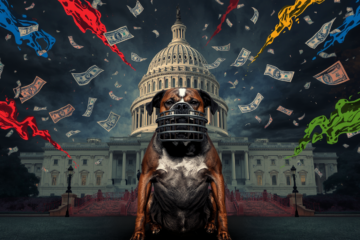
A truly competitive economy is impossible when Congress is for sale.
This is where the economic argument becomes a political argument. You cannot separate corporate power from political power when corporations spend enormous sums trying to influence legislation, regulation, procurement, tax policy, trade policy, labor policy, immigration policy, antitrust enforcement, and the courts.
The U.S. Chamber of Commerce, for example, has long been one of the most powerful lobbying forces in Washington. It does not represent “the free market” in any pure sense. It represents organized corporate power seeking political outcomes. Across the entire economy, federal lobbying spending has reached record levels. That money is not spent as charity. It is spent because influencing government is profitable.
If buying the rules produces a better return than competing under the rules, corporations will buy the rules.
That is why any serious pro-worker economic agenda must confront lobbying, campaign finance, revolving-door employment, congressional stock trading, regulatory capture, monopoly power, and the legal fiction that corporations should enjoy political rights designed for human beings.
A system that lets artificial entities accumulate political power against citizens is not a democracy operating through a free market. It is a managed economy for the donor class.
What a better answer looks like
A better answer starts by refusing the false choice.
We do not have to choose between defending corporate abuse and burning down markets. We do not have to choose between billionaire worship and bureaucratic control. We do not have to choose between corrupt capitalism and corrupt statism.
We can choose a republic where government belongs to the people, markets remain open to competition, workers can organize without retaliation, corporations are treated as tools rather than citizens, money is not treated as speech, and no donor class can buy permanent control of Congress.
That means simpler rules that apply equally. It means aggressive enforcement against fraud, wage theft, corruption, and anti-competitive conduct. It means ending special privileges for politically connected incumbents. It means stopping bailouts that protect executives while ordinary people absorb the pain. It means housing rules that allow homes to be built. It means drug rules that reward genuine invention without letting legal games block competition forever. It means labor law with teeth so workers can speak, associate, and organize without fear.
It also means rebuilding political power from the bottom up.
Because none of this changes if the same donor-approved candidates keep appearing on the ballot every two years and telling voters to pick the least bad option.
The major parties have had decades to fix this. They did not. In many cases, they helped build it. They took the money, protected the incumbents, and then asked Americans to keep fighting one another while the donor class kept writing the rules.
So the answer is not to wait for permission from either party.
The answer is to organize outside their loyalty structure and use their ballot structure against them.
That is Clean Slate 2028.
Independents and independent-minded Americans are the overwhelming majority. We outnumber each major party more than 2 to 1. The parties are weaker than they look because their primaries are often low-turnout contests controlled by a small slice of voters. That weakness can be used. Communities can find representatives from among themselves, support them, promote them, and elect them. District Teams can choose candidates before the primary season, then strategically enter the major-party primary that gives their candidate the clearest path.
That is not hiding. That is not pretending to be something we are not. That is recognizing that party labels have lost their moral authority. Republican and Democrat are not identities we owe loyalty to. They are ballot-access tools. If the donor class uses those labels to trap voters into choosing between candidates it already approved, then the people can use those same labels to break the trap.
Gen Z should not lower its expectations
Gen Z has every reason to reject the current arrangement. But rejecting the current arrangement does not require rejecting enterprise, innovation, ownership, or voluntary exchange. It requires rejecting the corporate-state merger that has made ordinary life less affordable, less stable, and less free.
Do not let anyone tell you that being pro-worker means being anti-business. Workers build businesses. Workers create value. Workers invent, serve, design, repair, teach, code, manufacture, deliver, nurse, clean, write, cook, drive, and keep the country alive. A healthy market should reward that. A captured market extracts from it.
Do not let anyone tell you that being pro-market means defending every corporate abuse. Markets require competition. Competition requires accountability. Accountability requires a government that cannot be purchased by the most powerful players in the market.
And do not let anyone tell you that the future is already lost.
It is not.
The future is being written by rules. Rules can be changed. Institutions can be rebuilt. Congress can be replaced. Corporate power can be stripped of constitutional privileges it never should have had. Money can be removed from its throne. Workers can be protected. Markets can be reopened. Communities can choose their own candidates. The donor class can be defeated.
The system feels rigged because it is.
But the answer is not despair. The answer is precision.
Capitalism did not fail you. Corporate capture did. Political corruption did. Short-term extraction did. Monopoly power did. A donor-owned Congress did.
Now name the real enemy, take the wheel back, and build something better.
References
OpenSecrets, “US Chamber of Commerce Lobbying Profile.” https://www.opensecrets.org/federal-lobbying/clients/summary?cycle=2023&id=D000019798
OpenSecrets, “Federal lobbying set new record in 2024.” https://www.opensecrets.org/news/2025/02/federal-lobbying-set-new-record-in-2024/
U.S. Department of Housing and Urban Development, “The Effects of Land Use Regulation on the Price of Housing.” https://www.huduser.gov/periodicals/cityscpe/vol8num1/ch3.pdf
Congressional Research Service, “Housing Supply: Current Trends and Policy Considerations.” https://www.congress.gov/crs-product/R48892
U.S. Department of the Treasury, “About TARP.” https://home.treasury.gov/data/troubled-assets-relief-program/about-tarp
Congressional Research Service, “Troubled Asset Relief Program (TARP): Implementation and Status.” https://www.congress.gov/crs-product/R41427
Federal Trade Commission and U.S. Department of Justice, competition and merger enforcement materials. https://www.ftc.gov/ and https://www.justice.gov/atr