THE BROKEN PROMISE: NO PROTECTION WHEN FIGHTING FOR A LIVING WAGE
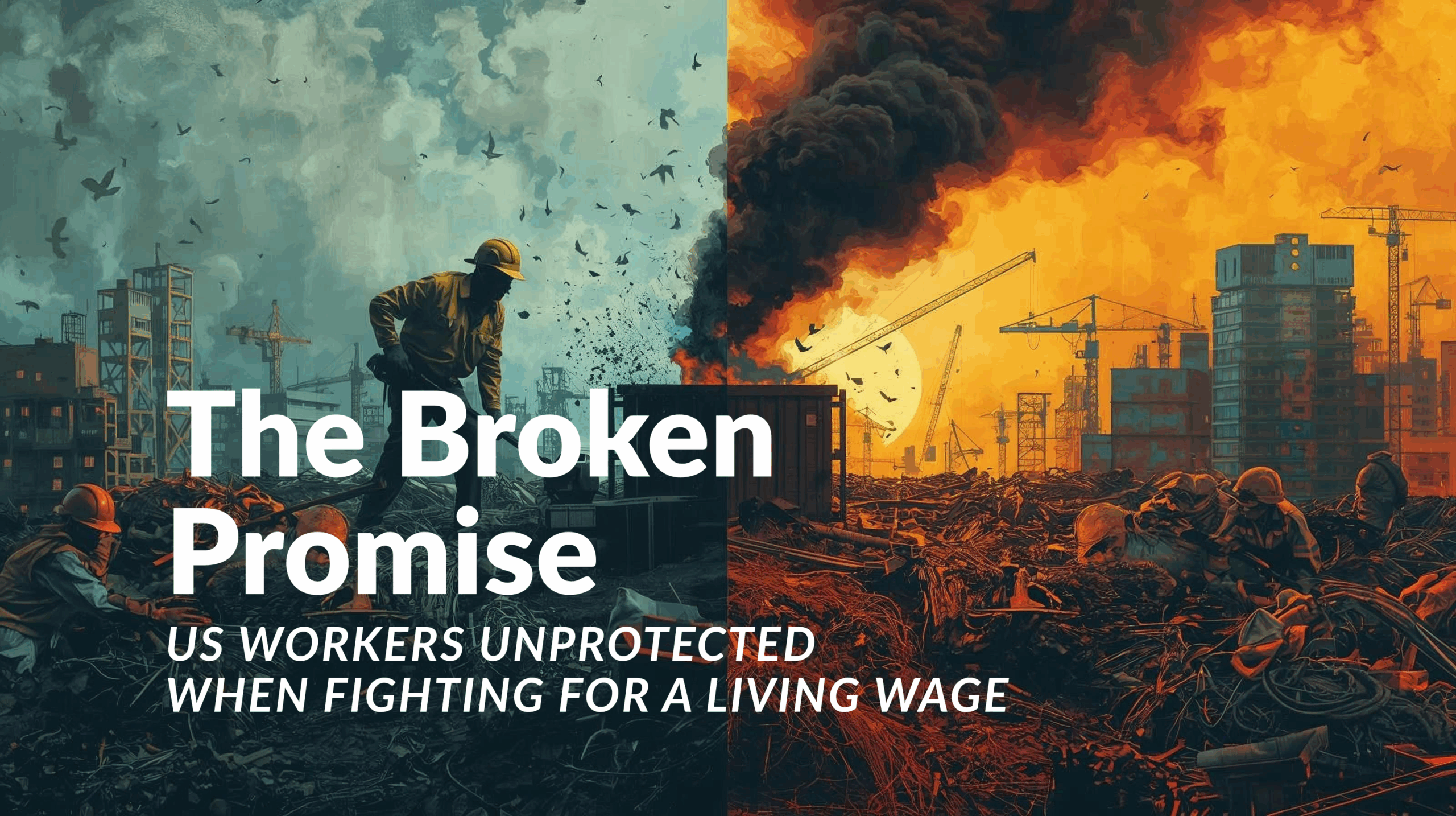
American Workers Deserve Government Protection in Their Fight for Living Wages
The fundamental promise of the American dream has always been that hard work should lead to prosperity. Yet today, millions of American workers find themselves trapped in a system where full-time employment fails to provide basic economic security. The argument that workers should demand better wages from their employers ignores the fundamental power imbalance that exists in modern labor markets. Good government would do everything possible to protect American workers while they demand a living wage from their employers. Instead, the government steps aside and lets corporate interests determine the fate of working families.
The Current Crisis of Worker Rights Violations
Across the United States, workers face unprecedented challenges, not just in securing fair compensation but also in the fundamental erosion of their workplace rights. The National Labor Relations Act (NLRA), designed to protect workers’ rights to discuss wages, organize, and engage in collective action, has become practically meaningless for millions of American workers. The National Labor Relations Board, charged with enforcing these rights, processed 24,566 cases in FY 2024 but issued only 259 decisions—less than 1% of filed cases received a resolution. With 25,435 cases currently open and the agency effectively shut down as “not actively maintained,” workers’ constitutional rights to free speech and association in the workplace have been systematically abandoned.
The crisis extends beyond economic compensation to the fundamental rights workers are supposed to enjoy under federal law. American workers face systematic violations, including illegal surveillance of their communications about workplace conditions, economic retaliation for exercising protected rights, denial of due process in employment decisions, and deliberate coercion to suppress constitutional freedoms. When workers are fired for discussing wages with coworkers, monitored for union activities, or punished for reporting safety violations, the very foundation of workplace democracy crumbles. This isn’t merely about wages—it’s about whether American workers retain fundamental constitutional rights within their workplaces.
The Power Imbalance in Modern Workplace Rights Enforcement
The suggestion that workers should simply “demand” their rights from employers fails to acknowledge the fundamental collapse of the enforcement system designed to protect them. Under the NLRA, workers have statutory rights to discuss wages, organize, and engage in collective activity—but these rights are only meaningful when enforced by the government through the NLRB. When that enforcement system fails, workers face impossible barriers:
Workers attempting to exercise their Section 7 rights encounter illegal surveillance of their communications, economic retaliation, including termination and hour cutting, and systematic threats designed to suppress protected activities. Employers can deploy sophisticated monitoring technology, teams of anti-union consultants, and legal strategies while individual workers face isolation and intimidation. The mathematics of enforcement failure are stark: with only one NLRB Board member currently serving. Even before the Trump administration neutered the NLRB, cases took an average of 117 days to process, and workers faced immediate retaliation while waiting months—or indefinitely during agency shutdowns—for rare and uncertain government protection.
This power imbalance becomes even more pronounced when considering the exclusive jurisdiction system. Because workers can only file workplace rights claims through the overwhelmed NLRB, the system’s failure creates a powerful deterrent. With less than 1% of cases receiving decisions and the agency currently non-functional, millions of legitimate workplace actions never occur as workers reasonably conclude that exercising their rights is untenable when facing retaliation without timely protection.
Historical Government Role in Worker Protection
Throughout American history, government intervention has been essential to protecting workers’ constitutional rights and establishing fair workplace standards. The National Labor Relations Act of 1935, passed during the New Deal era, was specifically designed to restore balance in the American economy during the Great Depression, when workers had no power against massive corporate concentration. The Act’s Section 7 protected individual workers’ fundamental rights to free speech, association, and collective action—creating a floor of workplace democracy, not to empower union bureaucracies but to protect individual liberty.
The original intent of the NLRA was clear: to ensure that American workers could exercise their constitutional rights within the workplace without fear of retaliation. This legislation emerged from a widespread recognition that true free markets require fair competition and honest rules that prevent the powerful from exploiting the vulnerable. When corporations use their wealth and influence to violate the rights of individual workers, they corrupt the very capitalism that made America great.
More recently, workplace safety regulations, anti-discrimination laws, and family medical leave protections have all demonstrated how government action can create more equitable working conditions. However, the unique nature of NLRA rights—statutory workplace protections that require government enforcement, as opposed to constitutional rights that directly restrict government action—makes the current failure of the NLRB particularly devastating. These rights exist on paper but become meaningless without effective enforcement, creating a constitutional crisis for American workers.
The Economic Case for Government Intervention
Contrary to claims that government protection of workplace rights harms the economy, substantial evidence suggests that strong worker protections benefit overall economic health. When workers can exercise their rights to discuss wages and working conditions without fear, it creates more efficient labor markets and better allocation of human capital. The free exchange of information about compensation and working conditions enables workers to make informed decisions about their employment, leading to better matches between their skills and available opportunities.
The current system of rights violations creates significant economic inefficiencies. Employers who illegally monitor and retaliate against workers undermine workplace morale, productivity, and innovation. When workers cannot safely report safety concerns or suggest improvements, companies miss out on valuable insights that could enhance their operations. The chilling effect of rights violations means that legitimate workplace improvements never materialize, resulting in billions of dollars in lost productivity for businesses and the economy.
Furthermore, the current enforcement failure creates massive externalities. When the NLRB processes only 259 decisions out of 24,566 filed cases, it effectively shifts the burden of enforcement onto workers who must risk their livelihoods to exercise their rights. This system creates a race to the bottom where companies that violate workers’ rights gain a competitive advantage over law-abiding businesses. Government protection of workplace rights would restore fair competition, ensuring that companies succeed based on innovation, quality, and efficiency rather than their ability to violate workers’ constitutional rights with impunity.
International Perspectives on Workplace Rights Enforcement
The United States lags significantly behind other developed nations in protecting workers’ fundamental rights in the workplace. Many democratic nations have established more effective enforcement mechanisms for workplace protections, recognizing that statutory rights require robust government action to be meaningful. Countries like Germany, France, and the Nordic nations have comprehensive labor courts and enforcement agencies that provide timely protection for workers exercising their rights.
Germany’s system of works councils and co-determination ensures that workers have genuine representation in workplace decisions, with strong legal protections against retaliation. France’s labor inspectorate actively monitors workplaces and imposes significant penalties for violations of labor rights. Australia’s Fair Work Commission provides rapid intervention in workplace disputes, with average resolution times measured in weeks rather than the months or years typical of the American NLRB system.
Most importantly, other developed nations recognize that exclusive jurisdiction through overwhelmed government agencies creates rights without remedies. Many systems provide workers with direct access to courts when government enforcement fails, ensuring that statutory rights remain meaningful even when government agencies are non-functional. These international examples demonstrate that adequate protection of workplace rights necessitates multiple enforcement pathways and rapid response mechanisms—the very elements lacking in the current American system.
The Moral Imperative for Government Action
Beyond economic considerations, there exists a fundamental moral imperative for the government to protect workers in their fight for living wages. The Declaration of Independence asserts that all people have the right to life, liberty, and the pursuit of happiness. When full-time work fails to provide basic economic security, these rights are effectively denied to millions of Americans.
Religious and ethical traditions across cultures emphasize the dignity of work and the moral obligation to ensure fair compensation for all. Catholic social teaching explicitly states that workers have a right to a “just wage” that enables them to live in dignity. Similar principles exist in the ethical traditions of Protestantism, Judaism, and Islam, reflecting a broad consensus across these belief systems about the moral necessity of fair compensation.
Practical Government Solutions
Protecting workers’ constitutional rights in their workplaces requires comprehensive government action to restore the effectiveness of the NLRA enforcement system:
Enhanced Penalties for Workplace Rights Violations: Congress should establish civil penalties of $50,000 per worker for violations of workplace rights, triple the penalties for repeated violations within five years, and impose corporate criminal liability on executives who authorize rights violations. Current penalties are so minimal that employers treat them as a cost of doing business rather than a deterrent.
Rapid Enforcement Mechanisms: The government should establish a 72-hour temporary reinstatement for workers fired for engaging in protected activity, emergency court orders to halt ongoing workplace violations, and expedited resolution processes with a maximum 14-day timeline, compared to the current average processing time of 117 days.
Private Right of Action for Workplace Rights Violations: After 14 days of inaction, workers should be allowed to sue directly in federal court when government enforcement fails, bypassing overwhelmed agencies like the NLRB. This would provide attorneys’ fees and costs for workers who prevail, as well as punitive damages for willful violations, and expedited court processes with a 60-day maximum timeline.
Protection of Worker Privacy Rights: Strong legislation is needed to ban employer surveillance of protected conversations, protect digital communications and social media activity, establish criminal penalties for the illegal monitoring of any collective activities, and ensure the equal application of all workplace rules regardless of the protected activity.
Due Process Reform in Employment: Workers deserve mandatory fair hearings before termination for engaging in protected activity, the right to confront witnesses and evidence in employment disputes, and the burden of proof to be placed on employers to demonstrate legitimate business reasons for adverse actions.
Restoring Agency Independence and Effectiveness: The NLRB requires guaranteed funding, independent boards protected from political interference, mandatory case processing timelines, and minimum staffing ratios to ensure that workers’ statutory rights have meaningful enforcement mechanisms.
Overcoming Political Opposition
Opposition to government protection of workers typically comes from business interests and ideological opponents who claim such protection interferes with free markets. However, these arguments ignore the reality that modern labor markets are already heavily influenced by government policies that favor capital over labor.
Current tax policies, trade agreements, and regulatory frameworks consistently favor corporate interests over those of workers. Government protection of workers would not interfere with free markets but would restore balance to a system that has become fundamentally skewed against working people.
The Path Forward
The fight for living wages requires both individual worker action and comprehensive government protection. Neither approach alone can solve the systemic challenges facing American workers. When workers organize and demand better wages while the government provides institutional support and protection, meaningful change becomes possible.
This isn’t about choosing between government action and worker empowerment—it’s about recognizing that both are essential components of a just economic system. Government protection creates the conditions under which workers can effectively demand fair compensation without fear of retaliation or economic ruin.
Conclusion
The belief that American workers should simply demand better wages from employers without government protection reflects a fundamental misunderstanding of modern economic realities. The power imbalance in labor markets, historical exploitation of workers, and current economic crisis all demonstrate why government action is essential.
Good government would do everything possible to protect American workers while they demand a living wage from their employers. This protection is not a handout but a necessary correction to systemic market failures that prevent workers from receiving fair compensation for their labor.
The time for half-measures and incremental changes has passed. American workers deserve comprehensive government protection that ensures full-time work provides a pathway to economic security and dignity. Anything less fails to honor the fundamental promise of the American dream and betrays the millions of workers whose labor builds and sustains our nation.
The choice is clear: we can continue down the path of worker exploitation and growing economic inequality, or we can build a system where government protection and worker rights combine to create prosperity for all. The American dream demands we choose the latter.