1973—The Start of Families Not Having Time To Cook!
By Randell S. Hynes
Make America Healthy Again Needs the US Workers Alliance (And Vice Versa)
You can’t Make America Healthy Again without making America Families economically secure again. The same corporate interests that filled our food with toxins also suppressed wages for 50 years. It’s the same playbook: privatize profits, socialize costs, capture the regulators.
Randell S.Hynes
I spent thousands of hours helping RFK Jr. reach the position where President Trump offered him the HHS helm. As Nevada Campaign Manager for Team Kennedy 2024, I believed in the mission: Make America Healthy Again. End the chronic disease epidemic. Clean up our food supply. Restore trust in our health institutions. Generally, stop corporate capture of our government agencies!
But here’s what I learned from my 33 years in tech, my experience being forced to train my foreign replacement at 63, and my work building the US Workers Alliance: You can’t make America healthy again without fixing what’s broken in American work.
The MAHA movement is fighting the symptoms. The US Workers Alliance is fighting the root cause. And it’s time we joined forces.
The Connection Nobody’s Talking About
When Secretary Kennedy talks about removing petroleum-based dyes from our food, reforming SNAP to prioritize whole foods, and investigating the autism epidemic, he’s addressing real problems. The MAHA community—led by passionate mothers and health advocates—is right to demand better.
But here’s the question nobody’s asking: Why did American families start eating processed food in the first place?
The answer isn’t ignorance. It isn’t laziness. It isn’t a lack of values.
The answer is 1973.
The Year Everything Changed
In 1973, something broke in the American economy. Productivity kept rising, but worker compensation flatlined. For the first time in American history, working harder didn’t mean earning more.
The numbers tell the story:
- 1973: Average hourly wage was $4.03 (equivalent to $23.68 in 2024 dollars)
- 2024: Average hourly wage is $22.65
- Result: After 50 years, real wages have essentially not increased at all
Families responded the only way they could:
- Mothers who wanted to stay home went to work (dual-income families rose from 46.9% to 53%)
- Single-earner households became dual-income by necessity
- Workers took on gig economy jobs (now 36% of the workforce)
- Families borrowed to make ends meet (average household debt: $105,056)
- Social services became essential, not emergency
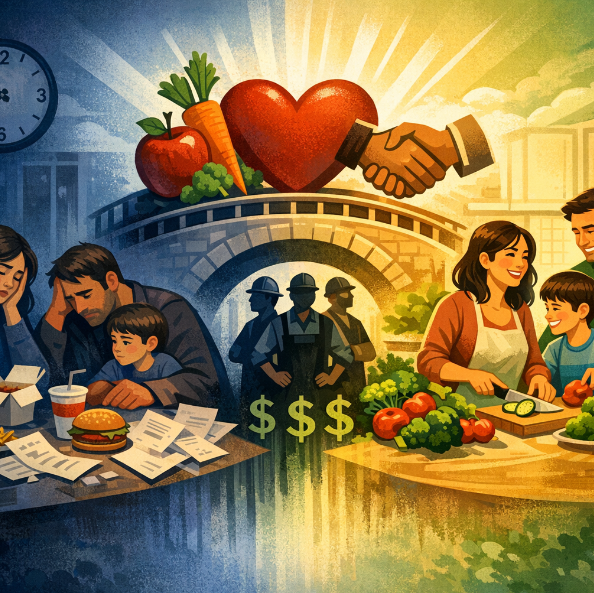
And here’s what nobody connects to the health crisis: Families stopped having time to cook.
It wasn’t a choice. It was mathematics.
The Time-Poverty Health Crisis
When both parents work 50+ hours per week, commute 10 hours, and have 2.5 hours per day for ALL personal needs—eating, sleeping, hygiene, childcare, housework—when exactly are they supposed to prepare healthy meals from scratch?
They’re not. And they don’t.
The data is devastating:
1970s:
- Single-earner families could afford a middle-class life
- Home meal preparation was the norm
- Fast food was an occasional treat
- Ultra-processed foods were rare
2025:
- Dual-income families struggle despite working more hours
- Ultra-processed foods comprise over 50% of American calories
- Fast food is a family staple
- Home cooking skills have declined generationally
The research is clear:
- Working mothers cite “time stress” as the primary barrier to healthy cooking
- Work schedule instability directly correlates with processed food consumption
- Families with unpredictable schedules can’t meal plan or prep
- Shift work disrupts sleep, which is linked to obesity, diabetes, and heart disease
The MAHA community sees the processed food. They see the chronic disease. They see the suffering children.
What they haven’t seen yet is the economic cage that makes it all inevitable.
The Same Enemy: Corporate Capture
Here’s where it gets interesting. The MAHA movement has correctly identified that regulatory agencies have been captured by the industries they’re supposed to regulate:
- FDA approves additives without adequate testing
- USDA dietary guidelines favor industry over health
- The GRAS (Generally Recognized as Safe) loophole lets chemicals into our food supply without review
- Conflicts of interest riddle advisory committees
Secretary Kennedy calls it “corporate capture,” and he’s absolutely right.
But here’s what the MAHA community needs to understand: The same corporate capture that gave us ultra-processed foods also destroyed worker protections.
The playbook was identical:
Food Industry:
- Lobby to weaken safety standards
- Appoint industry-friendly regulators
- Secure narrow court decisions
- Defund enforcement agencies
- Create backlogs that make enforcement meaningless
Labor Policy:
- Lobby to weaken worker protections
- Appoint business-friendly NLRB members
- Secure narrow court decisions
- Defund enforcement agencies
- Create 3-year backlogs that make enforcement meaningless
The result? Laws exist on paper but not in practice. Rights exist in theory but not in reality.
Workers have Section 7 rights under the National Labor Relations Act—the right to organize, to act collectively, to demand fair treatment. Just like food safety laws exist.
But try exercising those rights. Try organizing your coworkers to demand better wages or schedules. You’ll be fired. And by the time the NLRB rules in your favor three years later, you’ve lost your home, your healthcare, and your ability to feed your family.
Sound familiar? It should. It’s the same system that lets food companies poison us with impunity.
The Unintended Consequence: How Anti-Union Crusades Hurt ALL Workers
Here’s something both Democrats and Republicans need to understand: The decades-long campaign to weaken unions didn’t just hurt union members—it destroyed protections for all 170 million American workers.
The anti-union movement provided perfect cover for dismantling the entire enforcement infrastructure that protected worker rights. Politicians could campaign on “fighting union bosses” while quietly gutting the agencies that enforce labor law for everyone.
What happened:
- Defunded the NLRB under the guise of “reducing union power.”
- Appointed business-friendly board members who slow-walked enforcement
- Created 3-year case backlogs that make violations consequence-free
- Weakened penalties to the point where breaking the law became a cost of doing business
The result: Section 7 of the National Labor Relations Act gives ALL workers—union or not—the right to organize with coworkers and negotiate collectively. But without enforcement, those rights exist only on paper.
The Trump Administration’s approach continues this pattern: Efforts to “hobble union power” have also stunted non-union coworkers’ ability to negotiate for fair wages, better schedules, and safer conditions. When you weaken the enforcement system, you don’t just hurt unions—you hurt every worker who wants to speak up without getting fired.
This is why 90% of American workers (the non-union majority) have been left completely unprotected. The anti-union rhetoric provided cover for corporate capture of the entire labor enforcement system.
The irony: Many workers who cheered the weakening of unions didn’t realize they were also losing their own protections. Corporate interests played both sides—convincing workers that unions were the enemy while quietly removing everyone’s ability to collectively demand fair treatment.
The MAHA connection: Just as corporate capture of the FDA lets food companies poison us, corporate capture of labor enforcement lets employers exploit us. Same playbook, same result, same need for restoration of real enforcement.
The Hidden Subsidy That Makes Everyone Sick
Here’s the cycle that connects everything:
- Corporations pay poverty wages → Workers can’t afford quality food
- Workers need government assistance → SNAP benefits flow to corporations
- SNAP buys processed food → Because it’s cheap and convenient for time-poor families
- Processed food causes disease → Healthcare costs explode (up 600% per capita since 1970)
- Taxpayers fund healthcare → Through Medicaid and emergency rooms
- Corporations avoid healthcare costs → Because they don’t provide benefits
The corporation profits four times:
- Cheap labor (poverty wages)
- SNAP revenue (taxpayer-funded)
- No healthcare costs (taxpayer-funded)
- No accountability (captured regulators)
The taxpayer pays four times:
- Higher taxes for SNAP
- Higher taxes for Medicaid (healthcare now 18% of GDP)
- Higher insurance premiums
- Degraded health outcomes
And the family? The family gets processed food, chronic disease, and a lecture about “personal responsibility.”
The Math That Makes Healthy Eating Impossible
Let me make this concrete. Organic chicken costs $8 per pound. At minimum wage ($7.25/hour), that’s 90 minutes of work after taxes for one pound of chicken.
But it gets worse:
Housing Crisis:
- 1970: Homes cost 3.2x median income
- 2024: Homes cost 5.3x median income
- Result: Housing affordability has declined 66%
Education Crisis:
- 1973: Public university tuition was $514/year ($3,680 in 2024 dollars)
- 2024: Public university tuition is $10,340/year
- Inflation-adjusted increase: 181%
- Student loan debt: $1.78 trillion (up 677% since 2000)
Healthcare Crisis:
- 1970: $353 per person ($2,208 in 2024 dollars)
- 2024: $15,474 per person
- Inflation-adjusted increase: 600%
The Gig Economy Trap:
- 36% of workers participate in the gig economy
- 44% rely on it as their primary income
- 80% of gig-dependent workers struggle with a $1,000 emergency expense
- Often lacks benefits and job security
When families are drowning in debt ($105,056 average), paying 5.3x income for housing, and working gig jobs without benefits, they don’t have the time or money to choose healthy food—even when they desperately want to.
Why MAHA Can’t Succeed Without Worker Protection
Secretary Kennedy wants to reform SNAP to prioritize whole foods over processed junk. I support that goal completely.
But here’s the reality: A family working three jobs to afford rent doesn’t have time to cook whole foods, even if SNAP pays for them.
You can’t meal prep on Sunday when you don’t know your Tuesday schedule until Monday night.
You can’t cook healthy dinners when you’re working split shifts.
You can’t afford quality ingredients when your employer pays poverty wages and threatens to fire you if you complain.
This is why MAHA needs the US Workers Alliance.
What the C.L.A.W.S. Act Does
The Collective Labor Action With Strict Protections (C.L.A.W.S.) Act does for worker rights what MAHA wants to do for food safety: restore real enforcement.
Current law says workers can organize collectively. The C.L.A.W.S. Act makes that real by:
- Immediate, severe financial penalties for retaliation → Not three years later, not maybe, not a slap on the wrist. Immediate and prohibitive.
- Automatic enforcement → No 3-year NLRB/EEOC backlog. Violation = immediate consequence.
- Protection for ALL workers → Not just union members. All 170 million American workers.
- System-level change → Not workplace-by-workplace organizing. Universal protection.
When workers can collectively demand fair treatment without fear of retaliation, they can negotiate for:
- Living wages → Families can afford quality food
- Predictable schedules → Families can plan and prepare meals
- Reasonable hours → Families have time to cook and eat together
- Paid sick leave → Workers don’t have to choose between income and health
- Healthcare benefits → Preventive care instead of emergency rooms
This is health policy. It just doesn’t look like traditional health policy.
The Stress-Inflammation-Disease Pipeline
Here’s something the MAHA community needs to understand: Chronic job insecurity creates chronic inflammation. That’s not just stress—it’s the biological pathway to disease.
The research is clear:
- Fear of retaliation keeps workers silent about unsafe conditions
- Economic anxiety triggers stress hormones (cortisol)
- Chronic stress → inflammation → chronic disease
- You can’t “wellness” your way out of systemic economic stress
When 80% of gig workers struggle with a $1,000 emergency expense, when families carry $105,056 in average debt, when housing costs 5.3x income instead of 3.2x—that’s not individual failure. That’s systemic violence against working families.
And it’s making us sick.
The Mutual Benefits of Collaboration
What MAHA Gets from US Workers Alliance:
1. Root Cause Analysis
- Understanding why families eat processed food (economic necessity, not ignorance)
- Addressing systemic barriers to healthy eating (time poverty, wage stagnation)
- Connecting food policy to economic policy
2. Expanded Coalition
- 170 million workers who care about family health
- Labor unions that share an anti-corruption stance
- Working families who want both healthy food AND fair wages
3. Stronger Policy Arguments
- “Reform SNAP” becomes “Pay living wages so families don’t need SNAP.”
- “Eat whole foods” becomes “Protect workers so families have time to cook.”
- “End chronic disease” becomes “End economic conditions that cause chronic disease.”
4. Political Power
- Workers are voters
- Economic security is bipartisan
- Family well-being transcends the left-right divide
What the US Workers Alliance Gets from MAHA:
1. Established Infrastructure
- Network of passionate advocates (mom-fluencers with millions of followers)
- Grassroots organizing (Weston A. Price Foundation chapters nationwide)
- Political access (White House MAHA Moms Roundtable)
- Proven mobilization (successfully changed corporate and state policies)
2. Compelling Narrative
- Health framing makes labor issues personal and urgent
- Family focus appeals across the political spectrum
- Child health creates a moral imperative
- Anti-corruption stance aligns perfectly
3. Media Amplification
- MAHA influencers have massive platforms
- Health media covers MAHA extensively
- Crossover potential to reach new audiences
- Viral content potential (health + economics = engagement)
4. Validation of Core Argument
- MAHA proves that corporate capture is real and recognized
- The health crisis proves that the current system is failing
- Family struggles prove that individual solutions aren’t enough
- The chronic disease epidemic proves that systemic change is necessary
The Joint Campaign: “Take Back Dinner Time”
Imagine a campaign that unites MAHA’s health advocacy with worker protection:
Goal: Protect family dinner time through schedule predictability and fair wages
Message: “Family dinner matters for health—workers need protection to demand it.”
The Data Supporting This:
- Families with unpredictable schedules can’t meal plan
- Working mothers cite time stress as the primary barrier to healthy cooking
- Dual-income necessity (53% of families) eliminates meal preparation time
- Gig economy workers (36% of the workforce) have maximum schedule instability
Tactics:
- MAHA influencers share stories of time poverty preventing healthy eating
- US Workers Alliance provides economic data and policy solutions
- Joint social media campaign: #TakeBackDinnerTime
- State legislation combining schedule predictability + food quality standards
- Employer certification: “Healthy Work, Healthy Families.”
Outcome: A movement that addresses both symptoms (processed food) and root causes (economic conditions)
Addressing the Obvious Objections
“This sounds like socialism.”
No. This is capitalism with rules. We have food safety rules—MAHA supports them. We need rules for labor practices. Both prevent corporate abuse. Both protect families. That’s not socialism; it’s good government.
“Higher wages mean higher prices.”
Wages have been stagnant for 50 years (real wages essentially unchanged since 1973). Prices went up anyway. Corporate profits are at record highs. The money exists—it’s just going to shareholders instead of workers. Fair wages don’t cause inflation; corporate greed does.
“Workers can just quit if they don’t like their job.”
When you’re living paycheck to paycheck (80% of gig workers struggle with a $1,000 emergency), you can’t quit. When healthcare is tied to employment, you can’t quit. When employers can legally fire you for organizing with coworkers, you can’t quit. That’s not a free market—it’s coercion.
“Just meal prep on Sunday!”
Meal prep requires: (1) A predictable schedule to know what you’ll need, (2) Time off to shop and cook, (3) Money for bulk ingredients, (4) Kitchen equipment, (5) Storage space, (6) Cooking skills. When you’re working 50+ hours at irregular shifts for poverty wages, which of those do you have?
The Path Forward
Here’s what I propose:
Phase 1: Establish Connection (Months 1-2)
- US Workers Alliance engages with MAHA content on social media
- Share articles connecting work economics to health outcomes
- Reach out to MAHA influencers with collaboration proposals
- Attend MAHA events and introduce the worker perspective
Phase 2: Create Joint Content (Months 3-4)
- Co-authored articles by MAHA advocates and labor advocates
- Video series: “Why I Can’t Eat Healthy” (working families tell their stories)
- Infographics showing work-health connections
- Podcast interviews connecting the movements
Phase 3: Launch Campaign (Months 5-6)
- “Take Back Dinner Time” social media campaign
- State legislation combining health and labor provisions
- Employer certification program
- Joint advocacy days at state capitals
Phase 4: Build Infrastructure (Months 7-12)
- Formal coalition between MAHA groups and US Workers Alliance
- Shared policy platform
- Coordinated lobbying efforts
- National conference bringing movements together
The Research We Need
To make this collaboration concrete, we need research that connects the dots:
Study 1: Work Schedules & Family Nutrition
- Survey working families about the time available for meal preparation
- Correlate work schedule stability with nutrition quality
- Document health outcomes by work schedule type
- Quantify the “time poverty tax” on family health
Study 2: Economic Security & Health Outcomes
- Compare health metrics in states with strong vs. weak worker protections
- Analyze chronic disease rates by wage levels and schedule predictability
- Calculate healthcare cost savings from improved working conditions
- Demonstrate the ROI of worker protection as a preventive health policy
Study 3: The True Cost of Cheap Labor
- Calculate taxpayer subsidies for poverty-wage employers (SNAP, Medicaid, etc.)
- Quantify healthcare costs from work-related stress and time poverty
- Compared to the cost of enforcing worker protections
- Show that “cheap labor” is actually expensive for society
This research would give both movements evidence-based arguments for policy change.
Why This Matters Now
The chronic disease epidemic is real. The food system is broken. The MAHA movement is right about that.
But we can’t fix the food system without fixing the economic system that makes unhealthy food the only option for working families.
The data proves it:
- Real wages unchanged in 50 years
- Housing costs up 66% relative to income
- Healthcare costs up 600% per capita
- Student debt up 677%
- Average household debt: $105,056
- 36% of workers in the precarious gig economy
- 80% of gig workers struggle with a $1,000 emergency
This isn’t individual failure. This is systemic design.
Secretary Kennedy has the platform. The MAHA community has the passion. The US Workers Alliance has the economic analysis and policy solution.
Together, we can build a movement that addresses both symptoms and root causes.
We can Make America Healthy Again by making work work for families.
The Invitation
To the MAHA community: I see you. I hear you. I share your concern for family health and your distrust of corporate capture. I’m asking you to expand your analysis to include the economic conditions that make healthy living impossible for working families.
To MAHA influencers: Let’s talk. I have data, policy proposals, and a network of 170 million workers who care about family health. You have platforms, passion, and political access. Together, we can change the conversation.
To Secretary Kennedy: You’ve identified corporate capture as the enemy. You’re right. But corporate capture didn’t just poison our food—it destroyed our worker protections. We can’t fix one without fixing the other. The C.L.A.W.S. Act is a health policy. Let’s make it part of the MAHA agenda.
To working families: You’re not failing. The system is failing you. You’re not lazy for buying processed food—you’re exhausted from working multiple jobs. You’re not ignorant about nutrition—you’re trapped in economic conditions that make healthy eating impossible.
The solution isn’t individual—it’s systemic. And it requires both movements working together.
The Bottom Line
Make America Healthy Again is a powerful vision. But it’s incomplete without economic justice.
The US Workers Alliance is fighting for economic justice. But we need the MAHA community’s passion, platform, and political access.
We need each other.
The chronic disease epidemic, the processed food crisis, the autism surge, the obesity epidemic—these aren’t just health problems. They’re economic problems. They’re labor problems. They’re the inevitable result of 50 years of wage stagnation and corporate capture.
You can’t supplement your way out of economic anxiety.
You can’t meal prep your way out of poverty wages.
You can’t wellness your way out of systemic exploitation.
Real health requires economic security. Economic security requires worker protection. Worker protection requires the C.L.A.W.S. Act.
And making that happen requires MAHA and the US Workers Alliance working together.
I’m ready. Are you?
Randell S. Hynes is the founder of the US Workers Alliance and Buildup Cooperative. A 33-year tech veteran and U.S. Army Veteran, he served as Nevada Campaign Manager for Team Kennedy 2024. After being forced to train his foreign replacement at age 63, he dedicated himself to restoring real worker protections for all Americans. He blogs at Hynes.com and can be reached at (702) 849-4881.
Join the movement:
- US Workers Alliance: AllUSWorkers.com
- Sign the Paper Tiger Petition: AllUSWorkers.com
- Learn about the C.L.A.W.S. Act: USWorkersAlliance.com
- Follow the conversation: BuildupCooperative.com
This article is part of an ongoing series exploring the connections between economic policy and public health. Future articles will examine specific policy proposals, research findings, and success stories from states that have implemented worker protections.