Boomers Had One Duty: Warn Future Generations What Berries Not To Eat—We Failed

Boomers Had One Duty: Warn Future Generations What Berries Not To Eat—We Failed
By Randell S. Hynes
There’s an old story about boiling a frog. Drop him in hot water, and he jumps right out. But put him in cool water and slowly raise the heat, and he never notices until it’s too late. Maybe you’ve heard it. Maybe you’re the frog. Anyhow, clichés become clichés because they keep being true, and the version of this country you’ve inherited is the boiled-frog edition.
I’m not writing this to apologize. Apologies from my generation would be worthless currency, and you’d be right to reject them. I’m writing this because you deserve to know which berries were poison before you picked them, and my generation — the one that was supposed to be guarding the trail — handed you the basket and pointed at every bright, shiny one like it was safe.
It wasn’t. And the ones who told you it was? They knew.
This was not inevitable. They did this to us on purpose, and we can undo it together.
I want you to sit with that sentence for a moment, because everything else I’m going to tell you flows from it. The mess you’re standing in — the crushing student debt, the gig economy with no safety net, the algorithms that know you better than you know yourself, the politicians who perform rage on cable news and pass nothing that helps you, the corporations that are somehow people when it’s convenient and immune when it isn’t — none of it was an accident.
The job that doesn’t pay enough. The nagging knot in your stomach knowing that you and your coworkers can’t ask for a raise for fear of being fired. The trap of being unable to afford losing your health insurance — which is almost certainly woefully inadequate coverage. None of it was an accident. None of it was the natural result of progress or the unavoidable cost of modernity. It was engineered. Designed. Built, piece by piece, over decades, by people who understood exactly what they were doing.
And my generation let them.
The Berry of Division
The first berry they handed you was the bright red one: Pick a side. Left or right. Blue or red. Woke or anti-woke. They made you think the most important thing about yourself was which team you were on, and then they made sure the teams were defined in a way that guaranteed you’d never talk to each other long enough to figure out you were being played.
The division has ripped families apart. Thanksgivings have become battlegrounds. Parents and children stare at each other across a chasm that neither of them built, and neither of them can name the architect of. You’ve watched it happen. Maybe it happened to your family. Maybe you’ve got an uncle who thinks you’re a communist because you think healthcare shouldn’t bankrupt people, or a cousin who thinks you’re a fascist because you think maybe not every regulation is evil. You’ve been shoved into lanes, and the lanes are designed to keep you from ever looking sideways at the person next to you and realizing: Wait, we both got screwed by the same system.
The attempts to divide us are more evident than ever when we see politicians take views that are completely opposite to those of the “other” party, views that are exactly the opposite of those recorded on video years before. We know they don’t believe what they’re saying, and they’re saying it to keep us divided along party lines.
Read that again. They don’t believe it. It’s a performance. It’s professional wrestling in suits, and you’re the audience they need to keep watching so the advertisers — the lobbyists, the PACs, the corporate donors — keep paying. Every time you share that outrage post, every time you react to the provocation, every time you define yourself primarily as “against” the other team, you’re doing exactly what the system needs you to do. You’re the product, not the customer. You never were the customer.
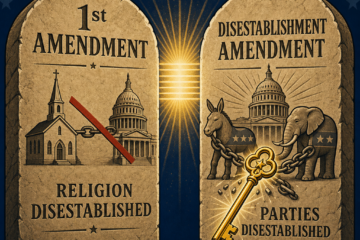
This isn’t both-sides-ism. I’m not telling you that the parties are identical or that your values don’t matter. I’m telling you that the system that presents you with only two options — in a nation of 335 million people — is a cage, not a choice. And the people who built that cage did it on purpose, because a population that can only choose A or B is a population that can be controlled by whoever sets the menu. For far too long, we’ve stood by and allowed the donor class to pick who shows up at our general elections. You might think that the primaries are where candidates are selected. It is not. That’s theater. Candidates are selected long before in the “Money Primary.” We don’t participate in that process, where no votes are cast. We don’t have an equivalent process. Not yet. We’ll have the People Primary, where we’ll find, vet, and nominate our own candidates, long before the parties’ Primary elections. Then we’ll literally take those elections over and nominate our own candidates for the general election.
There’s no reason to hide it. We have overwhelming numbers, and just need to rally around the cause of taking back our government from corporations.
The Berry of Compassion Without Oversight
The second berry was the one that looked like it was good for you: Trust the program. The government will help. The system has a safety net. We passed legislation with your name on it.
Here’s what they don’t tell you about compassion programs: they’re the easiest things in the world to capture. A program designed to help people is a program that moves money, and wherever money moves, someone is waiting to siphon it. Not the people who need it. Never the people who need it. The siphoning happens at the top, in the consulting fees and the administrative overhead and the no-bid contracts and the “public-private partnerships” that are really just private profit with a government seal of approval.
Every program that extends compassion through the expenditure or abatement of tax dollars must have dedicated oversight and real remedies to protect the money and Americans from unintended use or harm.
That sentence should be carved into the marble above every agency door in Washington. Instead, what we have is the opposite: programs designed to look compassionate on the surface while being structured to fail the people they claim to serve — and often to actively benefit corporations and special interests instead.
The visa system is one of the clearest and most damaging examples. Sold as a program to bring in “the best and brightest,” it has become a sophisticated wage-suppression machine that affects American workers at every level. H-1B guest workers are routinely paid $20,000 to $30,000 less than American workers for the same roles. Universities — the very institutions educating the next generation — regularly fill faculty, research, and staff positions with foreign guest workers while their own American students and graduates are overlooked or underemployed. At the same time, both legal and illegal immigration are used to flood labor markets across the economy, driving down wages for working Americans of all generations — from entry-level jobs all the way up to skilled technical and professional positions. You feel this every time a good job goes to someone on a visa while you or your classmates are still struggling to get a foothold.
Then there are Medicare and Medicaid, where massive fraud, administrative bloat, and poor oversight mean billions are wasted while patients get worse outcomes at higher costs. SNAP benefits that fail to truly stabilize struggling families. Childcare subsidies captured by bureaucracy and high overhead. Hospice programs plagued by overbilling scandals. And the endless infrastructure bills that take a decade to produce a single pothole fix.
Even the nonprofit sector — long presented as independent voices of compassion and grassroots change — has been revealed to be a sophisticated mechanism for recycling political money and organizing political unrest. They stir the pot, amplify division on cultural issues, and keep us bitterly divided so we never unite around our shared economic realities. What looks like organic activism is too often astroturfed division funded by the same donor class that benefits from our disunity.
Every one of these programs was sold with noble intentions. Almost all of them have been captured and twisted into something that hurts the very people they were meant to help.
The Berry of the Captured Pipeline
The third berry is the one that tastes like opportunity: Just vote harder. If you don’t like the system, change it from inside. Run for office. Get involved. Make your voice heard.
Sounds great. Except the pipeline is captured.
By the time a candidate appears on your ballot, they’ve already been through a gauntlet of gatekeepers who made sure they’d never rock the boat in a way that matters. Party leadership decides who gets funding. Major donors decide who gets airtime. The consultants decide what’s “electable.” And by the time you’re standing in the voting booth looking at two names, both of those names have already been vetted by the same system you’re trying to change. You’re not choosing change. You’re choosing which flavor of the status quo you prefer.
This is the voting booth trap, and it’s the most sophisticated one in the kit. It works because it feels like freedom. You get a sticker. You get to post about it. You performed your civic duty. But if the only candidates on the ballot were pre-approved by the very forces you’re trying to oppose, then what you performed was acquiescence with a side of sticker.
The two-party system isn’t in the Constitution. George Washington warned against it in his farewell address. The parties are private organizations with their own rules, their own donors, and their own interests, and those interests are not yours. They need your vote, but they don’t need your voice. They need your compliance, but they don’t need your consent. And they’ve built a system where the easiest thing in the world — checking a box for the lesser of two evils — is the one action that guarantees nothing will change.
You deserve to know that the box was designed before you walked into the room.
The Berry of Technological Inevitability
The fourth berry is the one they’re handing you right now: AI is progress. Adapt or die. The robots are coming for your job, and there’s nothing anyone can do about it, so you’d better learn to code — or prompt — or pivot — or hustle — or whatever the verb is this quarter.
Let me tell you something about technological inevitability. I spent 33 years in tech. I was there when the internet went from a curiosity to a utility. I watched the platforms grow from dorm-room projects to planetary infrastructure. I was in the room when decisions were made about what technology would do and who it would do it to. And I’m telling you: every single “inevitable” outcome was the result of a choice. A policy decision. A funding allocation. A regulatory gap. A deliberate looking-the-other-way.
AI displacing workers isn’t a force of nature. It’s a business model. It’s a choice made by people who stand to profit from it and enabled by politicians who either don’t understand it or are being paid not to. The idea that your labor — your time, your skill, your decades of experience — can be rendered obsolete by a machine trained on your own work product, without your consent and without compensation, is not progress. It’s theft with a press release.
At 63, I was forced to train my foreign replacement. I know what it feels like to be told you’re obsolete by the same system that told you, a decade earlier, that you were essential. The technology didn’t change that fast. The willingness of corporations to use it against workers did. And that willingness was enabled by a political class that has not passed a single meaningful piece of labor-protective legislation in the age of AI. Not one.
They want you to think this is inevitable because if you think it’s inevitable, you won’t fight it. And if you don’t fight it, they win. That’s the whole game.
So What Now?
Here’s where I’m supposed to tell you it’s hopeless. That’s what the algorithm wants you to hear. That’s what keeps you scrolling instead of organizing. Despair is profitable. Hope is dangerous.
I’m going to give you the dangerous thing.
There are 3.4 million workers in this country who are already awake to what’s happening. That’s not a hypothetical number — it’s the foundation of a movement that’s building right now, outside the captured pipeline, outside the two-party cage, outside the algorithm’s feed. It’s called the 99-Cent Revolution, and it’s the most absurdly simple idea you’ve ever heard: 99 cents a month from 3.4 million workers. That’s $3.366 million in recurring monthly revenue. Enough to fund a political operation that doesn’t owe the donor class a damn thing, because the donor class is you.
Ninety-nine cents. Less than a bad cup of coffee. Less than a streaming subscription you forgot to cancel. Less than the emotional cost of another election cycle, where you hold your nose and vote for the lesser of two evils, and nothing changes. For the price of apathy, you can fund a revolution.
And here’s what that revolution builds: the Real People Amendment. Three things. Strip corporate personhood — corporations are not people, and the legal fiction that they are has been the single most destructive doctrinal error in American constitutional history. Declare that money is not speech — because if money is speech, then the people with the most money have the most speech, and that’s not democracy, that’s an auction. Protect human labor from AI displacement — because the work of human hands and minds has dignity that no algorithm can replicate, and that dignity deserves the force of law.
These aren’t fringe ideas. These are the ideas that the captured pipeline will never let you vote on, which is exactly how you know they’re the right ones. If the system is terrified of an idea, that idea is aimed at the system’s weak point.
Clean Slate 2028 is the strategy. We’re not asking permission from the parties that failed you. We’re electing pledged representatives — candidates who sign a binding commitment to advance the Real People Amendment before they take a single vote. No more guessing what your representative will do once they get to Washington. The pledge is public, it’s binding, and it’s non-negotiable. You’ll know before you vote whether the person on the ballot works for you or for the people who funded their primary campaign.
This launches July 4, 2026. The symbolism isn’t accidental. 250 years after a group of people literally stuck their necks out and decided that a captured system wouldn’t dictate their future, we’re doing it again. And this time, we have the tools to make it stick without violence.
The Last Berry
There’s one more berry in the basket, and it’s the most important one: It’s too late. The system is too powerful. The money is too deep. The algorithm is too smart. The parties are too entrenched. You’re too young, too broke, too outnumbered, too overwhelmed.
That berry is poison too. DO NOT EAT THAT BERRY! If you have, SPIT IT OUT!
Every single structural change in American history was called impossible before it happened. The abolition of slavery was impossible. Women’s suffrage was impossible. The civil rights movement was impossible. The labor movement was impossible. Every single one of those things was called naive, unrealistic, dangerous, and doomed by the exact same people who benefit from telling you that change can’t happen. The people who tell you it’s too late are the same people who showed up late to every fight for justice in history and then took credit for the outcome.
You are not too late. You are exactly on time. You are exactly where you’re supposed to be. You’re the generation that grew up with the internet in your pocket, that can organize faster than any movement in history, that can fact-check a lie in real time, that can see through the performance because you’ve been watching performances your whole life. You’re the generation that has the most to lose and the most to gain, and the only thing standing between you and a government that actually works for you is the belief that it’s possible.
My generation didn’t warn you about the berries. That’s on us. But we’re here now, and we’re not going anywhere. The 33 years I spent in tech, the years I spent in uniform, the campaigns I ran in Nevada — all of it was training for this. I didn’t know it at the time. None of us did. But here we are, and the question isn’t whether the system can be changed. The question is whether you’re willing to be the generation that changes it.
They did this to us on purpose.
We can undo it together.
The water’s been boiling for a long time. But you’re not a frog. You never were. You just didn’t know the heat was being turned up.
Now you do.
Randell S. Hynes is the founder of the 501(c)(4) Buildup Cooperative doing business as U.S. Workers Alliance. A 33-year tech veteran and U.S. Army Veteran, he served as Nevada Campaign Manager for Team Kennedy 2024. After being forced to train his foreign replacement at age 63, he dedicated himself to restoring real worker protections for all Americans. He blogs at Hynes.com and can be reached at (702) 849-4881.