Restoring the American Melting Pot
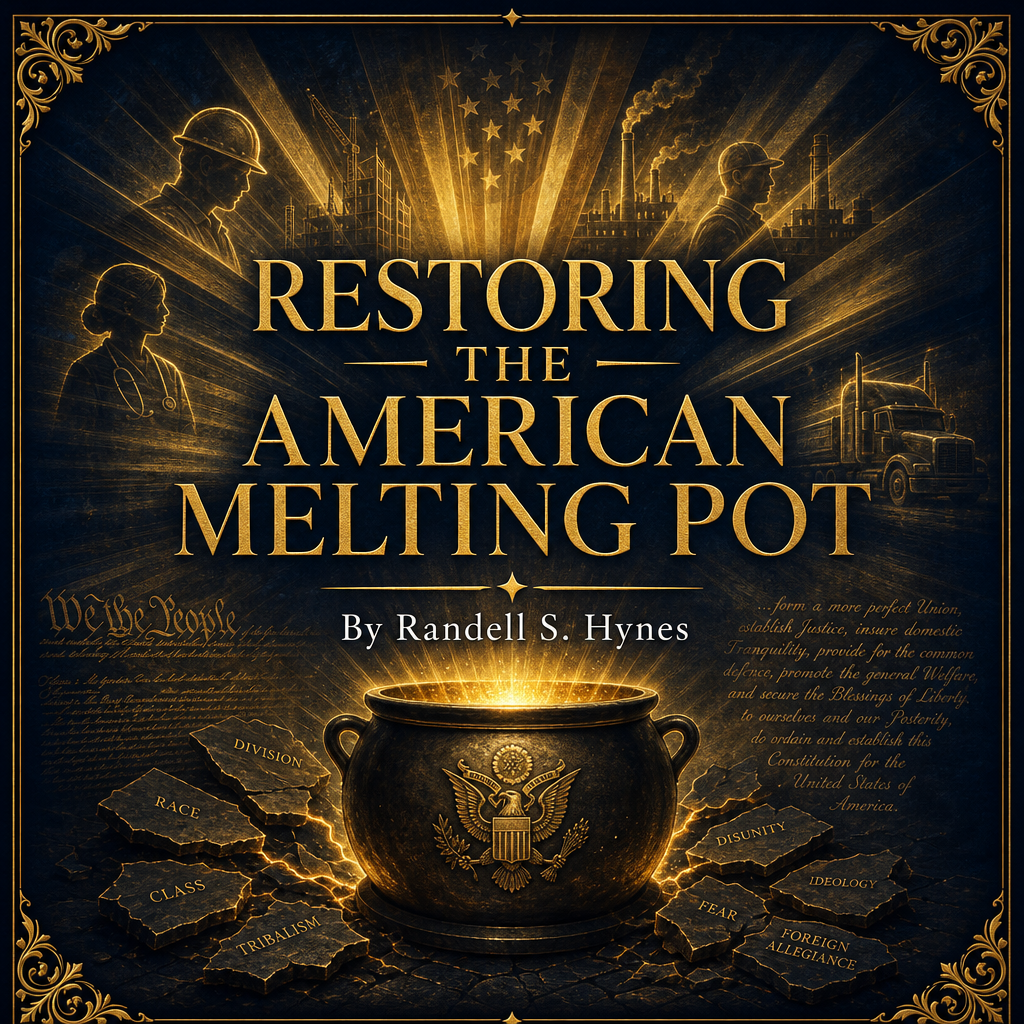
Restoring the American Melting Pot
Government and Corporate Capture Has Violated the Constitutional Inheritance of US Workers and Their Families
By Randell S. Hynes
The American melting pot is not a slogan or nostalgia. It is not a schoolbook decoration, a campaign phrase, or a sentimental memory from Ellis Island photographs. It is one of the deepest practical achievements of the American experiment. For generations, it took people from different nations, languages, races, classes, and religious backgrounds and asked them to become something new together: one people under one Constitution, bound by a common civic identity, a common language, equal protection under law, and a shared belief that every human being possesses dignity that no government and no corporation may erase.
That melting pot did not appear by accident. It grew from soil older than America itself. Its deepest roots run through the Judeo-Christian moral tradition, which taught the West that every person bears inherent worth because every person is made in the image of God. From that root grew principles that became indispensable to American life: the rule of law, equal justice, mercy restrained by order, the dignity of labor, the sanctity of family, the duty of self-government, and the belief that rights come before the state because human beings are more than instruments of power.
But the melting pot belongs to more than the religious. You do not have to pray in a church or synagogue to benefit from a civilization built on the idea that every human being has inherent dignity. You do not have to be religious to want safe streets, stable schools, honest wages, secure borders, equal law, and a government that serves citizens rather than corporations. The melting pot has Judeo-Christian roots and American branches. Every worker, religious or not, lives in its shade.
That is why the defense of the melting pot cannot be reduced to a narrow religious argument, a partisan immigration argument, or a nostalgic cultural complaint. It is a constitutional argument. Religious and secular workers, parents, families, citizens, and communities all have a stake in maintaining the civic inheritance that generations before us received, strengthened, and handed forward. The melting pot is the lived form of ordered liberty. It is how rights become real in neighborhoods, schools, churches, synagogues, workplaces, small businesses, and families. When it is destroyed, rights remain printed on parchment, but they lose their practical force in daily life.
Today, that inheritance is being broken. Not by accident. Not by ordinary disagreement. Not by the healthy tension of a free society. It is being broken by government and corporate capture working together.
Corporate power wants cheaper labor, weaker workers, divided communities, automated replacement, and a public too fragmented to resist. Captured government supplies the policy machinery: porous borders, abused visa systems, selective enforcement, sanctuary incentives, corporate subsidies, regulatory favoritism, and technology policy that treats US workers as obsolete before it treats them as citizens. One force profits from the fracture. The other legalizes it.
The result is not merely bad policy. It is a violation of the constitutional inheritance that made the American melting pot possible in the first place.
Government and corporate capture have violated our constitutional rights to equal protection under law, meaningful due process, free exercise of religion, freedom of association, meaningful petition for redress, domestic tranquility, the general welfare, the privileges of citizenship, the property interest workers have in their own labor, and the republican form of government promised to the states and the people. These are not abstract law-school categories. They are the legal names for injuries millions of Americans already feel.
When a working family watches wages fall because government refuses to enforce immigration law or allows visa programs to be used as corporate labor pipelines, that is not just economics. It is a constitutional injury to the dignity and value of citizen labor. When a public school must divert resources away from local children because federal policy has overwhelmed local capacity, that is not just administration. It burdens the parental right to direct a child’s education and upbringing in a stable community. When churches and synagogues face hostility, vandalism, or fear because government has failed to preserve civic cohesion and public order, that is not just social tension. It burdens the free exercise of faith. When citizens petition their representatives while corporate lobbyists write the rules, that is not just corruption. It hollows out the First Amendment right to seek redress from a government that is supposed to answer to the people.
The Constitution begins with a promise: “We the People.” It does not begin with corporations. It does not begin with agencies. It does not begin with NGOs, global institutions, foreign labor markets, or technology companies. It begins with a political people capable of governing themselves. That means the people must remain coherent enough to deliberate, secure enough to raise families, prosperous enough to exercise independence, and united enough to recognize one another as fellow citizens.
The melting pot is the social condition that makes “We the People” possible.
Without it, constitutional rights become isolated claims made by strangers against a machine. With it, those rights live inside a shared national life. The First Amendment assumes a people who can speak to one another. Equal protection assumes a common law applied to a common citizenry. Due process assumes stable families and communities capable of ordering their lives. The Guarantee Clause assumes that states are governed by citizens through republican institutions, not managed by corporate influence and administrative decree. Even the Preamble’s promises to establish justice, insure domestic tranquility, promote the general welfare, and secure the blessings of liberty depend on a people still capable of understanding themselves as one nation.
That is why mass non-assimilation is not a small problem. It is why illegal immigration cannot be treated as a mere labor-market adjustment. It is why visa abuse is not just a technical defect. It is why AI replacement cannot be dismissed as innovation while workers are discarded without transition, voice, or protection. Each of these forces weakens the same constitutional foundation: the ability of American citizens to live as a self-governing people in stable communities under equal law.
The religious worker sees the roots being cut. The secular worker feels the shade disappearing. Both are right.
The religious family may understand the crisis as an attack on the moral order that made liberty possible: human dignity, family, faith, law, and responsibility. The secular family may understand the same crisis through wages, schools, safety, housing, opportunity, and the right to raise children in a country that still acts like a country. These are not competing arguments. They are different layers of the same truth. The Judeo-Christian inheritance gave America much of its moral grammar. The Constitution translated that grammar into civic form. The melting pot made it practical across generations of ordinary people.
That is the inheritance now at risk.
Government and corporate capture have inverted the proper order of American life. Instead of government protecting citizens from concentrated power, captured government protects concentrated power from citizens. Instead of immigration serving the national interest, it is too often made to serve employers seeking cheaper labor and political actors seeking demographic advantage. Instead of technology serving human flourishing, it is deployed to eliminate workers while policymakers celebrate “efficiency.” Instead of assimilation creating one people, fragmentation creates separate societies that can be managed, marketed to, and set against one another.
This is why the fight for the melting pot is not anti-immigrant. It is pro-citizen, pro-worker, pro-family, and pro-assimilation. The melting pot has always welcomed people who come to become part of America. It has never required anyone to erase ancestry, faith, or memory. But it has required something serious in return: loyalty to the Constitution, respect for the rule of law, English as a common civic language, economic self-reliance, and a willingness to join the American story rather than stand permanently outside it.
A nation that stops asking for assimilation stops being generous. It becomes careless. Worse, it becomes exploitable. Corporations exploit non-assimilation for labor arbitrage. Political machines exploit it for votes and patronage. Activists exploit it for permanent grievance. Bureaucracies exploit it for budgets. Meanwhile, the people who pay the price are workers and families already struggling to keep their footing.
The victims are not abstractions. They are the construction worker undercut by unlawful labor. The nurse whose hospital is overwhelmed. The teacher trying to teach English, civics, and math all at once in a classroom stretched beyond reason. The parent who watches neighborhood trust collapse. The small business owner who plays by the rules while competitors do not. The engineer replaced through visa manipulation or automation justified as progress. The synagogue member who thinks twice before attending services. The church family that wonders why public order suddenly feels negotiable. The secular parent who does not speak in theological terms but knows something essential has been taken from the country their children were supposed to inherit.
Name the violations plainly.
Government and corporate capture have violated the right to equal protection by creating two systems of accountability: one for citizens who obey the law and another for those whom political actors prefer not to confront. They have violated due process by destabilizing the conditions under which families raise children, workers build lives, and communities maintain order. They have burdened free exercise by allowing civic disorder and imported hostility to make religious life less safe. They have weakened freedom of association by replacing organic assimilation with managed fragmentation. They have hollowed out the right to petition by allowing corporate power to dominate the channels through which policy is made. They have betrayed domestic tranquility by tolerating disorder as the price of political advantage. They have abandoned the general welfare by subordinating citizen well-being to corporate labor demands. They have emptied citizenship of practical meaning by treating US workers as interchangeable with any cheaper substitute, whether foreign labor or code. They have taken from workers the value of their own labor by policy choices that suppress wages and subsidize replacement. And they have threatened republican government itself by moving real decision-making away from citizens and toward institutions that do not answer to them.
This is not a claim that every bad law is unconstitutional. It is not a claim that courts have already recognized every injury in the form presented here. Courts are cautious. Doctrines like plenary power, standing, political question, and deference to elected branches make this case an uphill climb. But difficult does not mean false. Some constitutional arguments must be made before they are accepted. Some rights must be named before they can be defended. And some injuries become so widespread that silence becomes a form of surrender.
The melting pot is one of those injuries.
For more than a century, Americans have spoken about the melting pot as culture. We must now speak about it as constitutional structure. It is the civic environment in which ordered liberty survives. It is the shared national identity that makes equal law possible. It is the moral and social framework that allows religious and secular citizens to live together without becoming enemies. It is the bridge between inherited Judeo-Christian dignity and modern constitutional citizenship. It is the reason a nation of many peoples could become one people without becoming a tribe, an empire, or a collection of hostile enclaves.
If that structure is deliberately dismantled, the Constitution is not left untouched. It is left homeless.
This series, Restoring the American Melting Pot, begins from that premise. The first task is to recover the moral foundation: the Judeo-Christian roots of human dignity, law, family, and ordered liberty. The next task is to show how secure borders and real assimilation protect religious liberty rather than threaten it. Then we must show why secular families have the same stake in stable communities, common language, safe schools, and constitutional order. From there, we must examine the government’s duty to stop and reverse the damage caused by illegal immigration, legal immigration abuse, and non-assimilation. We must also confront the corporate profit motive that links open borders, visa abuse, and AI replacement into one broader assault on US workers. Finally, we must outline the legal case citizens should bring: a federal challenge that names the melting pot as a protected constitutional interest and demands that government once again serve the people who authorized it.
This argument belongs beside the broader worker-centered case made in UNINCORPORĀTUS: A 99-Cent Solution to the 1% Problem. That book names the corporate control of government and calls workers to organize politically beyond the narrow categories that have kept them divided. This series extends that same fight into the cultural and constitutional ground beneath it. Because workers cannot reclaim government if they no longer share a country. And families cannot pass down liberty if the institutions that sustain liberty have been captured, weakened, or sold.
The melting pot is not dead. But it will not restore itself.
It must be named. It must be defended. It must be rebuilt through law, policy, culture, faith, civic education, economic renewal, and a renewed insistence that America remains a nation — not a labor market, not a corporate platform, not a demographic experiment, and not a machine for replacing its own people.
Religious Americans should defend the melting pot because they know its roots. Secular Americans should defend it because they live by its fruits. Workers should defend it because without it they stand divided and replaceable. Parents should defend it because their children deserve more than managed decline. Citizens should defend it because the Constitution begins with them.
The melting pot has Judeo-Christian roots and American branches. Every worker, religious or not, lives in its shade. And now every worker, religious or not, must help restore it.
Randell S. Hynes is the author of UNINCORPORĀTUS: A 99-Cent Solution to the 1% Problem and founder of the U.S. Workers Alliance. His work focuses on restoring constitutional government for the American Majority — the 170 million U.S. workers whose labor, wages, families, and communities have been subordinated to corporate power. Through UNINCORPORĀTUS, he argues that workers do not need another party, another permission slip, or another institution captured by the 1%. They need a constitutional strategy to take their government back.
Read or listen to UNINCORPORĀTUS: A 99-cent Solution to the 1% Problem at hynes.com/99-cent-solution/.