The Party System Is the Capture Mechanism
The Party System Is the Capture Mechanism
Why the Same Constitutional Principle That Separated Church and State Must Now Separate Party and State
By Randell S. Hynes
Both parties have failed us. That was the diagnosis. Now comes the harder question: why?
It is not enough to say that Democrats and Republicans serve the same corporate donors, vote the same trade deals, and ignore the same workers. Plenty of people already know that. The question underneath is structural. What is it about the party system itself — not this party or that party, but the system — that makes capture not just possible but permanent? Why does reform never arrive no matter how many elections we hold? Why does every new Congress look like the last Congress with different faces? Why can’t good policy even be considered?
The answer is not corruption, though corruption is everywhere. The answer is not money, though money floods everything. The answer is not partisanship, though partisanship poisons everything. The answer is older and deeper than any of those. The party system is the capture mechanism. Not the thing captured — the thing that does the capturing. The machine that makes capture structural, self-perpetuating, and resistant to every remedy short of constitutional amendment.
And the reason that machine works so well — the reason it resists every reform and survives every election — is that parties became religion. Not like religion. Not analogous to religion. They became the same thing: the institution that occupies the corruptible center of government, demands loyalty, punishes dissent, divides citizens into orthodox and heretic, and concentrates unaccountable power in a hierarchy that answers to no electorate. For centuries, that institution was the church. The Founders disestablished it. The void left behind was filled by parties, which proceeded to produce the same five corruptions that made religious establishment intolerable. Parties became religion. Three words. Past tense. It already happened.
That is a large claim. It requires proof. Here it is.
The Constitution Never Mentioned Political Parties
Read the entire Constitution. The word “party” does not appear. Not once. The Framers designed a system of separated powers, federalism, and representation — a republic of individual citizens united under law, not tribes or factions. Every mechanism they built was a barrier to factional capture: staggered Senate terms so no single election could sweep the legislature, the Electoral College so no regional faction could dominate the presidency, the independent judiciary so no majority could command the courts, the veto so no Congress could run roughshod over the executive. They did not forget parties. They excluded them by design.
Washington said it explicitly. His Farewell Address in 1796 warned that the “spirit of party” would “gradually incline the minds of men to seek security in the absolute power of an individual” and would eventually destroy the Union. He called party spirit “a fire” that demands “a uniform vigilance to prevent its bursting into a flame.” He did not say ban parties. He said a wise people must “discourage and restrain” them. The distinction matters. Washington was not calling for abolition. He was calling for restraint — the same restraint the First Amendment later imposed on religion.
Madison defined the theoretical problem in Federalist No. 10. A faction, he wrote, is “a number of citizens, whether amounting to a majority or a minority of the whole, who are united and actuated by some common impulse of passion, or of interest, adverse to the rights of other citizens, or to the permanent and aggregate interests of the community.” Madison’s solution was not to ban factions — that would destroy the liberty that allows them to form. His solution was to control their effects through an extended republic with checks and competition, so that no single faction could dominate. He assumed factions would multiply and cancel each other out. He did not anticipate that two factions would capture the entire system and freeze out all others.
Jefferson, who himself founded one of the first parties, called parties “the last degradation of a free and moral agent.” Even the founders who formed parties knew what they were doing — and warned against it.
Parties emerged anyway. Not by constitutional design but by structural incentive: first-past-the-post elections, the presidency as winner-take-all, and the parliamentary logic of coalition that transferred into legislative party organizations. The system evolved toward two parties because the electoral rules reward two parties. That is not constitutional intention. That is structural accident. And the accident has become the architecture.
Two Parties Make Separation of Powers Mathematically Impossible
The Constitution divides government into three branches — legislative, executive, judicial — so that no single faction can dominate. That is the architecture of the republic. But when two parties control all three branches through party discipline, party-line judicial appointments, and party leadership controlling what reaches a floor vote, the separation is nominal, not functional. Three branches become two teams. The check-and-balance mechanism becomes a coordination mechanism within each party’s turn at power.
This is not a metaphor. It is a mathematical fact. Two parties cannot independently fill three branches. Party identity overrides institutional identity. Party-line votes are the norm. Cross-party oversight has collapsed. When the same party controls both legislature and executive, there is no check — only coordination. The system was designed for three independent wills checking each other, not two coordinated wills taking turns dominating.
Consider what this means in practice. When one party holds the presidency and both chambers of Congress, the leadership of all three branches answers to the same party apparatus. Committee chairs, floor votes, judicial nominations, executive appointments, regulatory agendas — all flow through the same party pipeline. The “separation” exists on paper. In operation, the branches coordinate under party direction. When the other party takes power, the same coordination simply reverses direction. The pendulum swings, but the machine stays the same.
The result: no branch can check another branch in the way the Constitution intended, because both branches answer to the same party before they answer to the Constitution. That is not separation of powers. That is separation of powers rendered inoperable by the party cartel.
Parties Function Like Established Religion in Government
The comparison sounds extreme until you examine it. Then it becomes unavoidable.
When established religion controlled government, bishops became politicians. When parties control government, party bosses become the government. When established religion divided citizens into believers and heretics, orthodoxy and dissent, the saved and the damned, established parties divide citizens into red and blue, us and them, the base and the enemy. When established religion declared that authority came from God — and that the church was the sole mediator between the divine and the secular — established parties declare that political viability comes from party approval, and that the party is the sole mediator between the citizen and the ballot. When established religion compelled conformity to state-imposed doctrine and punished dissent, established parties compel conformity to party-line positions and punish independent thought. When established religion concentrated unaccountable power in ecclesiastical hierarchies that answered to no electorate and could be removed by no democratic process, established parties concentrate unaccountable power in party leadership, national committees, and donor networks that answer to no electorate and can be removed by no democratic process.
Five harms. Corruption of government. Division of the people. Suppression of self-governance. Violation of individual liberty. Concentration of unaccountable power. Established religion did all five. Established parties do all five. The parallel is exact — not approximate, not suggestive, but exact. Parties became religion.
But the parallel is more than analogy. It is sequence. When the Founders disestablished religion from state power, they expelled the institution that had occupied the corruptible center of government for centuries. They did not eliminate the vacuum. They evicted the tenant. Political parties moved into the same space, claimed the same loyalty, demanded the same conformity, exercised the same gatekeeping over who could participate in civic life, and produced the same five corruptions. The First Amendment solved the religion problem. It did not solve the vacuum problem. There has always been a corruptible space at the center of government where institutions seek to embed themselves and redirect state power toward their own ends. For centuries, religion filled it. The Founders saw what that did and expelled it. Parties were already waiting in the hallway. A Party Disestablishment Amendment finishes the job.
This is why the culture wars are not organic disagreements among workers. They are manufactured divisions that keep 170 million Americans fighting each other instead of fighting back. Every time a worker in Alabama and a worker in Michigan realize they have been robbed by the same people, a consultant somewhere gets nervous. The party system exists to prevent that realization. It turns concrete shared harms — falling wages, rising costs, unsafe communities, captured institutions — into abstract partisan symbols. “Left vs. right.” “Suppression vs. democracy.” “Compassion vs. hate.” “Free markets vs. socialism.” Each framing converts a concrete injury that workers share into a tribal flag that workers fight over. The injury remains. The solidarity disappears.
The Abstraction Machine
Good policy is concrete. It names the worker, the wage, the employer, the border, the ballot, the school, the neighborhood. It asks who is being harmed, who is profiting, and what government should actually do about it.
Captured government survives by keeping everything abstract.
Political parties are the abstraction machine.
They turn concrete citizen harms into factional talking points — then call the gridlock democracy. They turn worker displacement into “innovation.” They turn wage suppression into “labor market efficiency.” They turn border chaos into “comprehensive reform” — a phrase that has meant nothing for thirty years because it was never supposed to mean anything. It was supposed to occupy the space where action would otherwise go. “Comprehensive reform” is the abstraction that covers the concrete fact that both parties want cheap labor and neither party wants to stop providing it.
At the deepest level, parties and established religion both operate as abstractions used to organize large numbers of people, create loyalty, reduce cognitive complexity, and direct behavior toward group goals. Both simplify complex trade-offs into slogans, identities, and moral binaries. Both create structures — churches and bureaucracies, priesthoods and party apparatuses, media ecosystems — that perpetuate the abstraction and extract compliance. Both allow elites within the system to steer mass behavior in directions that serve concentrated interests — doctrinal purity, electoral advantage, donor priorities — rather than the concrete welfare of the people.
The result is not deliberation. It is managed division. Abstractions compete for state power rather than government neutrally managing trade-offs between safety and rights. That sentence is the deepest diagnosis of what has gone wrong in American government. The party system does not simply fail to solve problems. It converts problems into abstractions that cannot be solved, because solving them would dissolve the tribal identities that keep the party cartel in business.
Why Good Policy Cannot Even Be Considered
Ask a simple question: why can’t Congress pass a law requiring employers to verify citizenship before hiring? The policy is concrete. The mechanism is straightforward. The public support is overwhelming. Yet the bill never reaches the floor. Why?
Because the party system makes it structurally impossible.
Party leadership controls the legislative agenda. A bill that threatens the shared interests of both parties’ corporate donors does not get a committee hearing, does not get a floor vote, does not get a debate. The filibuster — a procedural rule with no constitutional basis — gives each party a veto over anything the other party might want, and more importantly, a veto over anything both parties’ donors do not want. The 60-vote cloture threshold is not a constitutional requirement. It is a cartel agreement. Both parties maintain it because it gives each party an excuse for why it “can’t” deliver on its promises, while ensuring that neither party can threaten the donor arrangements that fund both.
Add primary systems that reward ideological purity over practical governance. Add campaign finance structures that make corporate donors the real constituency. Add party discipline that punishes representatives who vote against the party line even when their district demands it. Add media ecosystems that profit from tribal conflict and penalize bipartisan problem-solving. The result: good policy cannot even be considered. Not because the votes aren’t there. Not because the people don’t want it. Because the party system structurally prevents any policy that threatens the cartel from reaching the point where votes happen.
The Save America Act, which would require proof of citizenship for federal voter registration — a measure with overwhelming public support — cannot pass because both parties have structural incentives to prevent it. One party’s donors benefit from a porous system; the other party’s consultants benefit from having a permanent grievance to fundraise against. The policy is concrete. The system is abstract. The abstract system blocks the concrete policy every time.
The Founders Already Solved This Problem — For Religion
The First Amendment disestablished religion from state power through two paired clauses:
The Establishment Clause: “Congress shall make no law respecting an establishment of religion.” This banned the state from entrenching any religion over others.
The Free Exercise Clause: “or prohibiting the free exercise thereof.” This protected individual and collective religious practice.
The structure is deliberate and exact. The state cannot establish religion — but the state also cannot prevent citizens from practicing it. Disestablishment and free exercise coexist. The government is neutral toward religion: it does not privilege it, it does not suppress it, it does not use it as an instrument of power.
That same structure, that same logic, those same five harms, apply with equal force to political parties.
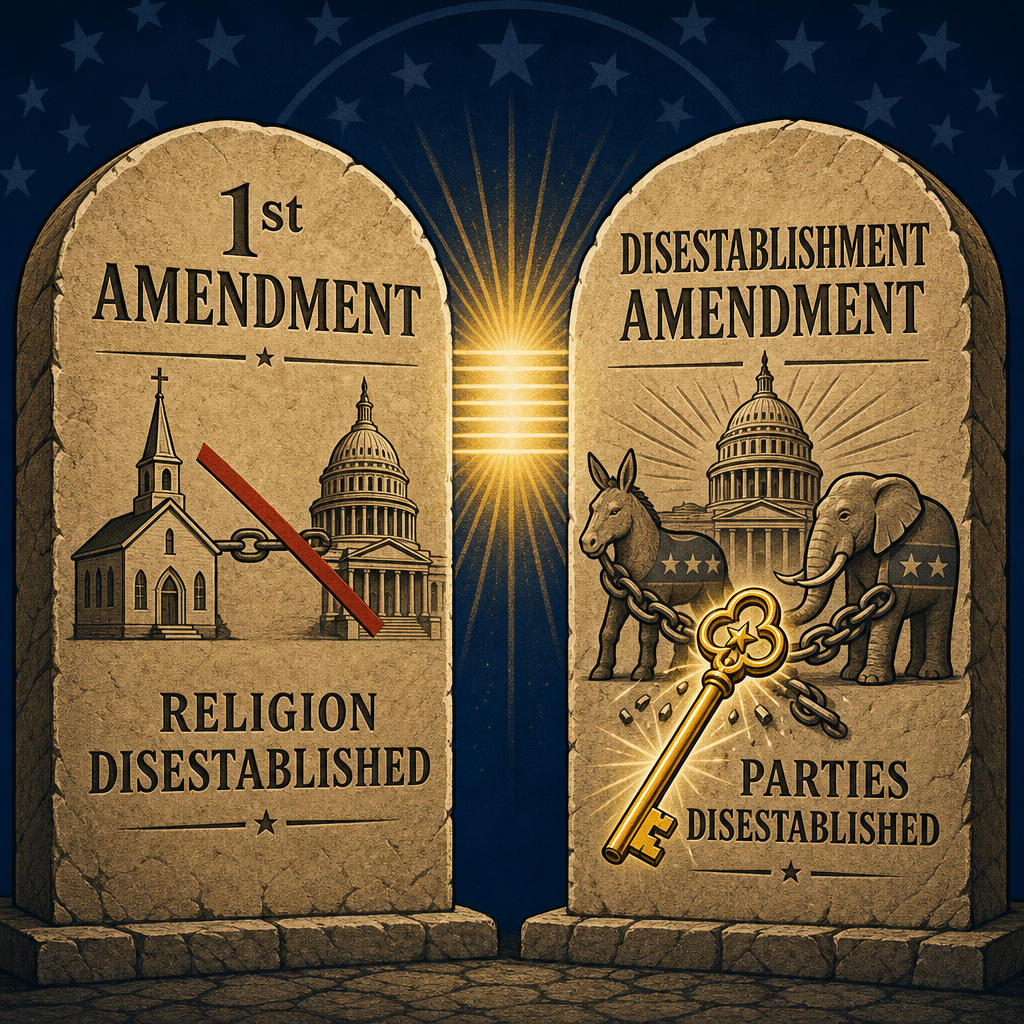
When established religion corrupted government, the Founders separated church and state. When established parties corrupt government today, the same remedy applies: separate party and state. Not ban parties — disestablish them. Not outlaw political association — protect it. Not destroy the clubs citizens voluntarily form — remove those clubs from the machinery of government they have seized.
The parallel is not analogy. It is structural isomorphism. The same five harms that made religious establishment intolerable make party establishment intolerable:
1. Corruption of government. Established religion made religious authority a path to political power and political power a tool of religious enforcement. Established parties make party loyalty a path to political power and political power a tool of party enforcement. When the church was entangled with the state, bishops became politicians. When parties are entangled with the state, party bosses become the government. The Founders separated church and state to prevent this corruption. We can separate party and state for the same reason.
2. Division of the people. Established religion divided citizens into believers and heretics, orthodoxy and dissent. Established parties divide citizens into red and blue, the base and the enemy. The First Amendment stopped the government from imposing religious uniformity. A Party Disestablishment Amendment stops the government from imposing partisan uniformity.
3. Suppression of self-governance. Established religion declared that authority came from God and the church was the mediator between the divine and the secular. Established parties declare that political viability comes from party approval and the party is the mediator between the citizen and the ballot. The Money Primary pre-selects both candidates before voters arrive. The names on the ballot were already approved by the system voters are trying to change. That is not self-governance. That is managed choice.
4. Violation of individual liberty. Established religion compelled conformity to state-imposed doctrine and punished dissent. Established parties compel conformity to party-line positions and punish independent thought. A representative who takes the oath of office and then votes the party line instead of the district’s interest has violated the liberty of the voters who elected them — and the party system is the mechanism that makes that betrayal routine.
5. Concentration of unaccountable power. Established religion concentrated unaccountable power in ecclesiastical hierarchies that answered to no electorate. Established parties concentrate unaccountable power in party leadership, national committees, and donor networks that answer to no electorate. The party bosses who decide which candidates are viable, which legislation reaches the floor, and which committee assignments go to loyalists are the modern equivalent of the bishops who decided which doctrines were orthodox, which sins were punishable, and which parishes received protection. Neither was elected by the people. Neither could be removed by the people. Both used the machinery of government to enforce their authority.
The Critical Objection: “But Parties Aren’t Established by Government”
The strongest objection to the disestablishment argument is this: parties are voluntary associations protected by the First Amendment. They are not state churches. They are not imposed by law. Citizens choose to join them, fund them, and vote for them. How can you disestablish something that was never established?
The answer: they are established now.
The two-party system has been structurally embedded into the government itself. Party control of ballot access — through laws that make it prohibitively difficult for independent or third-party candidates to appear on the ballot — is state entrenchment of two private organizations over all others. Party control of primary elections — using public funds to run private organizations’ selection processes — is state funding of faction. Your tax dollars pay for the Republican and Democratic primaries. The government uses public money and public machinery to entrench two private organizations over all others. That is establishment. Party control of legislative organization — committee assignments by party caucus, agenda control by party leadership, party-line votes enforced by party whips — is factional capture of the legislative process. Party control of campaign finance — through structures that privilege major-party candidates, debate access rules that exclude independents, and donor networks that funnel money through party committees — is state-subsidized cartel maintenance.
This is not voluntary association. This is state entrenchment of two private organizations over all other forms of political organization. That is establishment — the same way state churches were establishment, not because every citizen was forced to attend, but because the state used its power to privilege one institution over all others.
Germany’s Basic Law proves the principle is viable. Article 21 simultaneously protects party formation — “They may be freely established” — and authorizes party regulation — “Parties that seek to undermine or abolish the free democratic basic order shall be unconstitutional.” Germany’s constitutional court has enforced this provision for seventy-five years without destroying democratic freedom. The principle is established: constitutional regulation of party status is compatible with political liberty.
But the deeper objection remains even after the establishment argument is won. Suppose you disestablish parties the way the Founders disestablished religion. What prevents the next institution from moving into the same space? The answer is in the question. Disestablishing religion created the vacuum that parties filled. The First Amendment expelled the tenant but did not seal the building. The Party Disestablishment Amendment finishes the job: it strips parties of every structural privilege they hold in government, and it bars any future institution from claiming those same privileges. The amendment does not merely evict the current occupant. It converts the corruptible space from a vacant office into a constitutional wall. No party. No faction. No organization of any kind may hold privileged position in the machinery of government. That is what disestablishment means — not the removal of one institution but the permanent closure of the space that makes institutional capture possible.
The Remedy: Not “Already Unconstitutional” — “Should Be Disestablished by Amendment”
There are two ways to argue against party capture. One is weak. The other is strong.
The weak argument: “Political parties are already unconstitutional.” This requires proving that the Constitution implicitly prohibits party entrenchment — an argument that relies on interpreting the Framers’ silence as prohibition. Courts have refused to do this for two centuries. The Constitution’s silence on parties is not an implicit ban. It is a structural absence that parties filled by operational logic, not by constitutional warrant. You cannot argue that something is unconstitutional when the Constitution never addressed it.
The strong argument: “Parties should be disestablished by amendment, just as religion was disestablished by amendment.” The First Amendment’s Establishment Clause was explicit text, not an implication from silence. It did not claim that religion was already illegal — it made it unconstitutional going forward. A party disestablishment provision needs the same thing: explicit text, not creative interpretation of existing text.
This follows the same logic as the 28th Amendment itself. The US Majority Amendment does not claim that corporate personhood was always unconstitutional. It says: the Supreme Court fabricated corporate personhood through judicial interpretation, and we the people now correct that fabrication by explicit constitutional text. The Party Disestablishment Amendment says: the two-party cartel seized structural control of government through operational logic, and we the people now correct that seizure by explicit constitutional text. Same logic. Same mechanism. Same authority: the people amending their own Constitution to fix what time and power have broken.
The 21st Amendment provides the ratification model. Prohibition was constitutional — it was in the Constitution! — until the people made it unconstitutional by amending the Constitution. The 21st Amendment was ratified not by state legislatures (which were captured by the temperance lobby) but by state conventions — the only amendment ever ratified this way, because the Article V convention mechanism was designed for exactly this situation: when legislatures are captured, the people bypass them. The same mechanism works for party disestablishment. State legislatures will not vote to disestablish the party system that put them in office. State conventions of the people can.
The Repeal Precedent: When the People Bypassed the Captive Gatekeepers
In 1933, the proposition was impossible. The 18th Amendment — Prohibition — was literally in the Constitution. No amendment had ever been repealed. The temperance lobby had spent decades embedding itself in state legislatures across the country. Dry legislators blocked every reform bill, defied every election result, and ignored every mounting failure of the policy they had enshrined. The Wickersham Commission, appointed by President Hoover himself, reported in 1931 that Prohibition was unenforceable — and Hoover still refused to endorse repeal. The captured gatekeepers would not reform themselves. The system was designed to make reform structurally impossible. Sound familiar?
But the people were already there. In 1922, a Literary Digest poll found 40 percent of Americans favored modifying Prohibition and another 20 percent favored full repeal — sixty percent for change, and this was eleven years before it happened. By 1926, a Newspaper Enterprise Association poll found 81 percent favored modification or repeal. The majority existed. The will existed. The political system simply refused to acknowledge it, because the political system was captured by the minority that benefited from the status quo. The parallel is exact: today, 45 percent of American adults identify as independents — a record — and over 60 percent say the two major parties do such a poor job that a third party is needed. The majority exists. The will exists. The political system refuses to acknowledge it, because the political system is captured by the two organizations that benefit from the status quo.
Pauline Sabin understood the mechanism. A Republican National Committee member, a socialite, a woman who had supported Prohibition — she switched sides in 1929. Not because she had always opposed it, but because she watched the enforcement failure, the lawlessness, the corruption, and the rigid refusal of the captured political class to change course. She did not write a policy paper. She did not lobby the captured legislators. She built a rival organization — the Women’s Organization for National Prohibition Reform — that grew to more than a million members by 1932. A million women organized outside the captured system, demanding that the captured system be dismantled. She proved that the way around a captured institution is not through it but past it — you build the political force that makes the institution’s capitulation inevitable.
The economic emergency accelerated what the majority already wanted. The Great Depression destroyed the argument that Prohibition was protecting anyone. Brewery and distillery jobs were jobs. Tax revenue from legalized alcohol was revenue. Workers were destitute and the government was broke while the 18th Amendment sat in the Constitution forbidding both. The economic case became impossible to ignore — not because it was new, but because the Depression made it urgent. Workers today face the same accelerating urgency: wages stagnant for forty years, AI displacement arriving with zero transition infrastructure, both parties serving the corporate interests that profit from the displacement while abstracting the emergency into factional slogans. The urgency is not theoretical. The plant shuts down. The algorithm replaces the shift. The wage doesn’t cover the rent. The workers who are living the emergency do not need to be persuaded that the system is broken. They are already persuaded. They need a mechanism to bypass it.
Congress provided that mechanism in 1933 — not accidentally, but deliberately. The 21st Amendment is the only amendment in American history ratified by state conventions instead of state legislatures. Section 3 specified this explicitly. The choice was strategic: the temperance lobby had captured state legislatures through decades of organized pressure, primary threats, and donor networks — the same machinery that today’s party cartel uses to prevent reform. If the 21st Amendment had gone to state legislatures, it would have died in committee, just as every good-policy bill dies in committee today. Congress chose conventions because conventions answer to the people, not to the party organizations that put the legislators in office. Michigan voted 99 to 1. Utah clinched ratification 20 to 0. Pundits had predicted the process would take years. It took nine months — from February 20 to December 5, 1933. When the people get to vote directly, captured gatekeepers cannot slow them down.
This is the ratification model for party disestablishment. State legislatures will not vote to disestablish the party system that put them in office — the same way dry legislators would not vote to repeal the amendment that empowered them. The convention mechanism exists in Article V for exactly this situation: when the regular channels of amendment are blocked by the very interests the amendment would dislodge. The 21st Amendment proved that the Founders’ architecture contains its own escape hatch. The people do not need the cartel’s permission to amend the Constitution. They need 34 states to call conventions and 38 to ratify — and the conventions, unlike the legislatures, answer to voters, not to party organizations.
The Repeal Coalition did not wait for the temperance lobby to agree. It did not seek compromise with the dry legislators. It did not propose “reform” that left the temperance establishment in place while addressing its worst excesses. It disestablished Prohibition — completely, constitutionally, irrevocably. The 21st Amendment did not regulate alcohol. It removed the 18th Amendment from the Constitution and returned the question to the states and the people. Party disestablishment does the same thing: it does not regulate parties. It removes their structural privileges from government and returns political organization to the citizens. The temperance movement survived repeal. Americans still choose not to drink. But the government no longer enforces one faction’s doctrine over the whole country. After disestablishment, Americans will still organize around shared political views. But the government will no longer entrench two organizations over all others.
The Repeal was a popular movement — not a partisan one. It united Republicans and Democrats, business owners and labor unions, city dwellers and rural communities, men and women, around a single concrete proposition: the captured amendment must go. It did not require ideological agreement on what should replace Prohibition. It required majority agreement that Prohibition itself was the problem. Party disestablishment requires the same thing. It does not require ideological agreement on what should replace the two-party system. It requires majority agreement that the two-party system itself is the problem — that 170 million workers are being robbed by a cartel that uses government as its revenue stream, and that the constitutional mechanism to dislodge that cartel already exists and has already worked once in American history.
Nine months. That is how long it took to repeal a constitutional amendment that the captured political class said could never be repealed, that the temperance lobby said would destroy the republic, that the dry legislators refused even to consider. Nine months, once the people got to vote. The party cartel will say the same things the temperance lobby said: that disestablishment is radical, that it will cause chaos, that the system we have is imperfect but safer than the unknown. The temperance lobby was wrong. The party cartel is wrong for the same reason. The unknown is not chaos. The unknown is what the American people choose when they are no longer forced to choose between two factions that serve the same donors.
The Party Disestablishment Amendment
The amendment mirrors the First Amendment’s structure exactly:
Section 1. Political parties shall hold no privileged position in the government of the United States or in any State. No law shall establish, recognize, or entrench any political party as an instrument of the state, nor shall any public power — including ballot access, committee assignment, legislative agenda control, campaign finance privilege, or public funding — be reserved to or conditioned upon affiliation with any political party.
Section 2. The right of the people freely to associate for political purposes shall not be infringed. Nothing in this article shall be construed to prohibit voluntary political organization, advocacy, or association among citizens.
Section 3. The Congress shall have power to enforce, by appropriate legislation, the provisions of this article.
Section 1 is the disestablishment clause — the Establishment Clause for parties. It strips parties of every structural privilege they currently hold in government. No more official factions on the ballot. No more party-controlled primaries using public funds. No more committee assignments by party caucus. No more party leadership controlling which legislation reaches a vote. No more campaign finance structures that privilege major-party candidates. No more debate access rules that exclude independents.
Section 2 is the savings clause — the Free Exercise Clause for political association. It protects exactly what the First Amendment protects: the right of citizens to organize, advocate, and associate around shared political views. People will always organize around shared views — that is freedom. But the state does not have to entrench two organizations over all others. The disestablishment of parties does not abolish political groups. It abolishes the state’s power to entrench two parties over all other forms of political organization. Just as the disestablishment of religion did not abolish religious practice but abolished the state’s power to entrench one religion over others.
Section 3 is the enforcement clause — the same mechanism that appears in the 13th, 14th, 15th, 19th, 24th, and 26th Amendments, giving Congress the power to legislate the transition from the party-entrenched system to the disestablished one.
The structure is not novel. It is already in the Constitution. The First Amendment proved that disestablishment and free exercise coexist. This amendment proves that party disestablishment and free political association coexist the same way.
Why Disestablishment Comes After the US Majority Amendment
The three-stage amendment strategy is deliberate:
Stage 1: The US Majority Amendment (28th Amendment, Sections 1-3). Ends corporate personhood. Bans corporate money as speech. Establishes a constitutional AI speed limit. These reforms have the broadest existing public support and the clearest connection to the concrete harms workers already feel. They address the immediate symptoms of capture: the money, the corporate privilege, the displacement.
Stage 2: Congressional Reform and Accountability (29th Amendment). Term limits. Compensation reform. Decentralization. Lobbying restrictions. Single-subject legislation. Equal application of law. Fiscal responsibility. These reforms restructure the institution of Congress itself so that it cannot be recaptured from within once the money is removed.
Stage 3: Party Disestablishment. The deepest structural reform. This becomes necessary because the cartel will not willingly implement Stages 1 and 2. The cartel will write the enforcement legislation for the 28th Amendment in ways that preserve party power. The cartel will staff the review boards with loyalists. The cartel will reinterpret the amendment’s commands through captured courts. Stage 3 addresses the structural condition that makes capture possible in the first place — the party cartel’s embedded control of the machinery of government. Until you break the cartel, every other reform will be subverted in implementation.
The sequence is strategic. Stage 1 builds the movement and delivers the first concrete victories. Stage 2 reforms the institution so it cannot be recaptured. Stage 3 removes the mechanism that made capture possible — and makes recapture structurally impossible.
The People’s Primary: Competition With the Money Primaries
The constitutional amendment is the long game. The short game is already running.
The People’s Primary, organized by the US Workers Alliance as part of the Clean Slate Initiative, launches July 4, 2026. It is not a reform of the existing primary system. It is not a request for party permission. It is not a third party trying to break into the cartel’s ballot monopoly. It is direct competition with the party Money Primaries.
The Money Primary is how the cartel pre-selects candidates before voters arrive. Corporate donors and party leadership fund their chosen candidates in the primary, guaranteeing that by the time voters see names on the general-election ballot, both candidates have already been approved by the same system. The Money Primary is the reason both names on the ballot serve the same donors. It is the reason voting feels like choosing which captor holds the leash.
The People’s Primary breaks that trap. Workers in each congressional district — organized through District Committees — identify, vet, and select their own candidates. Those candidates sign the US Worker Pledge before they take a single vote. They are pledged to the district, not to the party. They owe their nomination to workers, not to donors.
The People’s Primary does not ask the cartel for permission. It competes with the cartel. It offers a competing pipeline for candidate selection — one that answers to the US Majority, not to the 1%. The 2% strategy makes it work: 3.4 million workers, organized at 8,000 per district, are enough to flip every House seat. Not a third party. A workers’ movement that replaces the cartel’s candidates with pledged representatives.
The Voting Booth Trap — where both names on the ballot were pre-approved by the system you are trying to change — ends when party and state are separated. The People’s Primary is the bridge between the current captured system and the disestablished one. It proves the principle works before the amendment is ratified. It builds the organization that will ratify the amendment through state conventions. It creates the political force that makes the amendment inevitable.
Americans Have Already Disaffiliated
The American people are ahead of their government on this. Gallup in 2025: a record 45% of U.S. adults identify as political independents. Both parties are at 27% each. More than half of Gen Z and Millennials identify as independents. Over 60% regularly say the major parties do such a poor job that a third party is needed. Pew Research finds 58% unfavorable toward the Republican Party, 59% unfavorable toward the Democratic Party. Congressional approval hovers around 17%.
This is not apathy. Americans still vote. They still participate. They are deliberately disaffiliating from the two organizations that have failed them. They are withdrawing consent from the cartel while searching for something to belong to.
The US Majority — 170 million workers — is that something. It is not a party. It is not a movement that demands your jersey. It is the name for what workers already are: the people who built this country with their labor and now watch both legacy parties auction it off to the 1%. The US Majority does not join a party. It dismantles the party privilege that prevents its majority from being represented.
The Party Disestablishment Amendment codifies what citizens have already chosen. It makes constitutional what Americans have already decided in practice: the two-party cartel no longer represents them, and the government they pay for should not be run as its private property.
The Founders’ Prescription
Washington did not say “ban parties.” He said “discourage and restrain” them. Disestablishment is restraint. It is not abolition — it is the removal of parties from the instruments of state power they were never supposed to hold. It is the constitutional equivalent of what the First Amendment did for religion: not the destruction of faith, but the liberation of faith from the state. Not the end of political organization, but the liberation of political organization from government capture.
The Constitution does not promise party government. It promises republican government. Government by the people — not by factions, not by cartels, not by two private organizations that have seized the machinery of the republic and turned it into a revenue stream for their donors.
The melting pot unites citizens under one Constitution. The party cartel divides citizens into two camps. The two cannot coexist indefinitely. One must give.
The First Amendment disestablished religion from state power because the five harms of establishment — corruption, division, suppression, violation, concentration — had become intolerable. Those same five harms are intolerable today. The mechanism is the same. The remedy is the same. The constitutional principle is the same. Parties became religion — and the same disestablishment that freed the republic from the church will free it from the cartel.
Break the cartel. Dislodge parties from government. Disestablish them — the same principle that separated church and state.
It is time.