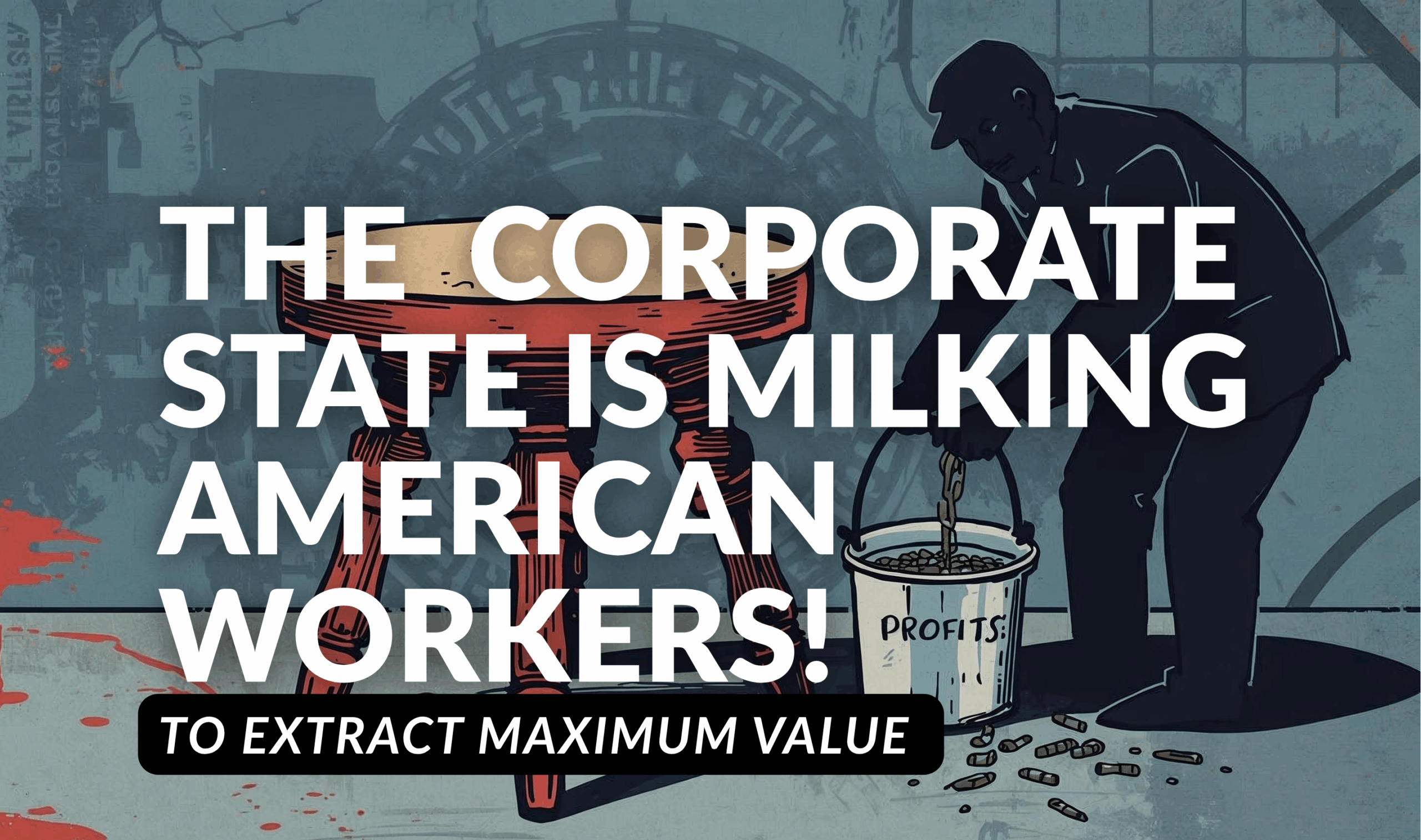
The Three-Legged Stool: How Corporate America Milks American Workers
Updated April 1, 2026
The corporate state has constructed an elaborate apparatus for extracting wealth from American workers, a system so pervasive yet so carefully obscured that most of its victims remain unaware of the mechanism draining their economic vitality. This apparatus rests upon three sturdy legs, each supporting the others in a coordinated assault on worker prosperity. The first leg denies workers meaningful protection when they attempt to negotiate with employers outside the traditional union framework. The second leg systematically replaces American workers with foreign workers through a visa system that has metastasized into an industry unto itself. The third leg dangles the promise of technological salvation through artificial intelligence while preparing to displace millions more workers. Together, these three legs support a stool upon which the corporate state sits comfortably, milking American workers of their labor, their dignity, and their future.
But this three-legged stool serves a purpose beyond mere corporate profit maximization. It exists to maintain a fundamental requirement of our current economic order: a quiet, distracted, and compliant tax-paying workforce that adds certainty to unlimited government borrowing. This borrowing, conducted in a manner reminiscent of the Bank of England’s historical monetary schemes, systematically robs future generations of their prosperity to enrich the present. The corporate state and the government apparatus have formed a symbiotic relationship, each feeding off the other. At the same time, ordinary workers bear the burden of a system designed to extract maximum value from their labor, yet it fails to protect their rights.
The First Leg: The Illusion of Worker Protection
The National Labor Relations Act, passed in 1935, ostensibly guarantees American workers the right to organize and collectively bargain with their employers. Section 7 of the Act explicitly states that employees have the right to engage in “concerted activities for the purpose of collective bargaining or other mutual aid or protection.” This language appears straightforward and protective. Workers can band together, with or without a union, to negotiate better wages, working conditions, and treatment from their employers. The law even makes it illegal for employers to interfere with, restrain, or coerce employees in the exercise of these rights.
Yet this legal protection exists primarily on paper, a hollow promise that crumbles upon contact with reality. The gap between the law’s promise and its enforcement has grown so wide that it now constitutes a chasm into which worker rights disappear without a trace. The National Labor Relations Board, the federal agency tasked with enforcing these protections, has become so ineffective that employers routinely violate the law with virtual impunity. The statistics paint a damning picture of systematic failure.
According to comprehensive research by the Economic Policy Institute, which analyzed National Labor Relations Board data from 2016 and 2017, employers were charged with violating federal law in 41.5 percent of all union election campaigns. This staggering figure means that in nearly half of all attempts by workers to form unions, employers engaged in conduct serious enough to warrant formal charges of illegal behavior. The violations were not minor technical infractions but substantial interference with worker rights. In nearly one-third of all elections, employers were charged with illegally coercing, threatening, or retaliating against workers for supporting a union. In another third of elections, employers were charged with illegally disciplining workers for supporting a union.
Perhaps most disturbing, employers were charged with illegally firing workers in one-fifth to nearly one-third of all union elections, depending on how the definition of firing charges is applied. These are not abstract statistics but represent real workers who lost their livelihoods for attempting to exercise rights supposedly guaranteed by federal law. When the potential bargaining unit exceeded sixty employees, more than half of all elections involved charges that the employer violated federal law. The larger the group of workers attempting to organize, the more likely the employer was to break the law in an attempt to prevent them from doing so.
These violations occur not because employers fear legal consequences but because they have learned through experience that the law carries no meaningful penalties. When an employer illegally fires a worker for engaging in union activity, the maximum penalty under current law is back pay, minus any wages the worker earned while seeking new employment. There are no civil penalties, no punitive damages, no criminal sanctions. The employer must simply make the worker whole for lost wages, and even this remedy can take years to obtain through the administrative process. For a corporation, this represents a trivial cost of doing business, a minor line item easily absorbed in exchange for crushing a union organizing campaign.
The weakness of these remedies has allowed illegal conduct to become a standard practice among corporations. Employers have learned that they can fire union supporters, threaten workers with plant closures, conduct surveillance of organizing activities, and force employees to attend mandatory anti-union meetings with virtually no risk of meaningful punishment. The law prohibits these actions, but prohibition without enforcement is merely a suggestion. Workers attempting to exercise their Section 7 rights face a Kafkaesque reality where the law promises protection but delivers only the illusion of recourse.
This enforcement failure affects not just the small minority of workers attempting to form unions but the vast majority of American workers who never reach that point. The National Labor Relations Act’s protections extend to all workers engaged in “concerted activities” for mutual aid or protection, regardless of whether a union is involved. Workers who band together to complain about unsafe conditions, to request better schedules, or to protest unfair treatment are theoretically protected by the same law. Yet these workers face the same enforcement vacuum. When employers retaliate against workers for engaging in such activities, the workers have limited practical recourse. The process for filing charges is cumbersome, the timeline for resolution is lengthy, and the ultimate remedies are inadequate.
The political system has failed to address this enforcement crisis because both the right and the left remain trapped in an eternal pro-union versus anti-union debate that obscures the real issue. Conservatives oppose strengthening worker protections because they view such measures as pro-union. Liberals focus their energy on expanding union organizing rights while neglecting the enforcement mechanisms that would make those rights meaningful. Meanwhile, ninety percent of private-sector workers who are not union members and are unlikely to be so suffer in silence, unable to exercise rights that exist in theory but not in practice.
This failure of worker protection serves the interests of the corporate state perfectly. Workers who cannot effectively organize or collectively negotiate have no choice but to accept whatever wages and conditions employers offer. This keeps labor costs low and maintains high profit margins. It also keeps workers atomized, isolated, and powerless, unable to mount collective resistance to the broader economic forces arrayed against them. A workforce that cannot organize is a workforce that cannot threaten the established order.
This represents the first leg of the stool: a legal framework that promises worker rights but delivers only the illusion of protection. Workers are told they have the right to organize and bargain collectively. Still, when they attempt to exercise that right, they discover that the law offers no meaningful defense against employer retaliation. The government refuses to enforce the protections it has enacted, creating a system where rights exist on paper but are often disregarded in practice. This leaves workers vulnerable, isolated, and unable to resist the extraction of their economic value by employers who face no consequences for violating the law.
The Second Leg: The Visa System as Worker Replacement Industry
While the first leg of the corporate stool denies workers protection when they attempt to organize, the second leg actively replaces them with foreign workers through a visa system that has evolved into a sophisticated industry for displacing American workers. The H-1B visa program, ostensibly designed to address genuine labor shortages in specialized fields, has been transformed into a mechanism for systematically underpaying skilled workers and replacing American employees with cheaper foreign alternatives. This transformation did not occur by accident, but rather resulted from deliberate policy choices that prioritize corporate profit over worker protection.
The H-1B program allows U. S. companies to temporarily employ foreign workers in specialty occupations that require theoretical or technical expertise. Congress created the program with the stated intention of filling genuine labor shortages while protecting both American workers and the foreign workers brought in to supplement the workforce. The law includes specific provisions designed to prevent employers from using the program to undercut American workers. Employers must attest that they will pay H-1B workers the higher of either the prevailing wage for the occupation in the local area or the actual wage paid to similarly employed American workers at the company. Employers must also attest that hiring H-1B workers will not adversely affect the wages and working conditions of American workers.
These protections, like those in the National Labor Relations Act, exist primarily on paper. The reality of the H-1B program bears little resemblance to its stated purpose. Rather than filling genuine labor shortages, the program has become a tool for replacing American workers with lower-paid foreign workers who have limited ability to change employers and virtually no bargaining power. The program is dominated not by companies directly hiring workers to fill specific skill gaps, but by outsourcing firms that use H-1B workers as a commodity to be placed at client companies, thereby undercutting the wages and working conditions of American workers.
The evidence of systematic abuse is overwhelming. Research by the Economic Policy Institute examining internal documents from HCL Technologies, one of the largest H-1B employers, reveals that the company explicitly structures its H-1B hiring strategy around maximizing the wage differential between H-1B workers and American workers. According to HCL’s own internal presentation, the company pays its H-1B workers tens of thousands of dollars less than it pays American citizens and permanent residents doing identical work. For Oracle database experts, HCL pays American workers $140,240 annually while paying H-1B workers hired from India just $85,459 for the same position—a difference of nearly $55,000 or 64 percent.
This wage theft is not incidental but central to HCL’s business model. The company’s internal documents state explicitly that H-1B nominations are “carefully constructed” to favor jobs with the widest wage gap between H-1B workers and U. S. citizens. The company targets H-1B applications for positions where “the cost of local hiring is significantly higher than landed,” meaning positions where American workers command substantially higher wages than H-1B workers from India. Throughout the presentation, HCL repeatedly emphasizes that the large wage differential between American workers and H-1B workers is “the critical factor” in determining which jobs to fill with H-1B workers.
Based on the data in HCL’s own documents, researchers estimate that the company is stealing approximately $95 million per year in wages from its H-1B employees by paying them less than the law requires. This represents wage theft on a massive scale, affecting thousands of workers and violating the explicit requirements of the H-1B statute. Yet HCL faces no consequences for this systematic lawbreaking because the Department of Labor has done virtually nothing to enforce the wage requirements of the H-1B program.
HCL is not an outlier but representative of an entire industry. The top H-1B employers are overwhelmingly outsourcing firms with business models identical to HCL’s. In fiscal year 2015, eight of the top ten H-1B employers were outsourcing firms, and all eight paid their H-1B workers wages similar to or lower than those of HCL. These companies—Cognizant, Infosys, Tata Consultancy Services, Wipro, Accenture, IBM, and Tech Mahindra—all paid their H-1B workers between $69,000 and $82,000 annually, far below the wages paid by companies like Microsoft and Google that directly employ their H-1B workers at $121,000 and $131,000, respectively.
The Cognizant Case: Judicial Confirmation of Systematic Discrimination
The discriminatory nature of this business model is no longer merely alleged—it has been confirmed in federal court. In a landmark December 2025 ruling, Chief U.S. District Judge Dolly Gee found that Cognizant Technology Solutions, one of the largest H-1B employers in the United States, had engaged in systematic discrimination against American workers through its “Visa Readiness” and “Visa Utilization” policies. The eight-year class action produced findings that starkly validate what displaced American workers have long alleged.
The court found that non-South Asian workers were seven times more likely to face involuntary termination than their South Asian counterparts. Non-South Asian and non-Indian workers were 8.4 times more likely to be terminated from “bench” status—waiting for assignment between client engagements. The statistical disparities reached ninety-six standard deviations from random distribution, a level the court described as having “less than one in a billion” chance of occurring by chance. During the class period, 88 percent of Cognizant’s U.S. workforce was South Asian, while non-visa employees faced a 30 percent termination rate from bench status compared to just 3 percent for visa holders, who were overwhelmingly of Indian origin.
The ruling followed an October 2024 jury verdict finding Cognizant liable for intentional discrimination against American workers in favor of H-1B visa holders from India. In March 2026, a Manhattan federal jury added an $8.4 million retaliation verdict for an NYU professor and former Cognizant employee who was fired after alleging systematic hiring bias. The total penalties against Cognizant since 2000 now exceed $41.9 million, including a 2019 Foreign Corrupt Practices Act bribery settlement with the Department of Justice and Securities and Exchange Commission totaling over $25 million.
These findings are particularly significant because Cognizant’s CEO, Ravi Kumar S, serves on the Board of Directors of the United States Chamber of Commerce—the organization that has lobbied most aggressively for expanded H-1B access. The Chamber has spent over $200 million on federal election advertising since 2010, all from a general treasury funded in part by foreign corporations and governed by a board that includes representatives of companies now found to have systematically discriminated against American workers. This is not merely a theoretical conflict of interest—it is a documented pipeline from discriminatory employment practices to political influence over the very policies that enable those practices.
The outsourcing business model relies on the ability to provide workers to client companies at rates substantially lower than what those companies would pay to hire workers directly. Since information technology services are labor-intensive, with labor costs representing more than 75 percent of total costs, the only way to undercut direct hiring is to pay workers substantially less. Outsourcing firms achieve these savings through a combination of offshoring work to low-wage countries, such as India, and bringing H-1B workers to the United States at wages far below those of American workers.
The Department of Labor has facilitated this exploitation through a flawed interpretation of the H-1B statute, which creates what critics refer to as the “outsourcing loophole.” When a company like Disney contracts with HCL to replace Disney’s American IT workers with HCL’s H-1B workers, the Department of Labor considers only HCL’s obligations under the law, not Disney’s. HCL must attest that it will not adversely affect the wages and working conditions of HCL’s own American workers. Still, Disney’s workers who are being replaced are not considered part of that comparison. This interpretation enables companies to circumvent the law’s protections by outsourcing the employment of H-1B workers to a contractor.
The consequences of this system extend far beyond the H-1B workers who are directly exploited. American workers in information technology and related fields face systematic wage suppression and job insecurity as employers gain the ability to replace them with lower-paid H-1B workers. The threat of replacement disciplines the entire workforce, making American workers reluctant to demand higher wages or better conditions for fear of being replaced. This dynamic has contributed to the stagnation of wages in technology occupations that once provided a reliable path to the middle class.
The visa system also accelerates the offshoring of American jobs. Outsourcing firms use a business model that combines offshore workers in low-wage countries with onsite H-1B workers in the United States. The typical ratio is 70 percent offshore to 30 percent onsite. The ability to bring H-1B workers to the United States at below-market wages is essential to making this model economically attractive to client companies. Without the ability to underpay H-1B workers, the cost savings from offshoring alone would be insufficient to justify the risks and complications of outsourcing. The H-1B program thus serves as the linchpin that makes large-scale offshoring viable.
The scale of this displacement is substantial. Approximately 600,000 H-1B workers are currently in the United States, with the largest employers receiving thousands of visa approvals annually. HCL alone has received more than 31,000 H-1B visa approvals since 2009. These workers are placed at hundreds of companies, including Disney, Google, FedEx, Intel, Microsoft, and many others. In numerous documented cases, American workers have been laid off and forced to train their H-1B replacements as a condition of receiving severance pay. These workers have watched their jobs disappear not because of a genuine labor shortage but because their employers found a way to pay less for the same work.
The political system has failed to address this exploitation because the debate over immigration policy has become so polarized that rational discussion of specific visa programs is nearly impossible. Advocates for expanded immigration oppose any restrictions on H-1B visas, viewing such restrictions as anti-immigrant. Opponents of immigration focus on undocumented immigration and border security while paying little attention to the systematic abuse of legal visa programs. Meanwhile, corporations that benefit from the current system lobby aggressively to maintain and expand the H-1B program, arguing that they face critical labor shortages that can only be filled by importing foreign workers.
The reality is that the H-1B program, as currently structured, serves primarily to transfer wealth from workers to corporations. It allows employers to pay below-market wages to foreign workers who have limited mobility and bargaining power. It enables the replacement of American workers with cheaper alternatives. It accelerates the offshoring of jobs to low-wage countries. And it does all of this while claiming to address labor shortages that, in most cases, do not exist. The program has become a subsidy for corporate profits, paid for by workers whose wages are suppressed and whose jobs are eliminated.
This represents the second leg of the stool: a visa system that has been transformed from a tool for addressing genuine labor shortages into an industry for replacing American workers with cheaper foreign alternatives.
FY 2027: Reform Rhetoric Meets Reality
The release of FY 2027 H-1B lottery data in March 2026 reveals the gap between the administration’s reform rhetoric and the reality facing American workers. Despite promises to protect American workers and a series of executive actions touted as transformative, the data shows a system still operating at full capacity, still dominated by the same outsourcing firms that have systematically discriminated against American workers, and still funneling foreign workers into jobs that should go to U.S. citizens.
The FY 2027 registration period saw approximately 200,000 to 220,000 registrations for just 85,000 available visas. While this represents a decline from the peak of 758,994 registrations in FY 2024—a peak driven by widespread fraud and manipulation that the government finally began to address—the absolute number of visas issued remains unchanged at 85,000 per year. This means 85,000 additional foreign workers will enter the U.S. labor market in FY 2027 alone, competing directly with American workers for jobs in technology, healthcare, and other sectors.
The administration implemented two major reforms ahead of the FY 2027 lottery: a wage-weighted selection system and a $100,000 fee on certain H-1B petitions. Both reforms sound impressive but prove largely illusory upon examination.
The wage-weighted lottery, which took effect on February 27, 2026, replaced the random lottery with a system that gives higher-wage positions better selection odds. Level IV (expert) positions receive four entries in the lottery, Level III (experienced) positions receive three, Level II (qualified) positions receive two, and Level I (entry) positions receive just one. The theory is that this will prioritize higher-skilled, higher-paid workers and reduce the ability of outsourcing firms to flood the system with low-wage petitions.
In practice, the reform does nothing to address the fundamental problem: the systematic replacement of American workers with foreign labor. The reform does not reduce the total number of visas issued. It does not prevent outsourcing firms from gaming the system by inflating wage offers at the registration stage. It does not distinguish between a genuine shortage occupation and a position created solely to exploit the visa system. And it creates perverse incentives for employers to inflate wage offers in their registrations, with no guarantee that those wages will actually be paid.
The $100,000 fee, imposed by Presidential Proclamation in September 2025, sounds even more impressive but affects only a fraction of new H-1B petitions. The fee applies only to petitions filed for beneficiaries who are outside the United States at the time of filing. It does not apply to the majority of H-1B beneficiaries who are already in the country on F-1 student visas participating in Optional Practical Training (OPT). These F-1 students, who historically account for over half of all H-1B cap petitions, are exempt from the fee entirely. The result is a reform that sounds transformative but leaves the bulk of the H-1B pipeline untouched.
Perhaps most telling is what the reforms do not do. They do not address the documented discrimination against American workers that federal courts have confirmed in the Cognizant cases. They do not revoke the H-1B sponsorship privileges of companies found liable for systematic discrimination. They do not prevent Cognizant’s CEO, Ravi Kumar S, from continuing to serve on the Board of Directors of the United States Chamber of Commerce—the organization that lobbies most aggressively for expanded H-1B access. They do not create meaningful enforcement mechanisms for the wage protections that already exist in law but are routinely ignored. They do not close the outsourcing loophole that allows companies like Disney to replace American workers with H-1B contractors while claiming the law does not apply to them.
Meanwhile, American workers continue to face displacement, wage suppression, and discrimination. The same outsourcing firms that have been found liable for discrimination—Cognizant, Infosys, Tata, Wipro—will continue to receive thousands of visa approvals in FY 2027. The Chamber of Commerce, with its foreign-influenced governance structure, will continue to lobby for expanded access to foreign labor. And 85,000 new H-1B workers will enter the U.S. labor market, competing for jobs that could and should go to American workers.
The healthcare sector illustrates the disconnect between reform rhetoric and worker reality. Under the wage-weighted lottery system, healthcare employers face particularly severe challenges. According to the American Hospital Association, approximately 67 percent of H-1B healthcare workers are paid at Level I or Level II wages, while just 2.3 percent reach Level IV. This means nurses, pharmacists, technicians, and therapists—the workers most needed in healthcare—will have significantly reduced selection odds under the new system. The reform, ostensibly designed to protect American workers, may actually harm healthcare delivery while doing nothing to address the systematic exploitation of the visa program by outsourcing firms.
The reforms also fail to address the legacy of fraud and manipulation that has already displaced hundreds of thousands of American workers. USCIS has implemented sophisticated pattern-detection tools, potentially including artificial intelligence, to flag anomalies in H-1B registrations. But these controls come after years of documented fraud. In FY 2024, the system saw 758,994 registrations for approximately 85,000 visas—a nearly 9:1 ratio driven largely by multiple registrations for the same beneficiaries. The new controls may reduce future fraud, but they do not address the hundreds of thousands of visas already issued through a compromised system, nor do they remedy the displacement of American workers that has already occurred.
The gap between reform rhetoric and reality is not accidental. It reflects the fundamental tension in American immigration policy between protecting American workers and serving the interests of corporations that benefit from access to cheaper, more compliant foreign labor. The Chamber of Commerce and its allies have spent decades building a system that transfers wealth from workers to corporations. The reforms of 2025 and 2026, while framed as worker protection, leave that system largely intact.
The government not only permits this exploitation but actively enables it through lax enforcement and flawed legal interpretations that create loopholes large enough to drive entire industries through. Workers who might otherwise have the leverage to demand better wages and conditions find themselves competing against a global labor pool willing to work for substantially less. The corporate state benefits from this competition while workers bear the costs.
The Third Leg: The AI Displacement Narrative
Having denied workers protection when they organize and systematically replaced them with cheaper foreign workers, the corporate state now asks workers to accept a third assault on their economic security: the promise of massive investment in artificial intelligence and automation technologies that will, we are told, create unprecedented prosperity while displacing millions of workers in the process. This narrative, promoted by technology companies and their allies in government, presents technological displacement as inevitable and beneficial, a necessary step in economic progress that will ultimately benefit everyone. The reality is far more complex and considerably darker.
The scale of the promised investment is staggering. Technology companies and their boosters speak of $9 trillion in AI and related technology investments that will transform the economy. Goldman Sachs Research estimates that AI adoption could displace 6 to 7 percent of the U. S. workforce, although it hastens to add that this displacement will be temporary, as new jobs emerge to replace those lost. Other estimates suggest that AI could affect up to 90 percent of occupations to some degree, with specific jobs facing complete automation while AI tools merely augment others.
The occupations most at risk of displacement include computer programmers, accountants and auditors, legal and administrative assistants, customer service representatives, telemarketers, proofreaders and copy editors, and credit analysts. These are not low-skill jobs but middle-class occupations that have traditionally provided stable employment and decent wages. They are precisely the kinds of jobs that have served as pathways to economic security for millions of Americans. The proposed automation of these occupations represents not progress but the elimination of economic opportunity for vast numbers of workers.
This narrative obscures several crucial realities. First, the new jobs that emerge from technological change are not necessarily accessible to the workers who are displaced. A customer service representative whose job is automated away cannot simply become an AI engineer or data scientist. The skills required are fundamentally different, and the training required is extensive and expensive. Moreover, even if displaced workers could retrain, there is no guarantee that sufficient new jobs will exist to employ them. The entire premise of automation is to reduce labor costs by doing more work with fewer workers.
Third, the timeline for AI displacement is likely to be compressed compared to previous technological changes. When manufacturing jobs were automated or offshored over several decades, workers and communities had time to adjust, however painfully. AI promises to automate knowledge work at a significantly faster pace, potentially displacing millions of workers within a few years rather than over the course of decades. This compressed timeline will make adjustment far more difficult and painful, overwhelming the limited social safety net and retraining programs that exist.
The corporate state’s promotion of AI displacement serves multiple purposes. It justifies eliminating jobs and reducing labor costs while claiming to be at the forefront of innovation and progress. It shifts the blame for job losses from corporate decisions to technological inevitability, making it seem as though no alternative exists. It creates a narrative in which workers who are displaced have only themselves to blame for failing to acquire the skills needed for the new economy. And it distracts from the fundamental question of how the gains from technological progress should be distributed.
Initial evidence suggests that AI is already impacting employment in specific sectors. Employment growth in marketing consulting, graphic design, office administration, and telephone call centers has slowed amid reports of AI-related efficiency gains. Unemployment among young workers in technology-exposed occupations has risen substantially. These are early indicators of a broader trend that is likely to accelerate as AI adoption increases.
The AI displacement narrative represents the third leg of the stool: a promise of technological progress that serves primarily to justify the elimination of jobs and the transfer of wealth from workers to capital. Workers are told that their displacement is inevitable and ultimately beneficial, that they should embrace change rather than resist it, and that their economic insecurity is the price of progress. Meanwhile, corporations promoting this narrative position themselves to capture trillions of dollars in value while bearing none of the social costs associated with the displacement they cause.
The Foundation: Debt, Compliance, and the Robbery of Future Generations
The three legs of the corporate stool—the denial of worker protection, the systematic replacement of American workers with foreign workers, and the AI displacement narrative—do not exist in isolation. They rest upon a foundation that gives them purpose and coherence: the need to maintain a compliant, tax-paying workforce that enables unlimited government borrowing. This borrowing, conducted through mechanisms familiar to the architects of the Bank of England’s monetary schemes, represents a systematic transfer of wealth from future generations to the present, enriching current elites while impoverishing those yet to come.
The United States federal government currently carries a national debt exceeding $35 trillion, with the debt held by the public representing approximately 100% of the Gross Domestic Product. This debt has grown dramatically over recent decades, driven by persistent budget deficits that show no sign of abating. The Congressional Budget Office projects that primary deficits—the annual deficit excluding interest payments—will range between 2% and 5% of GDP over the next thirty years. As the debt grows, so too does the annual interest burden, which now exceeds $1 trillion per year and continues to rise.
This level of debt would be unsustainable under normal circumstances, necessitating either substantial tax increases or spending cuts to balance the budget. Yet the political system shows no willingness to make such adjustments. Instead, the government continues to borrow, rolling over existing debt and issuing new debt to cover both current spending and the interest on past borrowing. This approach is possible only because of the unique position of the United States in the global financial system and the willingness of investors, both domestic and foreign, to continue purchasing U. S. government securities.
The sustainability of this borrowing depends critically on the relationship between the interest rate on government debt and the rate of economic growth. When economic growth exceeds the interest rate, the debt-to-GDP ratio can remain stable or even decline over time, even with modest primary deficits. When the interest rate exceeds the growth rate, the debt-to-GDP ratio rises inexorably, eventually reaching levels that threaten financial stability. Historical data provide no clear guidance on which scenario will prevail, as the relationship between interest rates and growth rates has varied considerably over time.
What is clear, however, is that the current trajectory of debt accumulation represents a transfer of resources from future generations to the present. When the government borrows money, it receives resources today that must be repaid in the future. If the borrowed money is used for productive investments that increase future economic capacity—such as infrastructure, education, and research—then future generations may benefit from the borrowing, despite having to repay it. But when borrowed money is used for current consumption or transfer payments, future generations bear the burden of repayment without receiving corresponding benefits.
The mechanism of this intergenerational transfer is subtle but powerful. When the government issues debt, it creates an asset for those who purchase government securities and a liability for future taxpayers. If the same individuals who hold the securities also pay the taxes to repay them, the net effect on wealth is minimal. But if individuals purchase securities, receive interest payments, and die before the debt is repaid, they receive the full value of the securities while future generations bear the cost of repayment. This dynamic allows current generations to consume more than they produce while forcing future generations to consume less than they make.
The corporate state benefits from this arrangement in multiple ways. Government borrowing enables lower taxes on corporations and wealthy individuals than would otherwise be possible, thereby increasing after-tax profits and returns on capital. Government spending, much of it financed by borrowing, provides contracts and subsidies to corporations while creating demand for their products and services. The need to service the debt creates pressure to maintain economic growth and financial stability, which translates into policies favorable to corporate interests. And the existence of large amounts of government debt provides a safe asset for corporations and wealthy individuals to hold, earning interest without risk.
Workers, meanwhile, bear the costs of this system in multiple ways. They pay taxes to service the debt, reducing their disposable income. They face pressure to accept lower wages and worse working conditions because the need to maintain economic growth and competitiveness is used to justify policies that favor capital over labor. They experience reduced public services as government spending is constrained by the need to pay interest on the debt. And they will ultimately face higher taxes or reduced benefits as the debt burden becomes unsustainable.
The connection between the three legs of the corporate stool and this debt-based system is direct and essential. A workforce that cannot organize collectively, faces constant competition from cheaper foreign workers, and lives under the threat of technological displacement, cannot effectively resist the extraction of its economic value. Such a workforce remains compliant, accepting whatever wages and conditions are offered, paying whatever taxes are demanded, and not questioning the fundamental arrangement that enriches current elites at the expense of future generations.
The historical parallel to the Bank of England’s monetary schemes is instructive. The Bank of England was established in 1694 to assist the British government in financing its wars by issuing debt that could be rolled over indefinitely. This arrangement allowed the government to spend far more than it collected in taxes, financing its expenditures through borrowing that was never fully repaid. The system worked because the Bank of England’s notes were accepted as legal tender, creating a form of currency backed by government debt rather than gold or silver. This allowed the government to effectively print money to finance its spending, with the costs borne by future generations through inflation and debt service.
The modern U. S. system operates on similar principles, though with greater sophistication. The Federal Reserve, like the Bank of England before it, facilitates government borrowing by purchasing government securities and managing interest rates. The dollar’s status as the global reserve currency allows the United States to borrow in its own currency without the constraints faced by other nations. This arrangement permits levels of borrowing that would be impossible for most countries, enabling the government to run persistent deficits while maintaining low interest rates.
The ultimate victims of this system are not current workers, who at least receive some compensation for their labor, but future generations who will inherit a massive debt burden without having received the benefits of the spending that created it. These future generations will face higher taxes, reduced public services, and diminished economic opportunities as resources are diverted to service debt accumulated by their predecessors. They will live in an economy where capital is scarce because current generations consume rather than invest, where infrastructure is crumbling due to deferred maintenance, and where social programs are inadequate because the fiscal space to fund them has been consumed by debt service.
This intergenerational theft is not accidental but inherent in the current system. The corporate state and the government apparatus have formed a symbiotic relationship in which each enables the other’s extraction of value from workers and future generations. Corporations benefit from policies that keep labor costs low and profits high. Government officials benefit from the ability to spend without raising taxes, deferring the costs to future administrations and future voters. Both benefit from a workforce that remains compliant and unable to mount effective resistance.
The foundation upon which the three-legged stool rests is thus a system of debt-financed consumption that transfers wealth from the future to the present, from workers to capital, and from the many to the few. This system requires a workforce that cannot effectively organize, that faces constant downward pressure on wages from foreign competition, and that lives under the threat of technological displacement. The three legs of the stool maintain this workforce in a state of compliance, ensuring that the extraction of value can continue unimpeded.
Conclusion: The Stool and Its Purpose
The genius of this system lies in its ability to present each component as either inevitable or beneficial. Workers are told that their inability to organize effectively is simply a matter of choosing not to join unions, ignoring the systematic failure to enforce the legal protections that supposedly guarantee their rights. They are told that replacing American workers with H-1B visa holders is necessary to address critical labor shortages, ignoring the overwhelming evidence that the visa system has been transformed into a mechanism for wage theft and worker displacement. They are told that AI displacement is the inevitable price of progress, ignoring the reality that the gains from automation flow overwhelmingly to capital while the costs are borne by labor.
Meanwhile, the foundation of government debt that supports this entire structure is presented as either a technical matter of fiscal policy or a necessary response to economic circumstances. Complex economic arguments about interest rates, growth rates, and debt sustainability obscure the intergenerational transfer of wealth that this debt represents. The fundamental reality—that current generations are consuming resources that future generations will have to repay—is acknowledged only in abstract terms that fail to convey the magnitude of the theft being perpetrated.
The corporate state sits comfortably upon this three-legged stool, milking American workers of their labor, their dignity, and their future. The system is designed to be self-perpetuating, with each leg reinforcing the others. Workers who cannot organize cannot resist the replacement of American workers with foreign workers. Workers who face constant competition from cheaper alternatives cannot resist technological displacement. Workers who live under the threat of displacement are unable to organize effectively. And workers who are kept in this state of insecurity and compliance generate the tax revenue needed to service the debt that enriches current elites at the expense of future generations.
None of these reforms will come easily because they threaten the interests of those who benefit from the current system. The corporate state will resist any attempt to strengthen worker protections, reform the visa system, regulate the deployment of AI, or constrain government borrowing. The political system, captured by corporate interests and dependent on campaign contributions from those who benefit from the status quo, will be reluctant to act. The media, which is often owned by corporations and heavily dependent on corporate advertising, will frame any proposed reforms as radical, impractical, or detrimental to economic growth.
The three-legged stool upon which the corporate state sits is not an inevitable feature of modern capitalism but a deliberate construction designed to serve specific interests. It can be dismantled, but only through sustained political action by workers and their allies. This will require building power outside the existing political structures, creating organizations that can effectively challenge corporate dominance, and developing a political movement capable of demanding fundamental reform. It will require recognizing that the current system is not broken, but rather working precisely as designed—to extract maximum value from workers while providing minimal protection for their rights and interests.
The question is not whether the current system is sustainable—it clearly is not—but whether it will be reformed before it collapses under its own contradictions. The corporate state would prefer to continue milking American workers until the system breaks down completely, at which point it will demand that workers bear the costs of reconstruction while capital escapes unscathed. The alternative is to force reform now, while there is still time to build a more equitable and sustainable economic system. This will require confronting uncomfortable truths about how the current system operates, who benefits from it, and what it will take to change it.
The three-legged stool is sturdy, but it is not indestructible. Each leg can be weakened through sustained pressure. The foundation can be undermined by exposing the intergenerational theft it represents. The entire structure can be toppled if enough people recognize it for what it is and commit to building something better in its place. The corporate state has constructed this apparatus over decades, but it can be dismantled if workers and their allies have the courage to challenge it directly and the persistence to see that challenge through to its conclusion.
The choice before us is stark: accept the continued extraction of our economic value and the theft of our children’s future, or organize to demand a system that serves the interests of workers and future generations, rather than those of current elites. The corporate state has made its choice clear. The question is whether workers will make theirs.