There Has Never Been A More Corrupt Government
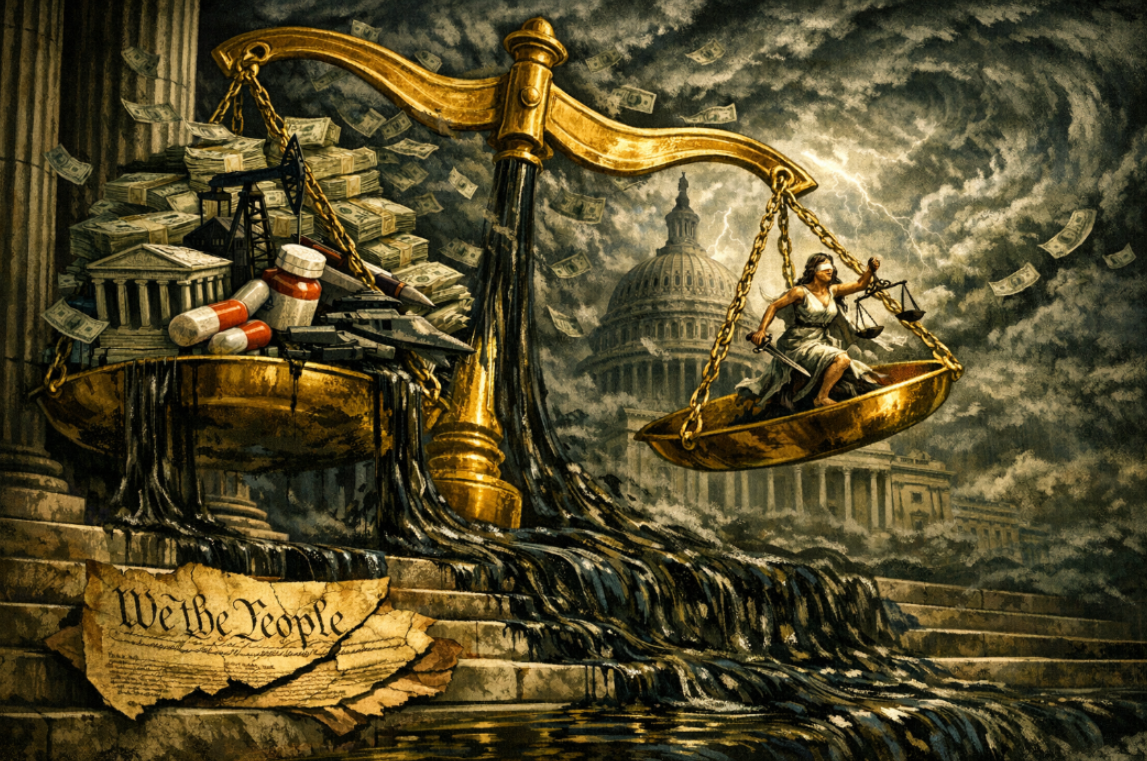
By any measurable metric—volume of money, breadth of influence, sophistication of mechanisms, and global reach—the current American political system represents the most corrupt governance structure in recorded history. This is not hyperbole. It is a verifiable fact that, when we examine the numbers and the mechanisms, private wealth now controls public policy on an unprecedented scale.
The Numbers That Define a New Era
Let us begin with the raw financial figures that dwarf anything previously witnessed in human governance.
The 2024-2025 Corruption Scorecard:
| Category | Amount | Context |
|---|---|---|
| Lobbying (2025) | $5.08 billion | First time in history lobbying exceeded $5 billion; 14% increase from 2024 |
| Dark Money (2024) | $1.9 billion | Nearly double the previous record of $1 billion in 2020 |
| Outside Spending (2024) | $4.5+ billion | Independent expenditures by groups not affiliated with campaigns |
| Organizations Lobbying | 15,768 | Up 12% from 14,061 in 2024 |
| Total Dark Money Since Citizens United | $4.3 billion | Accumulated since the 2010 Supreme Court decision |
To put these numbers in perspective: More money was spent on lobbying in 2025 than the GDP of 25 countries. More dark money flowed into the 2024 election than the entire economic output of some small nations.
Historical Comparisons: Why the Past Cannot Compete
Critics might argue that corruption has always existed. Let us examine the historical record and see how previous eras stack up against today’s industrialized influence-peddling.
The Gilded Age (1870s-1900): The Classic Benchmark
The Gilded Age represents America’s previous high-water mark for corruption. The figures are instructive:
- Boss Tweed and Tammany Hall: Stole between $45 million and $200 million in city funds—an estimated $1-5 billion in today’s dollars. Tweed became the third-largest landowner in New York City through graft.
- Central Pacific Railroad: Spent $500,000 annually in bribes between 1875-1885—roughly $15-20 million in today’s dollars per year.
- Crédit Mobilier Scandal: Union Pacific executives formed a sham construction company that billed nearly double the actual construction costs and bribed approximately a dozen congressmen with below-market shares.
- The Whiskey Ring: Federal agents and distillers underreported sales to cheat the government out of excise taxes, ensnaring President Grant’s personal secretary.
President Rutherford B. Hayes wrote in his diary in 1886: “This is a government of the people, by the people, and for the people no longer. It is a government by the corporations, of the corporations and for the corporations.”
Comparative Analysis: Even adjusting for inflation, the $5.08 billion spent on lobbying in 2025 alone exceeds the combined corrupt expenditures of the entire Gilded Age. The Central Pacific’s $500,000 annual bribe budget, adjusted for inflation, amounts to perhaps $15-20 million today. A single lobbying firm—Ballard Partners—took in $88.1 million in 2025, more than four times what the Central Pacific spent on bribes. The U.S. Chamber of Commerce spent $72.1 million on lobbying. The health sector alone spent $868 million.
The Gilded Age featured individual corrupt actors and localized political machines. Today’s system features industrialized corruption operating at scale across every sector of the economy and every level of government.
Ancient Rome: The Original Corrupt Republic
Rome’s political system was built on patronage, bribery, and wealth. The historical record shows:
- Electoral Bribery: Between 70 and 50 B.C., candidates “dispensed with promoting sporting events and simply bought votes.” Cicero wrote: “Bribery’s thriving…the interest rate has doubled…They offer as much as 10,000,000 sesterces for the vote of the first century.”
- Crassus: Perhaps Rome’s most corrupt politician, Marcus Licinius Crassus (115-53 B.C.) acquired wealth through “fire and rapine.” He controlled Rome’s only fire department and would haggle over the price of his services while buildings burned, often requiring owners to sign over their property.
- Provincial Graft: Governors like Verres plundered provinces with impunity. Cicero’s prosecution of Verres revealed systematic extortion that was “business as usual” for Roman provincial administration.
- The Praetorian Guard: In 193 A.D., after assassinating Emperor Pertinax, the Praetorian Guard literally auctioned off the emperorship to the highest bidder—Didius Julianus, who ruled for just two months before being killed.
Comparative Analysis: Rome’s corruption was staggering for its time, but it operated in a world with limited communication, transportation, and financial infrastructure. A Roman governor could plunder a province for personal enrichment. Today’s system allows multinational corporations to influence legislation affecting billions of people across continents. The scale difference is orders of magnitude.
When the Praetorian Guard sold the emperorship, it was a scandal that echoed through history. In 2025, pardons are effectively for sale: Binance paid $450,000 for one month of lobbying and its CEO received a presidential pardon. Countries are forced to “barter mineral resources” for USAID assistance. The auctioning of government favors has been systematized and normalized.
Modern Kleptocracies: Malaysia, Russia, and Beyond
The modern era has seen spectacular examples of state-level corruption:
- Malaysia’s 1MDB Scandal: More than $4.5 billion was stolen from the sovereign wealth fund between 2009 and 2015, with money used to purchase a $260 million superyacht, fund Hollywood films, and buy luxury real estate.
- Russia: Under Vladimir Putin, state corruption has become a fixture, with oligarchs amassing fortunes through proximity to power.
- Brazil’s Operation Car Wash: A sweeping corruption investigation that uncovered billions in bribes paid to politicians and executives across Latin America.
Comparative Analysis: These are staggering sums that have been stolen by individuals or small groups. But they represent theft—the illegal diversion of public funds for private gain. The American system has achieved something far more insidious: it has legalized the conversion of private wealth into influence over public policy.
In Malaysia, Najib Razak was prosecuted for the 1MDB theft. In America, the Supreme Court’s Citizens United decision and subsequent rulings have created a system in which the same activities—converting money into political influence—occur openly and with full legal protection.
Why America’s Corruption Is Unprecedented
1. The Legalization of Influence
Previous eras required corrupt actors to hide their activities. Boss Tweed was eventually convicted on 204 counts of fraud. Crassus operated through coercion and exploitation. The 1MDB scandal resulted in global investigations and prosecutions.
In America today, the corruption infrastructure is built into the legal system:
- Citizens United (2010): Declared that corporations can spend unlimited amounts on elections, and money is protected speech.
- Buckley v. Valeo (1976): Established that spending money to influence elections is a form of constitutionally protected free speech.
- Super PACs: Can receive unlimited contributions from corporations, unions, and individuals, with only nominal independence from candidates.
- Dark Money Networks: Nonprofits and shell companies can spend on elections without disclosing donors—$1.9 billion in 2024 alone.
- The Revolving Door: 15,768 organizations reported lobbying activity in 2025, employing former members of Congress, congressional staff, and executive branch officials at unprecedented rates.
2. The Industrial Scale
The Gilded Age featured individual robber barons and political machines. Rome featured individual corrupt governors and emperors. Today’s influence industry employs thousands of professionals operating across every sector:
- Ballard Partners: $88.1 million in revenue (2025)—the most any lobbying firm has ever earned. That’s a 3.5x increase from 2024.
- U.S. Chamber of Commerce: $72.1 million in lobbying expenditure.
- Health Sector: $868 million in lobbying—the largest sector spender.
- Finance/Real Estate: $711 million.
- Defense: $191 million.
These are not individuals making backroom deals. These are industries with professional staffs, strategic plans, and institutional infrastructure dedicated to shaping public policy for private benefit.
3. The Breadth of Influence
Previous corrupt systems were limited in scope:
- Tammany Hall controlled New York City politics.
- The Crédit Mobilier scandal involved about a dozen congressmen.
- A Roman governor could plunder a single province.
Today’s influence industry operates across:
- Every level of government: Federal, state, and local officials are lobbied simultaneously.
- Every branch: Legislative, executive, and judicial influence (through amicus briefs, judicial selection, and the revolving door).
- Every sector: Health, finance, defense, energy, technology, pharmaceuticals—no area of policy is untouched.
- Global reach: American lobbying firms now represent foreign governments and multinational corporations, extending influence beyond national borders.
4. The Sophistication of Mechanisms
Ancient bribery was crude: pay money, receive favorable treatment. Modern influence operations are exponentially more sophisticated:
- Astroturf Campaigns: Corporations fund “grassroots” organizations that appear to represent citizen movements but actually serve corporate interests.
- Think Tank Networks: Industry-funded research institutions produce policy papers and testimony supporting corporate positions.
- Legal Strategies: Organizations like the Federalist Society identify and promote judges favorable to corporate interests, shaping the judiciary for decades.
- Regulatory Capture: Agencies meant to oversee industries become staffed by industry representatives who then weaken regulations.
- Data and Targeting: Modern campaigns use sophisticated data analytics to identify vulnerable legislators and apply pressure through targeted advertising and constituent contact.
The $30 Trillion Context
The corruption metrics above—$5 billion in lobbying, $1.9 billion in dark money—represent only the visible surface of a much deeper problem. The actual cost of the system is measured in the policy outcomes it purchases.
Research by the U.S. Workers Alliance documents that $30 trillion has been stolen from American workers since 1973 through wage suppression. This is not theft in the conventional sense—no one broke into bank vaults. It is the systematic use of political influence to:
- Weaken labor protections
- Outsourcing and offshoring jobs
- Suppress minimum wage increases
- Prevent unionization
- Create tax structures that favor capital over labor
- Enable monopolistic practices that suppress competition
This $30 trillion represents the largest transfer of wealth in human history—far exceeding the loot stolen by any Roman emperor, Gilded Age robber baron, or modern kleptocrat. And it was accomplished primarily through the mechanisms of legalized corruption that now define American governance.
The Constitutional Dimension
Perhaps the most remarkable aspect of America’s corruption is that it has been constitutionalized. The Supreme Court has declared that:
- Corporations have the same free speech rights as citizens (Citizens United)
- Money equals speech (Buckley v. Valeo)
- Unlimited political spending is constitutionally protected
This means that addressing the corruption requires overcoming the constitutional barrier that now protects it. The Gilded Age eventually gave way to the Progressive Era, when reforms established civil service, tax reform, and limitations on corporate power. But those reforms faced no constitutional obstacle.
Today, any effort to limit money in politics faces a Supreme Court that has declared such limits unconstitutional. The very document meant to protect democracy now shields the mechanisms of its subversion.
The Comparison with Other Nations
When Transparency International releases its Corruption Perceptions Index, the United States typically ranks relatively well compared to countries such as Russia, Venezuela, and North Korea. But this index measures perceptions of corruption, and it tends to focus on bribery, embezzlement, and other traditional forms of corruption that are illegal everywhere.
What the index does not capture is the legalized corruption that defines the American system. In most countries, if a corporation wants favorable legislation, it must pay bribes under the table. In America, it hires a lobbying firm, contributes to a Super PAC, and funds a dark-money nonprofit—all perfectly legal, tax-deductible in many cases, and completely opaque to the average citizen.
The question is not whether America has more people going to prison for corruption. It is whether the system itself has been structured to convert private wealth into public policy influence on an unprecedented scale in human history.
The Pardon-for-Pay Example
The 2025 lobbying data reveals a particularly brazen example of how the system now operates. Binance, the cryptocurrency exchange, paid $450,000 for a single month of lobbying. Shortly thereafter, its CEO received a presidential pardon.
In previous eras, this would have been called bribery. Today, it is simply “lobbying.”
Similarly, reports indicate that countries have been forced to “barter mineral resources” for USAID assistance. Foreign policy has become another revenue stream, with access to American government services sold to the highest international bidder.
Conclusion: The Unprecedented Scale
Has there ever been a more corrupt government in terms of volume and power?
No.
- Volume: The $5.08 billion in lobbying, $1.9 billion in dark money, and $30 trillion in wage suppression represent financial flows that exceed anything in recorded history.
- Power: The American government’s reach—military, economic, diplomatic, and cultural—exceeds any previous empire. When that power is directed by private interests rather than the public will, the corruption has consequences greater than any historical precedent.
- Sophistication: The modern influence industry employs thousands of professionals using advanced technology, legal strategies, and institutional infrastructure that no previous corrupt system could match.
- Legal Protection: Unlike previous eras, where corruption was illegal, today’s system has constitutional protection, making reform exponentially more difficult.
The Gilded Age looks almost quaint by comparison. Boss Tweed stole from New York City. Today’s system steals from the entire American workforce—$30 trillion and counting.
Rome’s senators plundered provinces. Today’s system allows corporations to write legislation, capture regulatory agencies, and shape judicial appointments for generations.
The 1MDB scandal involved $4.5 billion stolen by a small circle of conspirators. The American system processes that much through lobbying firms every year—and calls it democracy.
This is not to minimize the suffering caused by historical corruption. It is simply to observe that never before has so much wealth purchased so much influence with so little legal consequence. The industrialization of corruption, combined with constitutional protection for the mechanisms of influence, represents a genuinely new phenomenon in governance.
The question now is whether it can be reversed—or whether it represents the permanent capture of democratic institutions by private wealth.
Research sources: OpenSecrets (lobbying data), Brennan Center for Justice (dark money analysis), History.com (Gilded Age corruption), Facts and Details (Roman political corruption), Journal of Democracy (kleptocracy analysis), and U.S. Workers Alliance ($30 trillion wage suppression research).