The Watchdog That Can’t Bark: How a Broken FEC Leaves $200 Million in Foreign-Influenced Election Spending Unchecked
The Watchdog That Can’t Bark: How a Broken FEC Leaves $200 Million in Foreign-Influenced Election Spending Unchecked
By Randell S. Hynes, Founder and President, US Workers Alliance
May 21, 2026
On May 5, 2026, I filed a complaint with the Federal Election Commission. It is designated MUR 8479. It alleges that the United States Chamber of Commerce — the largest lobbying organization in the United States and one of the largest spenders on federal elections in American history — has been violating federal law by allowing foreign corporations to participate in decisions about more than $200 million in election spending. The complaint names specific executives from Wipro Limited (India), Shell plc (United Kingdom), Deloitte Touche Tohmatsu Limited (United Kingdom), and Allianz SE (Germany) who sit on the Chamber’s Board of Directors with no firewall separating their participation from the Chamber’s election-related decisions. It cites the Palmer v. Cognizant jury verdict — which proved, with 96 standard deviations of statistical significance, that a Chamber board member’s company systematically discriminated against American workers — as evidence of the concrete harm this foreign-influenced governance structure inflicts.
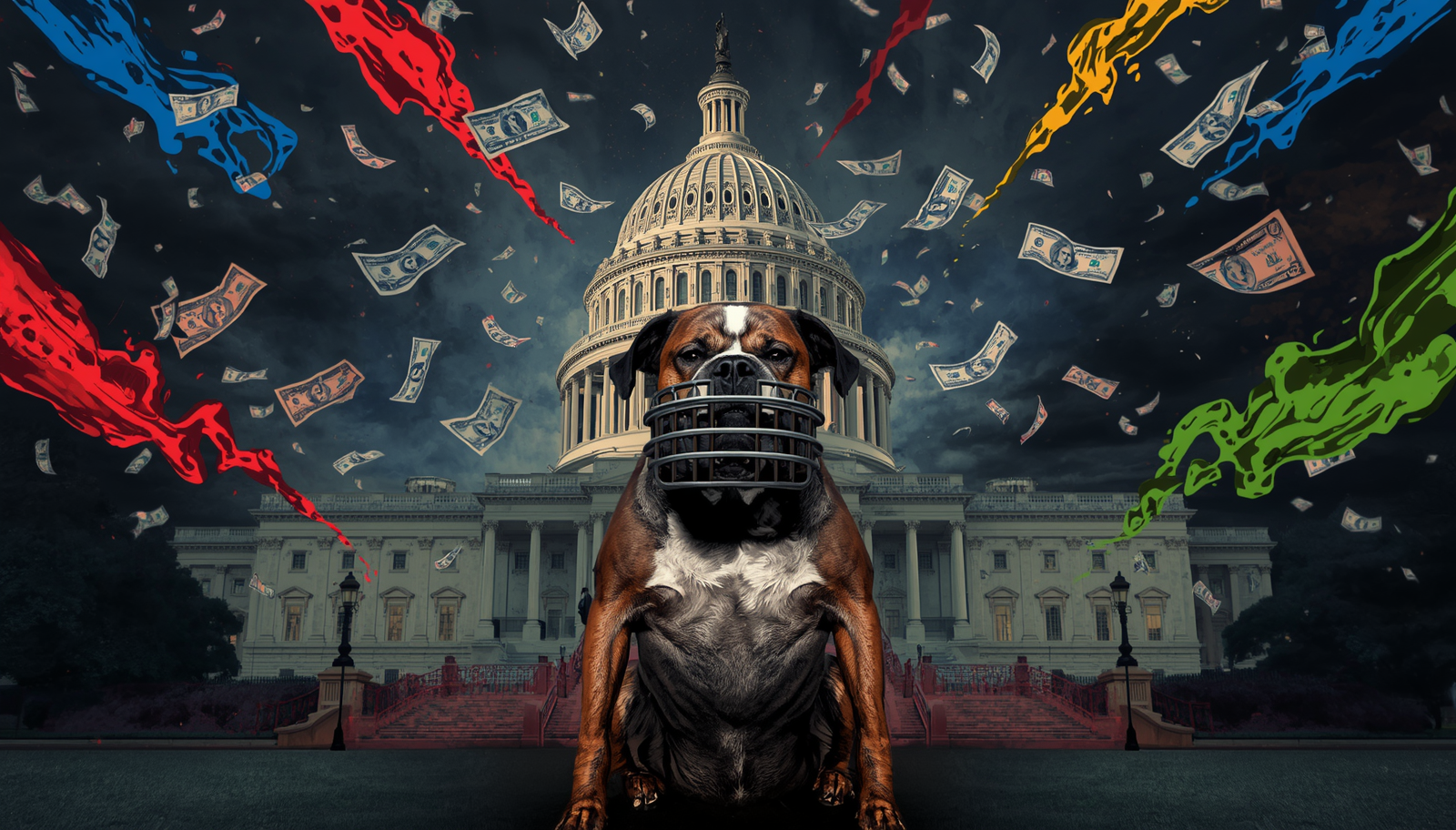
Three weeks later, the complaint sits untouched. Not because the evidence is thin. Not because the law is ambiguous. The complaint sits untouched because the Federal Election Commission cannot act. It does not have enough commissioners to vote.
Here is the arithmetic of paralysis. The FEC is supposed to have six commissioners, no more than three from any one political party, and it takes four affirmative votes to open an investigation, issue a penalty, authorize an audit, issue a rule, or take any other substantive action. As of this writing, the commission has two members — Chair Shana M. Broussard and Commissioner Dara Lindenbaum, both Democrats — and four vacant seats. Two commissioners cannot do anything that the statute requires four to do. The agency has been without a quorum since April 30, 2025, when Commissioner Allen Dickerson resigned. In October, Commissioner Trey Trainor also departed, reducing the commission to its current skeletal state. That is more than thirteen months without the ability to perform its most basic statutory functions.
The timeline of how we got here is worth recounting, because it was not an accident. In February 2025, President Trump fired Commissioner Ellen Weintraub, a Democrat who had served since 2002, without cause — a move she and numerous legal experts have called improper and unprecedented. In April 2025, Commissioner Sean Cooksey, a Republican, resigned. In May, Dickerson departed, leaving the FEC without a quorum. In October, Trainor resigned to enter private practice and run for Congress. The president took no action to fill any of these seats for months. In February 2026, he finally nominated two Republicans — Ashley Stow and Andrew Woodson — to replace the departed Republican commissioners. He has not nominated anyone to fill the two remaining Democratic vacancies. As of this writing, the Senate has not confirmed Stow or Woodson, and even if it does, the commission will have four members — the bare minimum for a quorum — meaning every substantive decision will require unanimous agreement among two Democrats and two Republicans on an agency that has deadlocked along partisan lines for most of its recent history.
This is not the first time the FEC has lost its quorum. It happened in 2008, in 2019, and again now. Each time, the paralysis has lasted months. But what makes this episode different is the openness of the hostility toward the agency’s independence. The Trump administration has asserted unprecedented presidential authority over independent regulatory agencies, has fired officials at the FTC, the Federal Reserve, and elsewhere, and has shown no urgency about restoring the FEC’s ability to function during a midterm election cycle in which billions of dollars are already being spent. The two remaining commissioners issued a statement welcoming the nominations of Stow and Woodson and expressing hope for “an expeditious process,” but Senate confirmation is historically slow — Trainor’s own 2017 nomination took 976 days to confirm. There is no reason to believe the current nominees will move faster.
The practical consequence is that the FEC’s enforcement docket is frozen. Complaints continue to arrive — the agency received more than 700 in a recent fiscal year — but no new investigations can be opened, no pending investigations can be resolved, and no penalties can be assessed. The staff continues to maintain the campaign finance database and process disclosures, but the core enforcement and rulemaking functions vested in the commissioners by the statute have been suspended. As former Commissioner Weintraub put it: “There’s no cop on the beat.”
For my complaint, the arithmetic is particularly daunting. The 2010 predecessor to MUR 8479 — which raised similar allegations about the Chamber’s foreign-funded political spending — deadlocked 3-3, with the three Republican commissioners voting to dismiss and the three Democratic commissioners voting to investigate. The Commission therefore took no action. The same partisan divide is likely to recur if and when the current complaint reaches a quorate commission, because the fundamental disagreement is not about the facts — the foreign corporate board membership is documented on the Chamber’s own website — but about whether the law should be enforced against the Chamber at all.
There is, however, a built-in safety valve. Under CREW v. FEC, 923 F.3d 1141 (D.C. Cir. 2019), if the Commission deadlocks and fails to act, the complainant has a private right of action to seek de novo review in the United States District Court for the District of Columbia, pursuant to 52 U.S.C. § 30109(a)(8). In other words, if the FEC cannot or will not enforce the law, the courts can. Stuart McPhail of Citizens for Responsibility and Ethics in Washington has noted that the loss of quorum does not prevent these private suits — it actually speeds them up, “allowing litigants to leapfrog the agency process.” A deadlocked commission, paradoxically, may produce faster judicial review than a functioning one that investigates and then deadlocks on the outcome.
But judicial review takes years and requires resources that most complainants lack. The statute was designed so that the FEC would be the primary enforcement mechanism, with private suits as a backstop — not so that a paralyzed agency would force every complainant into federal court because the commission could not muster four votes.
The law at the heart of MUR 8479 is not complicated. Federal law prohibits any foreign national from making a contribution or expenditure “directly or indirectly” in connection with any federal election. 52 U.S.C. § 30121(a)(1). The same statute prohibits any person from soliciting, accepting, or receiving such contributions from foreign nationals. § 30121(a)(2). Federal regulations go further: they prohibit foreign nationals from “directly or indirectly participating in the decision-making process of any person” with regard to federal election-related activities. 11 C.F.R. § 110.20(i). The plain text does not require that a foreign national make a specific decision about a specific expenditure. It prohibits participation in the decision-making process — including governance that encompasses election spending.
The Chamber’s structure violates this prohibition in at least four ways, each detailed in the complaint. First, the Chamber maintains no firewall separating foreign corporate influence from election-related decisions — no U.S.-citizen-only decision-making committee, no segregated fund for political activity, no reasonable accounting method to separate foreign from domestic funds. The FEC’s own Advisory Opinion 2006-15 established a three-part test requiring precisely these safeguards for domestic subsidiaries of foreign parents, and the Chamber fails every prong. Second, foreign corporations place executives on the Chamber’s Board who participate in governance decisions that encompass election spending. Third, foreign corporate dues enter the same general treasury used for election spending, thereby commingling those expenditures with foreign national funds. Fourth, Chamber leadership knowingly maintains this structure, thereby providing substantial assistance in making prohibited foreign national contributions and expenditures.
The APIC/Right to Rise enforcement precedent from 2019 resulted in a $940,000 fine for a single foreign national directing $1.3 million in contributions through a domestic entity. The Chamber’s election spending since 2010 exceeds $200 million, with executives from multiple foreign corporations serving on its governing body. The scale is more than 150 times larger. Yet no enforcement action has ever been brought.
The FEC has never approved the Chamber’s governance structure in any advisory opinion, rulemaking, or enforcement proceeding. The Chamber is operating in a legal vacuum — using a structure the FEC has never sanctioned, with no safe harbor, no advisory opinion, and no certification process. In 2010, when the Commission deadlocked on whether to investigate, the three Democratic commissioners voted to proceed, and the three Republican commissioners voted to dismiss. That deadlocked vote is not a final adjudication on the merits and does not have a preclusive effect. New factual developments since 2010 — including the identification of additional foreign-connected board members, the APIC enforcement precedent, Commissioner Weintraub’s 2016 warning that “no longer a consensus” exists for the safe harbor the Chamber relies on, and the Palmer v. Cognizant verdict demonstrating the concrete harm to American workers — support reconsideration.
The complaint asks the Commission to find reason to believe the Chamber has violated federal law; to authorize a full investigation including civil investigative demands for Board meeting minutes, membership records, and financial records; to assess civil penalties commensurate with the scale of violations; and to issue prospective injunctive relief requiring the Chamber to either remove foreign corporate representatives from election-related governance or establish the safeguards that FEC Advisory Opinion 2006-15 has required since 2006.
These are not radical requests. They are what the law already requires. The question is whether anyone will be in a position to enforce it.
The FEC’s quorum crisis is not a partisan issue, or at least it should not be. The foreign national prohibition was enacted by a bipartisan Congress and signed into law by presidents of both parties at different times. The prohibition applies equally to foreign corporations regardless of their nationality — whether Indian, British, German, or any other. The principle at stake — that foreign nationals should not participate in decisions about American election spending — is one that supporters of both parties have historically endorsed. The current paralysis prevents the enforcement of a law that both parties wrote.
But the paralysis also does something less visible and more corrosive: it sends a signal. When the federal agency charged with enforcing campaign finance law cannot open an investigation for more than a year, the signal to every organization that might be violating the law is clear. There is no cop on the beat. There will be no investigation. There will be no penalty. The seven-year statute of limitations is running, but the clock is running in favor of the violators, not the public, because every day without a quorum is a day the evidence grows colder, the witnesses become harder to locate, and the backlog of cases grows deeper.
The fix is structural and simple. The Senate should confirm the nominees already before it. The president should nominate commissioners to fill the remaining two Democratic vacancies, as the statute’s bipartisan design requires. Congress should recognize that an FEC without a quorum is not a temporary inconvenience — it is a systemic failure that leaves the most powerful actors in American politics free to operate without federal oversight during the elections that determine the country’s direction. And the public should understand what is at stake: not an abstract procedural dispute over agency staffing levels, but the practical question of whether the laws prohibiting foreign nationals from influencing American elections will be enforced at all.
MUR 8479 is a test case. The evidence is documented. The legal theory is sound. The foreign corporate board membership is admitted. The only thing standing between the law and its enforcement is the absence of four people in a room who can vote.
Randell S. Hynes is the founder and president of US Workers Alliance (Buildup Cooperative), a 501(c)(4) social welfare organization. MUR 8479, USWA v. U.S. Chamber of Commerce, was filed with the Federal Election Commission on May 5, 2026.
Contact: randell@usworkersalliance.com | (702) 849-4881 | usworkersalliance.com | @ViaUSWorkers